





RTVE presents a pioneering test of emission and reception in Ultra High Definition
La Corporación acoge en el Instituto de RTVE la presentación de un piloto de señal TDT 4K en DVB-T2, con codificación HEVC) en el que colaboran la UPM, Abertis, Sapec, Hispasat, Sony, LG, Panasonic y Samsung.
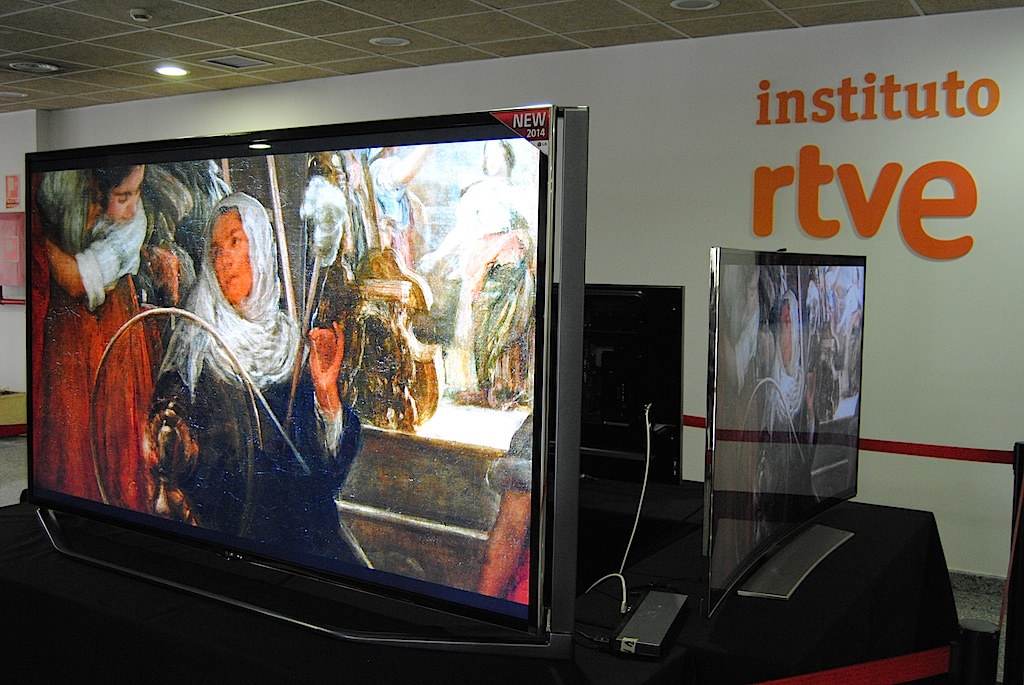
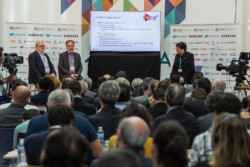
RTVE ha organizado en el Instituto RTVE una jornada para dar a conocer el proyecto piloto puesto en marcha para emitir y recibir señale de TDT en Ultra Alta Definición (4K9 así como los procesos seguidos para conseguirlo. La prueba que se ha presentado este martes, 24 de junio, ha implicado completar una cadena de captura, edición y postproducción, compresión, transmisión y recepción.
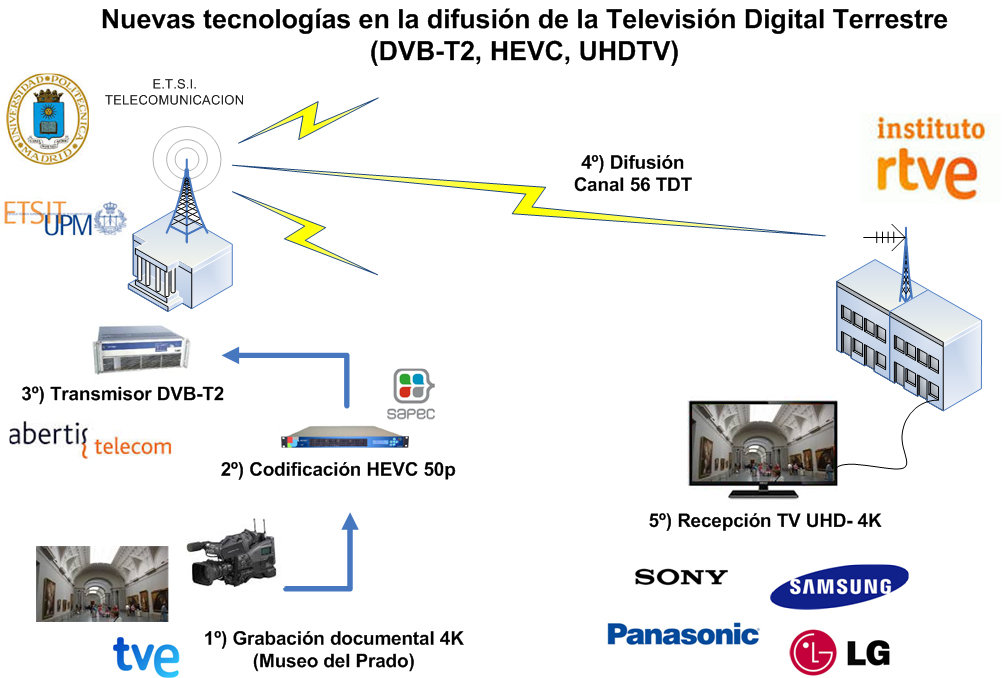
El proceso completo ha supuesto la grabación del documental La pasión del Prado en 4K. La señal se ha comprimido en HEVC a 50 frames por segundo, emitiéndose en DVB-T2.
En este proyecto de RTVE han colaborado directamente la Universidad Politécnica de Madrid, Abertis Telecom, Sapec, Hispasat, Sony, LG, Panasonic y Samsung.
Pere Vila, director de Tecnología, Innovación y Sistemas de RTVE, ha abierto esta jornada asegurando que “tras la grabación en 4K del documental La pasión del Prado, la preocupación era la transmisión de la señal en DVB-T2”. Por ello, TVE en colaboración con la Universidad Politécnica, RTVE reflotó la antigua emisora que se utilizó para las pruebas de la alta definición y con autorización de Industria se ha puesto en el aire una señal piloto en 4K. Para ello, se ha empleado la codificación que aporta la tecnología de Sapec en HEVC 50p y un transmisor DVB-T2 aportado por Abertis.
Según Vila, “la idea sería ahora poder mantener, sobre un múltiplex de DVB-T2, una señal en pruebas en Ultra Alta Definición probando a la par nuevos desarrollos en alta definición, contenidos en movilidad e incluso en radio”.
Miguel Ángel Cristóbal, director general de Sapec, ha destacado que “a medida que han ido creciendo las pantallas de tv, el hecho de mantener el tamaño del píxel da impresión de pérdida de calidad. El concepto ‘cine en casa’ se está imponiendo”. Para el director de Sapec,”resolución, colorimetría, presentación, mayor rango dinámico y mejora del audio deberían ser clave en entornos de Ultra Alta Definición”.
Con respecto a la mejora en colorimetría, Cristóbal ha recordado que el rango de color en UHD es más del doble que el existente en HD. Por lo que a la presentación se refiere, se han congratulado de que por fin la UHDV trabaje con un escaneo progresivo con posibilidad de mayores velocidades de imágenes por segundo (120 fps), reduciendo así la percepción del movimiento y reduciendo el parpadeo.
En lo que a rango dinámico se refiere, Miguel Ángel Cristóbal ha destacado las pruebas que se están llevando a cabo en todo el mundo con High Dynamic Range para lograr una sensación más realista. En cuanto a sonido, “se habla ya de estandarizar hasta 22.2 canales de audio con 16, 20 o 24 bits y un muestreo a 48 KHz y 96KHz. Esto permitiría una mayor inmersión en los contenidos permitiendo la percepción de los mismos sobre los tres ejes” ha asegurado.
Pese a todas las mejoras, el principal reto ahora es, a juicio de Miguel Ángel Cristóbal, transportar esta señal y a ser posible con la infraestructuras actuales, y ahí la compresión juega un papel fundamental. El uso de interfaces profesionales y el almacenamiento (UHD1@50p ocuparía 5,6 Teras o incluso 42 en 120p) son otras de las cuestiones que preocupan hoy en el sector.
En emisión, ha llamado la atención sobre el desarrollo que está viviendo la codificación HEVC para adaptarse a nuevos perfiles (Main12, Main422-12, Main444-10, Main444-12), con mayores niveles en cuanto al número de bits/pix y bit-rates. Además, incrementa a 33 los ángulos de predicción frente a los 9 del H264. “Se ha conseguido en HEVC optimizar la imagen incluso por el 50%, reduciendo bitrate manteniendo la calidad de imagen. Esto nos permite meter más programas por múltiplex y emitir 4K en DVB-T2, DVB-S2 e incluso contribuciones en 4K”, ha destacado.
Miguel Ángel Cristóbal ha concluido su intervención afirmando que “os retos son ahora la implementación de todas las herramientas en tiempo real, superar la complejidad en el desarrollo de decodificadores y codificaciones en HEVC con respecto a H264, así como la estandarización ‘Range Extension’ para aplicaciones de contribución. ¿Para cuando HEVC? Desde mi punto de vista personal, mucho antes de lo que suponemos”.
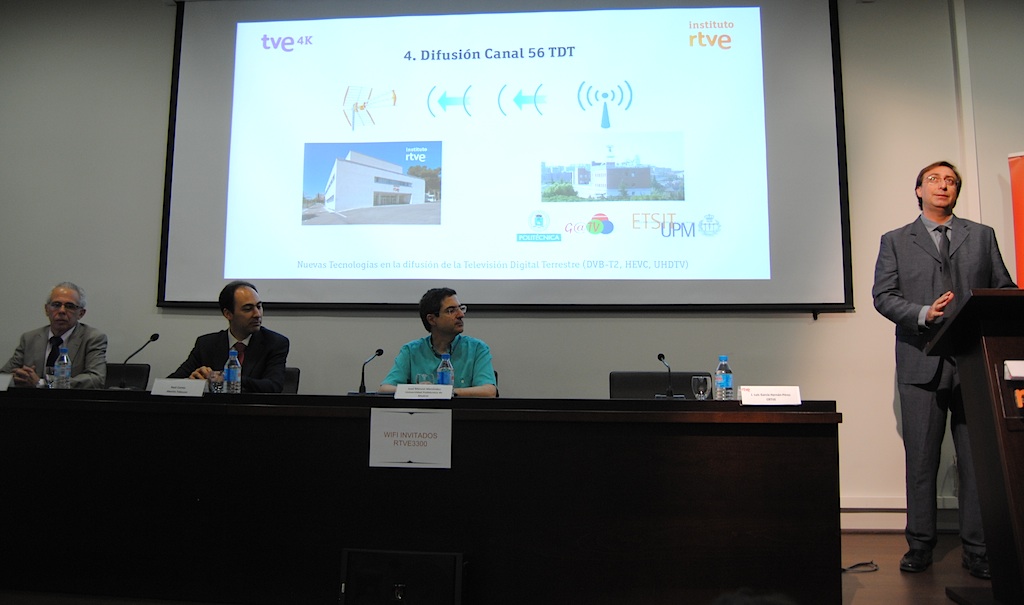
Emisión piloto en Ultra Alta Definición
Raúl Cortés, Key Account Manager en Abertis Telecom, ha centrado su intervención en la red de contribución, distribución y difusión con respecto al reto del 4K. Cortés ha repasado cómo en contribución hemos pasado de MPEG2 a MPEG4-H264 y ahora HEVC-H265, al igual que el audio ha evolucionado de MPEG1-LII a DD y DD+, en entornos de multiplexación estadística más que fija. En cuanto a interactividad, se ha migrado de MHP a entornos más dinámicos basados en HBBTV. En distribución, de DVB-T y DVB-S se ha evolucionado a DVB-T2 y DVB-S2… y “todo ello para que el usuario mejore la calidad, el número de canales y la interactividad. El cambio solo se justifica si lo que viene es mejor que lo que se tiene hoy”, ha enfatizado.
Cortés ha reflexionado también sobre las relaciones que en los nuevos entornos en Ultra Alta Definición mantendrán los organismos de estadarización, los fabricantes, los operadores, las productoras, el radiodifusor y la propia audiencia.
José Manuel Menéndez, coordinador del Grupo de Aplicación de telecomunicaciones Visuales de la UPM, ha hecho una descripción sobre el piloto DVB-T2 HEVC/ en Ultra Alta Definición que llevan a cabo en el canal 56 de UHF (754 MHz con un ancho de banda de 8 MHz, modo FFT 32K extendido, intervalo de guarda 1/128 y una PRA de 125W) desde la Escuela Técnica de Ingenieros de Telecomunicación. La emisión se lleva a cabo con una velocidad binaria de aproximadamente 37 Mbps.
El sistema radiante empleado en este piloto cuenta con cuatro paneles que distribuyen las señales procedentes de un workflow en el que interviene un ordenador donde se almacena el fichero 4K y mediante una pasarela ASI, se ataca un modulador DVB-T2 y un amplificador. El contenido es codificado en HEVC a 35 Mbps. La pasarela ASI permite atacar el modulador (un Egatel cedido por Abertis) mediante una interfaz DVB-ASI y el amplificador.
Menéndez ha destacado que una de las grandes ventajas del DVB-T2 es que “permite más posibilidades de configuración para todos los parámetros, lo que le confiere una gran flexibilidad para adaptarse a una variedad de situaciones en recepción móvil, UHDTV…” Además dentro de un mismo múltiplex, otra ventaja a su juicio del DVB-T2 es que permite incluir diferentes servicios incluso con calidad diferentes (Multiple Physical Layer Pipes).
Satellite
Jorge Rodríguez (Hispasat) ha expuesto que actualmente los satélite son la infraestructura más utilizada para la transmisión de contenidos de alta calidad. “Es de esperar que los satélites sean también un importante elemento en el despegue de la Ultra Alta Definición”, ha asegurado.
El operador satelital español comenzó a realizar sus primeros tests en 4K en 2013. El año pasado, coincidiendo con IBC, anunció su canal piloto 4K de cara a promover la tecnología y facilitar el desarrollo del 4K entre los diferentes actores del mercado. En el último NAB se presentó el primer servicio 4K permanente para Norteamérica.
En mayo pasado, Hispasat llevó a cabo ya la primera transmisión HEVC a 50 fps de un evento en directo (un encuentro entre Portugal y Grecia) en colaboración con la portuguesa Meo.
Dada la experiencia de Hispasat, para lograr una emisión en Ultra Alta Definición satisfactoria sería necesaria una velocidad de trama de 50/60p o mayor (100-120 fps), un rango dinámico mayor para lograr mejor calidad en condiciones de poco contraste y una profundidad de bit de al menos 10 bit para grandes pantallas 4K.
Did you like this article?
Subscribe to our NEWSLETTER and you won't miss anything.
Related articles
 RTVE will broadcast the 2026 World Cup in Ultra High Definition
 RTVE on the front line in testing Ultra High Definition in 4K and 8K
 RTVE shares its experiences with Ultra High Definition at the 4K Summit
 RTVE focuses on its Ultra High Definition projects at the 4K Summit in Malaga
 The evolution of Ultra High Definition is unstoppable
 First world broadcast of Ultra High Definition in DVB-T2 with content in HDR, WCG and AC-4
 Politics in Ultra High Definition
 From the Vatican… in Ultra High Definition
 Queen Sofía presides over the presentation of the ultra high definition TVE documentary 'The Passion of the Prado'
 Samsung presents its largest curved Ultra High Definition television at CES 2014
 The Prado Museum, in Ultra High Definition at 4K
 Hispasat and LG sign an agreement to promote Ultra High Definition
 Abertis will carry out the first worldwide broadcast of DTT in Ultra High Definition (UHDTV) in DVB-T2
 Ultra High Definition, closer every day