





The new needs of the distribution of major sporting events, with Eurovision Services
Álex Sánchez Díaz, COO of Eurovision Services (DUBAG Group), addresses all the current affairs of the company, which after its separation from the EBU (European Broadcasting Union – EBU) and its new private ownership continues to provide global event contribution and broadcast services for the biggest sporting events.
Eurovision Services obtained its own structure on January 1, 2019. The decision, confirmed just three months before by Noel Curran, then director general of the EBU, sought establish this subsidiary to respond to the new needs of the media industry, with digital transformation as a key variable in a future that had yet to be defined.
 The company, with more than 60 years of experience, had the objective of “remaining as a leader” in the global panorama of the broadcast industry. It would continue to provide service to the most demanding productions driven by UER, like the Eurovision Song Contest, but in parallel it would deepen its relationship with all types of content owners, broadcasters and private companies related to current affairs, sports and entertainment. “This new strategy will expand our portfolio of products and services to help our clients and EBU members connect their audiences with their content,” commented Marco Tinnirello, CEO of the company at the time.
In 2023, the Munich fund DUBAG Group decided to buy the company to take advantage of all the opportunities of a global entertainment market in which live entertainment continues to be a source of concern. congregation and axis of an important part of the audiovisual market. Although it is now pursuing a series of natural objectives of a totally private company, its founding purpose continues: to offer contribution and distribution, mainly, of sporting events, including long-distance connectivity with increasing relevance of environments IP through a series of data centers located in Europe and America, or via satellite for three regions: Europe, America and Asia.
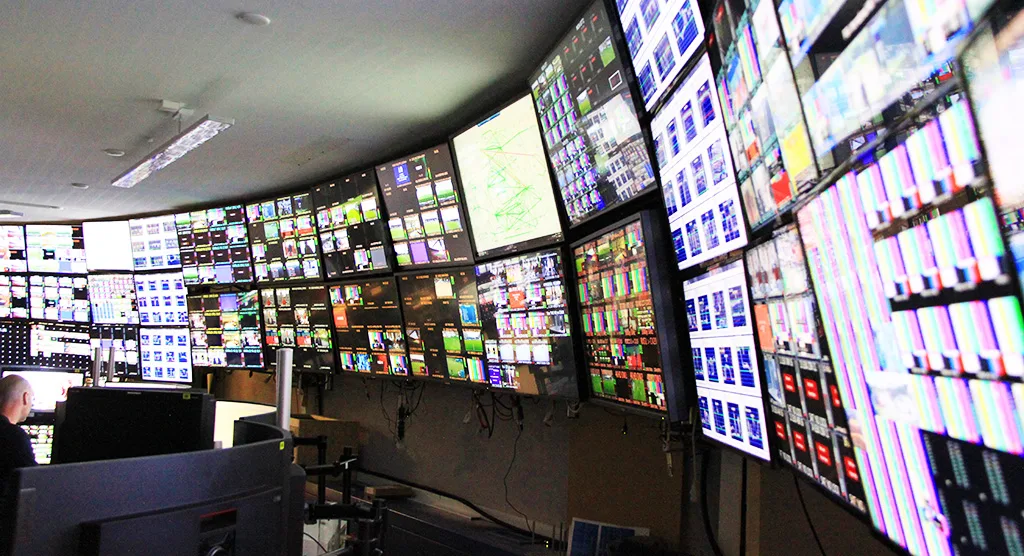
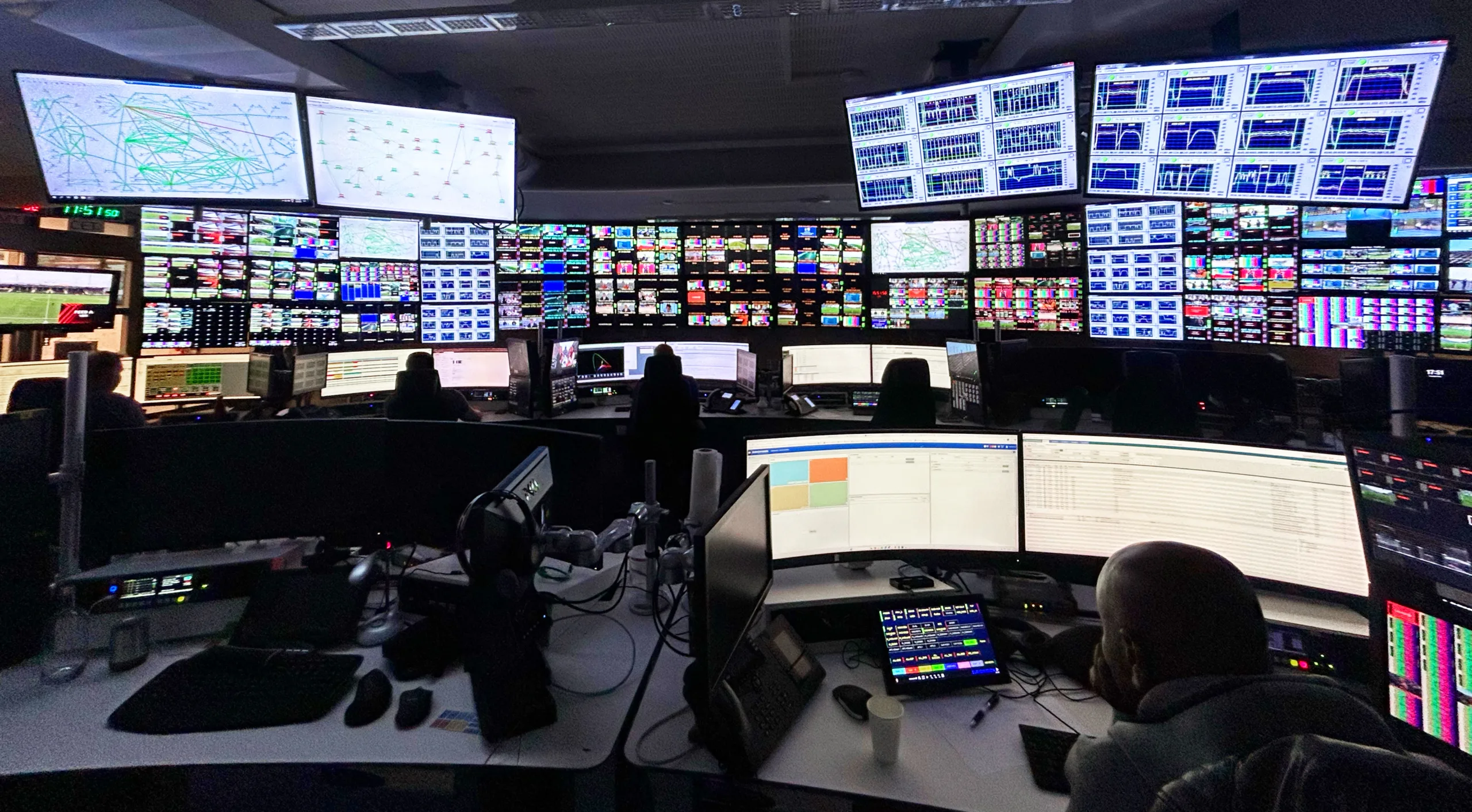
“We operate seven teleports and have a global fiber network with more than 150 PoPs,” he details. Alex Sanchez Diaz, who has held different positions in the company, both in his period at the EBU and in this stage of a private company, and currently holds the position of COO. With an extensive career that has taken him to companies such as Gestmusic o Dorna Sports, Sánchez analyzes the current situation of the contribution and distribution of the most demanding broadcast broadcasts, taking advantage of his privileged position as director of operations of Eurovision Services and the experience acquired after years at the foot of the canyon.
The evolution of the contribution and distribution of major events
How has the contribution and distribution of large broadcast events, as well as the needs of your clients, evolved in recent years?
Technology is allowing there to be other types of relay systems. The satellite, although still very current, is being replaced in part by digital systems, where the SRT It is gaining a lot of strength. However, this also brings greater complexity: before we had some workflows which were very established at the level of equipment compatibility, but now we find a greater range in the SRT. Clients have both professional and more industrial equipment. There are even times when operators use practically domestic solutions.
“The satellite, although still very current, is being replaced in part by digital systems, where the SRT “It is gaining a lot of strength.”
All this makes the interoperability has been affected and that the operations have become more complex and personalized to the particular casuistry that each taker. In the end, due to the nature of our work, what we do is distribute content to a large number of broadcasters.
Then, there has also been a very high increase in SLA agreements, with greater demands from the different actors. We are facing a very competitive market, in which there are fewer economic resources, but with requirements that are still very high.
Given the emergence of the SRT that you mentioned, is there complexity when it comes to transporting signals through this protocol to broadcasters that have not yet made the leap to IP environments?
At Eurovision Services, we always try to defend SRT with consolidation in SMPTE 2022-7. Those broadcasters in a digital environment that do not use this standard need to receive SRT in UDP and without RTP headers, so we are forced to make two types of distributions.
"We are facing a very competitive market, in which there are fewer economic resources, but with requirements that are still very high."
We have to adapt to the takers, but we, perhaps because of the heritage we have from the EBU, like respect the standards, trying to increase regulatory compliance with all these types of regulations, since it offers more resilience and can protect you against ISP outages, for example.
We cannot forget that SRT is distributed over the public Internet and, therefore, it is important to have greater protection in the shape of two transport streams, which is what 2022-7 gives you.
When HD prevails over UHD
Continuing on a general level of the industry, do you consider that there is an expansionist trend in terms of innovation? Is the market looking to receive different proposals for its contribution or is it comfortable with its current workflows?
In recent years there has been a slowdown in innovation. Previously, there was a lot of bet on UHD, but now we see that in the distribution of sporting events the vast majority is in 1080p 50p SDR. It is true that in some cases there is interest in HDR, but it depends on the type of market. For example, in Spanish, some 50p formats are even too demanding for some operators. As I mentioned before, the main trend is to provide more services with less cost.
Does this mean that the industry is definitively moving away from UHD?
Seen what has been seen, we are closer to HD than to UHD. All this is linked to the rights of each sports competition. That is, it depends on where each federation wants to position itself or right owner, establishing a quality standard.
If we talk, for example, about content that wants to be premium, the rights are much higher in terms of cost. Those federations can then decide to produce content at UHD quality, although there are usually 50p HDR or 50p SDR versions as well. Other federations have chosen to stay in what they call the format mezzanine, which is still at 50p.
From there, the broadcaster must decide in which format they want to broadcast the content and in some cases they will opt for a upconversion of the format mezzanine, but most will stay at 50p or even make a down conversion to 50i.
“4K or UHD streams imply very high bandwidths and the codecs have evolved, but the complexity that this implies makes it doesn't make much sense nowadays”.
To this day, it is still difficult to watch UHD streaming for live sporting events. Are there important limitations to the deployment of this type of broadcasts?
It is a question in which the profitability. 4K or UHD streams involve very high bandwidths and codecs have evolved, but the complexity that this implies makes it doesn't make much sense nowadays. Sometimes, some broadcasts are labeled UHD, but the user is not able to perceive that difference in quality with the high compression that usually accompanies it.
This leads us to a certain paradox. Telecommunications companies are betting on enhancing their IPTV windows through Smart TV applications, but then they cannot offer UHD beyond via DTV or decoders. It is a paradox, or, at least, contradictory messages.
It is true that we are facing a paradox, but one thing must be taken into account: production on site probably it makes sense to do it in UHD. In this way, you will be able to have a high quality file to manage and give different uses to that content. But when you have to transport all that signal live, if you want to preserve quality, the bandwidths are very large. Therefore, you will have to distribute and contribute to the event in other formats.
The combination of satellite and IP
The satellite remains key for Eurovision Services. Do you identify a short-term outlook in which it continues to be a preferred distribution route or is Internet transportation gaining ground?
Our vision is that the satellite will always be there to make the content distribution. The main program signal will always be distribute by satellite, possibly with an intermediate quality, but given the increase in the material to be transported at sporting events, we believe that this will be distributed through other means such as fiber and SRT with a higher quality.
For example, in a soccer match, you may have ocho feeds with ISO signals from each camera, which will be distributed through private fibers. Ultimately, the satellite will transport the main signal, and additional content will be distributed by other means.
Traditional broadcasters have been joined by new digital agents with a growing interest in live events such as DAZN, Prime Video or Netflix. Do these companies have different processes than Eurovision Services was used to?
All these platforms treat the live content part as a broadcast product. They use their own headers, which are digital, but the way of acquiring content is quite traditional. In the end Eurovision Services positions itself as another supplier for them. Our relationship is B2B and we do not go into how the platforms distribute content to end users.
Remote production: a trend that is also consolidated in Spain
From the perspective of Eurovision Services, how do you see remote production applied to top-level sporting events?
There is a trend that points towards this. Recently, we have done a sporting event with 20 production signs remote between a stadium in Spain and the United Kingdom, with coding JPEG XS that went towards the MCRs, including returns, with very low latency.
"He Spanish market is betting on remote production. Currently, JPEG XS is being used to make second division matches”.
He Spanish market is betting on these avenues. Currently, JPEG XS is also being used to do remote production of second division matches. It is an initiative that seeks to reduce costs, but it must be taken into account that this can only be achieved if it is a recurring event, with fixed facilities and an extensive competition calendar. It stops being so interesting when it is a shorter event, that can happen in a single week, because it implies a very high investment for a very short period of time.
Furthermore, beyond cost savings, remote production has other benefits linked to quality, since it allows federations and rights holders to homogenize the look and feel of that competition. That is, the same technical team is responsible for producing the same content and in the same way, regardless of where the event is held.
Aside from this remote production that you have recently carried out in Spain, what other projects has Eurovision Services promoted recently in the country?
We have an active presence in Spain. For example, Telefónica has connectivity with our content hub, so we can deliver any asset we have on our network to you with a stream transport over IP; In addition, we continue working with RTVE frequently, since we still have links with them from the time of the EBU, and with agents such as OBS.
Beyond our offices in Madrid and an MCR that will soon be expanded, recently we have completed the construction of a production center with 2110 technology which is used to produce global audiovisual content.
How do you think the content contribution and distribution market will evolve in the short term? Do you anticipate any changes to your customers' needs or key elements of your technology workflows?
Technology continues to evolve and allows you to do more things for less money, always taking into account economic resources that are increasingly limited. What I do consider is that the competitions are going to become more and more differentiated: those who are looking for more quality are going to follow that path, improving the content and offering additional functions, while others will have found, for now, their limit. In terms of formats, I don't expect a big change for 2026.
“We have completed the construction of a production center in Madrid with 2110 technology which is used to produce global audiovisual content”.
However, we are going to be quite busy, since we have a international event in the United States of which we will have to do global distribution. We know that we will face important technical challenges, but, in the end, they are the usual ones. Production will be done at 60 Hz, we will have to convert it to 50, and since there is more content, there will be a greater volume of material which will require conversion. In that area, we have seen and explored options to process content taking advantage of the advantages that a private cloud provides.
An interview by Sergio Julián Gomez
Did you like this article?
Subscribe to our NEWSLETTER and you won't miss anything.
Related articles
 SNRT prepares for its next big sporting events with a new UHD mobile unit
 LTN and Lumen offer a joint offering of production services for major sporting events
 AEQ Xpeak with RTVE in the most important sporting events of 2024
 AI, elections and major sporting events, thematic axes of IBC 2024
 The EBU sells Eurovision Services to the DUBAG Group
 UHD Spain analyzes NGA audio capture and playback at sporting events
 TVU's RPS enables Sky to remotely enhance production of two major sporting events
 Leader, co-star of the major sporting events of summer 2021
 Mediapro produces Africa's top sporting events
 Sony equips two new Mediapro 4K mobile units for the production of sporting events
 SAM technology in Timeline's new UHD mobile that will cover major sporting events
 Lawo will present at IBC a new technology aimed at the production of major sporting events
 AEQ technology, present in the most notable summer sporting events
 CopperHead 3400 facilitates 3D production of two of Australia's sporting events of the year