





UHD, an inevitable challenge: the issue of bandwidth and the coexistence of SDR and HDR


Xavier Bonet, production in TV3, coordinator of the post-production group of UHD Spain and head of the technology department CHESS, opens the doors to two interesting challenges that the industry will face in its transformation to UHD: the issue of bandwidth and the coexistence of SDR material with HDR.
Since the beginning of the audiovisual industry, there has been a struggle to ensure that the user experience is as realistic and immersive as possible, with the aim that the viewer can isolate themselves from their real environment and fully immerse themselves in the audiovisual experience. To achieve this objective, there have been many efforts and technological improvements throughout history, and now It's UHD's turn.
With the purpose of establishing a single criterion among all operators, within the Foro UHD Spain work is being done on the definition of UHD, and it is agreed that only an increase in resolution cannot be considered UHD. Most of the forum members believe that, for a product to be considered UHD, it must contain all the technical characteristics, WCG, HFR and NGA, defined in the standards. This does not mean that until a full implementation of all the concepts linked to UHD is achieved, very attractive intermediate situations cannot be dealt with, such as the HD signal in HDR.
An important idea to remember is that working in UHD does not mean that you must systematically push the characteristics to their maximum performance. For example, using an expanded color space (WCG) does not mean that an audiovisual cannot be produced in black and white, using immersive audio techniques (NGA) is not incompatible with producing in stereo, or that just because high temporal resolution (HFR) is used, a fiction cannot be made at 25p. Technology must be at the service of creativity, but it is important to clarify technological standards to achieve maximum compatibility between systems.

The impact of bandwidth
But the great challenge when implementing UHD appears when manage your bandwidth. And this generates some concern, especially in the field of contribution, where we work with low compression factors. Increase the spatial and temporal resolution, going for example from a 1080@25p format to another that is 2160@50p, means multiply by eight in bandwidth, so you have to be very cautious when choosing which of the improvements offered by UHD to use in each project. Fortunately, one of the biggest contributions is HDR, and its impact on bandwidth is small. Therefore, in this sense, the main problem for operators is to decide whether to bet on HLG hybrid format or by any of the PQ based trading options such as HDR10, HDR10+, Dolby Vision…
A concept that always goes hand in hand with HDR is WCG, and fortunately this does not have a strong impact on bandwidth either. However, professionals must learn to manage transformations between color spaces. The UHD establishes as a reference range the BT-2020, but for years now the gamut of cameras has greatly exceeded this color space, and the majority of new screens on the market cover almost 100% of a space. DCI-P3. Consequently, in post-production it is necessary to decide which are the most appropriate workflows so that these transformations do not distort the creative intention, while adjusting the colorimetry to the regulations and desired limits.
One of the aspects that has a clear impact on the bandwidth is the HFR and, for this reason, it is important to assess when it is convenient to use it. It is a widespread opinion that material produced in HFR produces a sensation in the viewer. feeling of realism, which on some occasions, such as sporting events, news programs, can be very valuable. But on some occasions, for example in fiction or certain documentaries, this sensation of reality can distance the viewer from the product's purpose of alienation, and this is due to the cultural background of the consumer. But new generations are used to consuming video games and social networks with an audiovisual narrative that is very far from the classic narrative, and consequently the differentiation between reality and fiction may be different. I mean, surely The audiovisual culture of society will be the one that will end up setting the pace of implementation of the HFR in audiovisuals.
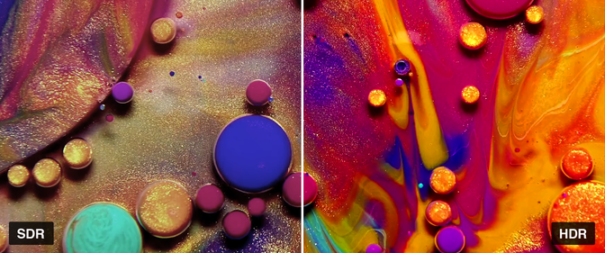
Can SDR material be mixed with HDR?
There are many production companies and television networks that have many hours of SDR-encoded archive and now they find that they must combine it with new material in an HDR project. And some of the questions that are usually generated are: “Should the master be completed in SDR first and then the HDR version or the other way around?”, or “Is it possible to combine these two signal typologies?”
The UHD Spain post-production group has asked these questions to a specialized colorist series and, from your experience, you can conclude that the best practices to have two versions of the same product, one SDR and HDR, consiste en realizar primeramente un master HDR y posteriormente generar una versión SDR, mediante el cambio de la ODT (Output Device Transform) en el caso de que se trabaje en ACES, o en aquellos casos que lo requieran, se puede realizar un Trim Pass a SDR mediante las herramientas de ajuste que ofrecen los programas de corrección de color.
Cuando lo que se requiere es generar un master en HDR que incluye material, por ejemplo de archivo, que está codificado en SDR, el proceso no debe sufrir ningún tratamiento especial. Hay que indicar mediante una IDT (Input Device Transform) al software de postproducción que el material proviene de un espacio de color ITU BT.601 o ITU- BT.709, and then treat it as if it were recorded in HDR. What is highly recommended is that, as far as possible, you avoid using SDR images that have “cropped” whites, since you cannot recover a signal that does not exist.
 Limitations and opportunities
Due to the destructive nature of LUT, it is not recommended for use in creative color correction environments. Even so, experience shows that some of the solutions on the market capable of performing technical conversions of SDR a HDR y viceversa, son muy satisfactorias. Eso si, habrá que tener precaución con pequeños detalles como grafismos, moscas, todo ese material que se sobre-impresiona y habrá que evaluar como tratar la diversidad de contenidos para ajustarlas a la emisión final.
Una de las principales limitaciones que tienen las operadoras de televisión es que, si emiten contenido HDR por su canal tradicional, lo deben hacer con un sistema retrocompatible con el SDR, ya que el parque de receptores no está totalmente adaptado a la UHD. La mejor alternativa seria realizar un simulcast en SDR y HDR, but the availability of radio spectrum does not allow it. For this reason in Spain, the majority of UHD content broadcasters are the platforms that distribute over the internet. The availability of bandwidth, the possibility of adapting the signal quality to each user, as well as the flexibility to implement new codecs, offer clear advantages over traditional broadcast channels, which do not leave television operators indifferent. Even so, We will have to see what path solutions such as 5G or DVB-I can take.
Xavier Bonet
Production at TV3, coordinator of the UHD Spain post-production group and head of the ESCAC technology department
Did you like this article?
Subscribe to our NEWSLETTER and you won't miss anything.
Related articles
 Harmonic will allow SES to optimize its satellite bandwidth
 RTVE saves more than 40% bandwidth in its contributions with Sapec's HEVC solution
 More bandwidth and greater capacities with the new 400 GbE switches from Cisco
 Panasonic and Newtec develop a satellite modem with higher bandwidth
 The World Cup in Brazil breaks the record for peak bandwidth for online video streaming
 Thomson Video Networks will focus its presence at IBC 2013 on optimizing bandwidth in OTT services
 Harmonic launches Iris 2.0 in response to better streaming bandwidth allocation
 They experiment in Argentina with 3D with the same bandwidth as 2D
 Brave optimizes bandwidth in live broadcasts over the Internet
 Nuevo analizador avanzado R&S FSW ofrece mínimo ruido de fase, máximo ancho de banda y operatividad
 Motorola reduces bandwidth need by 20%
 New Sennheiser SKM5200-II handheld transmitter with adjustable bandwidth up to 184 MHz
 Greater adjustable bandwidth in Sennheiser wireless devices
 Greater bandwidth and capacity in the new EVS XT[2]+ servers