





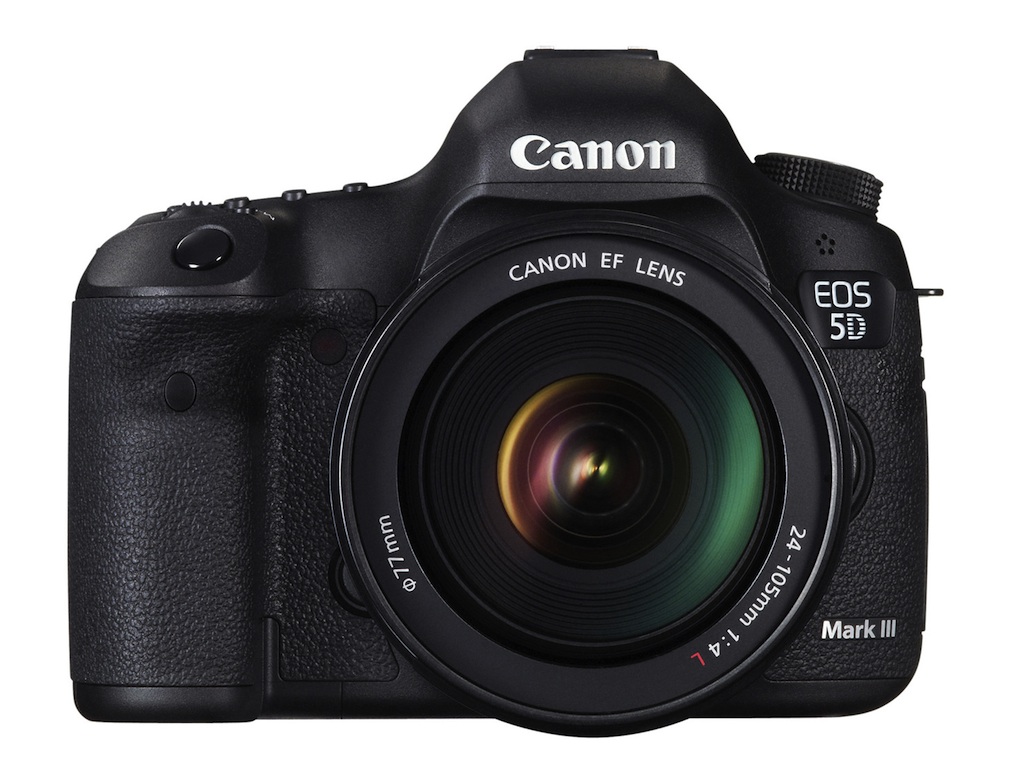
Canon presents the EOS 5D Mark III
Successor to the popular EOS 5D Mark II, it offers improved speed, higher resolution, greater processing power, as well as more creative options for both photos and video in true Full HD high definition.
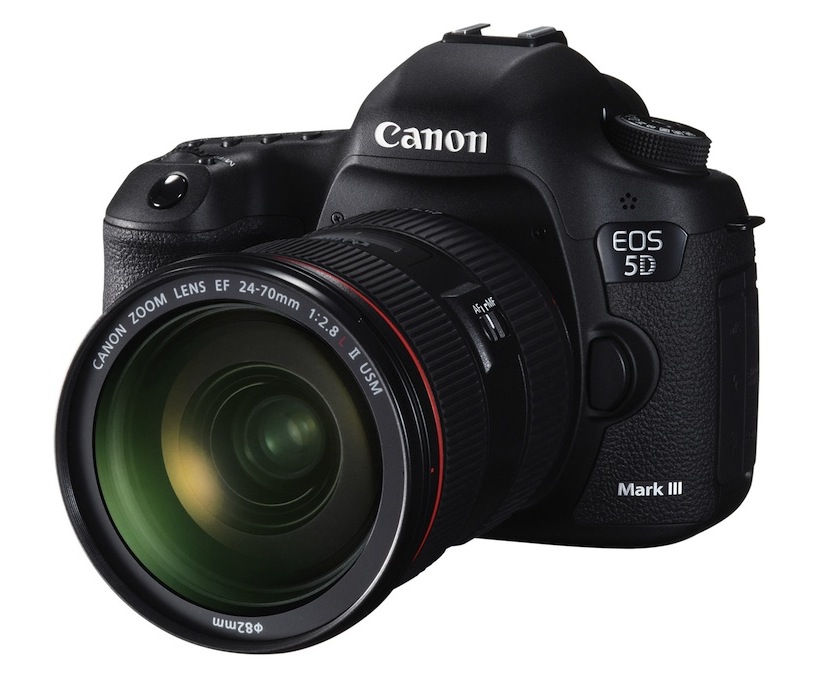
Canon today announced the latest addition to its popular EOS SLR camera range, the new EOS 5D Mark III which expands on the capabilities of the legendary EOS 5D Mark II, offering improved speed, higher resolution, greater processing power, as well as more creative options for both photos and video in true Full HD high definition, providing unparalleled artistic freedom for the most demanding photographers.
The new EOS 5D Mark III offers improved performance in almost every aspect. A new 22.3 Megapixel full-frame sensor offers the ideal balance of resolution for Full HD photos and videos and burst shooting at up to 6 frames per second (fps), while its 61-point AF system and 63-zone metering provides even greater speed, flexibility and precision.
Featuring the latest Digic 5+ processing technology, it also has enhanced video functions, providing not only greater image quality but also greater sound control, redefining the creative possibilities for both photographers and videographers.
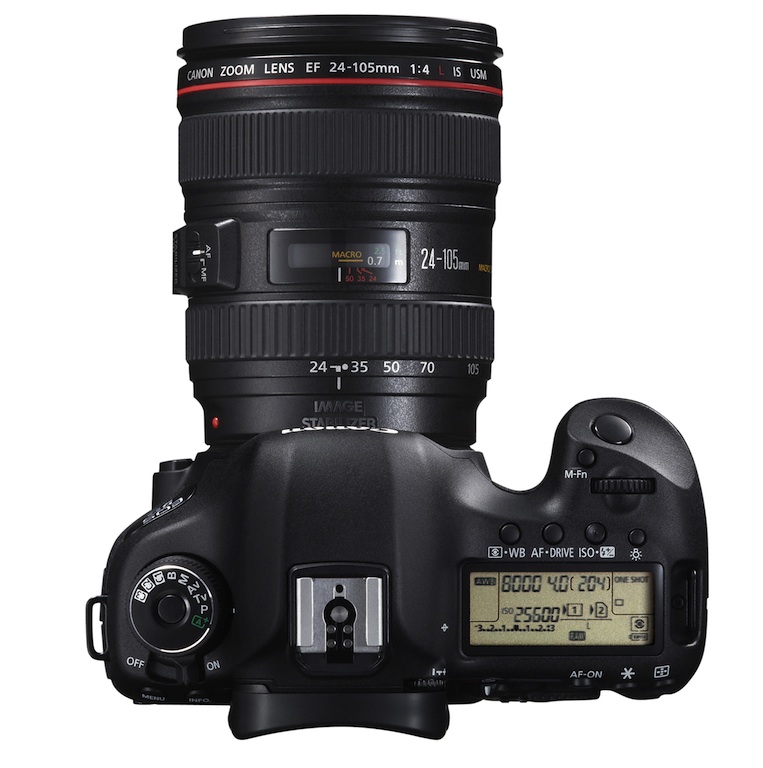
Improved features
The EOS 5D Mark III, with its comprehensively upgraded specifications, is the ideal tool for a growing number of still and video photographers. It incorporates a number of features first introduced with the Canon EOS-1D X, to provide greatly improved performance, flexibility, durability and handling.
The new 22.3 Megapixel full-frame sensor provides higher resolution and finer details, allowing you to capture a wide range of scenes, from spectacular landscapes to beautiful portraits. The high-speed continuous shooting function also offers additional creative possibilities. The camera, thanks to the extended readout to 8 channels, is capable of smoothly handling burst shots of up to 6 fps at full resolution, in series of up to 18 images in RAW format or more than 16,000 in JPEG format, without the need for additional accessories. Additionally, the advanced sensor architecture offers an interpolation-free ISO range of 100 to 25,600, expandable up to 102,400, making it possible to capture clean, high-quality images, even in extreme low-light conditions.
The EOS 5D Mark III uses the same 61-point wide-area AF system as the range's flagship, the EOS-1D X, providing exceptional sensitivity, precision and speed. It is one of the most advanced AF systems available today, with an impressive array of 41 cross-type points and five dual cross-type points, ensuring unparalleled precision across the entire frame. It also features the customizable AF presets introduced on the EOS-1D
Canon's famous iFCL metering system allows you to obtain very precise exposures, for which it incorporates a 63-zone double-layer sensor, connected to each point of the AF system. Focus information gathered by the AF system is analyzed along with color and luminance signals recorded by the metering sensor, allowing the EOS 5D Mark III to capture accurate skin tones as well as excellent results in a wide range of shooting situations.
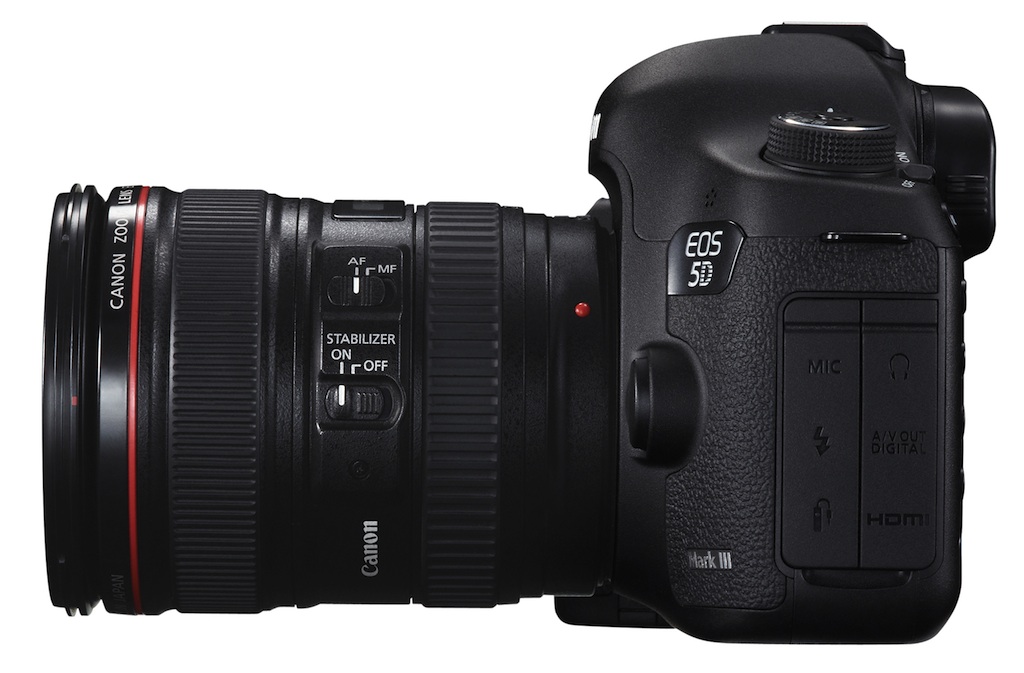
Creative possibilities
The EOS 5D Mark III features Canon's most advanced image processor, the Digic 5+, offering a host of new features without compromising camera performance. 14-bit A/D conversion provides smoother tonal gradation and color transitions, while the built-in HDR shooting mode combines three different exposures and allows you to apply one of five preset tone maps, capturing all the details of high-contrast scenes. Thanks to RAW processing and in-camera editing capabilities, photographers also have the option to immediately begin post-production on their images, while continuing to work.
The greater power of the Digic 5+ processor also allows for a series of tools that contribute to higher image quality. Lens peripheral illumination correction, lens chromatic aberration correction (lateral and axial), and high ISO noise reduction are performed in-camera without affecting performance, allowing photographers to continue shooting without lag in camera operation. Additionally, images can be rated in-camera by pressing a dedicated button, making it easier for photographers to classify images before proceeding to post-production.
New generation of EOS Movie
The EOS 5D Mark III builds on the excellent reputation of the EOS 5D Mark II, with a number of new features based on requests from photographers to deliver improved Full HD video performance. In addition to offering the depth-of-field control prized by video professionals, the new full-frame sensor combines the extensive processing power of the Digic 5+ to improve image quality, effectively eliminating moiré, false colors and other defects. The addition of a video mode switch and record button also makes it easier to use, allowing you to start recording immediately after activating video mode.
Other video features include manual exposure control and an enhanced range of high-bit-rate video compression options, supporting intra-frame (ALL-I) and inter-frame (IPB) methods. Various recording speeds are available from 24fps to 60fps, and SMPTE timecode support provides greater editing flexibility and easier integration into multi-camera recording.
Users can also check and adjust the sound level during recording using the camera's Quick Control screen; It has a headphone connection that allows you to control the sound level during and after recording. The enhanced processing power of DIGIC 5+ also makes it possible to trim the length of recorded videos in-camera.
The same rugged 8.11 cm (3.2") Clear View II LCD screen used in the EOS-1D headphone jack and lock mode dial, while the availability of a UDMA 7 compatible CF card slot and another SD card slot allows images to be captured simultaneously on both cards, automatically switching when one of them becomes full, and with the possibility of copying images from one card to the other in the same camera.
As part of the EOS System, the EOS 5D Mark III is fully compatible with more than 60 EF lenses, including the EF 24-70mm f/2.8L II USM, the new wide-angle lens in Canon's famous L series, a must-have for photographers. The camera is also compatible with a new series of accessories designed to expand creative possibilities, including the new Speedlite 600EX-RT, a new high-performance TTL flash with wireless radio connectivity. Additionally, the new BG-E11 battery grip offers greater handling flexibility and twice the battery life.
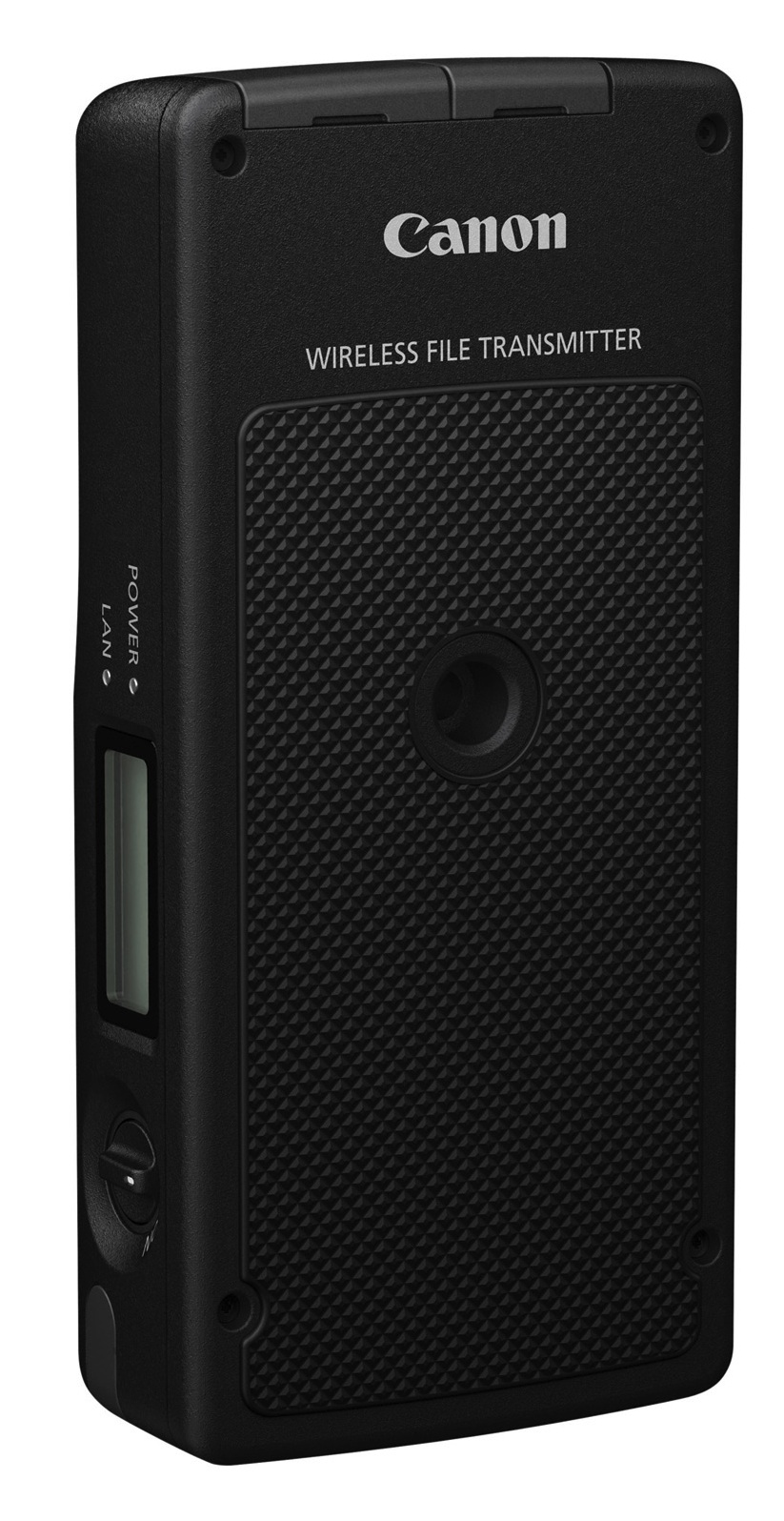 WFT-E7 transmitter and GP-E2 GPS receiver
Canon has also launched the WFT-E7, a new Wireless File Transmitter compatible with a wide range of EOS models. For those who need to transmit their images quickly and easily, such as press and sports photographers, the new WFT-E7 provides enhanced versatility via high-speed Wi-Fi and supports wired connection over a Gigabit Ethernet network. Supporting 802.11a/b/g/n for transfer speeds up to 150 mbps and Bluetooth for connecting external GPS units, the WFT-E7 enables ultra-fast direct image transfers to an FTP server or even a DLNA-compatible HDTV.
In addition, the WFT server function of the WFT-E7 allows you to access the camera settings or the scene framed in the viewfinder and control it through a web page with any device connected to the Internet, such as a smartphone, a tablet or a laptop. Camera settings can also be changed remotely using the EOS Utility program, allowing photographers to control and shoot the camera using either a wired or wireless LAN connection.
The WFT-E7 features a lightweight design and can be mounted to the bottom of the camera, a new AB-E1 mount or even the camera strap. For added versatility, it also supports linked shooting with up to ten other cameras, with wireless time synchronization ensuring that the time on all slave devices adjusts to that of the main camera to keep it the same across multiple units. During linked shooting, the WFT server function can also be activated to allow easy remote access to the main camera and slave cameras for greater creative control of lighting effects during multi-camera shooting.
Today Canon also launched the compact, lightweight, high-performance GP-E2 GPS receiver, which mounts to the camera's hot shoe, making it easy to tag the location of your images. Compatible with the EOS-1D
The GPS Logger function also allows photographers to track their route by downloading GPS data at regular intervals, whether the unit is mounted on the camera or in its case. Once back in the studio, photographers will be able to tag their images with data stored in GPS location files and can view their route using Google Maps or the supplied Map Utility software.
For greater accuracy in recording the time at which images are captured, photographers can also synchronize their camera clocks with the global atomic clock using UTC information downloaded from satellites. This is particularly useful for professional photographers who are shooting with multiple EOS 5D Mark III bodies and who want to process all the images together and sort them by the time each image was taken.
25 years of the Canon EOS system
Canon celebrates the 25th anniversary of the legendary EOS System. Since its inception in 1987, the EOS System has grown to become the most complete range of digital reflex cameras (DSLRs), interchangeable lenses and accessories, favored by photographers around the world.
The Canon EOS System made its debut in March 1987, with the launch of the EOS 650 SLR camera and three interchangeable EF lenses, including the EF 35-70mm f/3.5-4.5. This month, the system celebrates a long history of success, on the occasion of its 25th anniversary.
The EOS system, short for “Electro Optical System” and also named after the Greek goddess of dawn, was the world's first electronic mount system, representing a new generation of autofocus (AF) SLR cameras. In the years of analogue film cameras, EOS SLR cameras were already a huge success among a wide range of users, thanks to their innovative technologies and designs based on Canon's key concepts of high speed and ease of use. During this period, Canon pioneered the development of many technological advances, which made possible the launch of the top-of-the-range professional model, the EOS-1, in 1989. In 1993, the company continued to expand its number of users with the launch of the light and compact EOS 500 (EOS Kiss and EOS Rebel XS in other continents or countries).
Following the introduction of the EOS D30 in 2000, when the popularization of digital SLR cameras was in full swing, Canon developed advanced technologies such as its own CMOS sensors and high-performance DIGIC digital image processors, in order to offer products that met the company's key principles: high speed, ease of use and high image quality.
With the recent addition of the flagship EOS-1D
Additionally, Canon's interchangeable EF lens series, part of the EOS SLR system, holds an industry-leading position. EF lenses use some of Canon's most advanced and innovative optical technologies, including Ultrasonic Motor (USM), Image Stabilizer (IS), SubWavelength Structure Coating (SWC), anti-reflective technology and multi-coated Diffrgent Optical Elements (DO). The EF lens range currently consists of over 60 models, expanding the range of creative possibilities.
Additionally, with the recent launch of the EOS Cinema System for digital cinema products, the Canon EOS System now enables professional cinema film production as well as other high-end video applications.

Main features of the Canon EOS 5D Mark III
- Full format sensor, 22.3 Megapixels
- 61-point autofocus
- Continuous shooting up to 6 fps
- Sensitivity without interpolation of 100-25,600 ISO
- Full HD video, with manual control
- DIGIC 5+ 14-bit processor
- Improved weather sealing
- 8.11 cm (3.2 inch) 1,040,000 pixel display
- HDR mode with presets
Did you like this article?
Subscribe to our NEWSLETTER and you won't miss anything.
Related articles
 EOS R6 Mark III, Canon's new hybrid camera with a 32 MP sensor and 7K RAW recording
 Canon launches the EOS R1 mirrorless camera, its new flagship, and the long-awaited EOS R5 Mark II
 Canon offers new video capabilities on its EOS R5, EOS R6 and EOS-1D X Mark III cameras
 Canon updates EOS C70, C500 Mark II, C300 Mark III and R5 cameras
Canon updates EOS C70, C500 Mark II, C300 Mark III and R5 cameras
Canon updates EOS C70, C500 Mark II, C300 Mark III and R5 cameras
 Canon EOS M50 Mark II, a small but powerful mirrorless camera
 Canon to introduce significant improvements to the EOS-1D X Mark III and EOS R5
 Moncada presents the new Canon EOS C300 Mark III
 Canon strengthens its cinema offering with the EOS C300 Mark III and expands the recording capabilities of the EOS R5
 EOS-1D
 Canon launches the EOS C500 Mark II, a compact and versatile 5.9K full-frame camera
 Canon 5D Mark III, now with uncompressed HDMI video output
 New firmware for the Canon EOS 5D Mark III will improve video workflow
 What lenses to use with the Canon 5D Mark II, 7D and 550D in 'cinema mode'?