





Canon launches the EOS C500 Mark II, a compact and versatile 5.9K full-frame camera
Esta cámara de la serie EOS Cine cuenta con un sensor de formato completo que trabaja en combinación con el nuevo procesador DIGIC DV 7 de Canon.
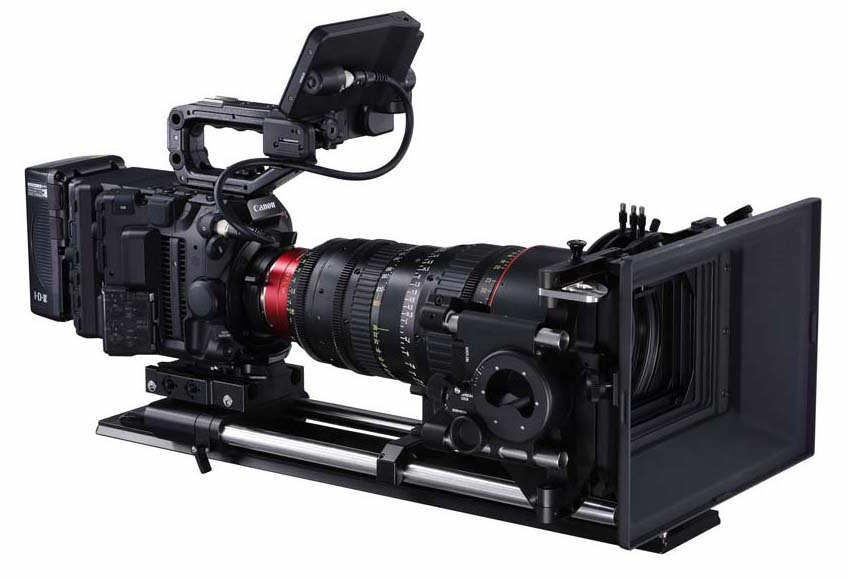
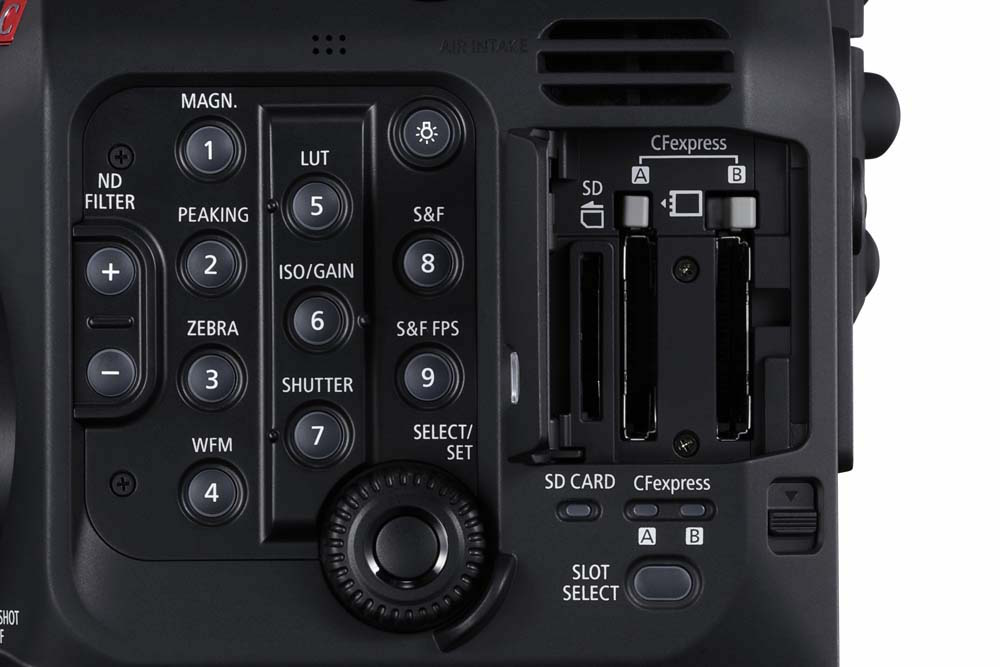
In the prelude to IBC 2019, Canon estrena la nueva cámara del sistema EOS C500 Mark II. Esta cámara de la serie EOS Cinema cuenta con un sensor de formato completo que trabaja en combinación con el nuevo procesador DIGIC DV 7 de Canon. Permite la grabación interna Cinema RAW Light de 5,9K y XF-AVC 4K 4:2:2 de 10 bits y cuenta con capacidad para grabación Cinema RAW Light con una resolución 5,9K en nuevas tarjetas de memoria más rápidas, como las tarjetas CFexpress. Para que los profesionales puedan disfrutar de mayor flexibilidad y eficiencia, es posible grabar simultáneamente el mismo formato de archivo en dos ranuras para tarjetas CFexpress.
El tamaño compacto de la cámara proporciona a los cineastas una libertad creativa sin igual. Gracias a su diseño flexible y modular, los profesionales pueden configurar la cámara con diferentes unidades de expansión, para adaptarse a los requisitos de cada producción.
La EOS C500 Mark II es la primera cámara del Sistema EOS Cine que incorpora una montura de objetivos intercambiable por el usuario para EF con Bloqueo Cine y PL, lo que ofrece a los profesionales una amplia variedad de selección de objetivos. También es la primera cámara del Sistema EOS Cine compatible con el Sistema de Estabilización de la Imagen Electrónico (Electronic IS).
Gracias al sensor 5,9K y al DIGIC DV 7 processor, recientemente desarrollado, la EOS C500 Mark II utiliza un algoritmo de procesamiento de alta calidad cuando sobremuestrea de 5,9K a 4K. Esto suprime el muaré y reduce el ruido, lo que da como resultado una calidad de imagen excepcional. Con su latitud de +15 pasos con espacio de color amplio, la EOS C500 Mark II es perfecta para Producciones de Alto Rango Dinámico. Además, la cámara va equipada con una unidad motorizada Full Frame ND (2, 4, 6, 8 y 10 pasos) de densidad neutra, lo que hace posible crear imágenes con una profundidad de campo reducida, incluso durante el día.
Grabación y flujo de trabajo eficientes
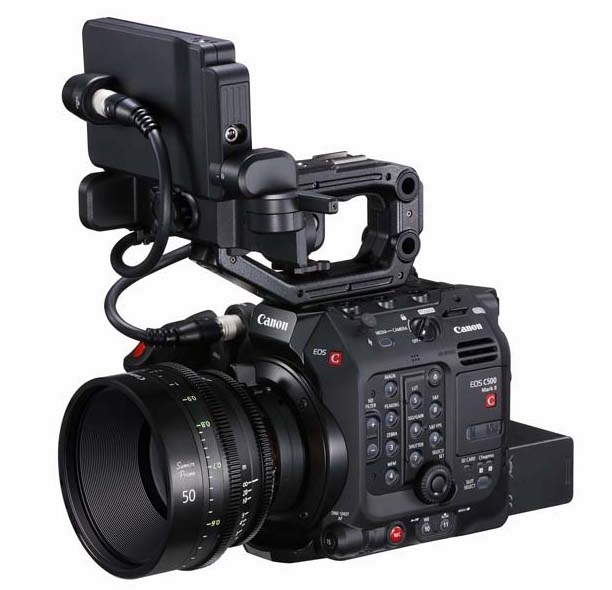
La versátil capacidad de multigrabación en diversos formatos de la EOS C500 Mark II proporciona eficiencia en el flujo de trabajo, para cubrir todos los requisitos de producción. Con el nuevo procesador de imagen DIGIC DV 7 de Canon, la cámara permite realizar grabaciones internas en formato Cinema RAW Light, con una resolución de 5,9K. El formato Cinema RAW Light cuenta con todos los beneficios de un archivo RAW en cuanto a flexibilidad en la postproducción, pero permite a la EOS C500 Mark II grabar archivos de alta calidad en un tamaño de archivo más pequeño.
Además de la capacidad de la cámara para grabar internamente en tarjetas CFexpress en formato Canon XF-AVC con 4K 4:2:2 de 10 bits, es posible grabar simultáneamente, así como realizar grabación proxy. Esto proporciona a los profesionales la flexibilidad más avanzada, ya que les permite elegir el formato más adecuado para sus necesidades de grabación y de flujo de trabajo. La cámara dispone de una interfaz avanzada 12G-SDI con unas velocidades de transmisión cuatro veces más rápidas que 3G-SDI. Esta interfaz 12G-SDI permite la salida de contenidos 4K 50/60p mediante un único cable, lo que simplifica los flujos de trabajo. Además, la salida HDMI permite 4K 50/60p mediante un solo cable.
Los cineastas pueden configurar la cámara utilizando dos unidades de expansión diferentes: la EU-V1 y la EU-V2. También hay disponibles dos visores (EVF-V70 y EVF-V50) como unidades opcionales. La capacidad de configurar la cámara con unidades de expansión, junto con su diseño compacto y ligero, ofrece a los cineastas una mayor flexibilidad de grabación.
La unidad de expansión EU-V1 añade una interfaz Genlock/Sync BNC, interfaz Remote B para el controlador remoto RC-V100 opcional, así como una interfaz Ethernet para transmisión IP o para control a distancia mediante el navegador. La unidad de expansión EU-V2 también incluye estas interfaces, pero añade dos entradas XLR adicionales, así como una interfaz para objetivos de 12 pines. Además de todo esto, está equipada con una montura para baterías V-Lock con D-tap y salida de corriente de 24 V.
Estabilización de la Imagen Electrónica
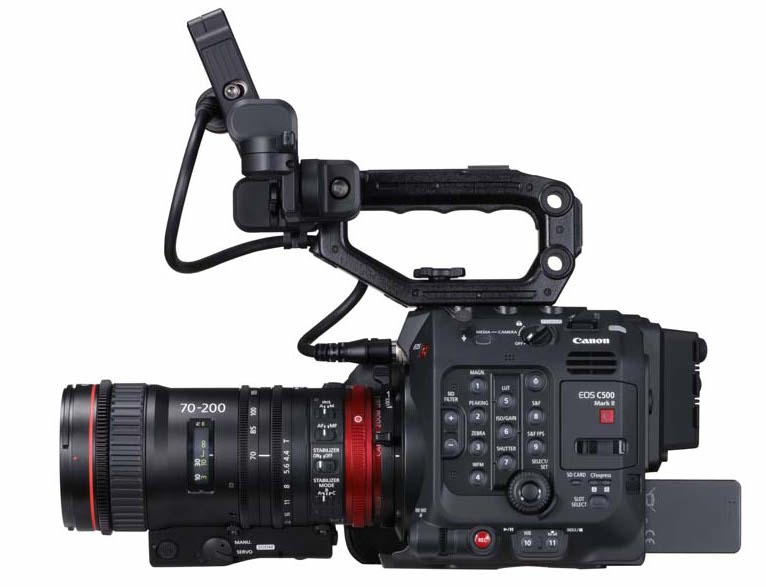
La EOS C500 Mark II es la primera cámara que incorpora Estabilización de la Imagen Electrónica (IS) en una cámara del Sistema EOS Cine, lo que dota a la cámara de una Estabilización de la Imagen en 5 ejes. Cuando está acoplado un objetivo compatible con la transmisión de datos, los datos de la longitud focal se reciben automáticamente. No obstante, cuando se utiliza un objetivo sin comunicación, la Estabilización Electrónica es posible introduciendo manualmente el dato de la longitud focal. Además, la Estabilización de la Imagen Electrónica es también compatible con los objetivos anamórficos.
Al igual que en otras cámaras de la gama, la EOS C500 Mark II incorpora el enfoque automático Dual Pixel CMOS AF de Canon. Dado que ofrece tanto AF one-shot y AF continuo, los profesionales pueden tener la seguridad de que sus grabaciones quedarán bien enfocadas. Asimismo, se pueden beneficiar de un funcionamiento del enfoque táctil suave e intuitivo con la nueva pantalla LCD LM-V2, así como de la Guía de Enfoque Dual Pixel, que notifica a los profesionales dónde está la posición de enfoque, tanto si está delante como detrás, lo que ayuda a un control preciso del enfoque. Además, la EOS C500 Mark II cuenta con AF de detección de cara y AF de seguimiento, lo que permite el control del enfoque en una amplia variedad de situaciones de grabación. Para ajustar de forma aún más precisa el rendimiento del AF, la cámara ofrece la posibilidad de ajustar la velocidad del seguimiento AF y su capacidad de respuesta.
La EOS C500 Mark II es compatible con los LUTs de usuario, lo que permite a los cineastas aplicar o personalizar sus propios LUTs. Al cargarlos en la cámara para una monitorización precisa del aspecto, los cineastas pueden aplicar LUTs diferentes a cada terminal. Con el botón LUT añadido, los profesionales pueden disfrutar de una mayor flexibilidad operativa. La EOS C500 Mark II también permite la grabación a una mayor velocidad, de hasta 50/60 fps, con una resolución de 5,9K con el códec Cinema RAW Light.
Main features
- Sensor de formato completo 5,9K
- Reproducción fiel de color gracias al “color science” de Canon
- Grabación en HDR con PQ/HLG y Canon Log 2/3
- Grabación interna en CFexpress / Cinema RAW Light y XF-AVC
- Cuerpo compacto y robusto de apenas 1.75 kilos
- Montura de objetivos intercambiable por el usuario
- Enfoque automático mejorado
- IS electrónico (estabilización de imagen)
- LUTs de usuario
- ND (2/4/6/8/10) interno
- Color falso / Marcador / Nivel de pantalla personalizable
Did you like this article?
Subscribe to our NEWSLETTER and you won't miss anything.
Related articles
 Jaime Martínez (Canon): “the C50 is the lightest, most versatile and compact camera so far in the Cinema EOS range”
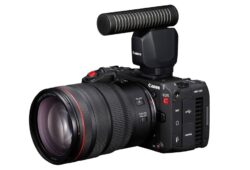 EOS C50: the new hybrid EOS Cinema camera with RF mount, full frame and versatile from Canon
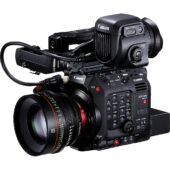 Canon updates the firmware of the EOS C500 Mark II to incorporate new Cinema RAW Light recording formats
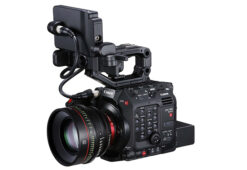 Canon updates EOS C70, C500 Mark II, C300 Mark III and R5 cameras
Canon updates EOS C70, C500 Mark II, C300 Mark III and R5 cameras
Canon updates EOS C70, C500 Mark II, C300 Mark III and R5 cameras
 'Nacional 106': a thriller with an air of a Castilian western filmed thanks to the agility and ergonomics of the Canon EOS C500 Mark II
 Ikegami debuts the UHL-F4000 4K HDR multi-function compact camera
 Canon EOS C200: the compact EOS Cine 4K camera to gain creativity and flexibility
 XC15: Canon's new 4K compact camera with a high-level audio interface
 Canon ME200S-SH Multipurpose Professional Compact Camera Turns heads at NAB
 Canon EOS 70D: Full HD at different recording speeds in a versatile camera
 EOS 6D: Canon launches its smallest, lightest full-frame DSLR with Full HD recording
 EOS C500: Canon unveils a digital cinema camera with 4K video recording at NAB
 Canon XA10, the new compact, professional and affordable camera from Canon