





Millennials y Generación Z: adiós a los mass media


Los medios de comunicación convencionales, los mass media, tienen hoy un difícil encaje con un contexto sociológico y cultural en el que priman el consumo individual de contenidos e información, casi siempre on demand.
La fórmula de “lo que quiera, dónde quiera y cuándo quiera” empieza a mostrar algunas de las consecuencias que afectan directamente a la industria mediática “tradicional”. Si durante años los medios han debido adaptarse a la revolución digital, la transformación de la señal, la eclosión multiplataforma y multisoporte, y la innovación en contenidos, ahora se enfrentan a la convergencia de todos estos procesos de mediamorfosis con una generación de usuarios que no se ven representados por los medios existentes, que nos los reconocen siempre como medios y que no los consumen. La nueva generación ha decidido que su “medio” es Internet y que lo interesante para ellos está en las ágoras opinativas que suponen las redes sociales y los canales individuales en streaming a las que han convertido en auténticas comunidades de nicho.
El estudio “Los nuevos consumidores mediáticos: Millennials versus Generación Z(ero)”
Los centennials o postmillennials constituyen el grupo de población actual que más profundamente está modificando el consumo de contenidos mediáticos de forma que han acentuado la brecha digital ocasionada por la generación inmediatamente anterior, los millennials, provocando así el inicio de un cambio de paradigma en el ecosistema comunicativo que, sin duda, tendrá consecuencias relevantes en muchos ámbitos de la sociedad.
En un estudio del Observatorio del Ocio y el Entretenimiento Digital (Killed) en colaboración con Panorama Audiovisual, y publicado en la revista Estudios sobre el Mensaje Periodístico, hemos podido constatar cómo, a pesar, de la escasa diferencia de edad existente hoy entre estos dos colectivos juveniles, presentan comportamientos distintos ante los medios que responden a un cambio de mentalidad y a la construcción de un espacio comunicativo propio por parte de la generación más joven. Este espacio comunicativo supone un reflejo cercano a sus valores y responde al uso generalizado y constante que hacen de Internet en todos los ámbitos de la vida. Para este colectivo los medios de comunicación no son prescriptores únicos de información y opinión, y tampoco son su fuente principal de entretenimiento. Mientras los millennials han seguido mostrando preferencia por los contenidos mediáticos de información, aunque en menor medida también que las generaciones precedentes, los postmillennials o centennials encuentran su zona de confort en las redes sociales y las aplicaciones digitales para teléfonos inteligentes.
Algunos resultados del estudio
El objetivo del estudio era observar las tendencias de consumo de contenidos mediáticos de los jóvenes de entre 18 y 25 años en España, así como sus preferencias en formatos digitales y medios de comunicación actuales, con el fin de avanzar en la interpretación de la actual brecha digital entre generaciones y cómo podría afectar a la industria audiovisual, a los medios convencionales y a la cultura digital en general. Para ello, seleccionamos a dos grupos de edad que consideramos actores protagonistas del cambio: los jóvenes de entre 18 y 21 años y los que tienen de 22 a 25 años. Los primeros constituyen una muestra de la generación Z, aquellos nacidos de 1999 en adelante, y los segundos representan al final del colectivo millennial, los nacidos entre 1985 y 1998.
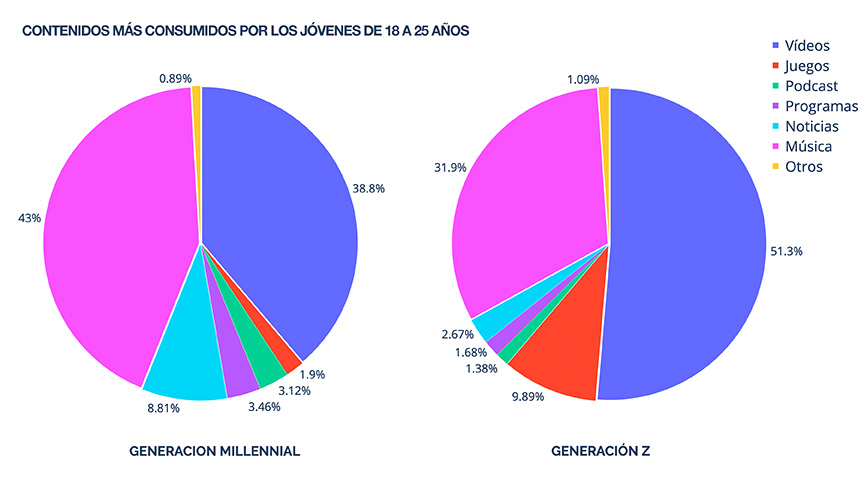
Tras la realización de más de 1900 encuestas, algunos de los resultados obtenidos señalan que los contenidos que más consumen los jóvenes de 18 a 25 años son, sin duda, los vídeos y la música. Ambos alcanzan en el colectivo millennial el 82% de sus preferencias y entre los centennials el 83%. Sin embargo, tomados por separado, la música parece perder seguidores con el cambio generacional: más de un 11% de diferencia entre ambos colectivos indican que las preferencias de los más jóvenes se concentran fundamentalmente en contenidos provistos de imagen. En la misma línea, se aprecia un significativo aumento del consumo de juegos y videojuegos en los dispositivos móviles y otras pantallas digitales en el caso de los centennials, un 8% más que en el colectivo millennial. También disminuye la escucha de podcast entre los más jóvenes y el consumo de noticias y programas mediáticos.
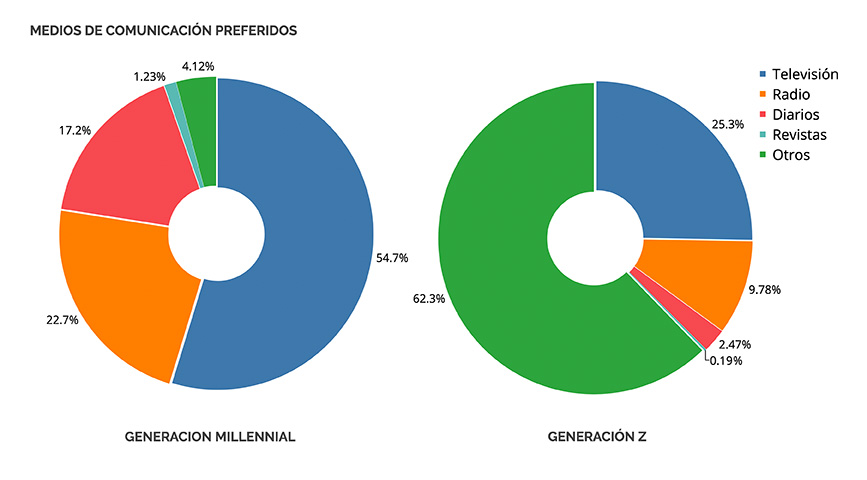
La preferencia por los contenidos televisivos disminuye cerca de un 20% en el caso de la generación Z respecto a la generación anterior, mientras se recortan también los procedentes de la radio y la prensa, aunque en menor porcentaje. La categoría Otros (presente en la encuesta de forma abierta), donde ellos mismos incluyen como “medios” a Internet, las redes sociales y las plataformas virtuales, son las que experimentan un crecimiento más importante, un 22%.
Sobre los contenidos mediáticos que consumen nos encontramos con varias señales: la radio no se escucha tanto como pudiera parecer a través de dispositivos con pantalla; los millennials dicen no escuchar la radio en un 46%, cifra que se incrementa hasta el 72% en el caso de la generación Z.
La participación en los contenidos por parte de los jóvenes se centra especialmente en los likes, un 44% en los millennials que aumenta hasta el 50% en la generación Z. Los comentarios a las publicaciones disminuyen con el cambio generacional, al igual que los “retuits” o el hecho de compartir en un blog o página propia que, en el caso, de la generación Z es inexistente (0% de respuestas).
Más entretenimiento, consumo rápido y poca atención
Para los medios tradicionales la adaptación a las TIC ya no es suficiente para alcanzar a esta audiencia. La generación Z es una generación participativa, concienciada, comprometida y está dotada de más recursos que ninguna otra hasta la fecha para lograr el triunfo social y personal. Sin embargo, el propio entorno digital y la excesiva protección social con la que han crecido les limita su capacidad de atención, reflexión, concentración y hasta de empatía con sus semejantes. Son jóvenes nacidos en el apogeo del capitalismo, en su mayoría dentro de regímenes democráticos desprovistos de memoria histórica anterior a 2001, pero que han conocido la crisis económica de 2008 y sus consecuencias. Gran parte de su desapego hacia los valores tradicionales proviene de la superación de ese contexto; su meta es obtener el éxito personal, en todos los aspectos, pero no siempre a través del esfuerzo, la disciplina o la formación continua de los millennials, sino mediante el desarrollo personal de habilidades competencias que les hagan ser “el mejor” en un contexto competitivo. En cierto modo, son descreídos del estatus anterior y el actual estado de desinformación y descrédito de la información mediática acentúa su preferencia por el entretenimiento. La prescripción inconsciente que tienen sobre ellos los formatos game, los videojuegos y los realities, por ejemplo, junto a los contenidos audiovisuales que expresan emociones y estados de ánimo que inundan las redes sociales, merecen una profunda investigación independiente; cabría preguntarse si son contenidos que responden a las demandas de los jóvenes o son códigos del mercado y la industria para simplificar el comportamiento y la dispersión de este sector de la población y lograr su favor.
La generación Z consume contenidos preferentemente en red y son contenidos que distribuyen grandes plataformas digitales en Internet; ya sean videojuegos, programas online o series de ficción, su mundo es virtual y enteramente audiovisual. Para los millennials el mensaje textual, aunque breve, y el audio digital forman parte de su vida diaria. La influencia que tienen los medios de comunicación en este colectivo es aún importante, en especial, los que distribuyen información a través de Twitter o Facebook, pero también en plataformas de podcasting. Los menores de 21 años, sin embargo, señalan en muy escasa medida su uso y en ocasiones hasta desconocen su existencia.
La generación de jóvenes actual apunta, como sus medios de comunicación preferidos, a Internet y las redes sociales, pero no son medios de comunicación en el sentido tradicional del último siglo. El reto para los medios de comunicación hoy es más complejo que nunca. Atraer a esta nueva generación de jóvenes para que se convierta en audiencia mediática es difícil sin caer en el sensacionalismo y el puro entretenimiento por doquier. Las demandas fundamentales de los millennials se centraban en la consecución de una mayor calidad en contenidos, dotar de más sentido del humor a ciertos programas, aumentar el contacto con la gente de la calle, mejores relatos y más ubicuidad para su consumo; las herramientas que se plantearon para lograrlo fueron el aumento de creatividad y la innovación en formatos, contenidos y estilos, además de ampliar las posibilidades de distribución y difusión. Sin embargo, hoy los centennials han interiorizado lo que es posible e imposible a corto plazo de esa fórmula y ya no demandan, han elegido: en su tiempo, sea laboral, social, familiar o de ocio, consumen prácticamente lo mismo y no son, generalmente, ni noticias de periódicos, ni programas de radio ni programas de televisión, salvo contadas excepciones.
Nereida López-Vidales
Profesora Titular de Periodismo y Coordinadora del Programa de Doctorado ELLCOM en la Universidad de Valladolid.
Directora del Observatorio del Ocio y el Entretenimiento Digital (OCENDI)

Did you like this article?
Subscribe to our NEWSLETTER and you won't miss anything.
Related articles
 All3Media International and Knox Media Hub renew their alliance to develop a new generation of metadata management tools
 Telemadrid outsources the generation of broadcast signals to Séptima Media
 Media Excel y Six Floor Solutions: alianza estratégica para “revolucionar” la distribución de contenidos y la generación de highlights
 MOG and Swiss TXT move together into a new era of mass journalism
 Memnon launches DARS.MEDIA, a new generation audiovisual material market
 DPG Media creates next-generation IP Live production studio with Sony
 Mediacloud and Altran join forces to offer next-generation cloud solutions for the media sector
 Los millennials y la televisión: qué programas ven y cómo consumen
 Aspera: next generation transport technologies for Media
 Tedial shows its latest generation Media Factory at BIT
 Mission 2, el Media Asset Management de segunda generación de Quantel
 New generation of Media Asset Management from SGT
 Mass Digital: training in Apple and Adobe solutions
Cursos Adobe y Apple de Mass Digital en el País Vasco
Mass Digital: training in Apple and Adobe solutions
Cursos Adobe y Apple de Mass Digital en el País Vasco