





AEQ offers the Smartalk service as a resident application for high-quality broadcasts from smartphones
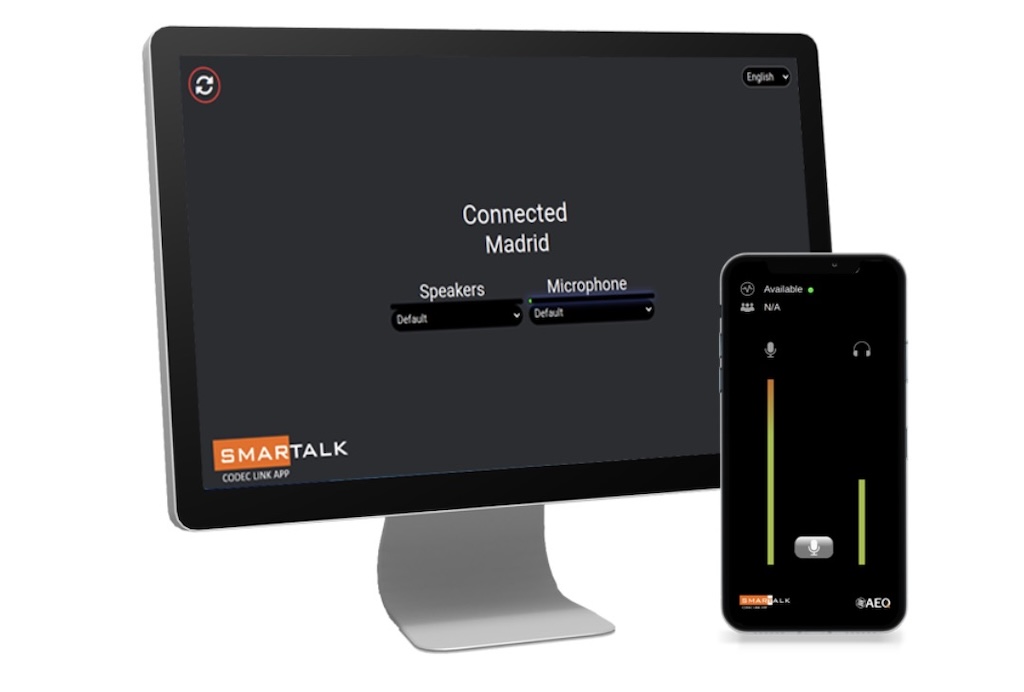
With Smartalk AEQ, sports commentators and other reporters will now be able to use professional microphones from their phones and establish communications with the station's audiocodec to broadcast events and send chronicles, or conduct interviews, with the highest quality and reliability.
The classic web-based Smartalk application generates links, which are occasionally sent by email, WhatsApp, QR code or any other means. When the guest clicks on the link, the application sends them an OPUS audiocodec that connects to the station's AEQ Phoenix audiocodec.
The resident Smartalk application is downloaded for free from Google Play or AppleStore, and installs a permanent application on the Smartphone
In both cases, without further intervention, the audio link between the device's microphone and speaker or headphones, and the station's audiocodec, is ready.
But the resident Smartalk app has a absolute control over the Smartphone, ensuring compatibility with equipment and allowing the use of professional microphones and headphones, making it suitable for professional use by reporters or sports commentators who regularly work with a station.
This way, it is not necessary to have an audiocodec, or to have to be helped to configure and use it. Thus, collaborators can intervene from any place where there is Internet connectivity.
The participant presses, the welcome screen appears, presses again and remains active on the air on the pre-assigned codec line, or the one available at the station, and is ready to participate. There is no need to send a mobile unit, or move the guest, as they use their own smartphone to connect and participate.
Any user of AEQ Phoenix audiocodecs can subscribe to the Smartalk service tested. If after the test you decide to subscribe to the service, you can purchase a renewable annual license based on the number of studio audiocodecs you want to enable for the service.
License use
Smartalk subscribers can make whatever use they want of the service, and download the application or send their web connection link as many times as they need during the subscription period, for the number of licensed Phoenix audiocodecs.
When a license, trial or definitive, is activated on a station PC, the web application is activated so that Smartalk users can create 'Guest' or remote terminal users, whether they connect with a resident application or a temporary web-based application through links.
Once remote users call, you just have to assign them an audiocodec channel and put them on the air. It also has an administrator window to register or modify stations, audiocodecs and other users.
If activated Smartalk para un audiocodecs AEQ Phoenix latest generation (Venus 4), audiocodec channels can be assigned individually to Smartalk by preset, allowing an audiocodec in the studio to dynamically work with Smartalk or against other portable audiocodecs. In other Phoenix audiocodecs, channels can be assigned to the service manually.
Smartalk uses the OPUS encoding very high quality of the AEQ Phoenix audiocodecs, which allows you to choose modes that allow you to use a remote PC, connecting a sound jack to it, even to broadcast musical events.
To have high availability and low delay, AEQ has created a redundant and distributed infrastructure on several servers in the cloud in different regions of the world, so that each audiocodec works against a sufficiently close cloud infrastructure.
https://www.youtube.com/watch?v=AdFyJrSz5PM&t=4s
Did you like this article?
Subscribe to our NEWSLETTER and you won't miss anything.
Related articles
 Bitmovin and StreamShark Partner to Deliver High-Quality Streaming at Scale
 TVU MediaMesh lands on Cerebrum (EVS) to coordinate broadcasts from the cloud
 Star Comunicaciones joins Soliton to offer high quality video streaming
 Trece TV achieves high-quality live connections from any smartphone using LiveU's Go Plan
 Dolby On, an application (iOS/Android) to record music and videos with high quality
 How to produce radio from home with the highest quality?
 AWS Elemental MediaLive offers statistical multiplexing for better streaming quality, performance, and bandwidth management
 Interra Systems offers support for Dolby Vision on its Baton QA platform
 Blackmagic demonstrates at ISE how it is possible to produce content of the highest quality in an agile, flexible and low-cost way
 Ateme and Optiva Media support Orange Spain's VOD service with a high-quality cloud video solution
 Yamaha offers high-quality audio to the new budget television Telegraaf Tv
 Audio quality is key when watching movies for smartphone users
 Europa FM launches its application for Android smartphones and tablets
 Yamaha now has an application available to control the M7CL V3 console from iPad