





Bank credit and private capital: the solution to improve audiovisual financing?
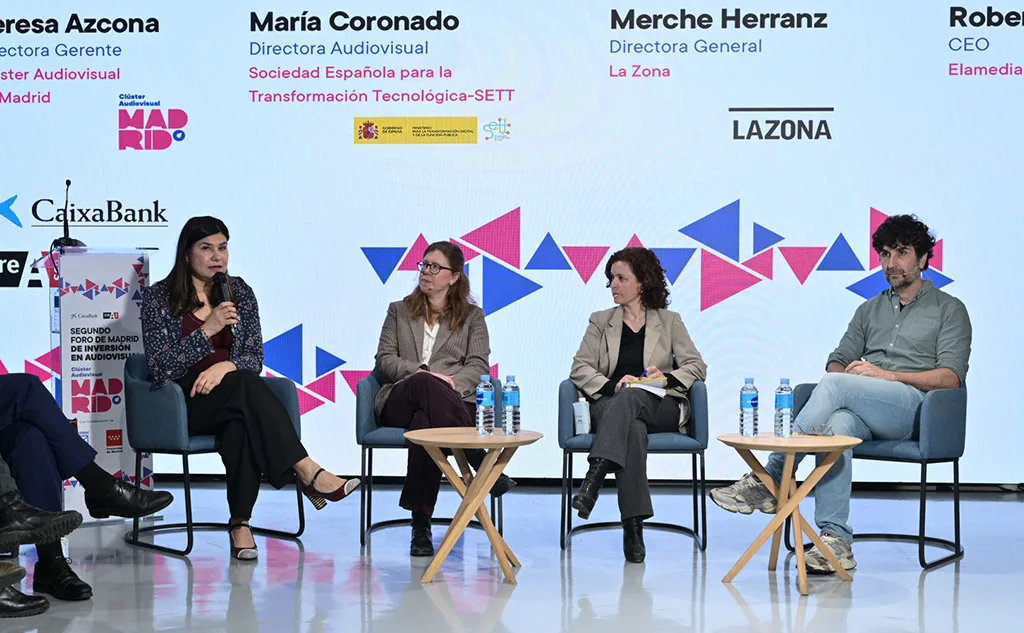
The II Madrid Audiovisual Investment Forum, an initiative of the Madrid Audiovisual Cluster in collaboration with public institutions and with the support of Create SGR and CaixaBank, has brought together production companies, experts, investment funds and financial entities to address new investment formulas in the audiovisual industry.
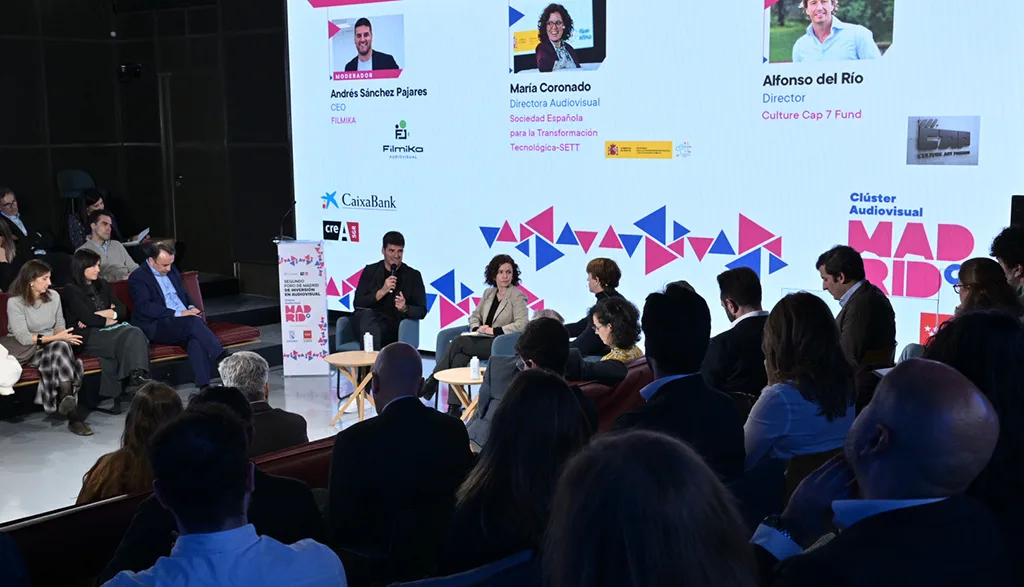 The event, with full capacity, has also served as a meeting point for professionals in the sector, facilitating the exchange of experiences and the creation of contacts between production companies, investors and institutional representatives. Attendees have been able to explore possible synergies, generate new opportunities for collaboration and strengthen their network of networking in an environment conducive to dialogue and business connection.

The program has included tables dedicated to bank financing of audiovisuals, with the participation of CREA SGR, Caixabank and different production companies; sessions on alternative financing; and analysis of the role of private equity, specialized funds and investment vehicles linked to technological transformation. Before, the institutional opening has had the participation of Raúl Berdones, president of Madrid Audiovisual Cluster; Javier Hernandez Sanchez, director of Institutional Banking Caixabank; Manuel Beltran general director of Institutional Relations and Strategic Projects of the Madrid City Council; y Luis Martin, Deputy Minister of Culture, Tourism and Sports of the Community of Madrid.
In his speech, the president of the Cluster thanked the institutional support and continued support for the Madrid audiovisual ecosystem, as well as the involvement of collaborating entities, partners and the organization's board of directors.
A financing model that evolves
They were present at the first technical table Pedro Martin, director of the Audiovisual and Culture Area of CREA SGR, who explained how guarantees work and their impact on reducing financial risk. It has been accompanied by Eduardo Gomez, director of the Cuzco Business Center CaixaBank, who spoke about the specific bank financing instruments for production companies and companies in the sector.
Clara Lago, general director of Horse Films, has provided the business perspective on the real financing needs, while Kiko Martínez, producer and CEO of Nobody is Perfect and president of Audiovisual Cluster of the Valencian Community, has defended financial structures adapted to production cycles and the retention of rights. The session was moderated by Irene Jimenez, co-founder of Audiovisual 451, which has guided the debate on the evolution of credit and banking specialization in the audiovisual field.
Alternative financing of audiovisual projects
In the block dedicated to non-bank financing, moderated by Jesus Prieto, advisor of CREA SGR, the focus has been placed on alternatives to traditional credit and on ways to boost projects through more flexible and innovative structures. He has also participated Patricia Lopez, director of Sego Creative, which has addressed new financial structuring formulas and the importance of designing tailored schemes that combine different instruments and adapt to the nature and phase of each project.
Jesus Martinez, technical advisor of Moby Dick Film Capital, has explained the hybrid financing models and private investment mechanisms applied to projects, focusing on how the combination of private capital, tax incentives and alternative formulas can improve viability and attractiveness for investors. After, Antonio Manso, executive director of Be&Jing Capital, focused his speech on specialized investment solutions, emphasizing the professionalization of financial vehicles and the need for solid structures that generate trust and sustainable profitability.
has closed Salvador Molina, president of Madrid Capital FinTech Cluster, who explained the determining role of financial technology in the diversification of resources, emphasizing how digitalization, collaborative platforms fintech and advanced solutions are expanding access to financing and transforming the investment system.
The cases of GOROS Investments and Culture Cap 7 Fund
In the practical analysis of Goros Investments they have participated Javier de Ros, founding partner of the company, who has developed the fund's investment strategy in companies in the sector, and Hernan Perez, executive general director of The Workout Group, which has detailed the experience of business growth after the entry of capital.
The investment via equity, it has been emphasized, allows companies to grow, consolidate employment and undertake larger projects, as well as face expansion and acquisition processes. In the case of production companies, it reinforces their ability to develop larger-scope productions and improve their positioning in the management of intellectual property rights.
Next, in a dialogue focused on specialized funds, led by Andrés Sánchez Pajares, CEO of Movie, the role of sectoral investment vehicles as a fundamental tool to professionalize and scale audiovisual financing was discussed. The table has been composed of Maria Coronado, audiovisual director of the Spanish Society for Technological Transformation (SETT), who presented the public strategy to stimulate the sector. Coronado detailed the priority lines aimed at strengthening competitiveness, promoting technological innovation and attracting international investment.
For its part, Alfonso del Rio, director of Culture Cap 7 Fund, addressed the fund's investment focus, aimed at audiovisual projects with a global vocation. During his speech, he highlighted the selection criteria, the search for talent with the capacity for international projection and the commitment to content with the potential to travel in multiple windows and markets.
The opportunities that SETT offers in the audiovisual sector
The last presentation, moderated by Teresa Azcona, managing director of Madrid Audiovisual Cluster, has reunited again Maria Coronado, who has delved into SETT's direct investment instruments and its role in strengthening the audiovisual ecosystem. It has made known how these tools seek to facilitate access to financing and support projects with the capacity for growth and international projection.
Merche Herranz, general director of In the Zone, has shared business experience in collaboration with public investment, highlighting the value of cooperation between the public and private sectors to promote solid and sustainable projects. Finally, Roberto Butragueño, CEO of Elamedia, has analyzed the impact of financial support on corporate growth, highlighting how strategic investment can favor the expansion and consolidation of companies in the sector.
The combination of instruments, key to the future
The closing was carried out by Javier Hernandez Sanchez, director of Institutional Banking CaixaBank, who emphasized the importance of strengthening collaboration between public administrations, financial entities and private investors to consolidate a stable, competitive financing framework adapted to the particularities of the audiovisual sector.
Throughout the Forum it has become clear that the combination of banking instruments, alternative formulas and capital vehicles has become a decisive factor in stimulating business growth, improving professionalization and strengthening the internationalization capacity of Madrid's audiovisual sector. The different sessions have made it possible to integrate the institutional vision with the market perspective, highlighting the growing role of non-bank complementary financing and specialized funds.
These tools, the organization points out, are consolidated as decisive instruments to structure larger operations, optimize risk management and enhance the attraction of private investment to the sector.
Did you like this article?
Subscribe to our NEWSLETTER and you won't miss anything.
Related articles
 Canon and More than Professional Video: master class to improve technique and audiovisual workflow
 Madrid Film Office participates in the European Film Market (EFM) to promote the capital as an audiovisual hub
 EGEDA: collaboration agreement with Segofinance to improve access to financing
 Claro tv+ chooses the TVkey Cloud solution from Nagra and Samsung to improve the experience of its subscribers
 Conecta Fiction & Entertainment se prepara para convertir a Toledo en la capital internacional del audiovisual
 RTVE and ICO renew their alliance to boost financing for Spanish audiovisual production
 CCMA demands in Parliament the “necessary financing” to promote the audiovisual industry
 La Caixa becomes a shareholder in the main Spanish private equity rendering farm
 Review the financing law, improve productivity and rationalize spending, the proposals that Sánchez leaves on the table before the end of his mandate at RTVE
 Audiovisual SGR and Natixis Coficiné sign a collaboration agreement to facilitate financing for the film sector
 Galician audiovisual professionals participate in a seminar on financing audiovisual work
 FAPAE urges the Government to implement new financing measures for cinema and audiovisuals
 New possibilities for the private sector in light of the reform of the General Audiovisual Law
 20 years of Telecinco: from Mamma Chicho to the largest private audiovisual group in the country