





Television in 2010, up for debate
A few months before the final analogue blackout, the Business Development Institute, with the sponsorship of Nagravision, has organized a conference today in Madrid in which the current situation of DTT and the probable scenario after April 3 of next year was analyzed.
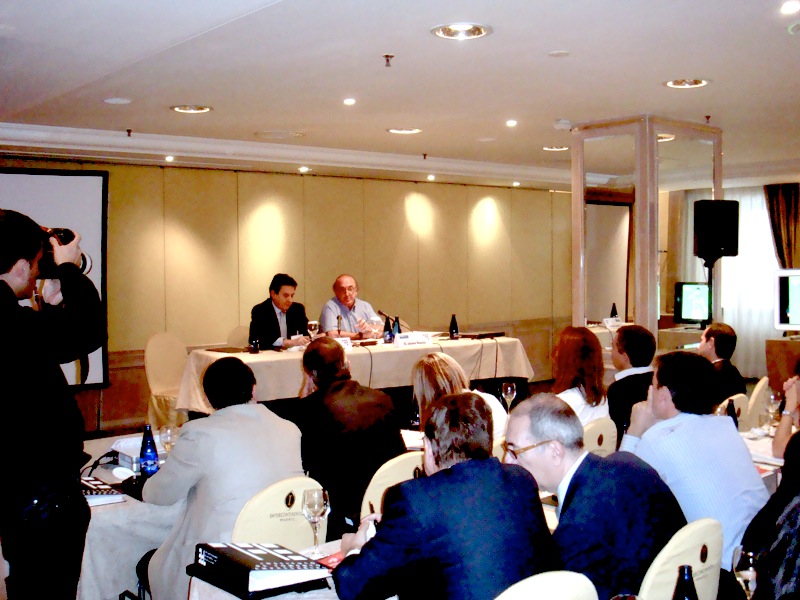
Eladio Gutiérrez and Jaume Roures, presidents of Impulsa TDT and Mediapro, during the conference organized by IFE
Under the presidency of the president of Impulsa TDT, Eladio Gutiérrez, the Business Development Institute has organized today in Madrid a conference under the title "Television 2010: new audiovisual business models, paid DTT services, exploitation of audiovisual content and the last leg towards DTT. The conference was opened by Raúl Rubio Velázquez, lawyer for Landwell-Pricewaterhousecoopers, who has explained the changes in competition after the modification of the advertising on RTVE, the opening of the DTT business to payment and the panorama that could occur around 2015 with the distribution of the digital dividend to cellular companies for services other than audiovisual such as broadband mobility.
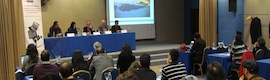
In a round table, the situation of the transition plan to DTT in the autonomous communities was discussed. In this colloquium in which the different visions that different communities have on DTT on key issues such as the digital dividend or local television have become clear, Ignacio León, communications director of the National Transition Office, participated; Ignacio Iturrioz, deputy minister of modernization of the Principality of Asturias; Gemma DFomènech, general director of communication and audiovisual broadcasting services; and Salvador Victoria Bolívar, vice-president of the Community of Madrid.
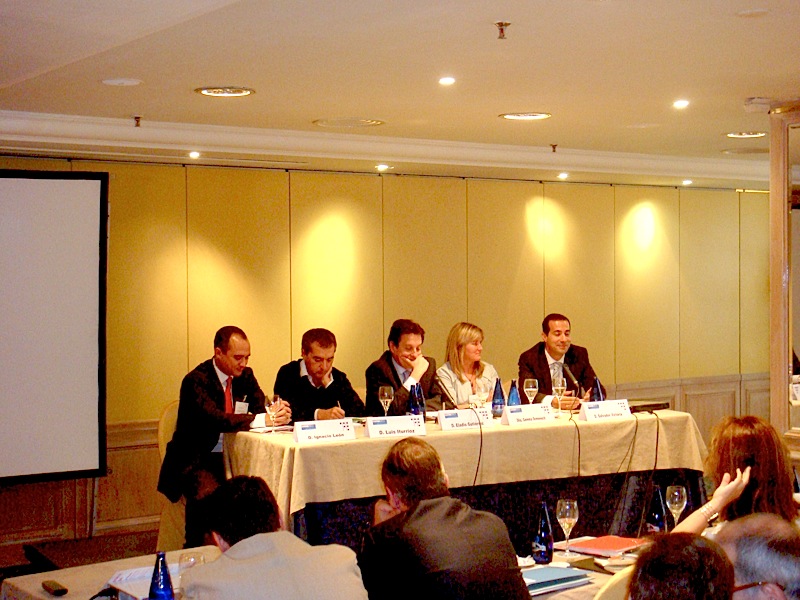
Round table on the transition plan to DTT in the autonomous communities
Jaume Roures
One of the most anticipated interventions of this day was that of Jaume Roures. The president of Mediapro recalled that "despite the usual media fires in radio talk shows with all the artillery deployed around the issue, Gol TV already existed last season through other platforms." Specifically, Gol TV through cable, ADSL and now DTT has already broadcast 1,400 matches with a high definition and Dolby 5.1 signal. Roures has joked about the reasons why Gol TV is not also distributed by satellite, stating that he does not understand them. He also highlighted that despite the fierce criticism revealed by some media, Gol Tv has meant the creation of 500 direct jobs and another 500 indirect jobs.
On the other hand, he commented that "hand in hand with Abertis, the manufacturers, and Nagravision, we have implemented innovation, research and development, benefiting from these steps whoever comes after." In line with the controversy that has arisen, Roures has pointed out that there are "DTT pay channels in numerous countries and no government has fallen as a result nor has it been accused of being a traitor." The president of Mediapro has emphasized that European operators have not seen DTT as an enemy to defeat but as an ally and has given the example of Cana+ France or Sky in the United Kingdom, where thanks to DTT these platforms have reached 7 and 9.5 million subscribers, respectively.
Roures has ventured to predict that "pay-per-view football, as an event, will disappear in the medium term, no longer existing anywhere in Europe. The highest quality offer is on channels dedicated exclusively to football rather than paying for a specific match. In Italy, for example, the ppv stage is already over."
Asked about the possibility of Mediapro starting other paid DTT projects, Roures commented that there is a capacity problem that will not be resolved until the new General Audiovisual Law comes into force. In principle, the law would authorize up to 50% of the multiplex for payment, an issue that the Telecommunications Market Commission has quarantined because it understood that it would not be pro-competitive.
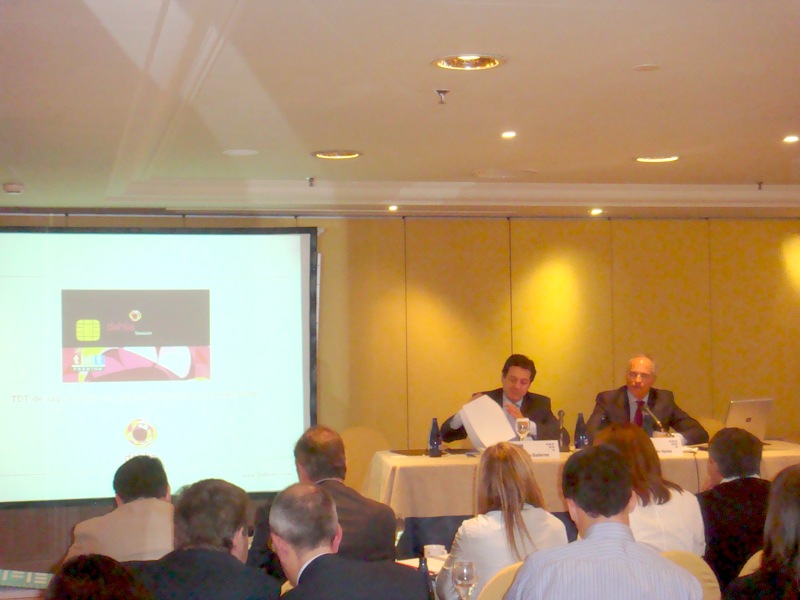
Fernando Ojeda, CEO of Dahlia TV
The Dahlia TV model
For his part, Fernando Ojeda, CEO of Dahlia TV, presented on this day the vision of this company that has been implementing a DTT payment platform in northern European countries, such as Finland and Sweden, and more recently in Italy. Ojeda has highlighted that "a paid DTT platform independent of television stations is needed, since otherwise it would be very difficult for a television station to enter a competitor's platform." Furthermore, he has admitted that the advertising crisis has further supported Dahlia TV's business model since the advertising market has proven insufficient for an offer of more than thirty channels along with a high fragmentation of audiences.
He has also highlighted that the Spanish pay TV market has lower penetration and higher price levels than neighboring countries, so a DTT pay TV platform with a competitive cost structure and high potential penetration would mean clear business potential. It should be noted that Dahlia TV is not a technical platform but rather a channel aggregator, with the different channels maintaining their brand, frequency and management at all times. Dahlia would therefore act as a platform that would manage agreements, package the offer, support marketing and take on customer management.
"From the point of view of the networks, it is evident that there is a decline in audiences and that the advertising crisis further supports our model. From the point of view of the consumer, it is clear that it is positive to be able to provide access to much broader content through a single platform," commented Ojeda.
"Today there is widespread confusion due to the lack of development. Our opinion is that what is important is the content and how it is packaged and how it reaches customers. It is advisable to separate audiovisual management from customer management. They are two totally different businesses and they can even hinder each other," he added. Ojeda has also defended a platform model where football plays an important role, but which must be supported by other types of family content "to avoid seasonal absences in the summer, when there is no league and families are on vacation."
Dahlia's slim advisor has given Sweden as an example of effectiveness in the exploitation of paid DTT. A country in which two platforms were presented, one of them participated by the rest of the operators, and another of an independent nature. Finally it was the independent platform that managed to take off.
In the Swedish case, according to Ojeda, the TV4 channel stands out, which managed to increase its income by 50 percent in five years and double EBITDA in a context in which the group's main channel was declining thanks to paid DTT. "Pay television is not just a subscription, it also has advertising and this has allowed them to grow. Now with the crisis they have experienced a decrease in advertising revenue and, however, they have increased in subscriptions, because the consumer is at home more. Their total audience, thanks to the launch of pay channels, increased."
The key: the contents
In the afternoon sessions, Enrique Lauricio, general secretary of FORTA, analyzed the role of regional television in the current scenario and future prospects, while the content director of Digital+, Álex Martínez-Roig, and the general director of the television division at Antena 3, Mikel Lejarza, addressed the importance that content plays in a new multiplatform television model.
This conference, organized by the Business Development Institute, concluded with a round table in which the consequences of the new scenario with respect to the advertising and content market were addressed. In addition to Míkel Lejarza, Andrés Armas, general director of Impulsa TDT, participated in this table; Javier Pons, director of TVE; Daniel Gavela, general director of Cuatro, and José Miguel Contreras, CEO of La Sexta.
Did you like this article?
Subscribe to our NEWSLETTER and you won't miss anything.
Related articles
 Entertainment as a “social showcase”, under debate at the Television Academy
 AI in news, analyzed in a debate promoted by the Television Academy
 European plans to rebuild the television industry, up for debate
 The electoral debate organized by the Television Academy, for the first time broadcast on Twitter
 The television of tomorrow, already today, under debate in Seville
 The Television Academy will organize the electoral debate in four
 The present and future of television news, up for debate
 The industry analyzes and debates the evolution to new OTT models and services on television
 The evolution of television under debate, on Futvra
 New trends in the connected television market, under debate
 Multichannel audio on television, under debate
 The Television Academy presents the Making Of of the 2011 Debate
 The future of the audiovisual sector in Spain, under debate
 The new television, under debate