





The Broadcast conferences take stock of the transition towards digital television
Within the program of Technical Conferences organized by Broadcast IT 2011, various experts have participated in a round table to analyze the current levels of integration in digital television.
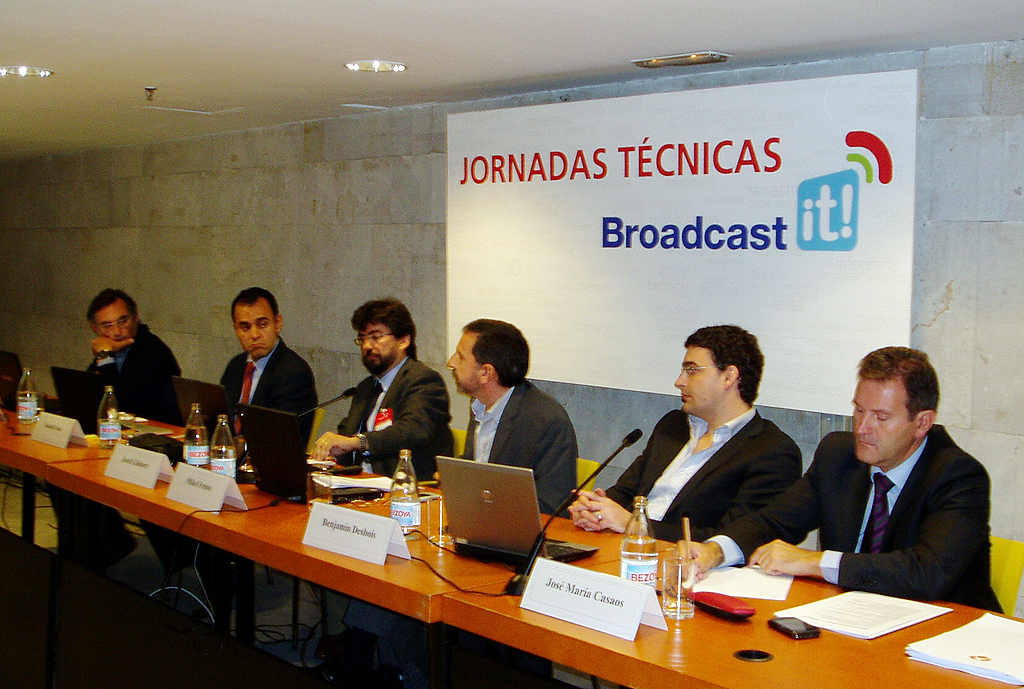
The Broadcast IT 2011 professional conferences held a round table on “Levels of integration in digital television”, moderated by Mikel Frutos, from EITB.
Firstly, the technical director of Canal Sur, José Enrique Zamorano, has explained the workflow of the content contribution and exchange system between the Andalusian regional channel and Forta, “a simple and complete integration focused on our workflow that is based on a central node with Tedial technology and a file transfer system,” he noted.
Likewise, the representative of Canal Sur has explained that this channel uses Panasonic P2 formats in DNG operations, for which they have had to perform an ingest between P2 and Avid Interplay, with which the camera operators themselves can automatically dump the contents and where, as a novelty, they have devised the black filling of the time code breaks to facilitate the editing work.
Next, the Director of Operations of Televisa Canales, Rodolfo Pous, spoke about the BPM workflow of the centralized system for the contribution and distribution of commercials at a global level through IT, which the Mexican network put into operation in February 2010 and where it has already integrated more than 2,000 materials. According to Pous, in this Tedial BPM commercial portal, which facilitates integration from clients to channels, Televisa plans to integrate pay TV in 2012.
For his part, the technical director of VSN, Jordi Utiel, has contributed the point of view of the manufacturer and integrator, addressing the future of integration, which, in his opinion, involves end-to-end solutions integrated from the factory and advanced integration on demand. “We are going towards greater complexity, more variety, multi-platforms and multi-screens,” he stated.
According to Gilabert, the key is to do things once and do them your way, while for manufacturers the dilemma they face is to innovate in products with broadcast standards and be able to differentiate themselves from the competition.
Avid Enterprise Sales Director, Benjamín Desbois, has unveiled Avid's vision and strategy with Integrated Media Enterprise and MAM solutions, which represent a profound change in the way of developing solutions and products for manufacturers. "Integrated Media Enterprise allows the integration of media operations and process management at a corporate level. It is an innovative content creation solution and a quality creative tool," he stated.
Debois has also explained the different levels of integration in digital TV, pointing out the possible keys to success, which would involve experience with similar models and relying on people who already know the system. When creating your own model, the secret would be to “start where it is important and move at your own pace, exchange ideas and work together with technological partners to access the maximum integration potential,” he assured.
Finally, the Technical Director of Antena3, José María Casaos, highlighted that, in the integration process "the digitalization of content has helped us a lot and Antena 3 has had to change its entire systems strategy." Casaos considers that in this matter all applications are valid, and has advocated for the interoperability of systems and the need to specify and parameterize according to the needs of each operator. “Of course, we don't have to go crazy, because we don't have to invent the wheel,” he concluded.
Did you like this article?
Subscribe to our NEWSLETTER and you won't miss anything.
Related articles
 The Paris 2024 Olympic Games showcase the latest advances in broadcast technology
 R&S Prismon facilita la transición del control maestro y el playout hacia la nube en PBS
 Gibraltar Public Television completes its transition to an end-to-end digital news environment with VSN
 The transition to 4K will be slow but progressive
 Jordi Capdevila and Roberto Pascual take stock of VSN's presence at NAB 2017
 Broadcast Solutions will organize a new edition of the Broadcast Innovation Days 2017 on June 1
 Telefónica will develop the digital transition of Radio Television of Galicia
 Yospace and the Scottish STV take stock of dynamic ad insertion
 Towards a new revolutionary concept of Digital Terrestrial Television
 EIKEN promotes the transition towards new business models
KIT Digital closes 2011 with a very positive balance
EIKEN promotes the transition towards new business models
KIT Digital closes 2011 with a very positive balance
 Hybrid television, towards another form of television consumption
 Digital+ on demand, a new step towards hybrid television
 Final balance of the transition to DTT in Spain