





Spanish cinema already grosses 36.8% more abroad than in national theaters
Spanish cinema grossed 150.5 million euros in international markets during 2012, compared to 110 million at the box office in national theaters. In terms of filming, less than half as many films are being produced this year as two years ago.
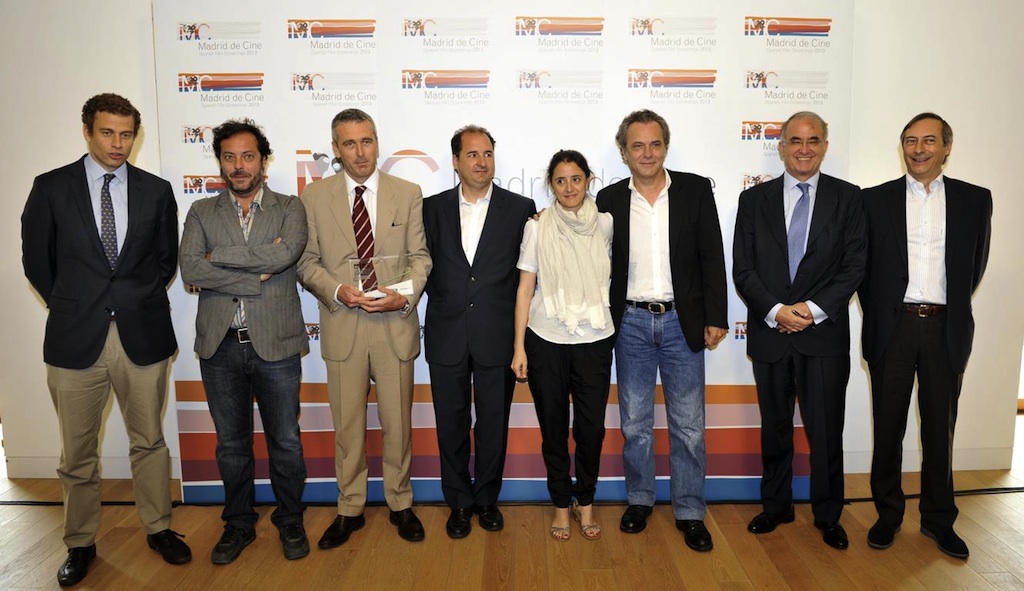
The FAPAE Confederation, within the framework of the VIII Madrid edition of Cine-Spanish Film Screenings, has presented the data on the performance of Spanish cinema internationally during 2012, which is unpublished and only prepared by FAPAE based on the information provided by RENTRAK and the European Audiovisual Observatory.
Este acto ha contado con la participación de Pedro Pérez, presidente de FAPAE, Jose Antonio Félez, presidente de AEC (Asociación Estatal de Cine), Jose Coronado, padrino de la VIII edición de Madrid de Cine y Arturo Guillén, vicepresidente de RENTRAK Europa, Oriente Medio & Africa (zona EMEA).
National production in the world
In Europe (in the 27 members of the European Union) a total of 1,299 films were produced in 2012, of which 14% are Spanish, with 182 feature films (including documentaries).
At a global level, Spain continues to occupy, like the previous year, ninth place among the countries with the highest number of films produced and fourth in Europe.
Spain, with a national market share by collection of almost 18%, rises to above half of all countries with indigenous market share data. Of 57 countries studied, belonging to all continents, Spain is ranked 23rd, surpassing 27th in 2011.
In terms of number of tickets sold, Spain occupies 12th position in world markets in terms of number of spectators (in 2011 it was 14th), with 93.6 million.
Collection and spectators
Once again, the data provided within the framework of Madrid de Cine demonstrate that Spanish cinema continues to achieve more success outside than within our borders.
During 2012, 36.8% more collections were made in all international markets than in Spanish cinemas. Especially significant data, since last year Spanish films obtained the highest grossing in recent times in national theaters, with 110 million euros at the box office (provisional data from Rentrak), and even so, they grossed more abroad.
This means that most of the global collection of all Spanish films exhibited in 2012 has been made abroad, specifically 57.8% of the box office comes from international markets, compared to 42.2% of the box office in Spain.
The Spanish feature films exhibited internationally during 2012 (including majority, equal and minority co-productions) have grossed 150.5 million euros and have been seen by almost 25 million viewers, which is 18.6% less than in 2011, but still 67.2% more than in 2010, when 90 million euros were raised.
Although the figure is lower than 2011, the year in which 185 million euros were raised, it is good data because there have been more than twenty titles that in 2012 have exceeded one million euros in revenue outside our borders, and nine of them raised five million.
The countries where Spanish films have obtained the highest grossing and, furthermore, have had a similar performance, are, in this order, Mexico, with 17.7 million euros; Italy, with 17.1; United States with 16.4 million; France with 13.24; and Argentina with 11.48 million euros.
By geographical area, proportionally, the box office of Spanish cinema is divided as follows: Europe (not counting Spain) remains the continent in which Spanish films have grossed the most, with 43% (in 2011 it was 45% and in 2010 62.3%), so there is greater distribution between the different continents. It is followed by Latin America, which with 35.2% has increased considerably compared to 2011, when it represented 18.1%, that is, it has raised more than double. The US represents 12.8%, down from 31.5% the previous year, Asia is up more than four percentage points, and Oceania represents 3.6%, just half a point below 2011.
Spanish titles exhibited
Interest in Spanish cinema abroad grows year after year. In 2012, 141 Spanish films were shown in cinemas outside Spain, which represents an increase of 28.2% compared to 2011 (with 110), and almost 55% compared to 2010, in which 91 titles could be seen.
Of these 141 Spanish titles distributed internationally, 70% are entirely Spanish films, majority or equal co-productions, and 30% are minority co-productions.
Countries
In 14 countries (of the 19 with complete analyzes provided by Rentrak) the number of Spanish films released has increased. The country that has shown the most Spanish films during 2012 was Italy with 37 titles, almost double the number seen in this country in the previous year, once again establishing a record figure, since it exceeds the highest obtained in previous years in other markets. The countries with the highest number of Spanish films exhibited in 2011 were Mexico with 36 and France with 25, and in 2010 Italy and Mexico with 25.
Next, Mexico with 32 Spanish films shown in cinemas (11.1% less than in 2011), Argentina with 29 (+20.8%), Colombia (+92.3%), France with 24 (-4%) and Brazil (+23.5%).
Other relevant countries where the number of Spanish films exhibited has increased are Germany with 18 (+50%), South Korea with 16 films compared to 7 in 2011, which represents more than double the number of films seen in their cinemas during 2012, Venezuela (+77.7%) and the United Kingdom/Ireland (+25%).
In the Asian market, in addition to South Korea, Japan stands out, with 6 films compared to 3 in 2011, and in Oceania, New Zealand, 8 compared to 5, and Australia remains at 8.
The Spanish films that have been shown in the greatest number of countries in 2012 have been The Impossible, distributed in 39 markets, To Rome with Love in 38, Un dios Savage in 28, Red Lights in 22, and Rec 3, The Skin I Live In and The Chef in 16.
Copies
The estimated number of copies distributed has been 14,200, an excellent figure, since it means 57.7% more than in 2011, which had an approximate of 9,000. That is to say, not only are more titles distributed, but they are increasingly doing so with a greater number of copies.
The country with the highest number of copies of Spanish films sold has been Italy, with 2,541, followed by Mexico, with 2,523, and France, with 2,032.
It should be noted that in 16 of the 19 countries analyzed, the number of copies has increased and they have also increased considerably, such as Italy, which almost quadruples the number compared to 2011, Mexico (+84.9%), France (+41.6%), Russia (+48.3%), United Kingdom/Ireland (+62.2%) or Argentina (+79%).
Advance 2013
In the analysis that FAPAE has carried out within the framework of Madrid de Cine, unpublished data from the year 2013 has also been made public, which is expected to be even better for Spanish cinema in its international projection.
Thus, several of the Spanish films that began their international career in 2012 continue to achieve international success in 2013.
Impossible, As of May 2013, it has been released in more than 70 countries. It is worth noting its recent premiere in the United Kingdom, where it has already raised 16.4 million euros; in the United States, 14.4 million euros; in Mexico, 8.4 million euros; and in Australia almost 4 million euros. The Spanish production has also been released in 2013 in Italy, South Korea and Brazil with more than 3 million grosses in each territory.
Another case is that of The Adventures of Tadeo Jones which was released in Russia and South Korea in 2012, in 2013 it has been distributed in more than twenty countries. It stands out that, as of May 2013, in Mexico it has raised 5.4 million euros, in Brazil, 2.9 million euros and in France, 1.7 million euros.
Updated data from the Spanish market
José Antonio Félez, president of AEC, has carried out an updated review of the Spanish market. As of June 12, 2013, notified filming has decreased by almost 26%, 43 in 2013 compared to 58 in 2012, which had already suffered a decrease of 41% in 2012 compared to 2011, which means that less than half as many films are shot as two years ago.
35% of these shoots are documentary or low-budget films, almost 40% are medium-budget feature films and only 25% have a high budget. The average cost of a Spanish film has been reduced by almost half in three years, going from 3 million euros to 1.8 million euros in 2012.
Según los datos estimativos de FAPAE la cuota de recaudación del cine español en salas en España, a 9 de junio, asciende a un 17,9%. Este porcentaje se sostiene gracias al buen comportamiento de títulos como Los amantes pasajeros, El Cuerpo, Los últimos días y Combustión, coproducciones minoritarias como Mamá (Canadá 67% y España 33%) y, recientemente, Fast & the Furious 6 (Estados Unidos 61%, España 39%).
Por su parte, Arturo Guillén, vicepresidente de RENTRAK Europa, Oriente Medio & Africa, ha comunicado que este último fin de semana ha sido el peor de la taquilla española hasta la fecha, con una recaudación global de poco más de 3 millones de euros y ha destacado que seis de los peores fines de semana de los últimos años en salas de cine nacionales, se han registrado en este año 2013.
So far this year, revenue has decreased by 16% and viewers have decreased by 20%. For Guillén, the situation in Spain is critical, but not exceptional, "since large American blockbusters from which much more was expected are not performing well. Furthermore, except in emerging markets such as Mexico or Russia, among others, the drop in spectators is quite generalized worldwide."
The Impossible, FAPAE-RENTRAK Award 2013
Coinciding with Madrid de Cine, the “FAPAE-RENTRAK 2013 Award for the Spanish film with the greatest international impact” was announced, which this year went to the film Impossible, produced by Apaches Entertainment, Telecinco Cinema and directed by Juan Antonio Bayona.
El padrino de esta edición de Madrid de Cine, Jose Coronado, y Arturo Guillén, vicepresidente de RENTRAK Europa, Oriente Medio & Africa, han hecho entrega del galardón a los productores de la película, Enrique López Lavigne y Belén Atienza de Apaches Entertainment, y Ghislain Barrois y Álvaro Augustín de Telecinco Cinema.
The purpose of this award is, on the one hand, to recognize and disseminate the work that producers carry out internationally and to especially value their contribution to the external dissemination of the image of Spain and Spanish cinema.
Jose Coronado ha destacado el enorme interés y la gran expectación que despierta el cine español a nivel internacional y que ha podido constatar en sus últimos rodajes fuera de España. “Se ha conseguido una industrialización del sector con una gran calidad artística y técnica, y lo fundamental que hay que conseguir es contagiar la ilusión porque esta industria no se venga abajo y luchar por ello”.
Lo imposible se ha estrenado, durante 2012, en casi 40 países, con una estimación de 1.160 copias, y obtuvo una recaudación de más de 12 millones de euros fuera de España. En su semana de estreno en España se posicionó en el séptimo puesto del box office mundial de recaudación.
A fecha de hoy, la película ya se ha estrenado en más de 70 países de todo el mundo. Su recaudación global, incluyendo España, asciende a más de 130 millones de euros y ha sido vista por 15 millones de espectadores.

Did you like this article?
Subscribe to our NEWSLETTER and you won't miss anything.
Related articles
 'Campeonex', best Spanish premiere in movie theaters of 2023
 Spanish cinema in theaters, still far from pre-pandemic figures, grows by 94% in 2022
 80 million euros: Spanish cinema collects twice as much in 2022 as the previous year
 The Madrid Film Festival announces the 75 national works in competition
 Spanish cinema raises more but shoots less
 1,513,958 spectators fill the theaters during the Film Festival
 Madrid de Cine-Spanish Film Screenings: the international showcase of Spanish cinema
 More than half of the movie theaters in Spain are already digitalized
 The increase in VAT on cinema will endanger the process of digitization of theaters
 Spanish cinema looks outwards
 Spanish cinema: more recognition outside than inside
 Spanish cinema continues to perform better internationally than locally
 Spanish cinema earns more abroad than inside
 The Film Festival increases the influx of spectators to theaters by 50%