





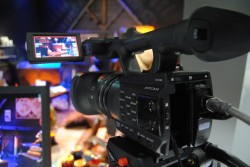
Panasonic AJ-PX270, a handheld camcorder that marks a new way of working
AJ-PX270 is the first handheld P2HD camcorder to incorporate AVC-ULTRA recording, combining high image quality, an extraordinarily low data rate and the mobility flexibility provided by your WiFi, 4G or LTE wireless connection.
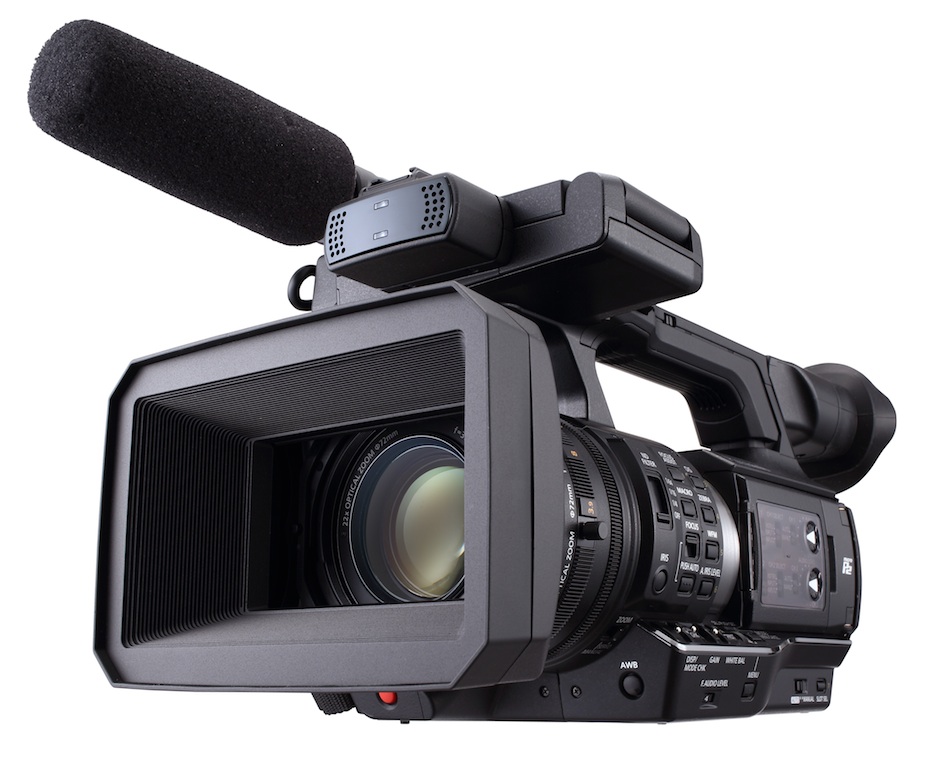
Since this March, Panasonic has been marketing the new AJ-PX270 handheld camcorder. Intended especially for news capture, this camera is designed to facilitate production work on television, short films, corporate videos... since it inherits all the advantages of a shoulder camcorder in a practical handheld device.
But the most notable aspect is the innovation in terms of recording formats and the flexibility in the way of working since it even allows you to send all the material directly over WiFi, 3G or 4G networks.
While the popular 200 (launched by Panasonic at the end of 2006) started from a hybrid concept with P2 and tape (miniDV), in the new 270 the tape has been replaced by the card and the possibility of sending media over the network.
 This marks a new scheme in workflows since it will allow content to be sent from the same place as the recording, thus considerably reducing the time between capture and emission.
With this camera it is possible to send content both live via streaming or material stored on the card.
While before you had to wait for the material to arrive to edit, now it will be possible to send the content from the recording location, thus considerably reducing the time between capture and broadcast. The operator can thus send a proxy to the newsroom by simply connecting a LAN cable or accessing a WiFi or mobile network (thanks to a dongle housed and protected within the camera body itself).
Initially, the PX270 allows you to connect to a WiFi network using an optional USB dongle or to a wired LAN network, and also supports uploading devices over mobile networks. Adapters to use 3G/4G and LTE networks will be available soon.
Two work schemes
The AJ-PX270 allows you to work from two schemes: capturing video and sending it later or in direct streaming.
When the subsequent sending of the material is considered, the camera allows content in proxy quality to be sent to the editorial office in just a few minutes. Even with last-minute information, it would be possible to go on air immediately based on this proxy material.
On the other hand, the editor can create a condensed version with the most notable images and return an editing list to the camera to consolidate only that part, thus reducing the amount of material to be ingested, saving time and storage space.
 The camera is based on a bidirectional approach since the metadata of each news item can be entered from the editorial office to subsequently identify the content in the cloud.
At the same time, the camera's own GPS would continuously send its exact location to the editorial office. This would allow us, for example, to send the closest ENG team to the location where the news occurs.
In the future, Panasonic intends to offer an FTP service in the cloud, although it is already possible to upload material to the cloud using the user's own FTP.
In terms of streaming, the new AJ-PX270 will increase the number of live connections in programs and news, by not having to move a mobile unit. Likewise, in events, it will allow great mobility of the camera by not depending on a cable.
Its connectivity with low latency of just one second allows maintaining a live conversion between the presenter on set and the reporter on the street.
It should be noted that the camera controls the streaming data rate, using less bandwidth when coverage conditions are adverse. It thus adapts the data rate according to the coverage conditions, always ensuring the best streaming quality.
Panasonic's proposal is an integrated solution, so it is not necessary to resort to external backpacks for connectivity over cellular networks.
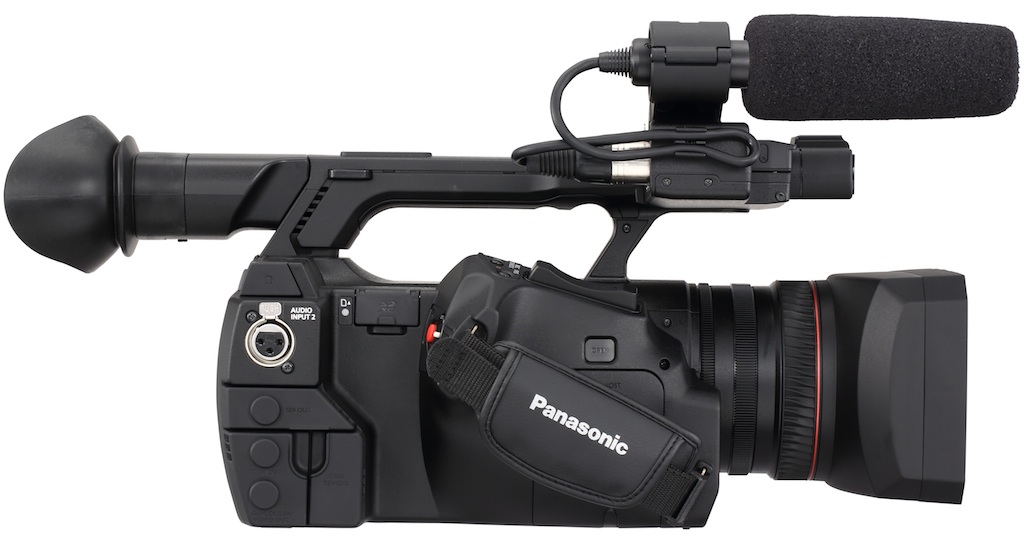
Man rendering on a shoulder camcorder
The new camera is a handheld camera, but it is very reminiscent of the functions of shoulder cameras with the controls in the same places, 22X zoom lens (from 28mm to 616 mm. 35mm equivalent), three manual rings (zoom, focus and iris), F12 sensitivity mode (new 2.2 megapixel 3MOS sensor), and switches and dials located in the same position as the shoulder camera. The camera has a function that allows you to speed up the zoom response, providing the freedom that every camera operator needs. The zoom knob on the handle allows for various zoom speeds, allowing for smooth zoom control even while recording shots.
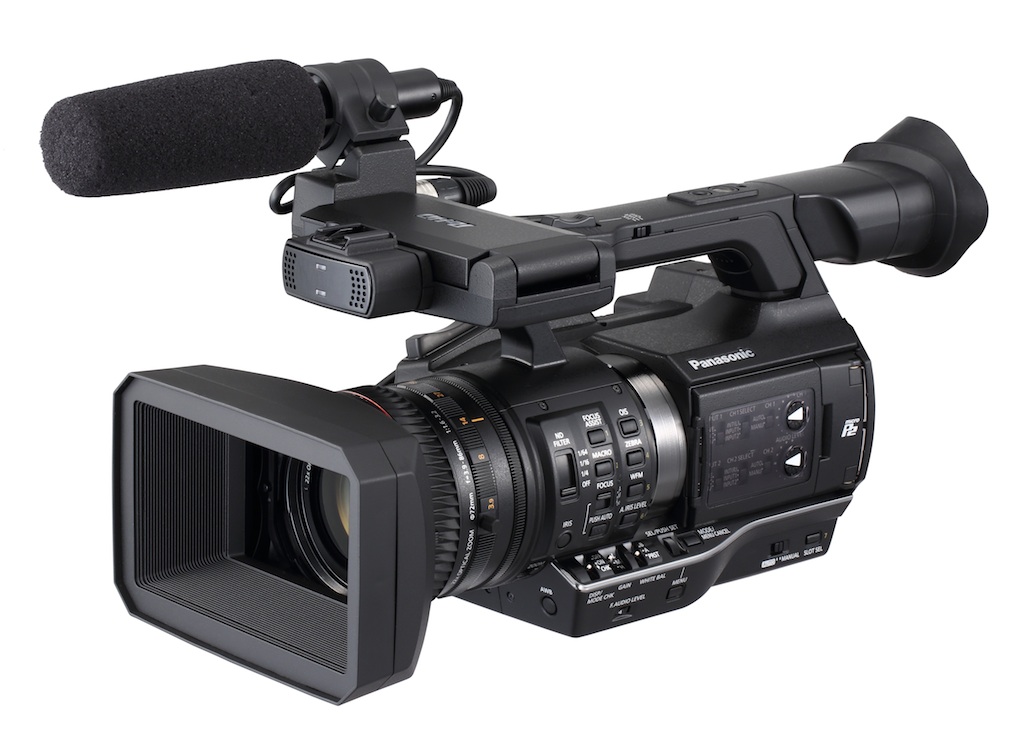 The new AJ-PX270 incorporates a new capture device with three 1/3 type MOS sensors, which achieves excellent image quality even in low light conditions. Equipped with the new AVC-ULTRA codecs, the PX270 features a wide range of recording modes. For high-quality recording, the AVC-Intra100 format can be selected, in addition to the optional AVC-Intra200 (coming soon). In applications where file size is critical, the camera allows you to choose between several AVC-LongG qualities, including 50, 25 or 12Mbps modes. The LongG50 and LongG25 modes offer 4:2:2 and 10-bit quality in a small file size, which saves storage space and reduces transfer time, while maintaining the quality level required in broadcast environments.
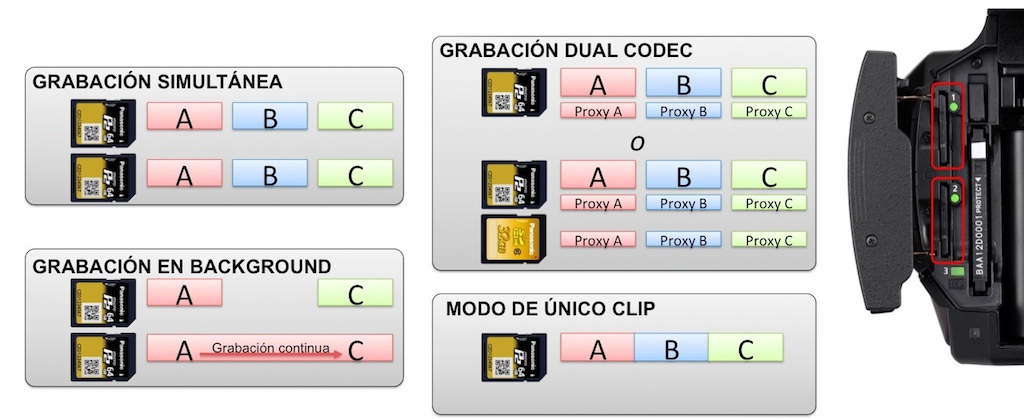
The camera has one P2 and two Micro P2 slots with 32 and 64 GB (up to 200 Mbps) or any standard SD card (up to 50 Mbps only). It allows you to record the same thing on two cards (as a backup), record with different codecs, record in the background (one never stops recording and the other keeps recording and stopping), or in traditional mode, recording a single clip.
It should be noted, on the other hand, that it is a very well balanced camcorder in terms of weight (it does not pitch and is very well compensated laterally).
Other notable features are the OLED viewfinder, applied for the first time in camcorders, and the high-resolution LCD monitor, which improves on all its predecessors. As for audio, it incorporates two The location of the XLR connector is designed so that the cable does not cause discomfort. For the first time in a handheld camcorder, it incorporates a front audio control, similar to that of shoulder camcorders, which makes it easy to adjust the sound during recording.
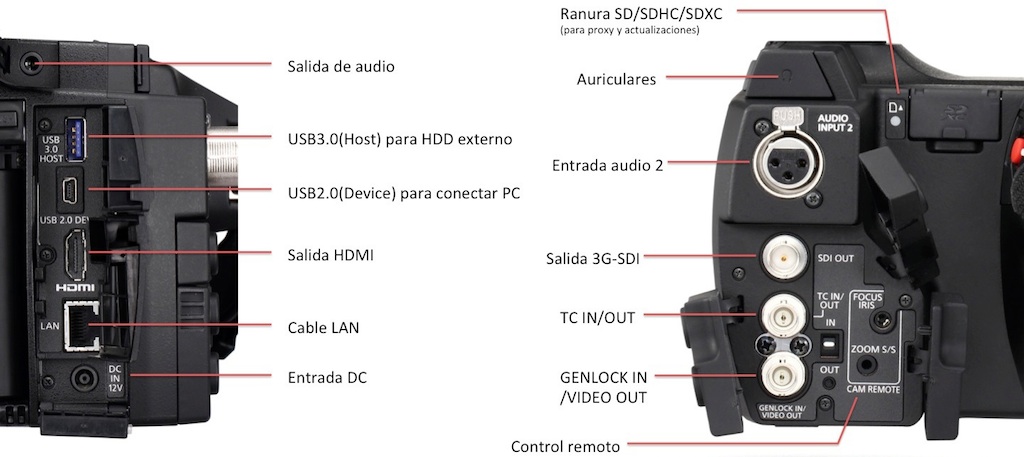
Formats and connectivity
In addition to the 1080/50i format, the PX270 supports other formats such as 1080/50p, 1080/25p, 1080/24p, 720p and standard definition, with their 60Hz equivalents. 1080/50p recording, for the first time on a P2 handheld camera, is available in AVC-Intra100 and AVC-Long G25 and G12 modes only. In addition, precisely in 1080/50p format, the variable frame rate function is available, to create slow motion or fast motion effects, with a range of 1 to 50fps (1 to 60fps in 60Hz mode).
As for input and output connections, the camera offers HD-SDI and 3G-SDI outputs for the 1080/50p format. It also offers HDMI output, in addition to the necessary connections to configure a multi-camera system, with genlock input and timecode input and output. A USB3.0 port allows you to make copies of the contents of the cards to external hard drives, at high speed.
A new capture device with three 2.2 million pixel MOS sensors offers a horizontal resolution of 1000 lines, and a sensitivity of F12, a figure that until relatively recently was only achieved in high-end shoulder camcorders. Minimum illumination is just 0.02 lux, while gain can be set from -3dB to 18dB in 3dB steps.
The PX270 features the Chromatic Aberration Compensation feature, recently awarded a Technology Emmy Award, which maximizes lens performance. The DRS function optimizes the image in high contrast scenes (for example, in backlight or sun and shadow situations), while the FBC function detects and compensates for the effects produced by camera flash lights. The camcorder offers various gamma curves, including cinema-style curves, as well as a powerful 12-vector color corrector, with 3 independent skin tone settings.
[youtube]http://www.youtube.com/watch?v=dVBiUI32Ur0[/youtube]
Did you like this article?
Subscribe to our NEWSLETTER and you won't miss anything.
Related articles
 Panasonic launches the AG-CX370, a handheld camcorder aimed at broadcast environments
 GECA and Konodrac agree to work hand in hand to promote hybrid television
 Panasonic announces the AG-AC30, its new handheld camcorder with integrated LED torch
 Danish TV East boosts contributions to 3G/4G networks with LiveU and Panasonic's new PX270
 Panasonic unveils its new 4K AG-DVX200 camcorder
 Panasonic updates the firmware of the popular AJ-PX270
 Panasonic updates popular AG-AC90 camcorder
 The new Panasonic AJ-PX270, now available for rent in Ovide
 Sony reinforces its XDCAM HD422 range with a handheld camcorder and an SxS field equipment
Anton/Bauer will collaborate hand in hand with Panasonic during the Olympic Games
Sony reinforces its XDCAM HD422 range with a handheld camcorder and an SxS field equipment
Anton/Bauer will collaborate hand in hand with Panasonic during the Olympic Games
 Cinegy makes a radical change in the way post-production works at Motorvision
 JVC GY-HMQ10: first professional handheld camcorder with 4K resolution
 2D and 3D recording with the new Panasonic HDC-Z10000 camcorder
 AG-HPX371 P2 HD, new shoulder camcorder from Panasonic