





Telecommunications and audiovisuals invoiced 7.49 million in the first quarter of 2016
Broadband and audiovisual services are the final services that increase their year-on-year billing. The total of quadruple and quintuple packages reached 10 million, which is 1.4 million more packages than a year ago.
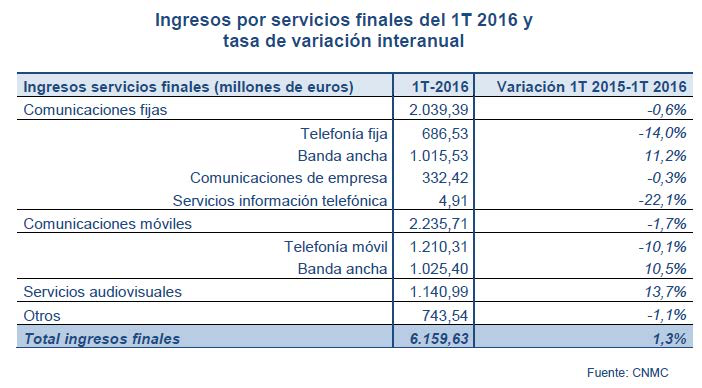
Statistical data from the National Markets and Competition Commission (CNMC) confirm that the total turnover of the sector in the first quarter of 2016 was 7,493 million euros, 2.9% higher than that of the same quarter of the previous year.
Audiovisual services, with an increase of 13.7% year-on-year, have accumulated eight consecutive quarters with positive variation rates. This growth, together with those registered by fixed and mobile broadband services, managed to offset the decline in other services. Fixed broadband revenues, by the way, exceeded 1 billion euros for the first time, after registering an increase of 11.2%, a rate very similar to that of mobile broadband.
Regarding data by operator, Movistar, which includes DTS data from the second quarter of 2015, represents 45.2% of the total market, and its revenues rose 4.3% compared to the first quarter of 2015. For its part, Vodafone, which includes Ono, grew by 5%, while Orange, after the purchase of Jazztel, billed 3.9% less compared to the same period of 2015. 2015. The three main operators account for almost 80% of the sector's total income.
In the field of free-to-air television, the two main operators, Mediaset and Atresmedia, increased their revenues, by 7.2% and 10.5% respectively.
Accesos NGA
In the first quarter of the year, installed NGA accesses (access to new generation networks, which allow you to enjoy very high-speed connections) registered an annual growth rate of 27.7%.
The deployment of these accesses reached 35.2 million, of which 24.4 million corresponded to fiber to the home (FTTH), compared to the 16.8 million that had been deployed a year earlier, which represents an increase of 45%.
NGA accesses on which some service is provided amounted to 6.8 million, 37.1% more than a year ago. Any landline, broadband or audiovisual service can be provided over these accesses.
In March 2016, fixed broadband connections that had a contracted speed of 30 Mbps or higher were 6.1 million, 83% more than in the same month of 2015. Thus, fixed broadband lines included in this speed range represented 45.4% of the total number of fixed broadband lines (compared to 25.7% a year ago).
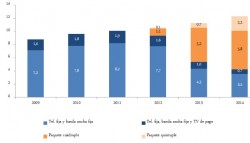
In March 2016, the total of quad and quintuple packages reached 10 million, which is 1.4 million more packages than a year ago. The five-fold package continued to be the one that grew the most, registering 3.9 million and added 1.3 million net additions in the last year compared to the less than 50 thousand that the four-fold package added. For their part, double telephony packages plus fixed broadband and triple packages – which also include pay television – continued to decrease in part due to the migration of these two modalities to quadruple and quintuple packages.
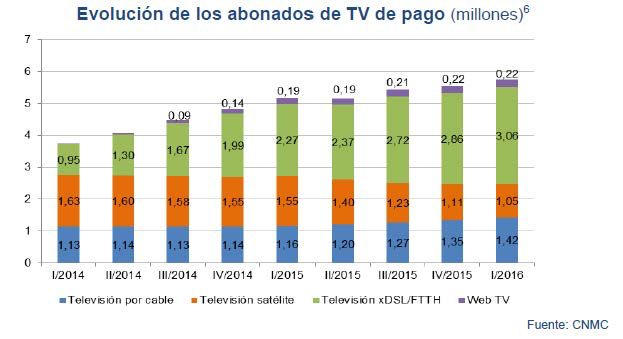
pay television
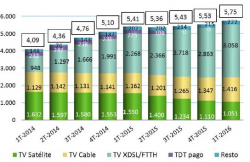
The number of pay television subscribers has grown again this quarter to exceed 5.7 million. IP television subscribers (xDSL and FTTH) and cable subscribers together grew by 1 million subscribers in the last year, in contrast to the decrease of almost 500 thousand subscribers registered by satellite.
On the other hand, in April 2016, the total volume of mobile lines that were connected to the Internet, including exclusive data lines, grew by 7% year-on-year to 39.4 million. The reason was the increase in voice lines linked to mobile broadband, which added 2.6 million lines in the last year, reaching 37.8 million. For its part, 13.5 million fixed broadband lines were registered, which represented an increase of 3.7% in the year.
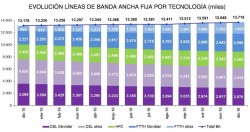
In the evolution of fixed broadband lines by technology, the progressive decrease in xDSL connections can be seen from the second quarter of 2014, coinciding with the increasingly significant presence of FTTH lines. Throughout 2015, 1.7 million fiber lines have been added compared to a loss of 1.4 million with xDSL technology.
Did you like this article?
Subscribe to our NEWSLETTER and you won't miss anything.
Related articles
 Pay television in Portugal adds 128,000 subscribers in the first quarter
 TV and radio revenues exceeded €1 billion in the second quarter of 2021
 Television advertising revenue drops 10% during the first quarter of 2021
 Pay television over IP exceeds 400 million euros during the first quarter of 2019
 Average spending on packaged telecommunications services by Spanish households decreased in the fourth quarter of 2018
 IPTV revenues exceeded 340 million euros in the third quarter of 2018
 Spain added 1.8 million new FTTH lines in 2016 compared to DSL technology that lost 1.3 million
 Audiovisual Panorama reached 1.33 million news items read during 2016
 Pay television revenues in Spain grow by 22% in the first quarter of 2016
 Investment in telecommunications increases by 30% in 2014 to exceed 5,000 million euros
 Industry budgets 670.17 million for technological innovation in telecommunications in 2016
 Atresmedia triples its profits in the first quarter to 3.3 million euros
 Ono grows in the first quarter of 2011
Antena 3 doubles its net profit in the first quarter
Ono grows in the first quarter of 2011
Antena 3 doubles its net profit in the first quarter