





Eutelsat launches the new 172B satellite that will reinforce coverage in Asia-Pacific
El primer satélite eléctrico de alta potencia construido por Airbus ya va en camino hacia la órbita geoestacionaria
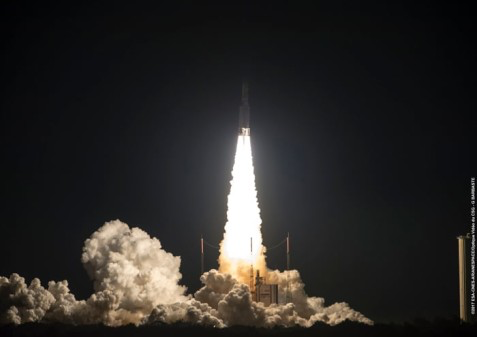 El satélite Eutelsat 172B de Eutelsat Communications ha sido lanzado exitosamente al espacio por un cohete Ariane 5 desde la base de Kourou. Los primeros datos de telemetría del satélite de 3.5 toneladas han sido recibidos y se están realizando los preparativos para el despliegue de los paneles solares el 3 de junio, seguido del despliegue 22 horas más tarde de los brazos robóticos que sostienen el sistema de propulsión eléctrica del satélite que permitirá su ascenso a la órbita geoestacionaria. El nuevo satélite de Eutelsat entrará en operación durante el cuarto trimestre de 2017.
Eutelsat 172B aumentará la capacidad disponible para aplicaciones de rápido crecimiento como conectividad en vuelo y marítima, backhaul celular, redes corporativas, distribución de video y servicios gubernamentales. Estará ubicado en 172° Este, una posición orbital clave que proporciona un alcance excepcional de Asia y el Pacífico, tanto en el mar como en tierra, desde Alaska hasta Australia. Diseñado para reemplazar el satélite Eutelsat 172A, proporcionará una mayor capacidad, más potencia y una cobertura mejorada a través de cargas útiles de banda C y banda Ku de amplia cobertura.
Conectividad en vuelo
Eutelsat 172B también incorpora una nueva carga útil multihaz de banda Ku que entrega 1.8 Gbps de rendimiento para servir a la región de más rápido crecimiento en el mundo para el tráfico aéreo. Asia Pacífico representa la mayor oportunidad para servicios de entretenimiento y conectividad en vuelo, con más de 8,000 aviones que volarán por la región en 2034.
La carga útil de alto rendimiento (HTS) del nuevo satélite será una plataforma importante de crecimiento para la conectividad en vuelo, en particular para Panasonic Avionics Corporation, uno de los principales proveedores de servicios de entretenimiento y conectividad a bordo para aerolíneas comerciales. Once haces elípticos permitirán a Panasonic unir la costa oeste de Norteamérica con Asia y Australia, apoyando el rápido crecimiento del tráfico aéreo en la región y el uso de ancho de banda en rutas de vuelo densamente utilizadas. Panasonic también utilizará la cobertura amplia de banda Ku para ofrecer televisión en vivo a los aviones.
Did you like this article?
Subscribe to our NEWSLETTER and you won't miss anything.
Related articles
 Enensys will promote Eutelsat's new DVB-NIP satellite distribution platform
 Eutelsat improves the free-to-air satellite reception experience on televisions connected with Sat.tv Connect
 Eutelsat takes another step in satellite integration within the IP ecosystem with the launch of Cirrus
 Eutelsat orders Konnect VHTS, a new generation satellite with the most powerful digital processor ever placed in orbit
 Eutelsat launches its first 4K service with HDR
 Nick Morgan, new VSN sales director for Asia Pacific
 RTVE will reinforce coverage of the Rio 2016 Paralympic Games
 Eutelsat intends to distribute content via satellite to second screens
 Telefónica launches a new satellite broadcast contribution service in Ka Band
 Tedial reinforces its expansion in Asia-Pacific with Magna Systems and Engineering
 Eutelsat and Cisco show satellite cloud video using SmartLNB technology
 Eutelsat launches an Ultra High Definition demo channel for the Asia-Pacific region
 Eutelsat offers with NewsSpotter an interesting option for contributing news via satellite
Latin America, Western Europe and Asia/Pacific, growing markets in DTT
Eutelsat offers with NewsSpotter an interesting option for contributing news via satellite
Latin America, Western Europe and Asia/Pacific, growing markets in DTT