





Long-form content: king on any screen
Although short video is more likely to be viewed in its entirety, for the first time long video (more than 20 minutes) represents the most viewed content across all types of screens, with 63%.
They spread it has published its quarterly report, Q1 2017 Global Video Index, which shows that for the first time long-form content was the most viewed on all types of screens. The report for the first quarter of the year also analyzes the differences in video consumption between the east and west coasts of the United States, the sustained growth of mobile devices and the emergence of new trends in online video advertising.
Although short video is more likely to be viewed in its entirety, for the first time long video (more than 20 minutes) represents the most viewed content across all types of screens, with 63%.
To a large extent this is due to the growing supply of premium content that already exists in multi-device format. As long-form content becomes more prominent, short-form content loses importance, precisely because large screens on mobile devices are increasingly common.
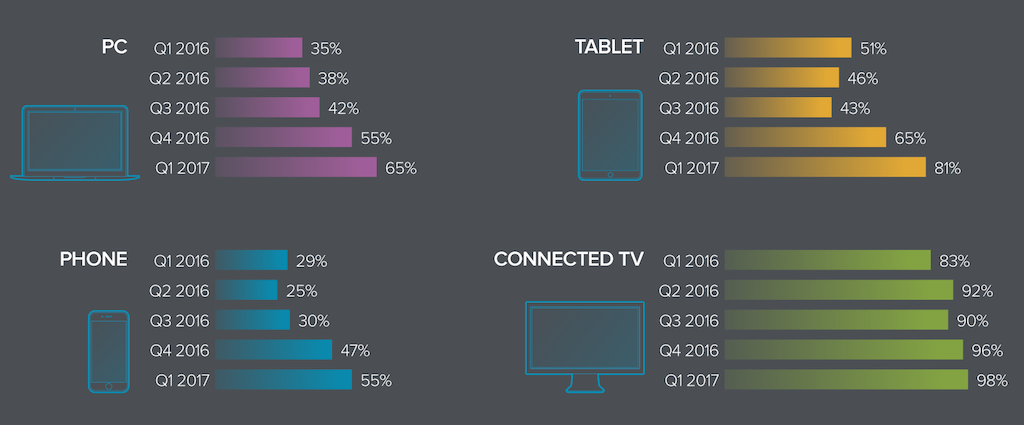
Segmented by device, the report reflects that long-form content represents: 98% of the total time spent watching video on connected televisions, which has grown from 83% the previous year; 81% on tablets, which has also grown significantly from 51% the previous year; 65% on computers, a figure that almost doubles that of the previous year (35%); and 55% in smartphones, which represents a growth of 26% compared to the first quarter of 2016.

Mobile viewing
Mobile viewing continues to be a major driver of OTT (Over The Top) content growth, reaching a new high of nearly 57% of all videos viewed in the first quarter of the year. Of them, 47% correspond to views from smartphones and 10% to tablets. While mobile viewing dominated across all regions, the report found an 11% gap between viewers in North America and the most active viewers in the Asia-Pacific (APAC) region. In contrast, Europe, the Middle East and Africa (EMEA), and Latin America (LATAM) experienced 10% year-on-year growth in mobile video consumption.
Differentiating by region, the report concludes that in EMEA, mobile viewing represents 54% of total views, growing from 42% the previous year. Meanwhile, in North America, mobile devices account for just over half of video views, up from 48% in 2016. In APAC, 61% of video views were made from mobile devices, up from 46% last year. In LATAM, mobile views reached 56%, up from 46% the previous year. Tablets represent 5% (the lowest figure in each region).
Jim O'Neill, Ooyala Principal Analyst and Strategic Media Consultant, highlights that "the adoption of mobile devices continues and consumers feel as comfortable watching long-form content from their smartphones or tablets as short videos. It is no longer enough to simply deliver content to mobile devices. The highest quality of the video must be ensured in addition to easy navigation, determining factors to achieve a pleasant experience. Video providers must be prepared to make their content available for mobile consumption and their business strategies must cover screens of all sizes.”
The study also highlights that APAC was the region with the greatest growth in video consumption from mobile devices, increasing 15% compared to the previous year. Finally, broadcasters increased their reliance on tablets for mid-roll ad delivery, serving 54% of such ads on such devices. Mobile devices represented close to 66%, displacing PCs (26.5%), which suffered a large drop compared to the 39% they represented in the last quarter of 2016.
Did you like this article?
Subscribe to our NEWSLETTER and you won't miss anything.
Related articles
 Atresmedia and 7 y Acción renew their long-term agreement
 Ana Rosa Quintana renews her long-term contract with Mediaset España
 C21 Live Director streamlines live streaming from anywhere, in any format and to any device
 Control any camera through any communication channel with CyanView
 Globecast Live, to bring any event to any screen
 On-demand and long-form content, the main means of monetization in online video for European television networks
 Analog Way QuickVu, a triple scaler-mixer for any screen resolution
 PlayBox SocialMediaBox: integrating social media content into a single channel or multiple channels into a single screen
 Envivio aims to provide audiences with a better experience on any screen
 DTS exhibits its latest innovations in digital audio for any screen at IBC
 Quantel: speed and efficiency anywhere, screen and resolution
Cross-platform content protection: how to secure it anywhere?
Quantel: speed and efficiency anywhere, screen and resolution
Cross-platform content protection: how to secure it anywhere?
 Epson EB-455Wi and EB-465i or how to turn any surface into an interactive screen
 NEC Display Solutions increases the life of lamps and filters in its projectors