





Imagine shares its vision of tomorrow's television with feet on the ground today
Imagine Communications and its distributors in Spain, QinMedia and Broadcast Meditel, are organizing a day in Madrid in which they have reflected on the latest trends in the industry while presenting the innovations presented at NAB 2017.
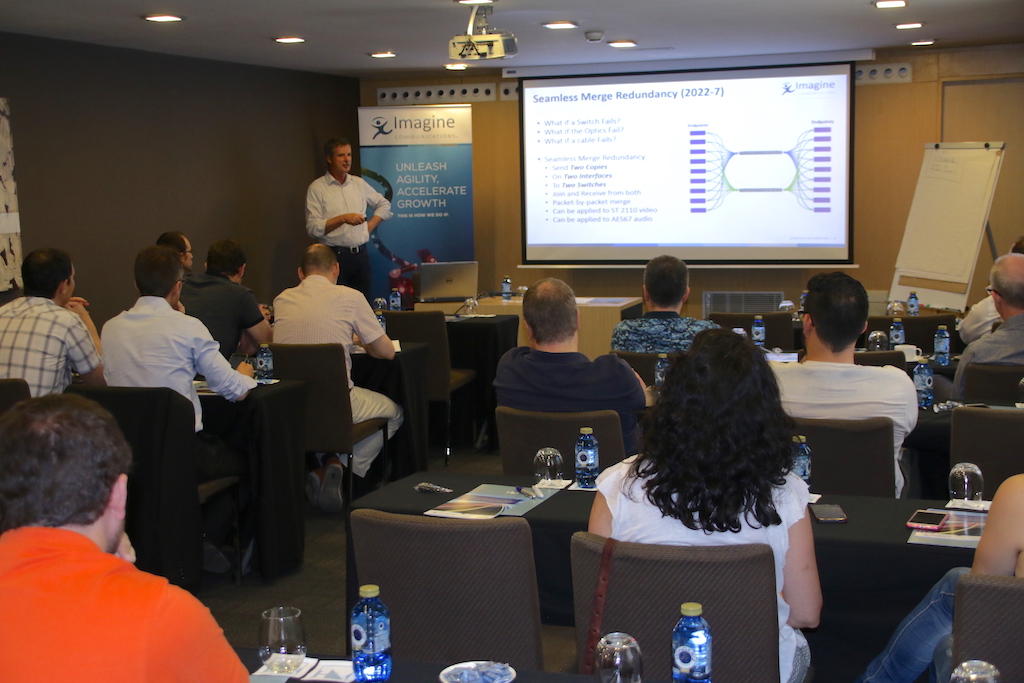
The migration towards a hybrid SDI/IP or totally IP environment, new cloud-based playout solutions, or solutions for multi-screen distribution have focused the interest of the professionals who attended this Thursday the conference that Imagine Communications and its distributors in Spain QinMedia y Broadcast Meditel, have organized in Madrid. At this event, the latest industry trends have been presented while the latest innovations released at NAB 2017 have been presented.
On the other hand, professionals have also been able to meet some clients who have already successfully faced these challenges.
Playout virtual
On this day it has become clear that the weight that software is gaining in this sector is allowing costs to be reduced and project development to be streamlined. Imagine offers a complete portfolio of solutions ranging from playout, master control and storage (Versio), to processing, encoding or transcoding (Selenium); passing through signal routing (Platinum), multi-screen display (EPIC), packaging, recording and advertising insertion (Telurio) and, finally, multi-channel management (xG).
The company's commitment to a cloud-native strategy has been evident in order to increase and accelerate broadcasters and production companies migrating all or part of their operations to virtualized environments, including public and private clouds. Thanks to the cloud and with the help of Imagine technology, they are already achieving significant increases in agility, scalability and flexibility in ingestion, playout, graphics, transcoding and encoding, Over-the-Top (OTT) services and dynamic advertising insertion workflows in the cloud.
Along these lines, Imagine is making a great effort to make its entire end-to-end portfolio available in a cloud environment providing unprecedented flexibility in choosing a deployment approach whether on-premises, cloud or hybrid, thus better adapting to your current needs and evolving seamlessly to accommodate future infrastructures.
In addition to providing new monetization opportunities for broadcasters, video service providers and other media companies, relocating critical functions to an agile, elastic and highly scalable geo-dispersed environment offers the potential to dramatically improve time-to-market, efficiency and flexibility of multimedia workflow as well as facilitate the transition from a capital-intensive model to a pay-as-you-go operating model.
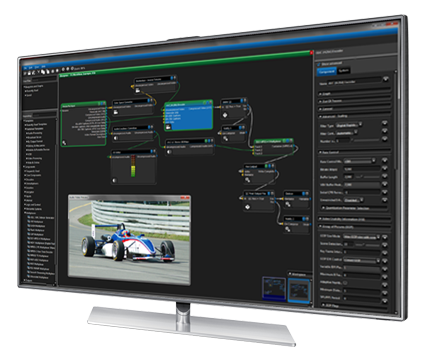 Imagine is a pioneer in the adoption of cloud-native technology based on a microservices design architecture. Zenium, the pure microservices technology behind its modular and cloud-native platforms, has enabled the company to accelerate the transition from core technology to the cloud and differentiate its solutions from purely cloud applications, which are unable to fully leverage the benefits of a geo-dispersed environment. One of the advantages of Zenium is its great flexibility that allows you to change the playout itself without having to install anything, since all the configuration and processing is in this technology inherited from Digital Rapids. In this way, based on different plug-ins and an API, the client can configure an on-demand solution.
Open Zenium offers media companies the ability to customize, modify, design and deploy next-generation workflows and services with unprecedented efficiency, scalability and performance, as well as access to a vibrant software community supported by teams of developers, architects and DevOps engineers. The primary objective of the program is to deliver the knowledge, tools and technology that empower operations with the flexibility, efficiency and scale to meet the unique and evolving needs of consumers and enable rapid response to changing market dynamics.
For the first time, a major technology provider is providing access not only to the intellectual property that underpins its innovative solutions with a community of its customers and partners, but is also building a community based on transparency. Imagine is providing access to the design patterns and best practices it has developed over the years, as well as the technology that powers its solutions, including its Versio, Selenio One and EPIC MV platforms. On the other hand, adopting a microservices-based architecture does not require average companies to make wholesale changes to their networks. Instead, Zenium's highly granular, component-based composition allows you to transition from monolithic applications to Cloud-Native gradually.
Cloud-native capabilities enable an end-to-end solution for delivering OTT services, including VOD, live/linear DVR and cloud, supporting subscription, targeted advertising and hybrid monetization models. The complete solution, which combines Siemens Convergence Creators' Smart Video Engine video platform and Imagine's multi-screen multimedia and advertising delivery solutions, will soon be available as a service on Microsoft Azure. This scheme promises to significantly reduce the barrier to entry for organizations looking to launch an OTT video service.
In this conference, organized by QinMedia and Broadcast Meditel, several projects with Versio based on the cloud have been put on the table and the advantages of working today starting from a hybrid environment with SDI outputs but with the possibility of having a second output in IP used today for monitoring and in the future as a 100% IP headend.
Multi-screen solutions
Siemens Convergence Creators has entered into close collaboration with Microsoft in the field of online video streaming. The result of this collaboration will be the integration of Microsoft Cognitive Services into Siemens Convergence Creators' premium video platform, Smart Video Engine.
 Microsoft Cognitive Services is a collection of twenty-five tools that enable applications to benefit from artificial intelligence algorithms such as emotion and feeling detection, vision and speech recognition, and language understanding. Smart Video Engine takes advantage of Microsoft Cognitive Services by making them available to developers who handle large volumes of video content.
Cognitive services APIs represent a powerful addition to Smart Video Engine, allowing you to intelligently automate processes such as video metadata enrichment. Taking those laborious tasks out of the hands of staff not only dramatically reduces operating costs but also allows for a level of enrichment that would not be feasible with manual handling. The improved metadata obtained with Microsoft Cognitive Services will allow Smart Video Engine to, among other things, provide appropriate content recommendations that, in turn, increase viewer spending, resulting in additional revenue for broadcasters and service providers.
In addition to the integration of Microsoft Cognitive Services and as part of a dedicated cloudification strategy, Smart Video Engine will also be available on the Microsoft Azure cloud platform. This will ensure smooth workflows for customers handling the encoding, packaging, CDN and DRM parts of their value chain within the Microsoft ecosystem.
Another new feature presented today is Selenio One XC, the latest software-only addition to the company's popular next-generation multipurpose compression platform. Optimized for both primary and secondary distribution, it enables content owners and video service providers to improve operational efficiency by delivering more channels over existing distribution infrastructures.
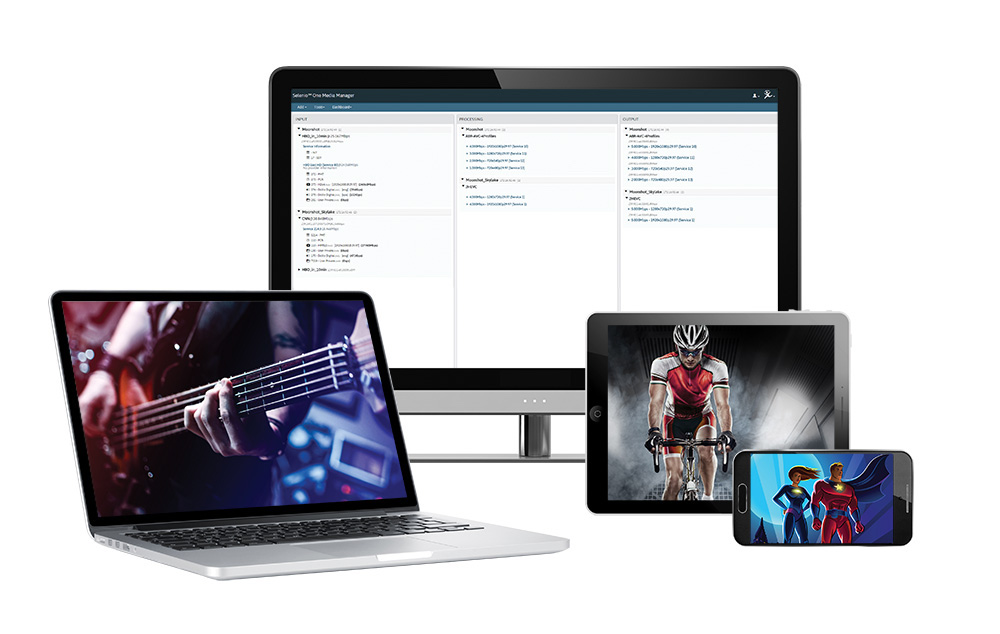 The solution, powered by Zenium, enables the development of flexible and modular platforms, and can be deployed with optional statistical multiplexing to allow media companies to maximize video quality and bandwidth efficiency. The native, software-only nature of Selenio One
The new Selenio One XC is initially aimed at providing video service providers with high video quality, and highly efficient linear transcoding capabilities. It can run on Linux-based virtual machines, making it deployable in a variety of data center and cloud environments. It supports IP-based H.264/MPEG-2 to H.264/MPEG-2 transcoding and can be paired with an optional multiplexer to provide bandwidth-conserving statistical multiplexing of expensive or bandwidth-limited distribution channels. The product is programmed to support adaptive bitrate (ABR) technology for Over-the-Top (OTT) distribution operations.
Starting from a common management system, encoding, transcoding and processing can be controlled and managed through a single solution and interface. Zenium's flexible and modular software framework allows new features, such as future formats, to be added to all Zenium-based configurations as they are developed. Features can be shared across different configurations within the Selenio One platform or by other Zenium-based solutions in the Imagine portfolio.
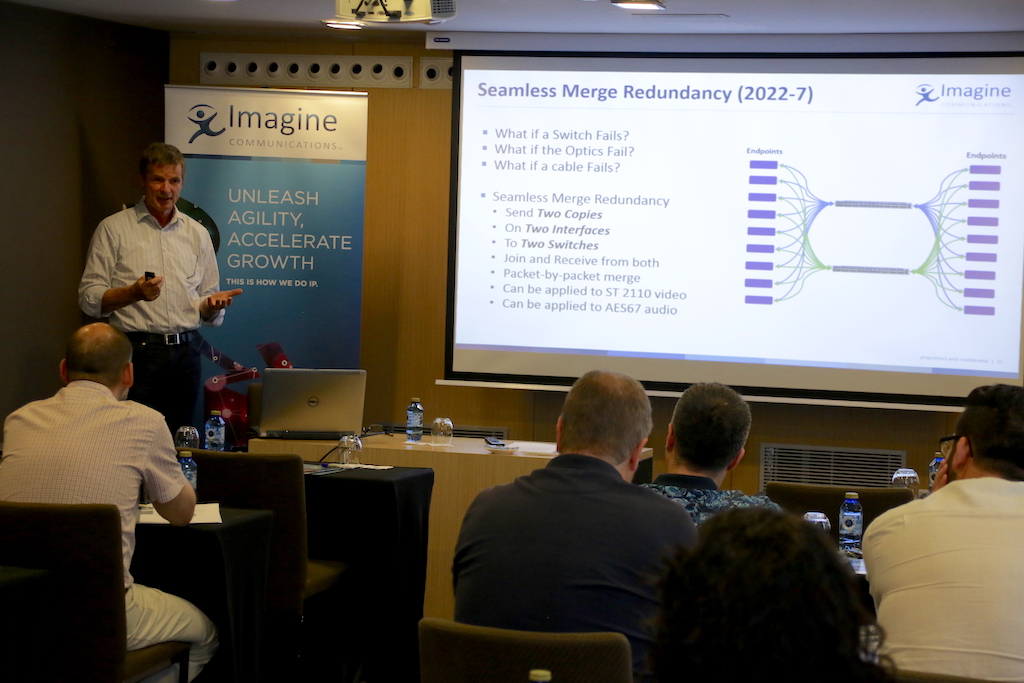
Live IP Infrastructure
The Imagine conference in Madrid has also served for professionals to resolve their doubts about how to design hybrid or fully IP production environments. To conclude these interesting sessions, some examples of top-level projects developed with Imagine technology have been presented.
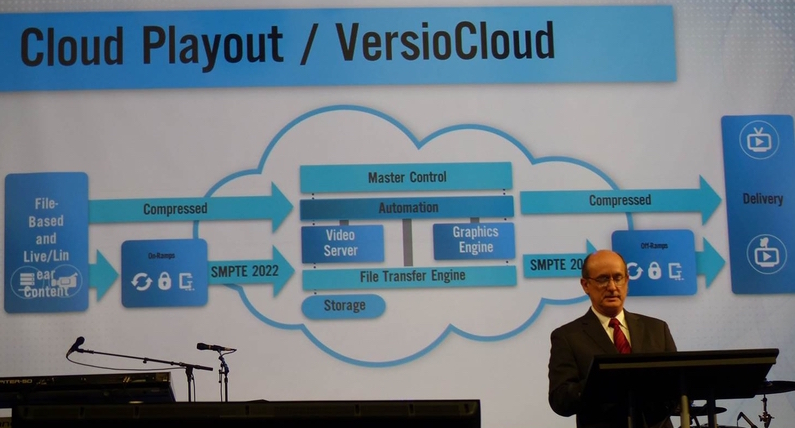
Disney|ABC Television Group is distributing its programming through a hybrid IP baseband control and playback system in which traditional equipment has been replaced by the virtualized equivalent in the cloud.
The new infrastructure includes the VersioCloud version of the cloud software application, the Magellan Orchestrator command and control system for hybrid control networks, and UCIP (uncompressed over IP) gateway modules to connect the baseband and IP worlds.
The project grew out of Disney's work with OTT services like Watch ABC and Watch Disney Channel, which give viewers the ability to watch shows on their media tablets and smartphones. The platform also gives ABC and Disney Channel sophisticated control over what users watch, including programs and advertising with support for dynamic spot insertion.
Instead of adding all the baseband broadcast servers, encoders and other ancillary equipment needed to deliver multiple versions of the same content in different formats to OTT viewers, Disney|ABC Television Group has opted for a data center and cloud model that allows it to encode and manage CDNs from the cloud.
On the other hand, Vice Media (New York) has implemented a new generation IP-based news production infrastructure based on Selenium MCP+UCIP, Nexio AMP and EPIC.
In Italy, Sky at its headquarters in Milan has launched a hybrid scheme based on Selenio MCP and Platinum IP3 (128×128 in IP and 128×250 in SDI) that serve four studios working under the leadership of Magellan SDN Orchestrator.
Finally, highlight TCP's new UHD mobile unit. In this case, Selenio Network Processor (SNP) supports HD and uncompressed HD signal streaming, Magellan SDNO handles sources and destinations and EPIC MV allows monitoring and multi-display.
Did you like this article?
Subscribe to our NEWSLETTER and you won't miss anything.
Related articles
 Imagine Communications Expands Collaboration with Google at IBC 2024 to Achieve “Total Television”
 Christie shares her vision of the future of cinema at Expocine 2020 in a virtual edition
 TVE shares its first production experiences on 5G, cloud and edge networks at the 5G Forum
 RTVE shares its vision of 5G applied to the media at the 5G Forum
 Imagine Communications implements a playout over IP in the Russian CTC Media
 Tv Azteca prepares for a future on IP with Imagine Communications
 The television of tomorrow, already today, under debate in Seville
 Imagine releases the results of a macro survey on hot spots in the sector
 Imagine, Grass Valley, SAM, Lawo and Nevion promote the AIMS alliance to boost production over IP
 The CEO of Ericsson presents his vision on the transformation of the industry at MWC2015
 SES shares its vision of the future 5G ecosystem at Mobile World Congress
 An aerial camera on cables falls onto the playing field in the US.
 Clearing doubts about the effects of 3D on vision
 Ovide, on the pitch, in the Copa del Rey final