





Clearing up doubts about the effects of 3D on vision
Un proyecto común realizado por el Col·legi Oficial d’Òptics Optometristes (COOOC), TV3 Televisió de Catalunya y el Gremi d’Empresaris de Cinemes de Catalunya, con el aval de la Facultat d’Òptica i Optometria de la Universitat Politècnica de Catalunya pone el marcha el primer test de visión colectiva en cines.
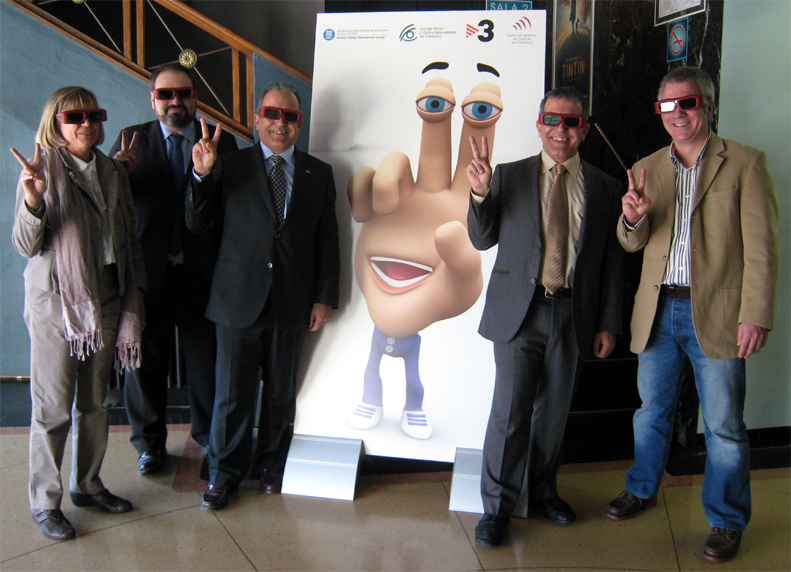
Este fin de semana se ha puesto en marcha el primer test de visión binocular en los cines. La iniciativa tiene como protagonista a Víctor, el primer óptico optometrista tridimensional de la historia, y forma parte de la campaña “Viu en 3D!”, impulsada por el Col·legi d’Òptics Optometristes de Catalunya (COOOC), TV3 Televisió de Catalunya y el Gremi d’Empresaris de Cinemes de Catalunya, con el aval de la Facultat d’Òptica i Optometria de la Universitat Politècnica de Catalunya.
El objetivo de esta sencilla prueba, de dos minutos, es detectar defectos en la visión binocular, un problema que afecta a 900.000 personas en Catalunya y más de 5 millones en España, y que dificulta, e incluso puede llegar a impedir, apreciar los efectos del 3D. La campaña estará en cartelera hasta enero de 2012, llegando a más de 400.000 espectadores y con la colaboración de más de 800 ópticos optometristas y 85 pantallas 3D.
Uno de los mensajes clave de “Viu en 3D!” es que las pantallas en 3D (cine, televisión, videojuegos…) bien aplicadas no son perjudiciales para la visión. Es más: pueden constituir un excelente método de entrenamiento, ya que estimulan el uso de los dos ojos de una manera conjunta y coordinada, es decir, la visión binocular. “En la mayoría de los casos, no se puede atribuir la dificultad de percibir los efectos 3D a la tecnología de los sistemas de visionado, sino a la presencia de una alteración en la visión binocular del espectador”, explica Alfons Bielsa, presidente del COOOC.
“Como profesionales responsables de velar por la salud visual, hemos querido poner en marcha una campaña para informar y concienciar a la población sobre la importancia de tener una buena visión binocular. No sólo para poder ver y disfrutar de las películas en 3D, sino porque vivimos en un mundo tridimensional, de manera que disponer de una visión binocular eficaz es mejorar nuestra relación con el entorno. Sin duda, la proyección de un sencillo test en un lugar tan concurrido como las salas de cine es una manera muy eficaz de ofrecer una opción rápida, sencilla y universal para descubrir la calidad de nuestra visión binocular”, añade Bielsa.
El test visual de ‘Viu en 3D!’ es una sencilla prueba autodiagnóstica básica de visión binocular que se proyectará en 85 pantallas 3D de toda Catalunya justo antes de comenzar la película. Dura sólo dos minutos y consta de tres tipos de pruebas. Este test ha sido producido íntegramente por TV3 Televisió de Catalunya y está avalado por la Facultat d’Òptica i Optometria de Terrassa.
El encargado de explicar a los espectadores los pasos que se han de seguir para realizar correctamente este test es Víctor, el primer óptico tridimensional del mundo.
“Es un personaje que hemos creado a propósito de esta campaña. Es una mano que representa el signo de la victoria de la visión binocular, porque con la visión conjunta y coordinada de los dos ojos ganamos en calidad visual”, explica Lluís Bielsa, vicepresidente del COOOC. “Además, tiene su propia web, www.victor3d.cat, dirigida al público general y donde se informa de diferentes aspectos de la visión binocular, incluido el test que se proyecta en las salas de cine”.
Toda la producción del test ha corrido a cargo de TV3, por su experiencia pionera en el Estado de producir y emitir contenidos en 3D y por su compromiso de servicio público, tanto a nivel audiovisual como de participación con diferentes sectores profesionales y de investigación.
Según Eloi Molinas, responsable del equipo de Producció i Gràfics en Temps Real de TV3, Televisió de Catalunya, “este proyecto es una muestra de devolución a la sociedad de todo aquello que ésta invierte en su televisión pública, no sólo en cuanto a contenidos e información, sino a servicio público, a nivel transversal”. El equipo de producción y de gráficos en tiempo real del Departament d’Imatge i Serveis Artístics de TV3, liderado por Paulí Subirà, ha impulsado este proyecto, que sitúa a TV3, nuevamente, al frente de la innovación audiovisual a nivel internacional.
Desde el Gremi d’Empresaris de Cinemes de Catalunya, su presidente, Camilo Tarrazón, valora muy positivamente esta iniciativa, donde “las salas de cine aportan un valor añadido a sus espectadores, además de su función lúdica habitual. A través del formato pionero 3D, más de 400.000 espectadores podrán utilizar nuestras infraestructuras para saber si padecen algún tipo de disfunción de la visión binocular y corregirla, y sabrán que ésta no es debida al sistema 3D sino a problemas visuales del mismo espectador”.
Por su parte, la decana de la Facultat d’Òptica i Optometria de la Universitat Politècnica de Catalunya, Ester Guaus, destaca que el test será un estudio de salud visual sin precedentes entre la población catalana pero que, además, “también pondrá de relieve y ayudará a difundir mejor el papel del óptico optometrista como profesional sanitario que cuida de la salud visual, que a veces es poco conocido socialmente. Se conoce la figura del óptico optometrista que hace refracciones, monta y vende gafas o adapta lentes de contacto, pero muchas veces se desconoce que, en realidad, analiza el estado de la salud visual y que está capacitado para detectar disfunciones muy amplias”.
Por otro lado, los espectadores también recibirán un folleto informativo sobre la visión binocular: por qué vemos en 3D, síntomas de alerta ante un posible problema visual, consejos sobre visión, etc. Se repartirán más de un millón de dípticos en los cines y en las ópticas participantes en la campaña impulsada por el COOOC.
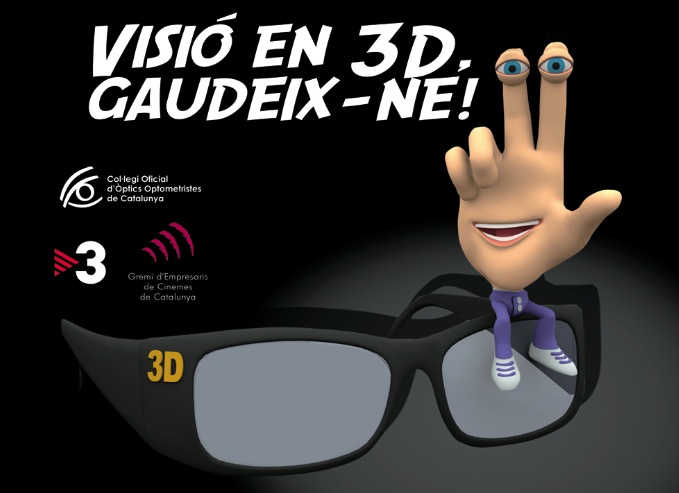
Más de 800 ópticos optometristas se suman a la campaña
Paralelamente a la proyección del test en las pantallas 3D de las salas de cine, la campaña “Viu en 3D!” también estará presente en más de 800 ópticas optometristas de toda Catalunya, donde aquellos espectadores que no hayan superado las pruebas, porque se les ha detectado alguna anomalía en la visión binocular, podrán realizarse un examen completo de la mano de un profesional óptico optometrista.
Las ópticas que participan en esta iniciativa están identificadas mediante un distintivo adhesivo con la imagen de la campaña “Viu en 3D!” en su escaparate.
Además, el COOOC también ha creado un kit especialmente diseñado para ellas de “Viu en 3D!”, con dípticos informativos para sus clientes, expositores, ejemplares del test de visión binocular y un protocolo de trabajo elaborado por la Facultat d’Òptica i Optometria de Terrassa (UPC).
En una siguiente fase de esta campaña, está previsto llegar también a las escuelas con una serie de conferencias dirigidas a estudiantes de 1º de ESO. Estas charlas las impartirán ópticos optometristas y, además de explicar el funcionamiento del sistema visual y de proporcionar consejos para una buena visión binocular, se realizarán pruebas de visión en 3D entre los estudiantes.
El 12% de la población, incapaz de apreciar el efecto 3D
Mareos, dolores de cabeza, cansancio o visión doble son algunos trastornos que pueden aparecer viendo una película en 3D. Además, en la vida cotidiana se pueden presentar otros signos como, por ejemplo, dificultad para calcular las distancias, esfuerzo al fijar la vista cuando se lee, déficit de comprensión lectora… e incluso bajo rendimiento escolar. “De hecho, es una de las principales causas de fracaso escolar y de bajo rendimiento laboral”, afirma Alfons Bielsa, presidente del COOOC.
Se calcula que casi un 12% de la población, que equivaldría a más de 900.000 catalanes y a 5 millones de españoles, es incapaz de percibir las imágenes en 3D.
Según Alfons Bielsa, “la Asociación Americana de Optometría calcula que, hasta un 56% de las personas entre los 18 y 38 años podrían tener problemas en su visión binocular. Un leve mareo al comenzar a ver una película en 3D es normal pero, si persiste, es una señal muy probable de que existe un trastorno visual”.
Basta con una pequeña disparidad en la coordinación entre los dos ojos o “con una diferencia de agudeza visual entre un ojo y otro por una graduación no actualizada de las gafas, por ejemplo, para que la visualización de la película en 3D no sea óptima”.
¿Cuáles son los principales signos de sospecha?
Las personas que no perciben los efectos 3D son justamente las que sufren alteraciones en la visión binocular poco evidentes. “Si es lógico que una persona con visión de un solo ojo no pueda apreciar los efectos en 3D, podríamos suponer también que es lógico que una persona con una buena agudeza visual en los dos ojos pueda percibirlos perfectamente. Pero esto no es necesariamente así”.
Si tenemos molestias, sensación de fatiga o detectamos que los más pequeños ponen una cara inexpresiva ante los espectaculares efectos del cine en 3D, podemos tener la certeza de que, efectivamente, existe una alteración binocular. Cuando esto sucede, lo más conveniente es visitar a un óptico optometrista para que realice un análisis optométrico completo, no sólo para detectar si hay miopía, hipermetropía o astigmatismo, sino también para revisar la visión binocular.
El problema acostumbra a solucionarse en la mayoría de los casos con una actualización de la graduación, con terapia visual i/o lentes prismáticas, acompañadas de recomendaciones ergonómicas y posturales.
Did you like this article?
Subscribe to our NEWSLETTER and you won't miss anything.
Related articles
 RTVE promotes research on AI and journalism with the VIII call for aid Impulsa Visión
 TV3 brings the great 'Eufòria' concert to the cinema in Dolby Atmos and Vision
 Panasonic reveals its vision for the future of video production in a virtual event
 Veset, Zixi and KnoxMediaHub share their vision on the impact of the cloud in the audiovisual sector
 RTVE brings together the industry in a workshop on production on IP environments
 Tedial will share his vision on the adoption of IMF in MAM systems at HPA Tech Retreat 2018
 Sony organizes a series of courses on IP live production at Pinewood Studios
 Imagine shares its vision of tomorrow's television with feet on the ground today
 The CEO of Ericsson presents his vision on the transformation of the industry at MWC2015
 The SGAE takes stock in its Yearbook of the accumulated effects of the crisis on the sector
 Clearing the clouds: seamless streaming and content delivery networks
 An aerial camera on cables falls onto the playing field in the US.
 Internet on the TV? A question with many doubts in the air
 GI Joe: six studios united around Autodesk to create the most impressive visual effects