





Mobile video to grow at a CAGR of 55 percent between 2017 and 2022
En España, el tráfico de datos móviles se multiplicará por 6 entre 2017 y 2022, habrá 41 millones de usuarios móviles (88% de la población) y 103 millones de conexiones.
Hace más de una década, cuando comenzó el Informe Cisco Mobile Visual Networking Index (VNI), el tráfico móvil (o celular) representaba menos del 5% del tráfico IP total cruzando las redes globales. Hoy, el rol y el uso de las redes móviles se ha incrementado enormemente.
El acceso móvil para consumidores y empresas ha aumentado a escala global. El mayor alcance y calidad de la banda ancha móvil han generado una enorme demanda de comunicaciones móviles, servicios multimedia y aplicaciones móviles de IoT.
Según la actualización de previsiones de este año (2017-2022), el tráfico móvil estará a punto de alcanzar un Zettabyte anual a finales del período contemplado. Para 2022, el tráfico móvil representará casi el 20% del tráfico IP global y alcanzará 930 Exabytes anuales. Esto supone casi 113 veces más que todo el tráfico móvil global generado sólo diez años antes, en 2012.
En España, el tráfico de datos móviles se multiplicará por seis entre 2017 y 2022 (crecimiento interanual del 43%), alcanzando 6,3 Exabytes anuales en 2022 (1 Exabyte en 2017) y suponiendo el 12% de todo el tráfico IP del país (fijo y móvil).

Vídeo móvil
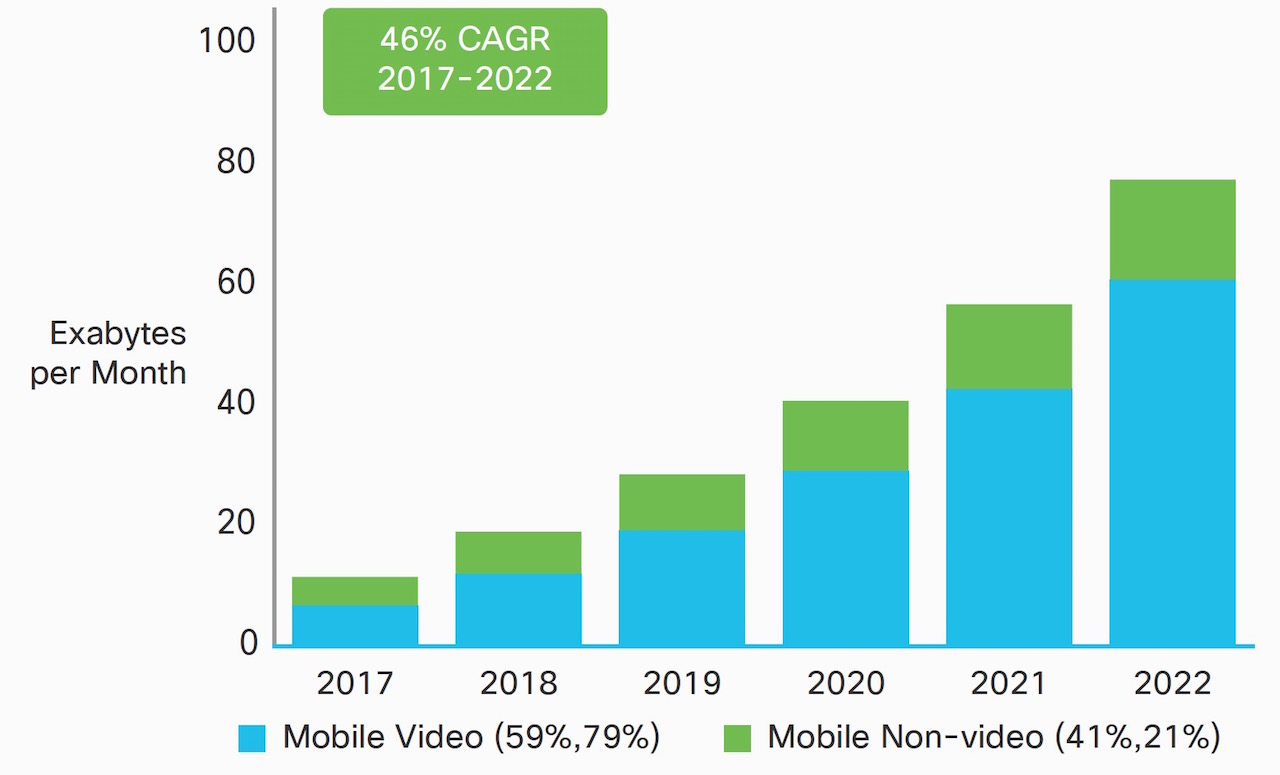
Debido a que el contenido de vídeo móvil tiene tasas de bits mucho más altas que otros tipos de contenido móvil, el vídeo móvil generará gran parte del crecimiento del tráfico móvil hasta 2022. El vídeo móvil crecerá a un CAGR del 55 por ciento entre 2017 y 2022, superior a la media general del tráfico móvil CAGR del 46 por ciento. De los 77 exabytes por mes que circularán por redes móvil en 2022, casi 61 exabytes serán vídeo. De hecho, ya desde 2012, el vídeo móvil representa más de la mitad del tráfico mundial de datos móviles.
As for the realidad virtual y realidad aumentada están preparadas para ser el próximo grupo de las mayores tendencias en tecnología móvil. La evolución de la informática de vanguardia y los avances en las redes inalámbricas, que van desde el inminente lanzamiento de 5G hasta las soluciones de conectividad móvil de alta eficiencia, junto con el acceso a dispositivos móviles y portátiles más inteligentes, han contribuido a proporcionar un entorno rico para la proliferación y el crecimiento de la realidad aumentada y la realidad virtual.
La adquisición acelerada de teléfonos inteligentes, tabletas y dispositivos portátiles está contribuyendo de manera significativa a la desarrollo de los mercados de RA y RV. A nivel mundial, los teléfonos inteligentes representarán el 54,7% de las conexiones de dispositivos en 2022 (la tasa media anual de crecimiento anual (TAMI) de 9 por ciento), y el 93% del tráfico total creciendo a una CAGR del 48 por ciento. Se espera que el desarrollo del mercado de la realidad aumentada y de la RV siguen una tendencia similar.
Si bien los videojuegos son una de las aplicaciones clave que impulsan la realidad virtual, la realidad aumentada está impulsada principalmente por aplicaciones industriales como la venta al por menor, la medicina, la educación, el turismo, las compras al por menor…
En comparación con la RV, actualmente la RA parece estar creciendo a un ritmo más lento, pero con sus múltiples aplicaciones en diferentes industrias tiene la oportunidad de hacerse más popular que la RV. El jurado está todavía fuera, ya que las cosas acaban de empezar a evolucionar en este fascinante espacio.
Todas estas innovaciones en materia de RA y RV impondrán nuevas exigencias a la red en términos de calidad y prestaciones.
Los requisitos de ancho de banda y latencia serán cada vez más importantes para una experiencia de RV y RA de alta calidad, y Los proveedores de servicios tendrán que tomar nota de esta nueva demanda. Globalmente, el tráfico de realidad aumentada y virtual crecerá casi 12 veces de 22 petabytes por mes en 2017, a 254 petabytes por mes en 2022.
Internet de las Cosas
Las tecnologías móviles siguen conectando a más personas y objetos que nunca. En 2017, había 5.000 millones de usuarios móviles en todo el mundo, pero en los próximos cinco años esta cifra aumentará en 700 millones hasta alcanzar 5.700 millones de usuarios, lo que representa aproximadamente el 71% de la población mundial. En España, habrá 41 millones de usuarios móviles (el 88% de la población) en 2022, desde los 40 millones contabilizados en 2017.
Para el año 2022, habrá más de 12.000 millones de dispositivos y conexiones IoT móviles (frente a los 9.000 millones contabilizados en 2017). En 2022, las redes móviles soportarán más de 8.000 millones de dispositivos móviles personales y 4.000 millones de conexiones IoT.
En España habrá 103 millones de dispositivos y conexiones IoT móviles en 2022 (2,2 per cápita), desde los 63,7 millones contabilizados en 2017 (10% de incremento interanual). Las conexiones IoT móviles supondrán más de la mitad (50,3%) del total (51,8 millones), desde los 13,6 millones en 2017 (21,3%).
El Informe actualizado también destaca el continuo esfuerzo de las operadoras móviles de todo el mundo para mejorar el rendimiento de la red móvil. La velocidad media de la red móvil global se multiplicará por más de tres, desde los 8,7 Mbps en 2017 a los 28,5 Mbps en 2022. La velocidad móvil varía significativamente en función de la zona geográfica, a medida que la adopción de 5G comienza a acelerarse en algunas regiones. En España, la velocidad media de la red móvil se multiplicará por más de cuatro, aumentando desde los 15 Mbps en 2017 hasta los 66,7 Mbps en 2022 (incremento interanual del 34,8%).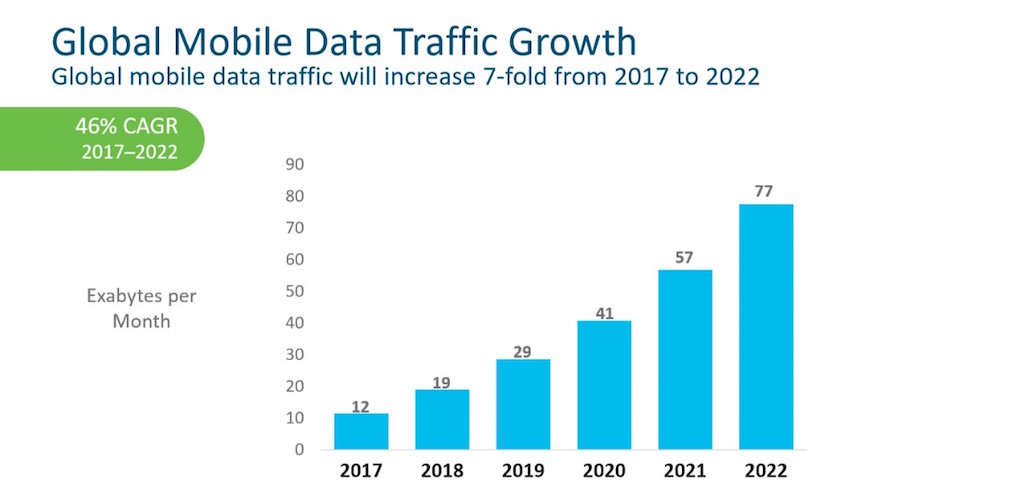
5G
En 2022, las conexiones 5G representarán más del 3% del total de conexiones móviles (más de 422 millones de dispositivos 5G y conexiones M2M globales) y casi el 12% del tráfico total de datos móviles globales. En España, las conexiones 5G representarán el 4,9% del total de conexiones móviles (5 millones de dispositivos 5G y conexiones M2M) y el 19,2% del tráfico total de datos móviles en 2022.
Para 2022, la conexión media 5G (22 Gb/mes) generará aproximadamente 3 veces más tráfico que la conexión media 4G (8 Gb/mes). En España, la conexión media 5G (20 Gb/mes) generará 3 veces más tráfico que la conexión media 4G (6,7 Gb/mes) en 2022. En España, la velocidad media 5G (190 Mbps) será más de 2,5 veces mayor que la velocidad media 4G (86,6 Mbps) en 2022.
Descarga hacia redes WiFi
En 2017, el tráfico descargado mensualmente (13 Exabytes) superó el tráfico mensual móvil/celular (12 Exabytes).
En 2017, el 54% del tráfico total de datos móviles fue descargado (62% en España); para 2022, se descargará el 59% del tráfico total de datos móviles (71% en España);
En 2017, el tráfico IP total (fijo y móvil) mundial se dividía en: 48% cableado, 43% WiFi, 9% móvil. En 2017, el tráfico IP total (fijo y móvil) en España dividía en: 38% cableado, 56% WiFi, 6% móvil.
En 2022 el tráfico IP total (fijo y móvil) mundial se dividirá en: 29% cableado, 51% WiFi, 20% móvil. En 2022 el tráfico IP total (fijo y móvil) en España se dividirá en: 24% cableado, 64% WiFi, 12% móvil.
A escala global, los puntos de acceso WiFi totales (incluidos los del hogar) se multiplicarán por cuatro entre 2017 (124 millones) y 2022 (549 millones). En España, los puntos de acceso WiFi totales (incluidos los del hogar) se multiplicarán por cuatro entre 2017 (4 millones) y 2022 (16 millones).
Did you like this article?
Subscribe to our NEWSLETTER and you won't miss anything.
Related articles
 EITB promotes a synchronized gaming experience between television and mobile
 Amazon Prime Video launches the 'Group Video' function that will allow you to watch content and chat among a group of friends
 The Festivalito starts with one hundred and fifty participants in 'La Palma Rueda 2017'
 VideoReferee in action as video judging system at Basketball EuroCup 2017 and at NAB 2017
 De Bombay a Lisboa, entre las primeras paradas internacionales de Animayo en 2017
 Mobile video will account for 78 percent of all mobile traffic in 2021
Television advertising investment in 2017 will grow by 5.3%
Mobile video will account for 78 percent of all mobile traffic in 2021
Television advertising investment in 2017 will grow by 5.3%
 Video will multiply IP traffic by three, reaching 82 percent of global traffic in 2020
 The increase in smart devices, mobile video and 4G networks will multiply global mobile data traffic by 8
 Smart TV sales will grow by 21% over the next four years
 Cloud traffic will grow 35 percent annually between 2012 and 2017
 3D in the home will grow by almost 500% in 2011
 IBE360º or how to make synchronization between television, Internet and mobile profitable
 The IVAC will subsidize between 16 and 20 percent of films shot in the Valencian Community