





The increase in smart devices, mobile video and 4G networks will multiply global mobile data traffic by 8
En apenas cinco años, según el informe Cisco VNI Mobile, el vídeo móvil acaparará la mayor tasa de crecimiento de todas las aplicaciones móviles.

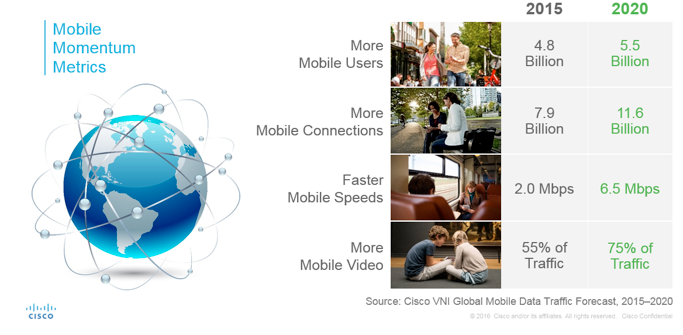
En 2020 habrá 5.500 millones de usuarios móviles a escala global (el 70% de la población mundial) con una media de 1,5 conexiones per cápita, mientras en España habrá 40,8 millones de usuarios móviles (el 88% de la población), con una media de 2 conexiones per cápita.
Así se desprende del Informe Cisco Visual Networking Index (VNI) sobre Tráfico Global de Datos Móviles 2015-2020, que desvela cómo la adopción de dispositivos móviles inteligentes, la mayor cobertura móvil mediante redes 4G y la creciente demanda de contenido incluyendo vídeo multiplicarán por 8 el tráfico global de datos móviles en los próximos cinco años. En España, el tráfico global de datos móviles se multiplicará por 7 en dicho período.
Se espera que los dispositivos y conexiones móviles inteligentes supongan el 72% del total en 2020 (desde el 36% contabilizado en 2015) y generen el 98% del tráfico móvil en dicha fecha. En España, los dispositivos y conexiones móviles inteligentes supondrán el 74% del total en 2020 (desde el 66% contabilizado en 2015) y generarán el 100% del tráfico móvil en dicha fecha.
Los smart phones generarán el 81% de todo el tráfico global de datos móviles en 2020 (76% en 2015). La proliferación de teléfonos móviles incluyendo “phablets” (que combinan características y funcionalidades de smart phones y tablets) crece con tanta rapidez que más personas tendrán teléfonos móviles (5.400 millones) que electricidad (5.300 millones), agua corriente (3.500 millones) o automóviles (2.800 millones) en 2020. En España, los smart phones generarán el 75% de todo el tráfico global de datos móviles en 2020.
Por su parte, el vídeo móvil tendrá la mayor tasa de crecimiento de todas las aplicaciones móviles. La mayor demanda de mejor resolución de vídeo y mayor ancho de banda y velocidad de procesamiento incrementará el uso de dispositivos conectados a redes 4G, de forma que la 4G superará a la 2G como tecnología celular predominante en 2018, y a la 3G en 2020. La 4G supondrá así más del 70% de todo el tráfico móvil en 2020, mientras las conexiones 4G generarán seis veces más tráfico al mes que el resto de conexiones móviles en dicha fecha. En España, la 4G supondrá el 86% de todo el tráfico móvil en 2020 (49% a finales de 2015) y el 51% del total de conexiones móviles (22% en 2015).
Tráfico global
En 2020, el tráfico global de datos móviles alcanzará los 366,8 Exabytes anuales (44,2 Exabytes en 2015) o 30,6 Exabytes mensuales (3,7 Exabytes en 2015), lo que supone un ratio de incremento interanual del 53% entre 2015 y 2020. En España, el tráfico global de datos móviles alcanzará los 2,9 Exabytes anuales o 240 Petabytes mensuales en 2020 (tasa de incremento interanual del 47%).
Los 366,8 Exabytes anuales equivalen a 120 más veces que todo el tráfico global de datos móviles generado en 2010 o lo que es lo mismo, 81 billones de imágenes (como MMS o Instagram) o 7 billones de vídeo-clips (por ejemplo, YouTube) o más de 2,5 vídeo-clips diarios por cada habitante del planeta durante un año.
Entre 2015 y 2020 el tráfico global de datos móviles aumentará dos veces más rápido (tres veces en España) que el tráfico global de datos fijos.
En 2020, más del 75% del tráfico global de datos móviles será vídeo (76% en España).
En 2015, el 51% de todo el tráfico móvil fue descargado sobre redes WiFi y small cell (50% en España), mientras en 2020 lo hará el 55% (60% en España).
Conexiones más inteligentes
En 2020 habrá 11.600 millones de dispositivos/conexiones móviles (incluyendo 8.500 millones de dispositivos móviles personales y 3.100 millones de conexiones M2M), desde los 7.900 millones de dispositivos y conexiones M2M contabilizados en 2015. En España habrá 105,5 millones de dispositivos/conexiones móviles en 2020 (aproximadamente 2 por habitante), desde los 59,6 millones de dispositivos contabilizados en 2015.
A escala global, el 72% de los dispositivos/conexiones móviles serán inteligentes en 2020 (36% en 2015), y el 98% de todo el tráfico de datos móviles procederá de dispositivos y conexiones inteligentes (89% en 2015). En España, los dispositivos y conexiones móviles inteligentes supondrán el 74% del total en 2020 (66% en 2015) y generarán el 100% del tráfico móvil en dicha fecha. En España habrá 51,3 millones de conexiones M2M en 2020 (9,4 millones en 2015), y el tráfico M2M crecerá 27 veces entre 2015 y 2020 suponiendo el 12% de todo el tráfico de datos móviles (3% a finales de 2015).
Los smart phones, portátiles y tablets generarán cerca del 92% de todo el tráfico global de datos móviles en 2020 (94% en 2015), mientras el tráfico M2M supondrá el 7% (3% en 2015) y los terminales básicos el 1% (3% en 2015).
En 2020, el 66% de todos los dispositivos/conexiones móviles será compatibles con IPv6 (36% en 2015), mientras el tráfico IPv6 supondrá el 54% de todo el tráfico de datos móviles (13% en 2015). En España, el 71% de todos los dispositivos/conexiones móviles será compatibles con IPv6 (62% en 2015).
Conectividad 4G
La velocidad media global de las redes móviles se multiplicará por 3,2 entre 2015 (2 Mbps) y 2020 (6,5 Mbps). En España, la velocidad media de las conexiones móviles se multiplicará por 3 entre 2015 (3,8 Mbps) y 2020 (12 Mbps).
En 2020, las conexiones 4G supondrán el 40,5% del total (13,7% en 2015), las conexiones 3G el 38,7% (33,7% en 2015) y las conexiones 2G el 13,5% (52,3% en 2015). En España, las conexiones 4G supondrán el 51% del total en 2020 (22% en 2015), las conexiones 3G el 25% (60% en 2015), las conexiones 2G el 7% (16% en 2015), mientras las conexiones LPWA supondrán el 17% restante (2% en 2015).
El tráfico 4G se multiplicará por 13 entre 2015 y 2020 a escala global (en España se multiplicará por 12) y las conexiones 4G procesarán el 72% de todo el tráfico de datos móviles (86% en España) desde el 47% que suponían en 2015 (49% en España).
Aumentan los puntos de conexión WiFi
Los puntos de conexión WiFi o hotspots -incluyendo los de los hogares- se multiplicarán por 7 a escala global entre 2015 (64 millones) y 2020 (432 millones), mientras los hotspots de los hogares aumentarán desde los 57 millones contabilizados en 2015 hasta los 423 millones previstos para 2020.
En 2015, el tráfico descargado a redes WiFi mensualmente (3,9 Exabytes) superó por primera vez al tráfico mensual móvil/celular (3,7 Exabytes).
En 2020 se generarán 38,1 Exabytes de datos mensuales descargados a redes WiFi, excediendo igualmente el tráfico móvil/celular mensual previsto (30.6 Exabytes).
Did you like this article?
Subscribe to our NEWSLETTER and you won't miss anything.
Related articles
 Haivision Hub, global video networking service, is now available
 RTVE launches 'RTVE Cooking', the first video skill that teaches how to cook from smart devices
 The coronavirus puts the networks in Spain to the test with video accounting for 70% of traffic
 El tráfico de datos móviles aumentó en un 115% interanual en el tercer trimestre de 2017
 Mobile video will account for 78 percent of all mobile traffic in 2021
 Mobile devices now account for more than half of online video views
 Video will multiply IP traffic by three, reaching 82 percent of global traffic in 2020
 Video consumption from mobile devices continues to rise unstoppably
 Cloud traffic will multiply by four between 2014 and 2019
 Global IP traffic will triple by 2019
 In 2019, mobile video will account for 72% of all global mobile data traffic
InStream Mobile: Low Latency HD Video for Mobile Devices
In 2019, mobile video will account for 72% of all global mobile data traffic
InStream Mobile: Low Latency HD Video for Mobile Devices
 El video online es el mayor impulsor de volumen de tráfico móvil
 Cisco MOVE Optimizes Mobile Video Experiences Over Wireless Networks