





The number of Spanish households subscribed to audiovisual platforms grows by 20%
La nueva edición del Anuario SGAE de las Artes Escénicas, Musicales y Audiovisuales, ofrece datos estadísticos básicos para caracterizar el sector cultural.
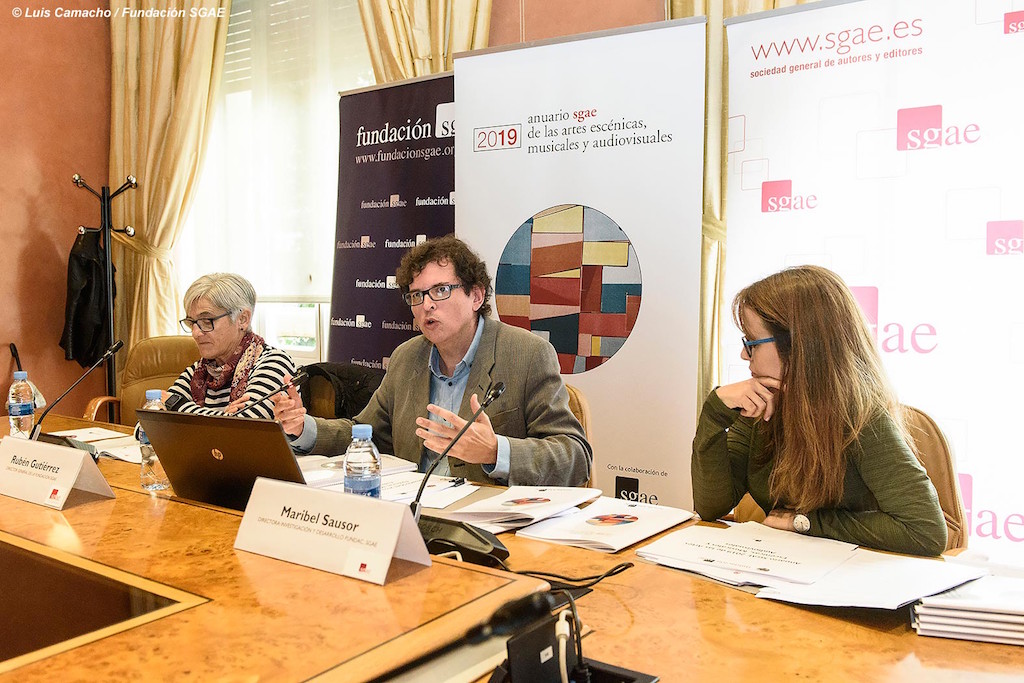
The SGAE Foundation ha presentado este jueves 17 de octubre, el Anuario SGAE 2019 de las Artes Escénicas, Musicales y Audiovisuales, volumen que ofrece datos estadísticos básicos para caracterizar el sector cultural. Se trata de una investigación consolidada, ya en su decimonovena edición, que constituye uno de los recursos básicos para conocer diferentes ámbitos del sector cultural.
Rubén Gutiérrez, director general de la Fundación SGAE, Pilar Granados, directora general de Consultoría Estratégica de Investigación de Mercados (CIMEC), y Maribel Sausor, directora de Investigación y Desarrollo de la Fundación SGAE, han presentado los resultados del sector y tendencias de consumo cultural en el año 2018 en una rueda de prensa abierta a los medios de comunicación, celebrada en la sede de la SGAE en Madrid.
El Anuario SGAE 2019 ofrece información rigurosa y detallada sobre los principales sectores de las Artes Escénicas, musicales y audiovisuales, con decenas de miles de datos numéricos y 350 gráficos y tablas estadísticas, algunos de elaboración propia. Surge como resultado de un laborioso proceso de captura y tratamiento de datos, compilación de fuentes y análisis de esta información. Esta publicación, nacida en 1999, se ha convertido ya en una herramienta fundamental para los estudiosos del mercado cultural español.
La información recogida ha analizado en términos cuantitativos y estructurales los siguientes sectores del panorama cultural: Artes Escénicas (teatro, danza y ópera), música clásica, música moderna, cine, música grabada, televisión, vídeo, radio y nuevas tecnologías. Para cada apartado, despliega un informe que analiza los principales datos de ese sector, destacando sus aspectos característicos a lo largo del año 2018, aportando elementos para la comparación con el ejercicio de 2017, y una tendencia de evolución, para cotejar el estado del sector respecto a 2008.
Cine
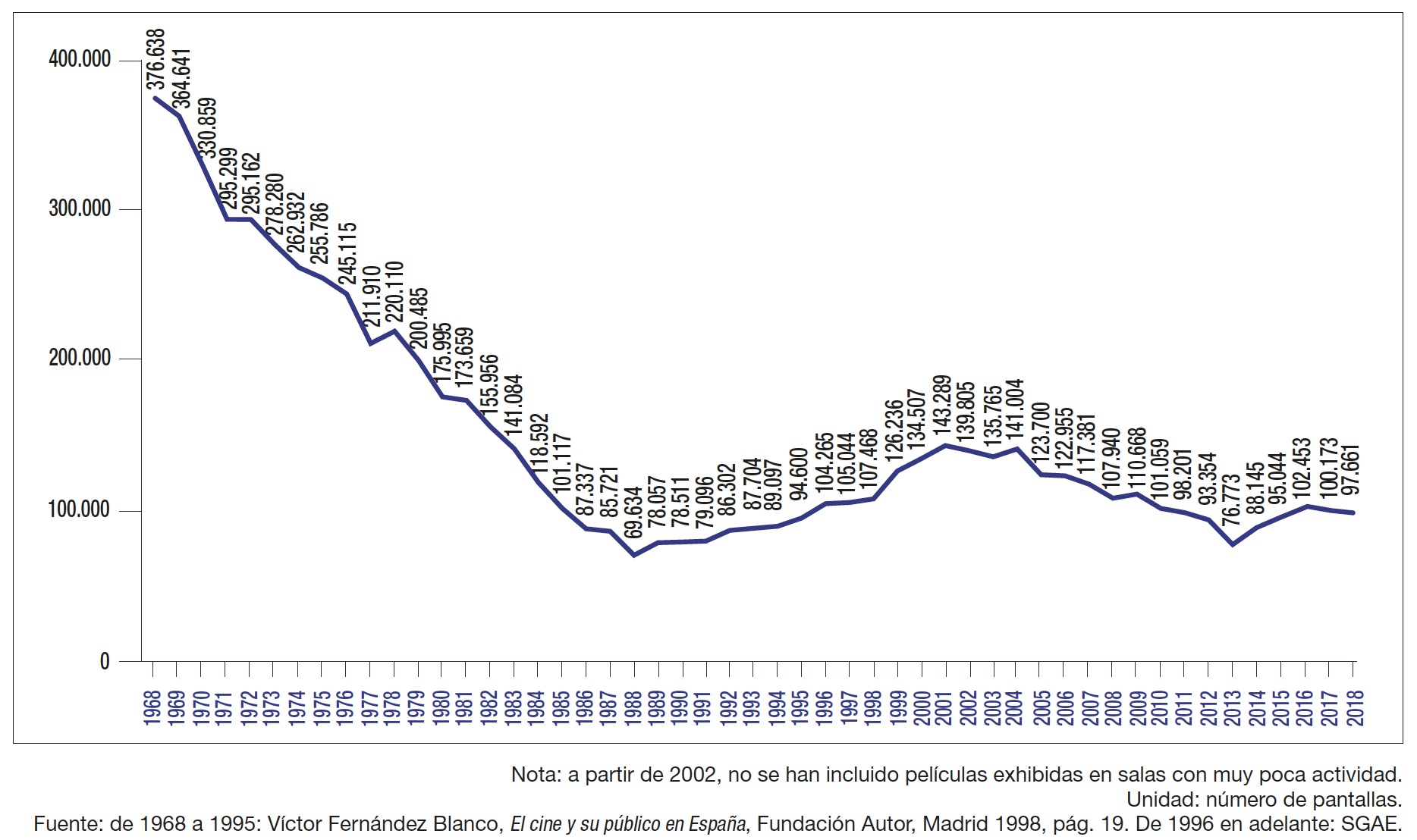
En 2018 se mantiene la tendencia decreciente iniciada un año antes. Salvo el número de largometrajes exhibidos, que crece un 4,4% respecto a 2017, los demás indicadores acumulan nuevas pérdidas.
En concreto, el Anuario observa los siguientes descensos: del 0,2% en el número de pantallas, del 1% en el número de sesiones, del 2,5% en la asistencia y la recaudación. Si analizamos las diferencias de 2018 respecto a 2008, encontramos pérdidas mayores en el número de sesiones, con un 22,6% menos, en la asistencia, que pierde un 9,5%, y en la recaudación, que desciende un 7,2%. Volvemos a encontrarnos una excepción, el número de largometrajes, que se ha incrementado respecto a dicho año un 12,2%.
Durante 2018, se exhibieron un total de 1.951 largometrajes en 3.812.949 sesiones de 3.578 pantallas a las que acudieron 97.661.327 espectadores.
Madrid vuelve a ser la comunidad con más asistencia, con un 19,5% del total estatal, 19.064.835 espectadores. A continuación, Cataluña, que con 17.520.332 asistentes concentra el 17,9%. En tercer lugar, encontramos Andalucía, con 14.905.158 entradas vendidas, lo que equivale al 15,3%.
The media de entradas vendidas por habitante en 2018 fue de 2,1 (0,1 menos que en 2017), cifra que es superada por Madrid (2,9), Illes Balears y Comunitat Valenciana (ambas con 2,4) y Cataluña, La Rioja y Navarra (las tres con 2,3).
En 2018 se recaudaron 579.076.127 euros por venta de entradas de cine. Vuelve a ser Madrid la comunidad con una recaudación mayor, con 126.435.515 euros (el 21,8%). La siguen Cataluña, con el 19,2%, 111.238.583 euros, y Andalucía, con el 14%, 80.795.942 euros. El precio medio de la entrada de cine en España vuelve a situarse en 2018 en 5,93 euros. Superan dicha media las siguientes CCAA: Madrid (6,63), Cataluña (6,35) y Asturias (5,97 euros). El gasto medio anual por habitante en España fue de 12,39 euros. Madrid (19,22 euros), Cataluña (14,64 euros), Comunidad Valenciana (13,63 euros), Illes Balears (13,44 euros) y Navarra (12,64 euros) superaron dicha media.
The película más taquillera en 2018 fue Jurassic World: el reino caído, dirigida por Juan Antonio Bayona y quinta película de la saga. La sigue Bohemian Rhapsody, dirigida por Bryan Singer y ganadora de diversos premios, entre los que destacan dos Globos de Oro y varios Oscar. En tercer lugar, aparece Vengadores Infinity War, dirigida por Joe y Anthony Russo, tercera de la saga basada en los cómics. Los Increíbles 2, dirigida por Brad Bird, se sitúa en cuarto lugar y es la película de animación con más recaudación de 2018. Por último, en quinto lugar, encontramos la película Champions, dirigida por Javier Fesser, que se convierte en la película española con más recaudación de 2018.
Video
El Anuario SGAE 2019 destaca que el sector videográfico está sufriendo un cambio de tendencia que perjudica al mercado físico y más tradicional. De esta forma, siguen cerrando en España los tradicionales videoclubs y algunas entidades relacionadas, como la Unión Videográfica Española, quedan abocadas a una obligada inactividad.
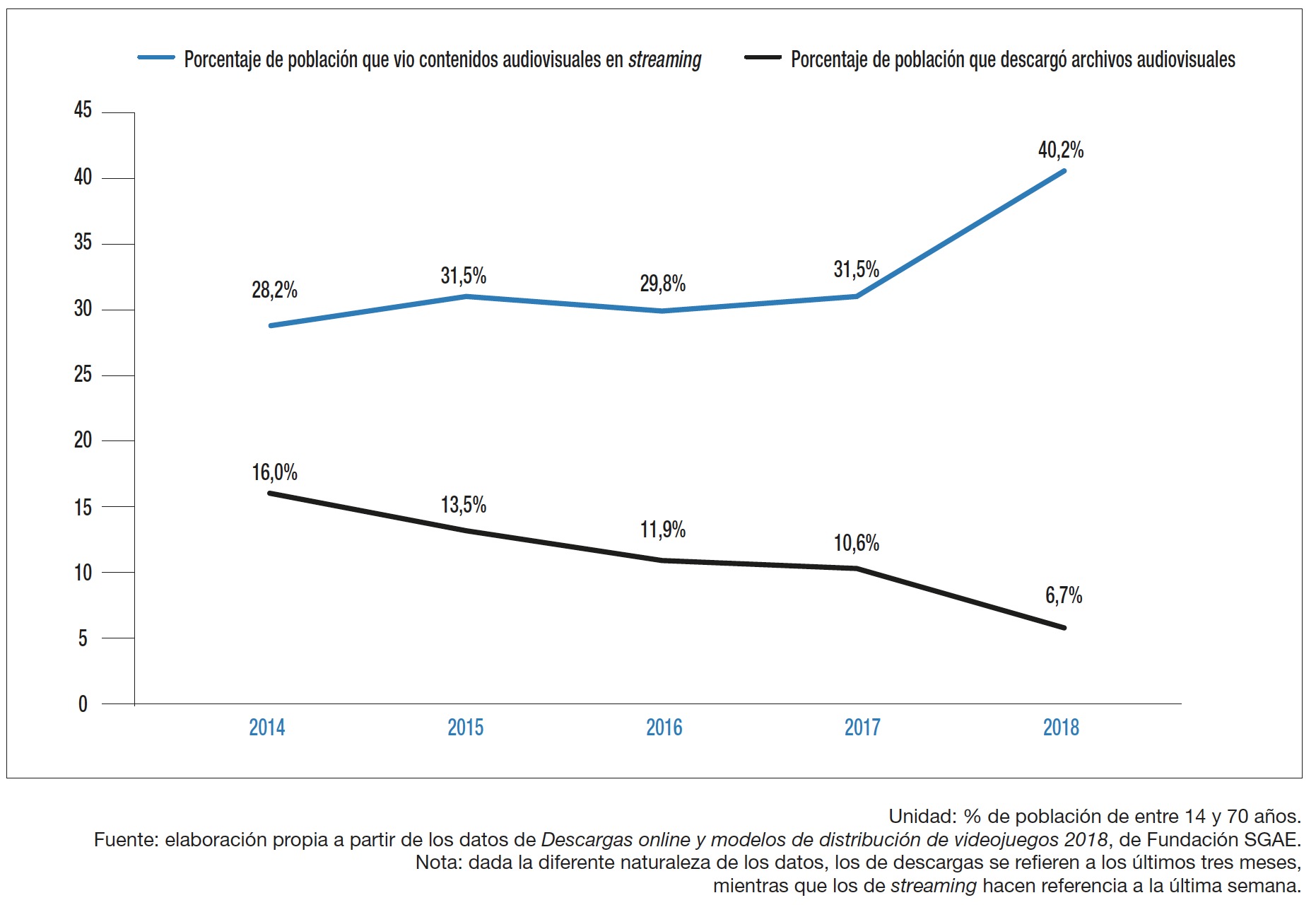
Sin embargo, la evolución de los archivos audiovisuales vistos en streaming fue positiva. Un 40,2% de la población española declaró haber visto en 2018 algún vídeo de esta forma la última semana. Dicho dato implica un incremento de 8,7 puntos porcentuales respecto al año anterior. Por el contrario, el porcentaje de población que declaró haber descargado algún archivo audiovisual fue del 6,7% (3,9 puntos menos que en 2017).
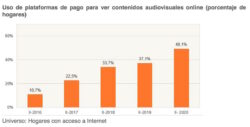
La SGAE destaca el auge que están experimentando la televisión de pago y las nuevas plataformas, que ofrecen gran variedad de contenidos audiovisuales a la carta. El porcentaje de hogares españoles abonados a alguna de ellas en 2018 fue del 63,1% (lo que implica una subida respecto a 2017 de 20,1 puntos porcentuales).
Television
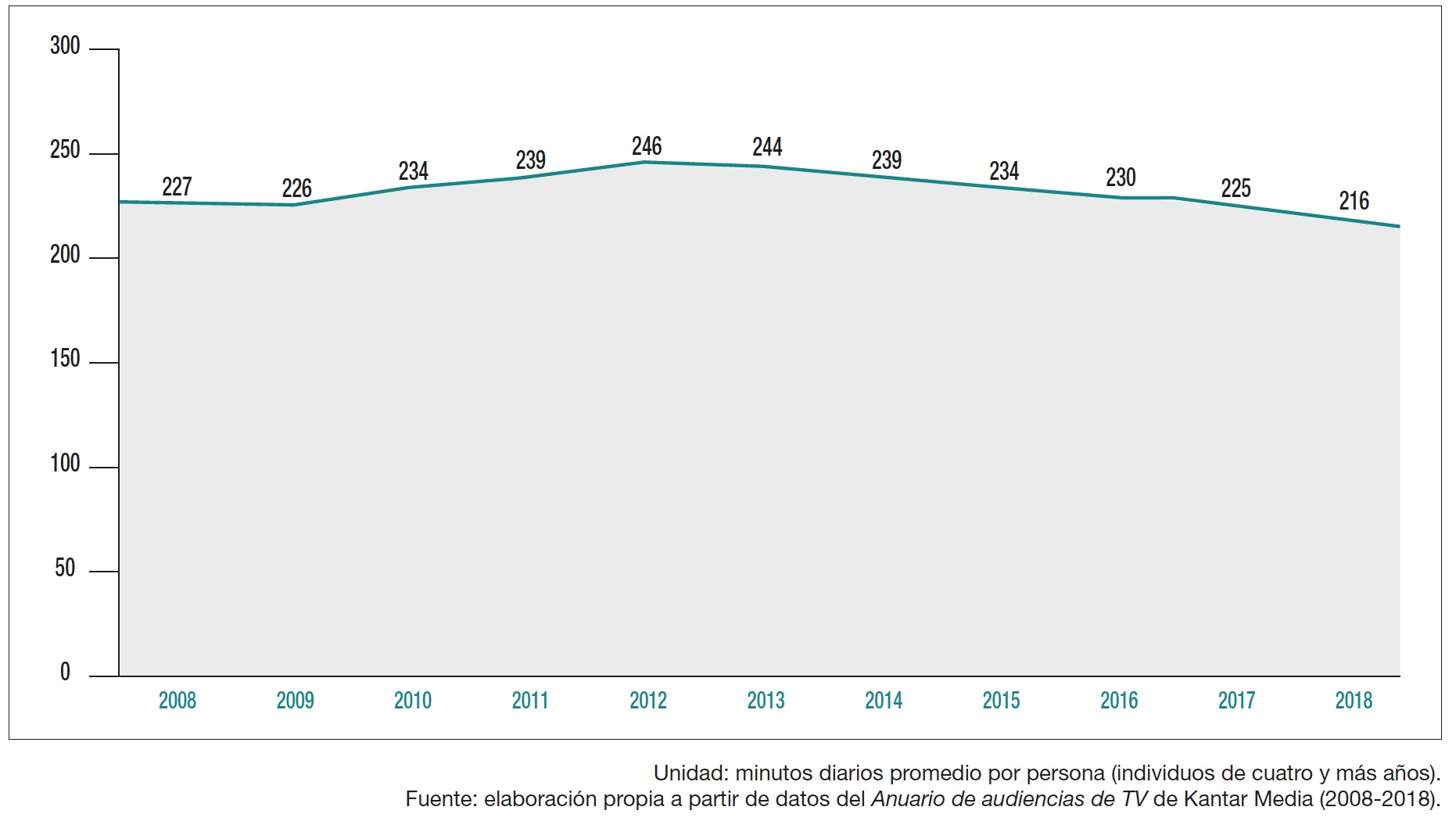
Se mantiene la tendencia descendente del consumo televisivo. En 2018, la media de consumo diario por habitante cae hasta los 216 minutos, lo que implica un descenso de nueve minutos respecto a la media de 2017. Comunidad Valenciana y el conjunto de comunidades que componen la categoría “resto” fueron las que mostraron un mayor consumo, con una media de 236 minutos. Las siguen Castilla-La Mancha (con 229 minutos) y Asturias (con 224). En el otro extremo, encontramos Murcia (con 200 minutos), Cataluña (con 203) e Illes Balears (204).
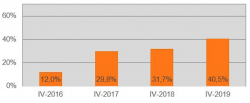
En oposición a lo anterior, el porcentaje de hogares que utilizan plataformas de pago (como Netflix, HBO, Amazon Prime…) aumenta, según los datos de la CNMC. Según dicha entidad, durante 2018 se registró una media anual del 32,7%, lo que implica un incremento de 6,5 puntos porcentuales respecto a la media del año anterior.
Did you like this article?
Subscribe to our NEWSLETTER and you won't miss anything.
Related articles
 Six out of ten Spanish households with Internet pay to watch audiovisual content online
 The daily use of VOD platforms and Smart TVs grows
 Half of households with Internet consume audiovisual content on online payment platforms
 The number of FuboTV subscribers grows during confinement by 148%
 Four out of every ten households with Internet consume audiovisual content on online payment platforms
 By 2024, Africa will have 46 million homes subscribed to pay television
 1 in 3 households connected to the Internet use payment platforms to watch audiovisual content online
 Pay television becomes the service least valued by Spanish households
 Eastern Europe will multiply the number of subscribers to SVOD services by six
 Pay television grows in Spain to reach 5.43 million subscribers
 The number of pay television subscribers continues to increase in Spain thanks to the pull of IPTV
 Spanish homes have an average of seven devices connected to the Wi-Fi network
 Second EGM wave: the number of moviegoers grows and radio and television consumption decreases
By the end of 2017 there will be 165 million households subscribed to IPTV
Second EGM wave: the number of moviegoers grows and radio and television consumption decreases
By the end of 2017 there will be 165 million households subscribed to IPTV