





5G, IoT, Artificial Intelligence, Cloud Computing and Blockchain will transform our lives in the coming years
The Future Shock Report prepared by Gray reveals some of the technology trends between now and 2022.
Gray Spain has presented the report Future Shock 2 of technology trends 2020-2022. A study led by Oscar Pena, Chief Digital Officer of the agency, in which it has been analyzed how the technological revolution is causing an unprecedented social transformation with effects on the labor, commercial, cultural, social and also political market.
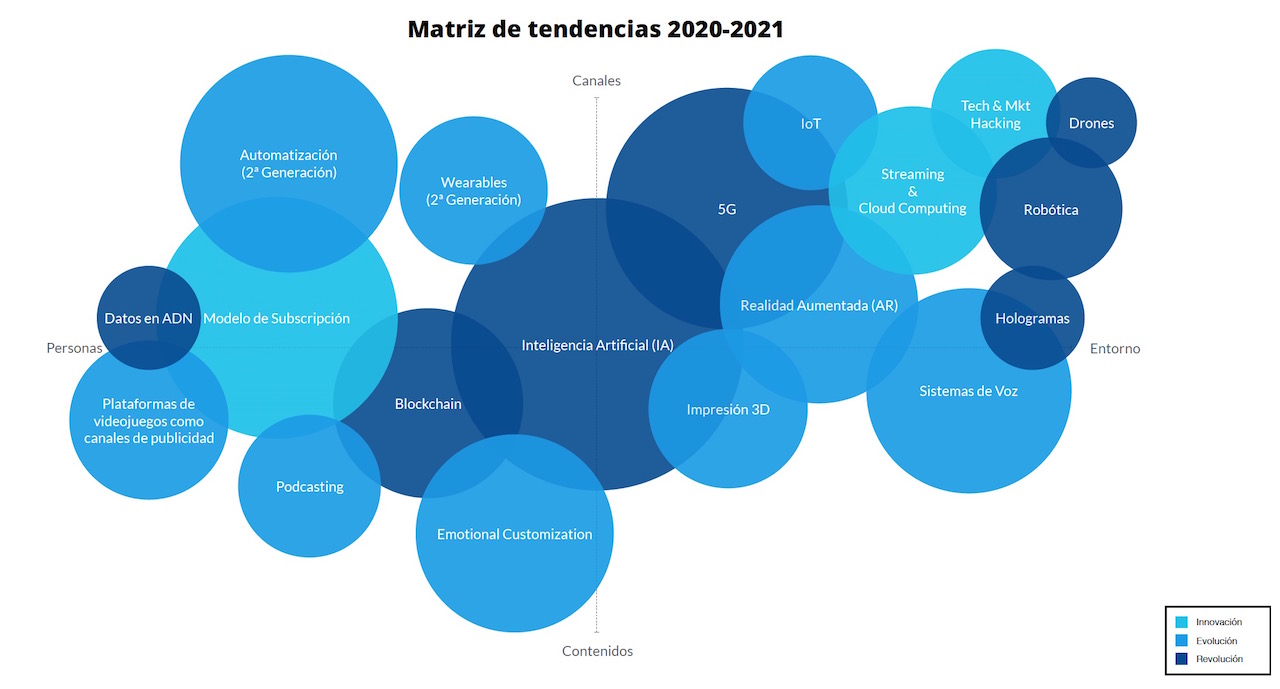
This report identifies and analyzes which technologies and uses are going to transform or are transforming our lives, classifying them as innovation, when they alter a trend by introducing notable novelties; evolution, when they change an already existing trend in form; and revolution, when they represent a drastic and profound change from a previous trend.
5G, IoT, Artificial Intelligence, Cloud Computing and Blockchain will transform our personal and professional lives in the coming years. All the technologies analyzed by the report are complementary and their joint application anticipates relevant changes in the way of interacting with content, giving rise to a fully connected society, without delays in communication, as well as devices capable of anticipating and making people's lives easier. In the media, blockchain will be the key to fighting fake news.
Óscar Peña explains that "the title of the report is not whimsical, I recall Alvin Toffler from memory. The writer who anticipated a scenario that has practically come true. It is true that, in the face of accelerated and profound changes, people and companies are afraid and are not prepared. This report tries to shake the pillars so that we begin to invest in these changes or, at least, consider them an experimentation laboratory so that we can modulate the society and company of the next 30 years."
And he adds: "that same scenario in which the dizzying speed makes us slow in the way we learn to adapt, is reproduced again. Fortunately, we have more advanced generations than in the 70s, but no one can take the shock away from us."
 5G transversal

5G will transform the way millions of devices cooperate with each other by sending and receiving information in real time. It will mean greater speed, greater bandwidth, lower latency and lower energy consumption. In other words, Peña explains that "it will make communications possible in new formats never seen before, and the possibility of millions of people joining simultaneous collaborative environments, as occurs with video games."
This technology will also mean an increase in analytical and data collection capacity that will help us optimize supply chains, perform predictive maintenance, predict trends... "This data collection can put people's privacy at risk, which raises the need for us to decide what information we want to be public or not, what is the scope of the services we hire and the devices we install."
 Artificial intelligence
Artificial Intelligence, in its simplest form, is an algorithm. Little by little, more complex algorithms are being created to automate processes and connect services that allow recurring tasks to be carried out. In the media, it allows information to be adapted to the consumer's interests by adapting the content to the emotional state of that moment.
Furthermore, this technology will make the transformation of news consumption in media go even further: "in the future we will subscribe to content services that adapt to our life on the move. News will be communicated to us when it is relevant through many devices, and we will consult it in another way (perhaps the refrigerator, perhaps the bathroom mirror while we wash our face, perhaps the car while we go to work...)."
At a business level, the practical application of AI will serve to automate and improve its processes, which will have a positive impact of 15% on the world economy, that is, global GDP will increase by around 15.7 billion dollars. Each company, depending on the sector it is in, will choose where to automate to achieve the greatest benefit.
Internet of Things
The IoT is already among us. They are in any of the hundreds of devices capable of automating tasks within the home. Those small measurement and automation devices integrated into things so common in our lives such as a light bulb, an alarm clock, a vase or a power thief.
It is estimated that there are already around 26 billion devices connected to the Internet worldwide (Statista). This figure leaves each citizen with about 3 of these devices.
 Netflix, entertainment model
Companies are going to transform their business vision focused on products and services into much more flexible subscription-based models. In Spain this year, streaming video consumption (OTT) has equaled free-to-air TV consumption. This phenomenon has extended to audio with platforms such as Spotify, Apple Music, Google Play Music or Tidal and podcasts. All these new features already installed in our daily lives will be followed by the new video game streaming platforms on which industry giants such as Electronic Arts, Google (Stadia), Apple (Arcade), Steam, Nintendo, Sony (Playstation), Microsoft (XBox), among others, are working.
Blockchain
The use of blockchains will generate transparency and greater trust throughout the value chain of any business. No sector will be immune to all its capabilities, from banking to journalism, including logistics, e-commerce, advertising, medicine, law and carsharing.
In the media sector, it is presented as the best weapon to end fake news. The Associated Press has already implemented this system that allows them to have exact traceability of where a specific article that has previously been uploaded to a content management system (CMS) appears published. All this using decentralized block technology to prevent altered news from being published.
Retos 2020-2022
The new technologies presented in the report are changing and will change personal relationships, they will represent an advance in the ways of working, changing the way we communicate and interact with the people around us. All these advances also expose us to chaos: "if they stop working it would mean a momentary blackout or absolute blackout. For now, fortunately, all systems have routing systems that prevent the entire system from stopping working."
Future Shock 2 concludes that the next challenges facing technology are improving the user experience, connecting with new devices, achieving more energy efficiency and making all derived products and services attractive to people's lifestyles. “To achieve all these challenges we are not alone, we are accompanied, for the first time in history, by artificial intelligence.”
Did you like this article?
Subscribe to our NEWSLETTER and you won't miss anything.
Related articles
 Vida automates workflows with Media Factory and Artificial Intelligence
 Without people there is no intelligence (or artificial) in broadcasting
 Alibaba Cloud and OBS use the cloud with Artificial Intelligence in Paris 2024
 Limecraft proposes the concept of Media Intelligence versus Artificial Intelligence
 VSN is strongly committed to the democratization of MAM technologies thanks to the Cloud and Artificial Intelligence
 2020, a year of Artificial Intelligence in RTVE Innovation
 Haivision accelerates cloud computing strategy through the purchase of LightFlow
 Cinco proyectos de RV/RA, inteligencia artificial y blockchain competirán en el primer Zinemaldia & Technology
 Artificial intelligence democratizes content transmission
 Ready or not, Artificial Intelligence has arrived
 Aicox Soluciones will exhibit its solutions for 4K, IP, cloud and artificial intelligence at BIT Audiovisual
 Cloud computing, big data, Internet of Things, artificial intelligence and cybersecurity, trends in the ICT sector
 Rock the Cloud: the present and future of mobility, video and cloud computing
 Gartner identifies the ten technologies that will mark the coming years