





Mediapro and LaLiga: Technological keys to the 21/22 season and the future of broadcasts
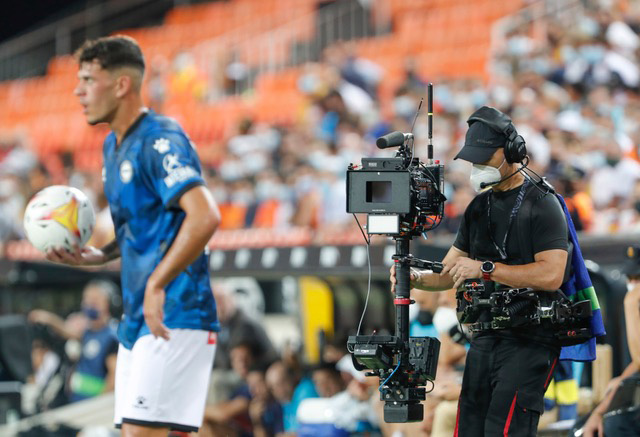

After the absence of the public due to the pandemic, LaLiga begins a new season in which UHD, immersive sound, remote production, the use of the cloud, multi-screen, 5G and virtual advertising make up the added value that has made the broadcasts of the best league in the world a global benchmark in broadcasting.
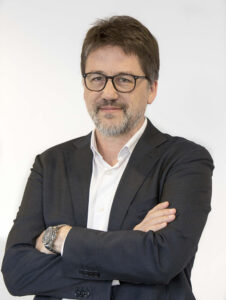
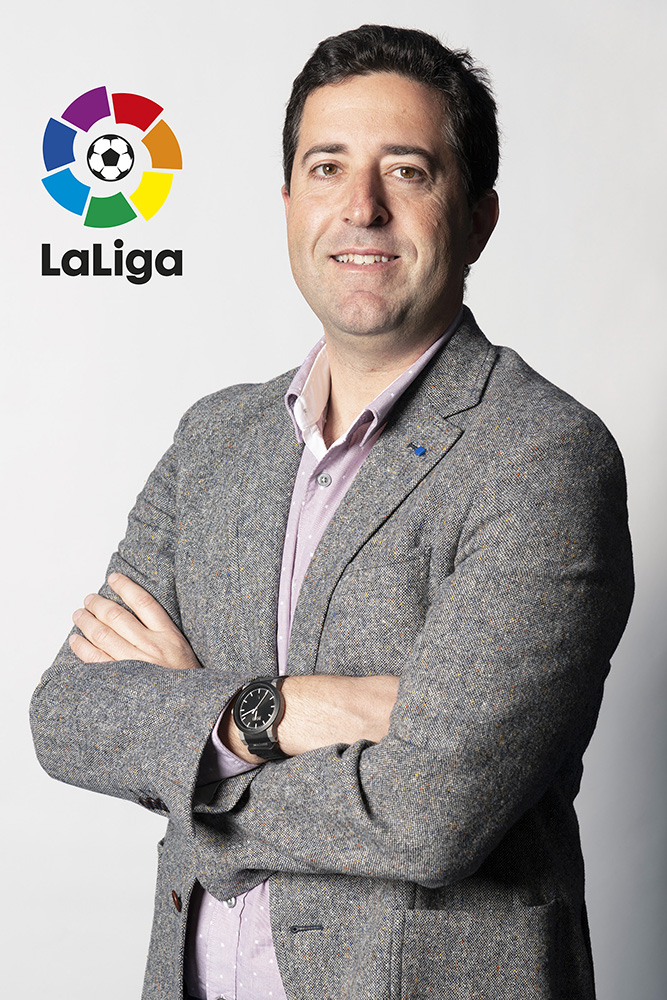
Emili Planas, CTO and operations manager of Mediapro; Òscar Lago, director of Mediapro, and Sergio Sánchez Castañer, Head of TV Production of LaLiga They share some of the new lines of work in sports production at the highest level.
The technical, visual and narrative evolution of sports productions dedicated to the beautiful game have been characterized by unstoppable progress for decades.

The will of the football clubs, the invaluable support of LaLiga in favor of the internationalization of the competition, the courageous support of content providers and the unquestionable talent of production companies such as Mediapro have made LaLiga currently a node of innovation and know how.
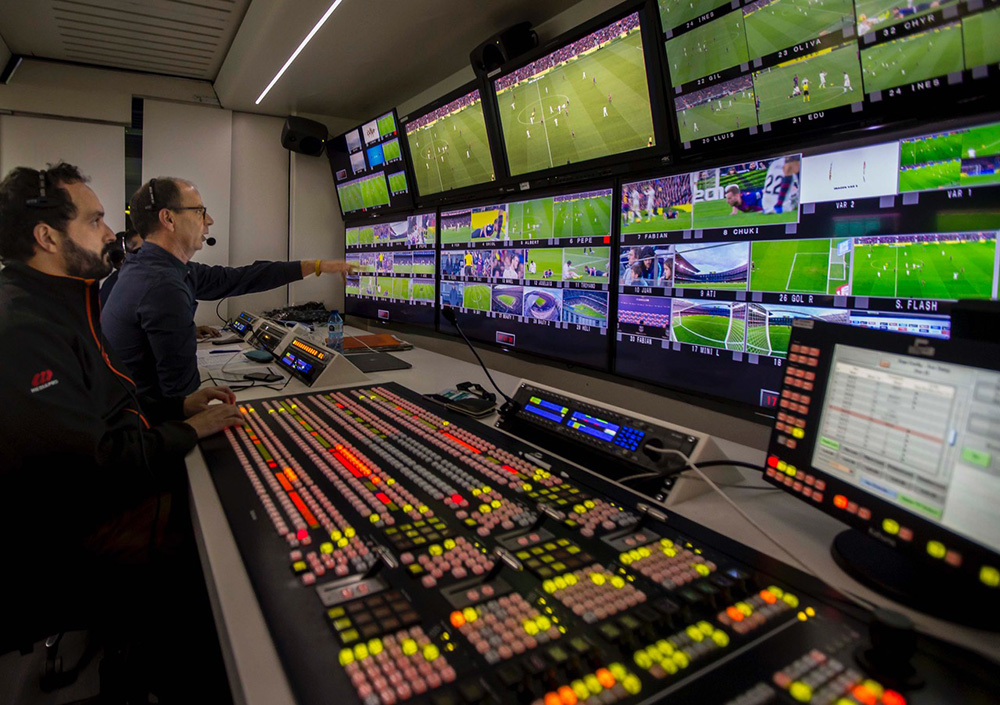
 The question is not trivial. The thousands of hours of work dedicated to the work, neither. A constant collective effort is what has ended up defining the competition as a world reference in terms of sports performance, technological boost and support for the development of clubs. Everything is measured, everything has a meaning and everything is rethought week by week.
The last major rethinking took place just a few months ago, when the Mediapro team, led by Òscar Lago and Emili Planas, together with the LaLiga division led by Sergio Sánchez Castañer, were approaching a new season marked by the gradual return to normality.
The public returns to the stadiums
The relaxation of health measures has allowed us to begin to see the public occupying the stands of competitions such as LaLiga. And with this movement, everything changes. The narrative returns to its being, and the training environment evolves to the reflection of true football passion, in which fans passionately deposit their feelings. This, as it could not be otherwise, is reflected in the production of LaLiga. Planas exemplifies this change with the return of 5.1 audio, which “made no sense” without the absence of the atmosphere surrounding the competition.
Lago provides the operational side of the production, but also the creative side, which will end up defining the story that surrounds the meeting. For him, the return of the public marks a before and after. Now they can play with plans that were not available before. You can show the reaction of the public “when there is an important play or a goal”, something that, in short, “helps the team a lot.” television show”.
The pandemic has served to put the value on role of the public in sports broadcasts. But also to improve the broadcast. This “freedom” when redefining positions has allowed us to improve the coaching chamber, which was previously “lateral, in profile”; or keep robotic cameras in the changing room tunnels, which “take up less space and give a more beautiful shot than the one provided by the operator with the camera on his shoulder.” Aside from capture, this period has helped Mediapro to experiment with “decentralized and delocalized” elements of production, as well as to develop new augmented reality graphics with tracking data. Mediacoach. “We are going to maintain the technical knowledge that we gained thanks to Covid,” Lago emphasizes.
Extensive coordination work
 Sergio Sánchez is clear that LaLiga, as a “worldwide reference competition”, has the purpose of being at the “technological cutting edge". In this way, it assumes a role of "disseminator, prescriber and promoter of technology development applied to television broadcasting in sports." It is a process that is carried out hand in hand with clubs, rights owners and Mediapro itself, promoting “coordinated and sustained” work that works on a “strategy for continuous improvement and development of television production.” Whether through continuous meetings or with the match director, who verifies that the necessary support is provided to meet the audiovisual quality standards, the competition always moves towards improvement, guided by high standards.
In the end, LaLiga provides all types of resources with the firm objective of enforcing its quality standards: “We share the goals of the seasons, the new resources available, we review procedures and carry out supervision and correction match by match,” Sánchez highlights about the continued work of all the agents that make the tournament possible.
How do you improve a high-level broadcast?
Technological leaps can accompany the improvement of production. Thanks to “small” resources, such as innovative production or the mere implementation of HDR, you can generate that always grateful “wow” effect of a broadcast. However, in what way can the production of a sports competition be improved? Is the solution in scaling resources? Maybe adding new elements?
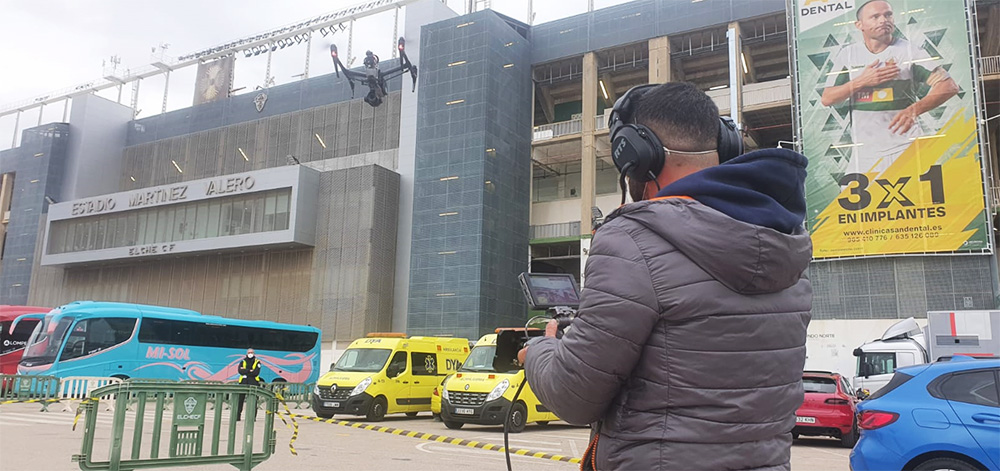
On behalf of LaLiga, Sergio Sanchez addresses the issue from two perspectives: quantitative and qualitative. Within the first group, highlights the “enormous” increase in the provision of technological resources: "We have more and more cameras, more modern mobile units, we do remote productions in many more matches, we have LaLiga audiovisual assets in the stadiums, such as aerial cameras...". However, he passionately defends the qualitative progress, which goes through “add value added content"different from what can be found in other competitions. In this area, Sánchez highlights the use of drones or the new cinematographic camera.
From Mediapro, Lago considers it necessary to clarify that the scaling of technological solutions, although it is a great resource, is not always the best tool: "A greater number of cameras does not allow you to use more shots during the broadcast or increase the pace of shots. [...] It is something that must be assessed qualitatively and not quantitatively." As the director explains, having more camera angles and measurements will improve the repetitions and images seen on the field of play, being able to choose the best angle for each moment. This is how you work in big competitions like World Cups or Euro Cups, in which you work even with 44 cameras.
Planas shares his colleague's opinion, although he points out that a growth path involves adding cameras with better or different features, such as high-speed ones: "The quality implicit in each camera also implies greater quality on the part of the viewer in the perception of the play."
Innovate or not?
I have a question: to what extent can new elements be added without breaking the daily routine to which the football spectator is accustomed?
Oscar Lago: "In the end, The making of a football match consists of telling a story. Make known what is happening on the ground with all its collateral actions and its entire background. However, sometimes breaking something means the viewer doesn't like it. We continually think about the viewer. That's why we constantly analyze and evaluate what you like and don't like. We try to have the best elements and, above all, be very innovative, although innovation sometimes means risk and not getting it right. Our goal is to make things that most viewers like. And now, with this whole new situation that whether young spectators are not so interested in football or not (which there would be a lot to talk about here), we also try to capture the attention of young spectators.”
What things do you have in mind to attract this audience?
Oscar Lago: "We think about many things. What's more, I'm sure that in a year or two we will do things that don't even cross our minds. The cinematographic image, for example, has been a "boom" among young people, since it reminds them of video games and gives a sensation of hyperrealism. Other things that we have contemplated is the multiscreen, which will have an evolution in the future. Perhaps, although we are doing futurology here, we can provide different graphics options during the game depending on the type of audience. One will be able to see the game with the same execution, with a very tactical graphics; and another will be able to see it with a more fun, more casual staging."
Sergio Sánchez: "We are not discovering anything in the sense that each generation consumes content differently. It is a challenge to offer more personalized content or adapted to each viewer profile. [...] In view are the experiences that have been developed successfully, such as "casters", which was once a brave decision. There are many viewer profiles and the challenge is to offer different possibilities so that each viewer finds their preferred option."
The multiscreen comes to LaLiga
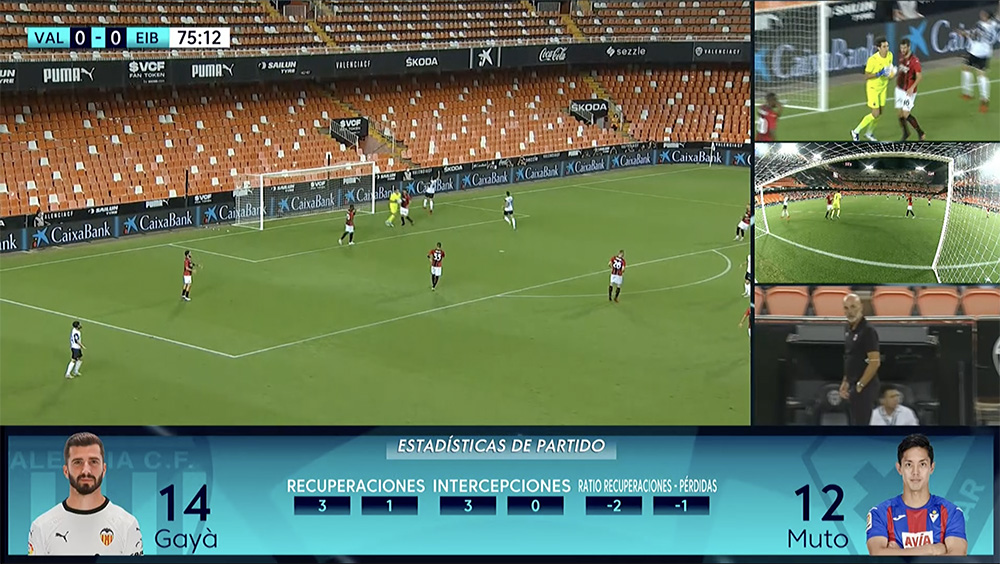
One of the main novelties of the 21/22 LaLiga season is its multipantalla, a parallel signal that shows a different way of watching the game, with a selection of parallel shots that allow a different follow-up of the action than the viewer usually does.
As Planas comments, this initiative responds to a new viewer profile. We are talking about people who no longer watch television, but frequently watch football through their tablet or computer. This public, accustomed to consuming in a multidisciplinary environment such as Twitch o YouTube, requires a new type of stimulus to capture its engagement. The proposal, halfway between an interactivity proposal and the second screen with additional information, seeks to complement the operators' current commitment, although its evolution in the medium term is not ruled out.
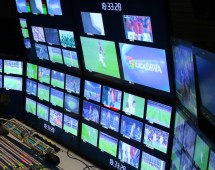
How is this signal produced? As Planas details, all signals travel from the mobile unit to the production center in Barcelona, from which LaLiga production is centralized. From this reception of live signals, all the screens are generated through an online production system. cloud and the final production is sent to the different destinations.
The value of the cinematic look
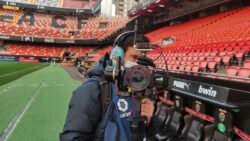
The cinematographic camera It is one of the main developments that came to fruition during the 20/21 season, marked by the pandemic. It is quite a milestone, if we consider the generous acceptance by the respectable of this look cinematic, a term translated in Mediapro's production for LaLiga due to a limited depth of field and a slightly different color treatment.
 “To do that look film we needed a large sensor camera, a full frame 35 mm", Planas begins to detail the process of selecting and adapting the LaLiga film camera. The first tests began with a camera Sony Alpha and Prime optics without zoom “to be able to play with very open apertures.” Once satisfied with the visual finish, Lago suggested the need to be able to use that camera as if it were one more in a game. In his own words: "The final camera works in dual mode. It has a television mode, with a normal camera depth, and with a very quick change it goes to cinema mode." Currently, this system operated with a steady It is used for previews, warm-ups, players exiting the field, out of bounds or goal celebrations, among other uses.
The camera that the Mediapro team has finally opted for is a Sony Venice, which shares the sensor size with the Sony Alpha and allows colorimetry and dynamic range to be adjusted much more quickly. The system, which requires a focuser to obtain the best results, collects live signals with almost no latency in 1080p50 HDR 10-bit 4:2:2. However, the original signal it captures is 4K, material that can later be used for archives or summaries.
Bringing the competition closer to the viewer
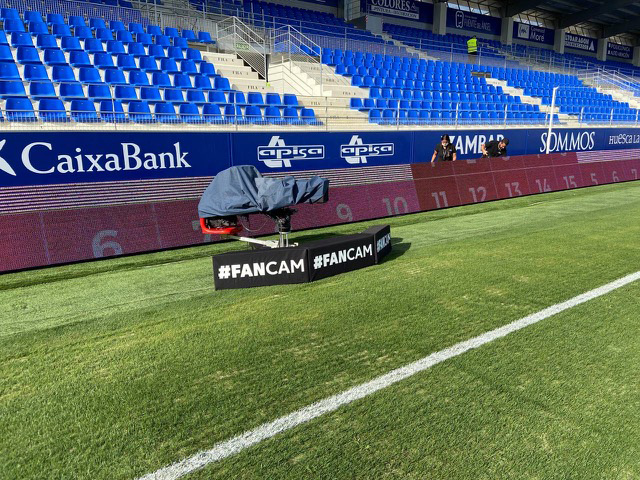
Another key this year is the Fancam, a resource to bring the protagonists of the action, the footballers, to their followers in a much closer way. And there is a collective desire to bring viewers closer to the action. However, there are barriers. Barriers overcome in other teams but that have not yet been crossed in the world of football. Listening to coaches give instructions or obtaining biometric data from the action, as has happened in other competitions, could help reduce the distance with the players.
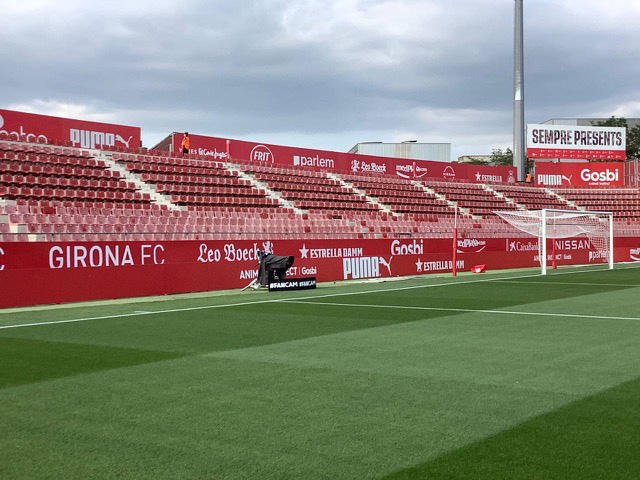 The reality is that neither in LaLiga nor in any other top-level football competition has this ban been opened. In Planas' opinion, this type of resources, although technically possible, may not be positive for the competition. Lago shares the opinion of his colleague, and emphasizes the need to value the progress of the competition during the last decade. "Ten years ago there were no regulations to follow. Each television station that had the rights negotiated directly with each club every week to obtain depending on what type of images. Everything was very unstable. There are thousands of sounds that were not captured because it was not allowed to put a microphone or a television in a specific place," he comments, to later vindicate the current situation: "Now we have a regulation and we all go hand in hand with the same objective. The clubs have understood that the improvement of audiovisual production is not a whim of a television station or a director, but rather it directly benefits them. to them […] We work in a very comfortable way and at all times they encourage us to make improvements.” “In the end there is things that are private and they do not favor the competition or anyone. It is a very simple regulation that is no more or less restrictive than other competitions,” says Lago.
Sánchez, for his part, recognizes that historically football has been a sport "extremely conservative" in terms of the "preservation of the privacy of some content." In his opinion, sport must "evolve" with the aim of becoming "more televisual and closer to the viewer." The head of LaLiga, although he recognizes the progress that has been made in this regard in recent years, placing the value of the television broadcast regulations to which Òscar Lago previously referred, considers that it is necessary to continue carrying out pedagogical work on the "value of the generation of audiovisual resources on the development of the structure of the competition itself and its clubs.”
UHD production in LaLiga
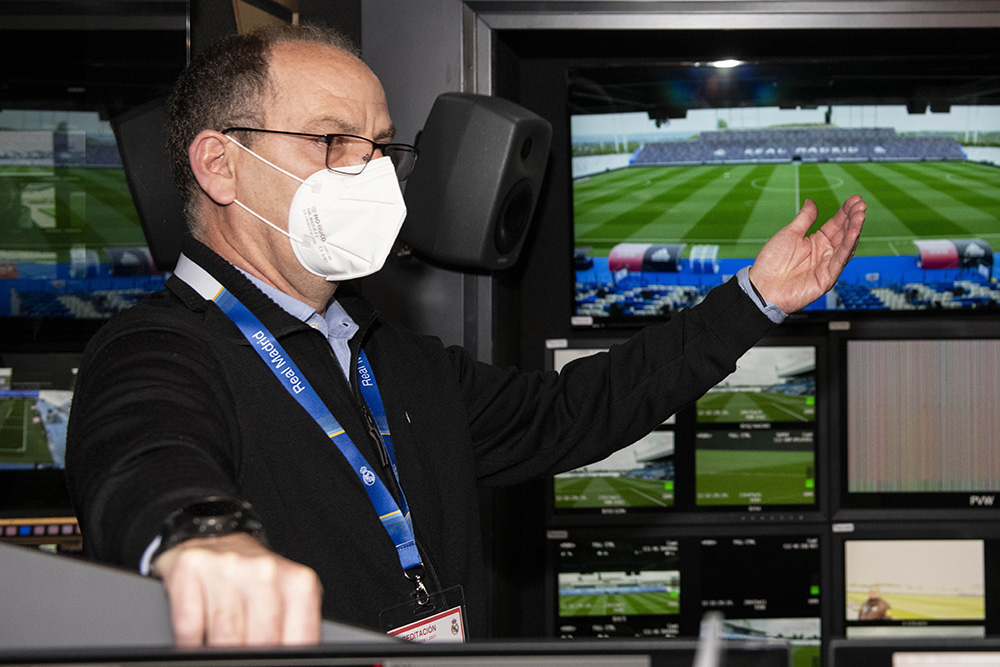
Currently, LaLiga has several matches each week with a UHD production. This operation began in the 2016/2017 season. At that time, the Mediapro team had a UHD mobile unit with 8 4K cameras, which amounted to a third of the entire production. It was a complex period, given that, as Planas relates, “at that time nobody did live UHDIn fact, it could be doubted that the production was clearly profitable taking into account the percentage of viewers who could enjoy this resolution and features.
As the years and seasons have passed, the situation has changed. Mediapro has bet everything on UHD production, developing its own internal workflow to be able to offer an HD signal of the highest quality based on a 4K workflow. Currently, all cameras used for production, except mini cameras, start from native 4K HDR quality. This enables maximum HD SDR quality, given that “the starting point is very high,” Planas points out.
Currently, in Spain you can see a selection of matches in UHD. But only the match. The preview of the match in 4K, something that is already offered in other European leagues, remains a pending issue. As Emili Planas explains, this decision corresponds to the operators and would imply certainly high costs, given that it will not only involve transmitting images of the stadium and the environment in UHD, but that all the videos used during this format as well as all the production control by the operator would have to be prepared in 4K. However, Mediapro's CTO is confident that it will be implemented within a very short time.
Remote production at the largest meetings
Currently, Mediapro dominates remote production flows and could launch into producing a classic, if you wanted, under this format. Why haven't you decided to take the leap yet? What is missing from remote production to get to that point?
Emily Planas: "Production must be approached from two perspectives. Technically it is possible. In addition to being technically possible, it is economically possible... There we could already have discussions, because we are talking about very specific events and remote production is done when you have a regular production. What's more, if you do a concrete and specific event, the technological development to cover that event is so great that in hours of engineering it will probably no longer be worth it. Another question, which is what Òscar can explain to you, is how a classic is made and if it could be made taking into account all the human resources involved.
Óscar Lago: "I just have to say that it is something that will come. I don't know when, but it will come. It will take an adaptation phase, because in the end it is difficult to replace direct contact with people on the team. But, obviously, if technology allows it, sooner or later it will be done."
So, the biggest challenge could be adapting, personally, to this new type of interactions in the field of production?
Óscar Lago: "In the end, there are things that seem very far away and that when you encounter them, you adapt very easily. The production teams are used to working off-site for many years at Mediapro and the dynamic already exists. In the end, there are things that until you do them seem impossible. But I don't see any more problem than that: an adaptation period that would surely be brief."
 The use of the cloud in sports production

The use of technology cloud in production has multiplied exponentially in the last five years. Decisions originally discarded now become common resources of large production companies. Mediapro is no less. As Planas explains, we are facing a “fantastic” resource, since in the absence of specific resources or when providing a service that was not planned, it works as a window to provide solutions to a production.
Computing or storage under a pay-per-use model. These and more tools are on the table. And what's more, the mobile units located around the stadiums themselves show progress in this field. Planas provides more details: "Until recently, a cell phone or a production center was a place full of equipment capable of receiving signals, processing them, and treating them. They were made up of dedicated and very expensive machines, since they worked with baseband signals with the capacity to modify very large bandwidths. The IT part has been reaching these capacities on a more or less regular basis. [...] It started with sound, then with graphics and now it has reached video signals."
Despite this progress, Planas believes that “there is still a world” until a production can be done completely in the cloud. Today, it still pays to have computing that is rented to third parties “in your own rack room.” Mediapro, given the high specifications of its clients, does not conceive cloud production as its main way of working. The requirements are too high. Technology has not reached that point. However, it is already being put into practice in other products such as Ubeat, an eSports channel.” “Ubeat is a channel where the level of quality of service is high, but not as high as LaLiga. In addition, their workflow lends itself to doing it in the cloud,” says Planas, although they acknowledge that they study project by project the convenience, or not, of workflows in the cloud.
 Does 5G really Will it mark a before and after?

5G technology, which has currently reached urban centers in our country as a reinforced 4G, raises numerous possibilities in the future in terms of production. Planas, when asked about the role that future 5G networks will have, those whose specifications contemplate solutions such as Edge computing, identifies two great applications: "For us there are two things to take into account regarding 5G. On the one hand, there is how we can take advantage of its bandwidth and higher level of connectivity for our production. On the other, it is understanding how 5G can increase the chances of the viewer connecting with high-quality video streaming for content consumption."
Within the first block, Planas affirms that the presence of 5G in the stadiums will not only allow there to be sufficient bandwidth in the stadiums, allowing one to send a photo, an audio or access the internet, but also offer “new types of content to the spectator who is on the field." The Mediapro team has several ideas about what type of content could be offered to give added value to the spectator who travels to the stadium. However, the unknown lies in who will be able to market these new products. The club? The broadcaster? The telco? An OTT? In this regard, Sánchez defends the development of 5G, as well as new technologies, in LaLiga's strategic objective in Help clubs increase club revenue match day (game day). "In this sense, 5G will enable enormous development. Our regulations already allow the match signal to be easily transmitted to spectators through giant screens," he says, opening the door to receiving content in real time on fans' mobile devices.
On the other hand, there is the application of 5G in production. In this regard, Planas states that “remote production capacity” could be increased exponentially, reducing latency to negligible amounts for all types of productions. However, to reach this point, a true 5G network deployment is necessary, with a high density of nodes in key infrastructures... such as stadiums.
Hyperpersonalizing virtual advertising
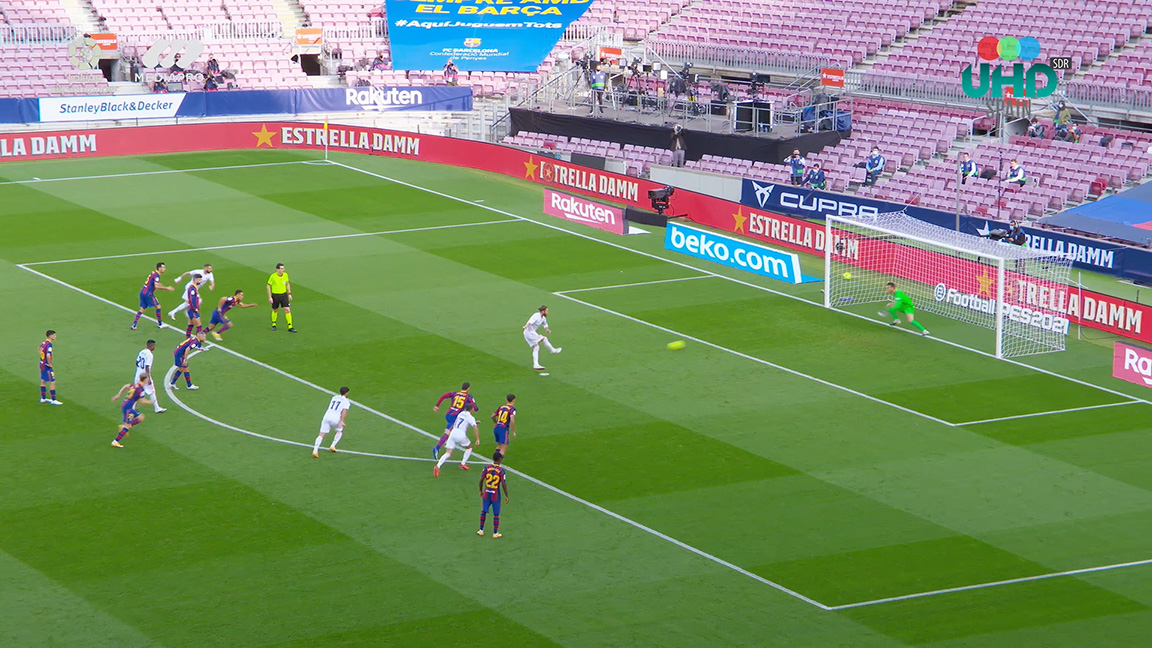
2012. That was the year in which Mediapro implemented virtual advertising in its operations. A system that has been gaining stability and versatility over the years, and that currently allows replace or insert specific advertising for each market. The question is its evolution. As the latest marketing trends seem to indicate, increasingly closer to hyperpersonalization, this involves creating personalized advertising for the viewer.
Go from the 12 feeds What Mediapro currently offers at 15 or 20 is a simple question. But personalize advertising to each user taking into account their personal preferences? That, according to Planas, is a more complex task: "Personalized advertising is relatively complex at a technical level, since the virtual advertising must be inserted into the viewer's final device, be it a tablet, a PC or a television. However, the challenge is also at a commercial level, since marketing models will have to change."
The H.265 standards already support a graphics layer, which is used to add a specific fly or add interactive advertising banners. However, from there to applying it to a broadcast and making changes to each user's own image, there is a world. Planas believes that it is difficult for “it to be done easily in the short term.” “And, also, make it profitable,” he adds.
LaLiga is firmly committed to the development of these technological and commercial solutions. Sánchez highlights that innovations in artificial intelligence have allowed the development of this type of resources to which the competition deposits numerous resources: "LaLiga has hired an international company that verifies the quality of virtualization of advertising match by match. [...] In an extreme case of system instability, action could be taken to provide an alternative and thus protect the supreme good, which is the integrity of the match signal and its quality standards."

The future of broadcasts
Emili Planas, Òscar Lago and Sergio Sánchez have expressed their particular vision on the development of technology in sports broadcasting. However, where is its future headed? What will mark the next five years?
Sánchez consider that tomorrow involves continuing to contribute added value that differentiates the broadcasts, which will generate “more proximity and closeness of the viewer to the event”, making them feel “part of it”. Taking this precept as a reference, the head of LaLiga's television broadcasts focuses his speech on the possible participation of the viewer in the broadcast: "There is a dynamic that is clear. The viewer will be the one who configures the broadcast according to his way of understanding the match or his preferences. There are viewers interested in a more technical profile, but others who simply want a more conventional observation of the match." “Obviously, it is difficult to predict the evolution of our sector in the long term, but currently the main challenges are working on proximity, closeness and personalization of the viewer's experience,” he remarks.
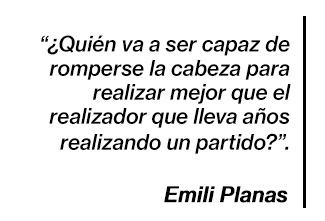
Òscar Lago is clear that the viewer must continue to occupy a central role. What's more, as he points out, "it will take an active part in future interactive products, through which the viewer will be able to interact with the screen and choose things that they will like." Emili Planas shares his colleague's vision, although he recognizes that, until now, the viewer has played a passive role. “Who is going to be able to rack their brains to perform better than the director who has been making a game for years?” asks Planas.
The definitive and transformative evolution of support
While the concepts of participation are promising on paper, the reality is that viewers They barely participate actively in the broadcast. In fact, two years ago, Mediapro offered, together with LaLiga, a second screen application based on data from Mediacoach, a deep professional source with all the data to understand a match. Despite the promise of the development, the vast majority of Spanish viewers did not use it regularly. In the end, as Planas details, "the usual football spectator can be with friends or family, but always watching the screen. He does not take his eyes off that screen, so the second screen was not common."
 However, something has changed. The game is no longer seen only on television, but on any device. Mediapro and LaLiga are clear about it. And, if the viewer watches a match on an interactive screen, it is possible that they can receive additional information to be managed by the user themselves without losing vision of the match. And that the same person expresses an interest in a team to receive personalized and editorialized information. And, to personalize the broadcast, you can have the tools to manage graphic layers, choosing which statistics or which plans to see.
All of that is possible. And change may come before we know it.
A report by Sergio Julián Gómez
Did you like this article?
Subscribe to our NEWSLETTER and you won't miss anything.
Related articles
 LaLiga continues its crusade against piracy by accusing Cloudflare of profiting from illegal football broadcasts
 CEI (Coruña Immersive Studio): the technological keys of the last large virtual production set
 The technological innovations of the 22/23 LaLiga season
 Mediapro Argentina incorporates the use of Sony's Venice camera in its sports broadcasts
 UGC in broadcast: keys, technological solutions and dangers
 The technological keys to Mediapro's 9:16 production for LaLiga and TikTok
 LaLiga adds an acrobatic drone to its audiovisual broadcasts
 LaLiga wins the Sportel Innovation Award thanks to the support of Mediapro and Sony
 Multi-camera, cinema camera and FanCam: the audiovisual news of the 2021/22 LaLiga season
 The new cinematographic camera from LaLiga and Mediapro takes the audiovisual experience of football to another level
 The latest technological solutions from Mediapro, at NAB 2019
 Mediapro goes one step further in innovation in its LaLiga broadcasts
 Broadcasters from all over the world meet at the Mediapro headquarters to learn about the latest technological news in LaLiga
 LaLiga, in collaboration with Mediapro, will introduce important technical innovations in the next season