





The making of the 2024 Champions League final, from within
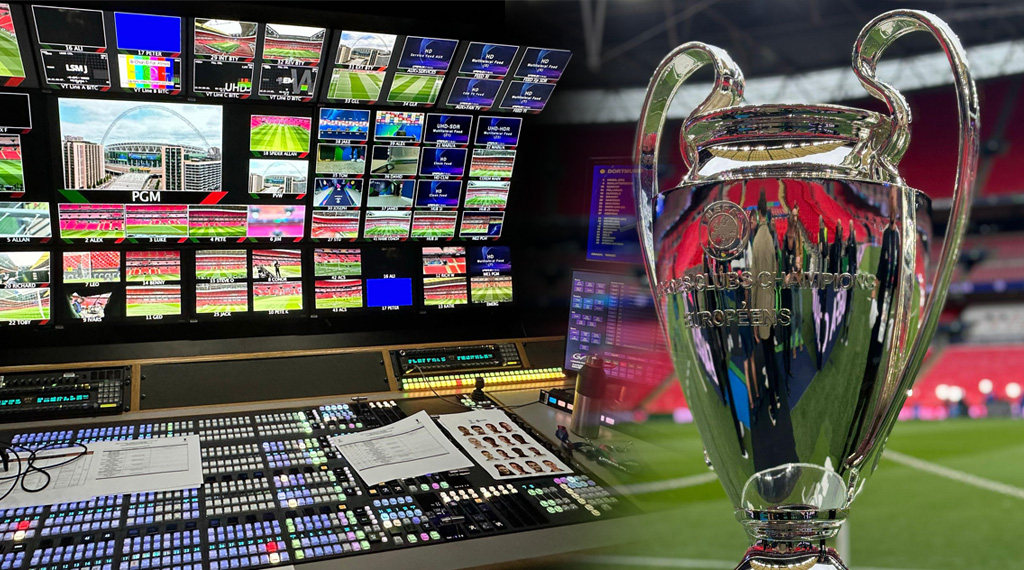
Jordi Alfaro, vision mixer in TNT Sports, shows how the holding of one of the most important sporting events of the year worldwide was shaped: the final of the Champions League, which in its 2024 edition faced Borussia Dortmund and Real Madrid.
The spectacular stadium of Wembley, located in London, hosted the final of the UEFA Champions League, the most important club competition in the world. Despite a first half in which the German team seemed to be able to challenge the Spanish team for the crown, the Real Madrid expanded his legacy by raising his 15th orejona and gathering, in the process, millionaire audiences. For example, its reach in Spain, where it achieved a 48,8% of the share in its open broadcast The 1, to which we would have to add the data harvested through Movistar Plus+, owner of the television rights throughout the season.
90 minutes of football, preceded by three hours in advance and the subsequent celebration of the trophy, were produced from near the London venue by the team of TNT Sports, designated as host broadcaster of the final. Since the beginning of the season, this British organization has worked hand in hand with the UEFA to define the master lines of realization of the meeting. Some of them, creative decisions like the always correct one british production, and others imposed by the sports organization, such as the standardization of production in an HD-HDR format.
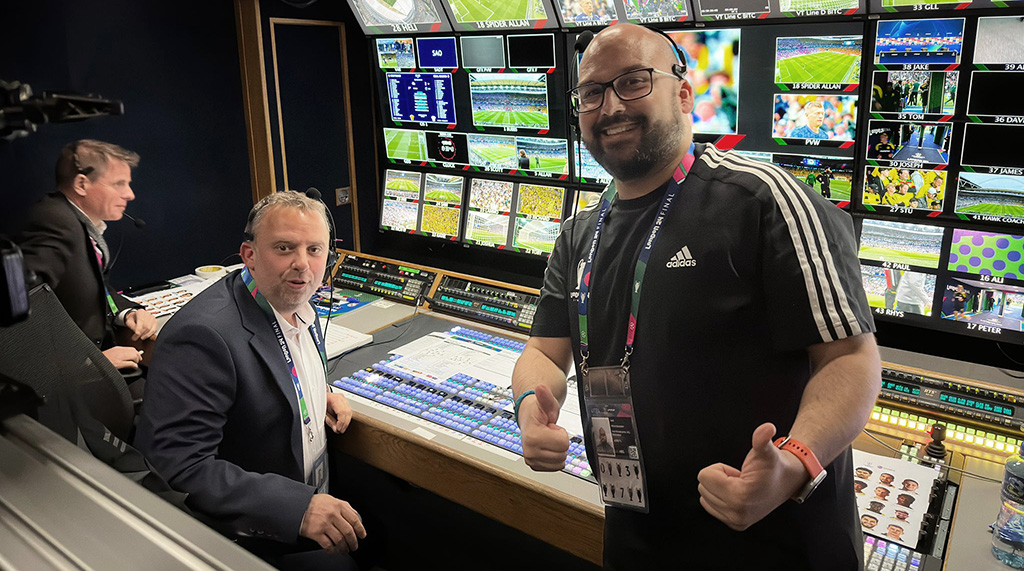 Jordi Alfaro has been linked to the world of filmmaking throughout his entire professional career. After producing football matches in the old Canal+ and accumulate four years of experience alongside Dorna Sports in MotoGP, he decided to travel to London to “learn English”, like so many other Spaniards. What was initially going to be a stay of two or three months, has become more than a decade: shortly after, he began making content for the economic channel Bloomberg, and shortly after he began to work making Premier League y Champions League. Since then, he has accumulated hundreds of matches of experience, including grand finals like the one that took place on June 1.
In this report, Alfaro shares his experience as vision mixer of the sporting event, second in command of a achievement led by experienced TV Director Rob Levi. The planning of the appointment, the creative decisions, the technological challenges, the unpredictability of the live or the decision to relegate the UHD to a upscale… The director addresses these topics and many others to share a complete photograph of how a historical veil for the millions of fans of the beautiful sport.
Understanding Anglo-Saxon realization
To understand the position of Jordi Alfaro in the realization of host broadcaster of the 2024 Champions League final, it is necessary to know the differences between the British and Spanish model: “In the UK, the mixer (vision mixer) does not cut the cameras during the match, but rather the director himself does it (TV director)”. This crucial difference in functions in the control room makes the producer/mixer duo distribute the game to choose which cameras are used or what state the repetitions are in: “The director has 70% of the production, but I have 20%. vision mixer "He helps a lot by running the game, singing cameras or helping when a replay is not ready."
"He director has the 70% of completion, but I have the 20%. He vision mixer helps a lot making the match, singing cameras or helping when a repeat is not ready”.
The remaining 10% of the equation is assumed by the figure of the replay boss, in charge of offering the repetitions completely autonomously. "We are a team of three people who always work together, we know each other very well and we trust each other. Whatever is said, we respect the criteria of the election," highlights Alfaro.
In the case of European competitions such as the Champions League, the production trio welcomes a fourth person which is called “the producer"This link between UEFA and the production of the match acts as intermediary to ensure correct communication between the parties in the event of any incident. The incident at the beginning of the match on June 1 attests to this: "As soon as the match started, after 30 seconds, three individuals entered the grass. Obviously we did not show it, because at that moment you do not know what is happening: if it is an attack, a political issue... At that moment, the producer shouted at us: "Don't show the playing field!"
Differences between a normal match and the grand final
TNT Sports, a joint company between BT Sport y Warner Bros. Discovery Established in the United Kingdom and Ireland, it usually produces its Champions League matches with an 18-camera scheme. Alfaro, after checking the previous day that everything is technically in order, is in charge of holding the meetings. A Champions League final is different: Meetings began in September 2023 and on-site preparation took place on seven days prior to its celebration.
"The first three or four days we make sure that the three trucks that are going to be dedicated to the international signal are ready. (...) If I lose the mixer, will our Kahuna, in main truck, what process do we have to do? If I lose the router and the emergency bridge, do we jump to the next truck? What happens if we lose power in the main truck?” explains Alfaro, who refers to three mobile units provided by EMG: a principal, from where broadcasts the international signal realized; one of back, prepared not only to replace the main director in case of failure, but also in charge of performing the opening ceremony with Lenny Kravitz, and a third vehicle service feed in charge of offering additional signals with best moments, replays, helicopter or Spidercam signals. All this set-up Technical testing is carried out in coordination with UEFA's technical managers, who verify that the production design meets the requirements of an event of these characteristics.
“The plans of the steady-cam with the Sony Burano "They were spectacular, the image quality was brutal and the operator was very happy."
After verifying that the deployment of signals and equipment had been established correctly, the tests began, which lasted during the Wednesday and Thursday: “Those days we rehearsed the ceremony, the arrival of teams, the celebration, the presentation of trophies…”. On a technical level, the TNT Sports team did not encounter any problems except the configuration of a camera Sony Burano, employed in a steadycam to give close shots of the American musician in the run-up to the meeting: "Normally we would use the Sony Venice for these shots, but since the camera operator needed a lot of mobility, we opted for a smaller and easier to operate camera. The truth is that we ran into problems mounting the camera at the radio frequency level with the antennas and we had to ask Sony itself for help. They worked quite hard and we were able to integrate them into the broadcast. The shots of that steady-cam "They were spectacular, the image quality was brutal and the operator was very happy."
On Friday, the machinery started with the teams visiting the stadium, press conferences and live training. Twenty four hours later, D-Day arrived: “It is a very long week for us,” Alfaro acknowledges.
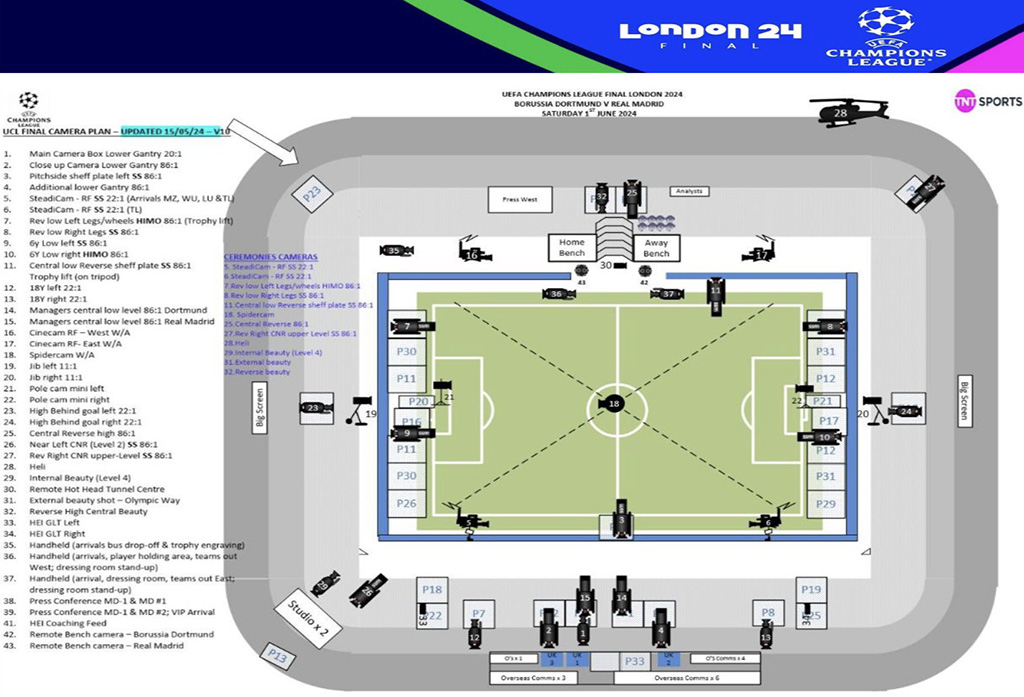
A technological bet with 42 cameras without UHD
Although the standard performance of a Champions League match is 18 cameras, the figure was expanded to 42 ahead of the grand final. "We added a lot of cameras to the filming. We had 14 super slow-mo, of the high-speed and we add others that cannot be used in normal matches. For example, the cranes We do not use them in the Premier League since there is no space and it is difficult to get them approved. But for a Champions League final, and even more so at Wembley, we didn't have any tests,” explains Alfaro.
Among the teams deployed on the field of play were unpublished additions for the TNT Sports team facing the Champions League as of the steadycam on the playing field, which carried super slow-mo cameras. "UEFA accepted them for the first time. We did several tests and they were scared, but I think they gave great images, especially in the replays." Another addition that required negotiation were several robotic cameras located in the dugouts: "We had to ask permission from the teams. There were two cameras that also gave the option of repetitions in slow motion, which allowed us to have great repetitions of the coaches and the players on the bench.”
“It is a bet that the UEFA has decided to do. No The matches will take place in 4K, and from next season in the Champions League, the same: we are not going to make 4K in no country, but we are going to make a climbed”.
The entire Champions League final, as was already anticipated during the weeks prior to the event, occurred with a HD-HDR standard, a movement that will also extend to the holding of the imminent Euro Cup and that represents a significant setback for the defenders of UHD as a production standard: "It is a bet that UEFA has decided to make. The matches are not going to be produced in 4K, and from next season in the Champions League, the same thing: we are not going to do 4K in any country, but we are going to scale it to 4K." Aside from theories that may justify this decision in the low penetration of UHD televisions in Europe as a whole or the reduced supply by the rights holders of this format, Alfaro believes that the decision is possibly an “economic issue.” In his own words: “It is cheaper to produce in HD-HDR in all countries, and obviously it is easier for UEFA, which can then control all production at the European level.”
UHD technology is ready, of course. But even the TNT Sports team acknowledges that it would have been complex to shape a final of these characteristics, with such a number of cameras and resources, in UHD: "We had 66 signals entering the pixel, and 14 or 16 output, which would have made it almost impossible to have offered everything in 4K. At the end of the day, I think that HD-HDR looks pretty good. Also, when you do a scaling, maybe the people who work in broadcast notice it, but most people don't."
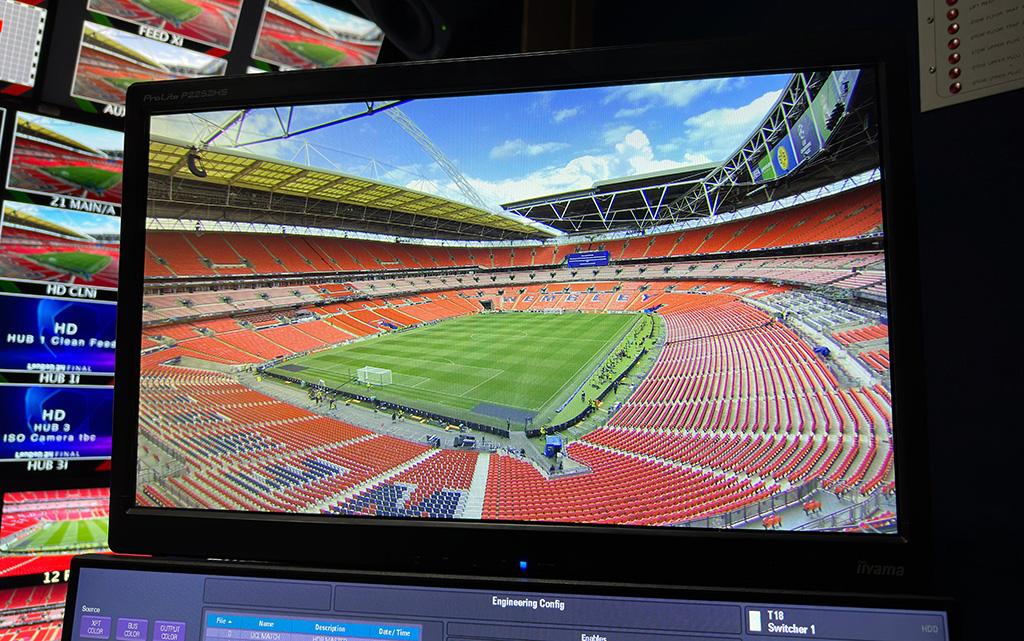
Cinematic look, before and after the game
Only 2 of the 42 cameras used in the production of the Champions League final had cinematic features. It is a conscious decision: the technology yields spectacular results as has been demonstrated with the LaLiga team in Spain, but “creatively” it does not fit with the vision of TNT Sports: “We use a lot of steady live. When the ball comes down the sideline, we poke them a lot. But we believe that, on a creative level, when you cut from a broadcast camera to one with look cinematic, it doesn't look that good. I think what Mediapro has done is incredible and fantastic, which can vary the look of the same camera, but we, for economic reasons and ease, wanted to use a steady normal”.
“We believe that, creative level, when you cut from a camera broadcast one with look cinematographic"It doesn't look so good."
The cameras of look cinema for the Champions League final were used in the preludes to the meeting: the arrival of the players to the stadium, their celebrations once they have won the title or to capture the reactions of the fans. "There we do go in with the cinematics, but during the match we limit ourselves to the basics. That is the basic rule of football coverage in England. Although it may sound a bit bad, we don't like to do strange things: English football is like that, they have learned to do it like that and they know how to do it very well," Alfaro points out.
He arrives match day: final touches and realization
"Believe it or not, the most relaxed day for me and for the majority of the team is the day of the game. We have done so many tests of all kinds that it makes us much more relaxed," says Alfaro about the day of the game. The decisive day began at 11:30 in the morning (British time) and extended past midnight.
In the words of vision mixer from TNT Sports: "After settling down and having a first meeting, at 12:30 we did all the technical tests and retested all the cameras, positions, microphones and replays, which took us an hour and a half. Then, from 2:00 p.m. to 3:30 p.m. we did the end-to-end test, a UEFA initiative in which we have a running order in which we have to show different elements: that the audio and video are "OK" for the broadcasters, graphics tests, tests of all the technologies from UEFA suppliers such as semi-automatic offside or goal line technology. " After a one-hour break, at 5:00 p.m. the show started. international signal: arrival of teams, inspection of the pitch, ceremony, match and celebrations.
"From March we change the monitoring and we adapt it to 42 cameras, even without having them, so that the director and I can we would get used to how we were going to work in the final”.
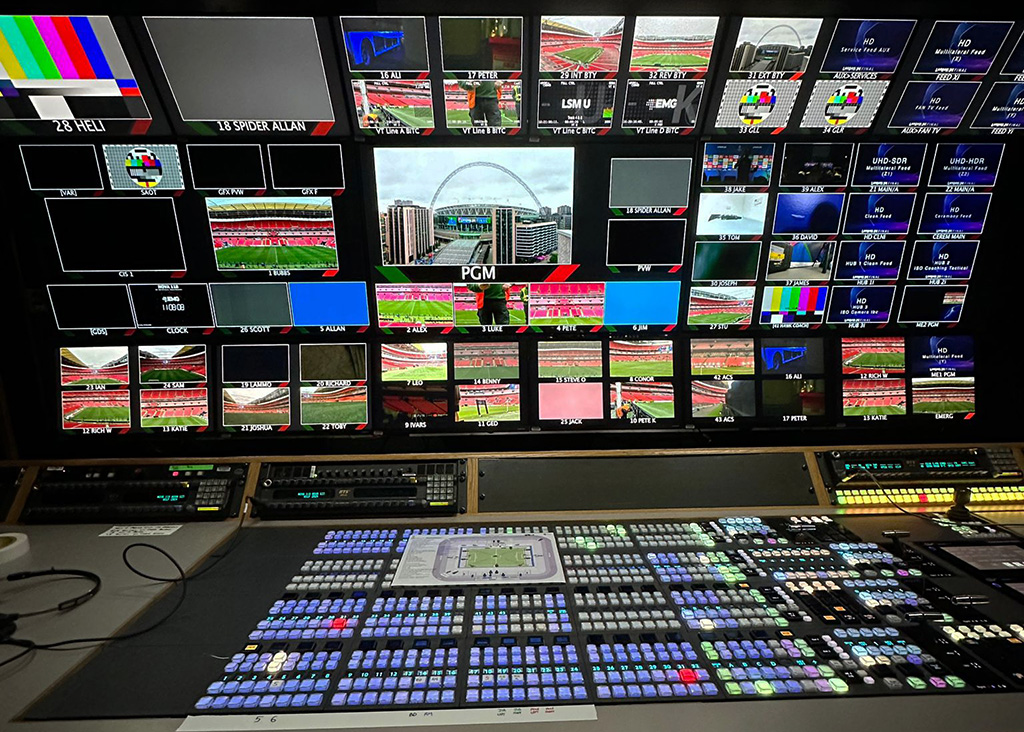
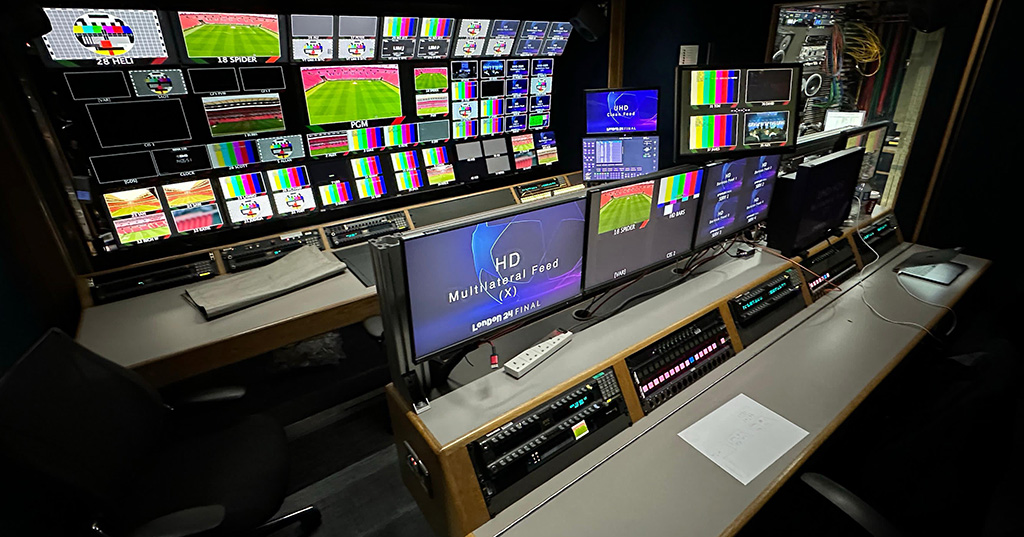
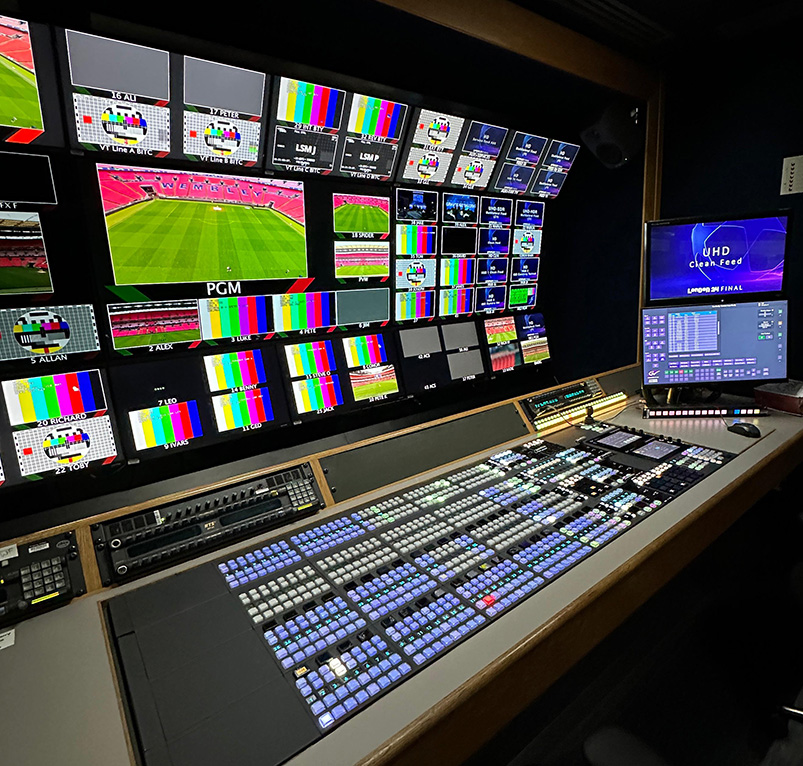
The mobile unit from which the final was held was an old acquaintance of the TNT Sports team: the same EMG vehicle from which all the Champions League matches have been produced. The operation did not differ from a normal journey, except for the difference of starting to monitor many more cameras. However, Alfaro was prepared: "Since March we changed the monitoring and adapted it to 42 cameras, even without having them, so that the director and I could get used to how we were going to work in the final." In the end, although 30 cameras were used in the live show, Alfaro adapted the mixing console to handle all the signals at his disposal: "We had to take two benches, as is always done in matches of this level. I used 60 buttons instead of 40 to accommodate all cameras, graphics or EVS. “That was the only big difference in making this final.”
Chaos after the final whistle
Minute 90, five minutes of stoppage time… and the execution scheme changes. The completion of the Wembley final is before dozens of lights in parallel of protagonists of the meeting and fans. The broadcast scheme of the meeting is completely modified to go to the purest direct: a constant improvisation in a framework of euphoria.
“We sense that the Madrid I was going to win the final ten minutes before. At that moment, we began to prepare the cameras what we need, we send a steadycam al dock of Madrid and we arranged the cinematic cameras”.
"We sensed that Madrid was going to win the final ten minutes before. At that moment, we began to prepare the cameras we need, we sent a steadycam to the Madrid bench and we set up the cinematic cameras,” explains Alfaro, who also alludes to the chaos of a celebration of these characteristics: “We tried to show the best reactions as best we could. The problem is that at the same moment you have Jude Bellingham jumping on one side, Kroos with Modric in his last game, Ancelotti going to kiss his wife. It's complicated! You have to decide in milliseconds what you want to teach.”
To cover this celebration, TNT Sports relied on a floor manager, a profile that from the pitch alerted the production team of the status of the assembly of the platform for the ceremony, or previously scheduled events, such as the one in which the cup would arrive on the pitch. Even so, the crucial moment was covered: "We had very controlled and rehearsed the moment in which the trophy would be raised. We knew that we were going to start with the hi-motion camera live, then we were going to cut to the steadycam passing in front of the trophy and in fourteen seconds there would be fireworks, so we were going to go to the helicopter. Everything was super studied.”
 Remote production… starting in 2026?
As is usual for broadcasts of this nature, everything was done on site. It didn't matter that TNT Sports had four years of holding Premier League matches remotely with the mobile unit in the stadium and producing from London. In the end, as Alfaro comments, ““There is always the doubt.”.
He vision mixer It has produced large remote matches, such as the final of the Women's World Cup from Australia, which took place “without any problem” with a deployment of 26 cameras. However, its daily operations have yielded drawbacks to bet on this technology. And, of course, the human factor is decisive: "We have had some problems remotely. On some occasions the fiber can fail and the mixer hangs for 10 or 15 seconds, something you cannot afford in a Champions League final. Furthermore, in a final as big as the Champions League, on a creative level, we all want to be on site to better control the rehearsals and see the physical places where the protagonists are going to appear."
It is true that the Euro 2024, which will be held in just a few weeks, will opt for an in-person model. Even so, there are voices that indicate that the change, that which will redefine the production of major live sporting events, could be much closer than expected: “At the level of the World Cup 2026, what I'm hearing is that, although all the filmmakers are going to be on site in the United States, all the repetitions will be done remotely. The path is already beginning to take hold and I believe that, at some point, perhaps in 2030, we will be able to do completely remote production. “I think we are very close and the key will be to convince the bosses that it will not fail.”
A report by Sergio Julián Gómez
Did you like this article?
Subscribe to our NEWSLETTER and you won't miss anything.
Related articles
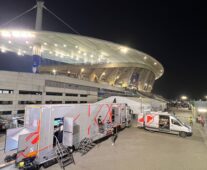 UEFA once again entrusted Mediapro with the production of the Champions League final
 Kings League, from within: this is how the Ibai and Piqué soccer tournament is held
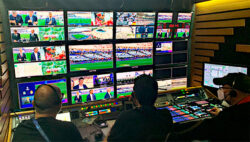 Mediapro: great technical and human deployment to cover the UEFA Champions League final
 Mistika Ultima (Sgo), used for the post-production of the Champions League final show
 UEFA once again trusts Mediapro to produce the Champions League final
 Mediapro produces the final phase of the European Champions League of Volleyball
 Mediapro will produce the final phase of the UEFA Champions League in Lisbon
 Eliance covered the Champions League final from a bird's eye view
 Mediapro will produce the UEFA Champions League final with a large deployment of special cameras
 The Champions League final, captured live in 4K with the Sony HDC-4300
 Multi-camera production in the hands of Sky subscribers in the Champions League final
 TV3 broadcasts the UEFA Champions League Final in Dolby Digital Plus
 Thirty-four cameras for the Champions League final
 TV3 will produce the Champions League final in 3D