





Graphics and large LED screens in broadcast formats: the case of 'Mañaneros' (RTVE)
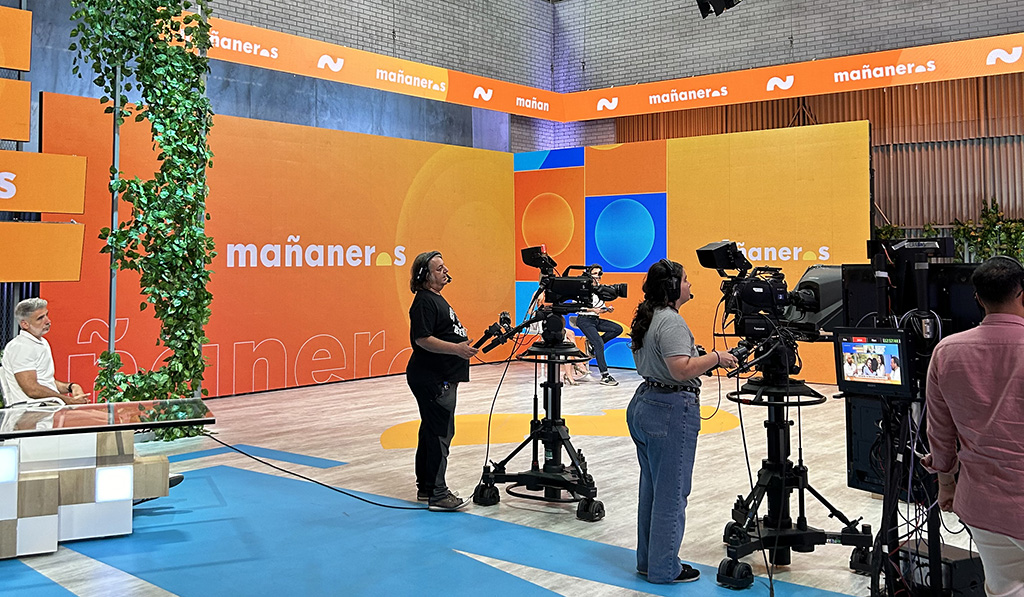

José Antonio García, member of the graphics team at Miss Motion for the magazine RTVE y The Comet TV 'Mañaneros' addresses the creation of content to feed the large LED screens that increasingly star in the scenery of television programs, analyzing challenges and workflow.
Historically, the union of scenography and graphics in the broadcast context has been based on changing trends that, especially in recent decades, have found in the technology quite an incentive. Innovations such as the generation of virtual environments based on chroma, the interaction with physical elements or the superimposition of graphics in real environments have allowed us to improve the narration and, in the process, optimize the engagement by one public willing to let yourself be surprised con new visual formats.
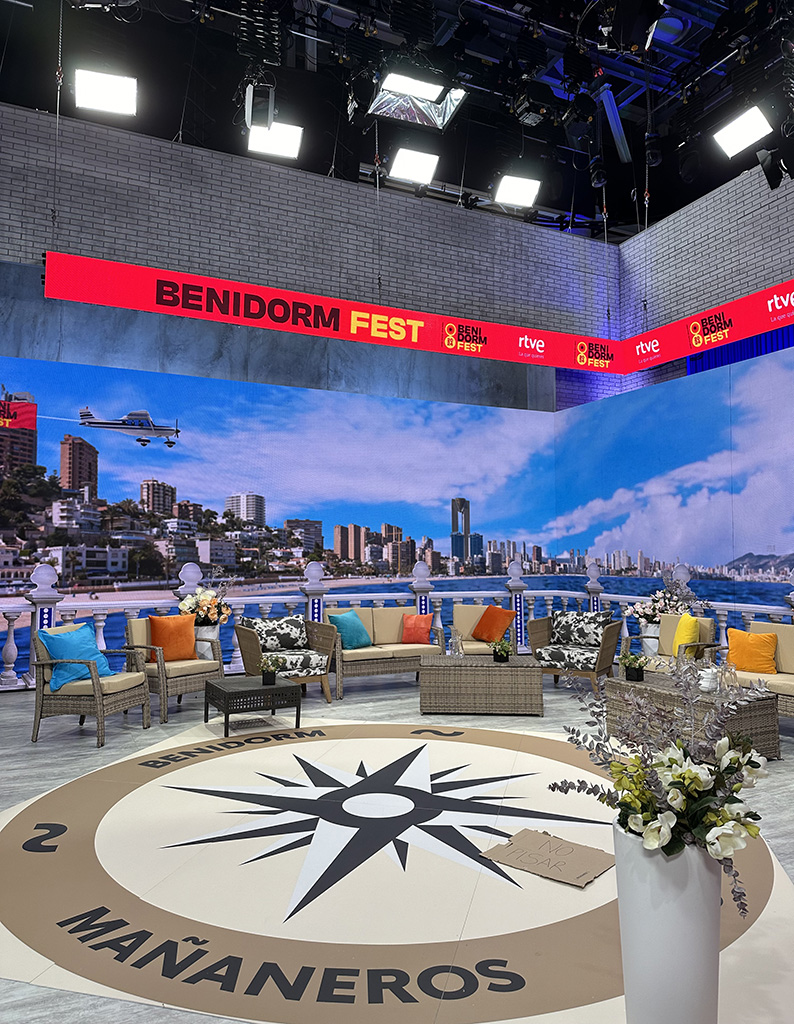
Las large LED screens have emerged as the great visual trend of the last five years. Currently widespread in most of the broadcasters in our country, although present for almost a decade, these supports provide great opportunities to improve the visual finish of the set and improve the narration. For the RTVE team, este tipo de recursos “incrementan la capacidad de comunicación y aporta imagen de marca”; hasta tal punto, que todos sus centros territoriales han acometido una transición a este tipo de recursos. Comparte esta visión Jesús Lozano Corchón, director of image and production of Antena 3 News, que valora positivamente la percepción de unos espectadores que se encuentran con elementos “espectaculares y curiosos”, o Andrés Díaz Díaz, director de ingeniería y mantenimiento de sistemas de televisión de Mediaset Spain, quien destaca cómo estos soportes pueden ofrecer un “nuevo planteamiento audiovisual del relato informativo”.
José Antonio García ha centrado su carrera profesional en la creación de grafismo para formatos de magazine. Tras haber trabajado en solitario en formatos como Madrid Direct o realizar distintas labores en La Roca, actualmente centra su actividad en el diseño de pantallas con escenarios e informes para Mornings, programa matinal de RTVE en coproducción con La Cometa TV. García cuenta cómo es trabajar con este tipo de soportes y de qué manera afecta a su trabajo diario, basado en aunar espectacularidad, integración con elementos escenográficos y narración para dinamizar un formato que bebe de elementos como la agilidad o la variedad temática.
The day to day of Mornings
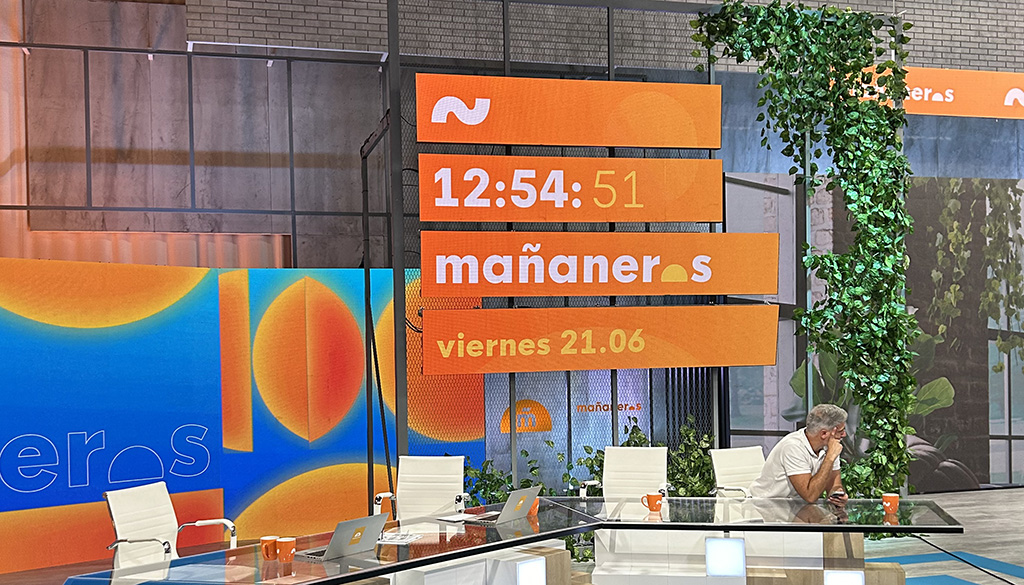
El equipo de grafismo de Mornings, composed of seis personas, works from 7 in the morning to prepare the graphic resources that will flood the magazine starting at 10:40. The editorial team send your requests, and its coordinator, Nabil Boufada, is in charge of distributing the game among the members: "There are more complex requests and others that are simpler. Everything is done on the day, and in general you don't usually take anything with you for the next day."
The team of graphics of Mornings, composed of seis personas, works from 7 in the morning to prepare the graphic resources that will flood the magazine based on the 10:40.
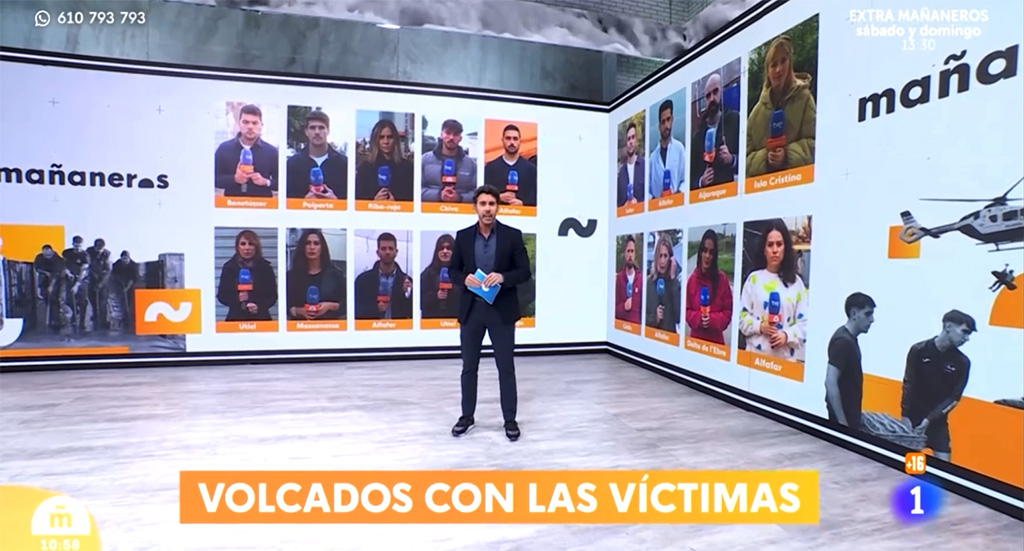
It does not differ from the usual work of the graphics team of any current affairs program. The differentiating element is the large screen of the Spanish manufacturer of LED screens Alfalite that structures the scenography of the format, conditioning its day-to-day life and throwing opportunities in the process: “In Mornings, we believe that they have two very interesting functions to tell the news. The first are the reports that are prepared around information, providing graphics, maps, data or images, and the presenter supporting the message. Our goal is to make it easier for the viewer to understand the topic, because in the end there are four hours of live shows per day with a lot of elements to cover.”
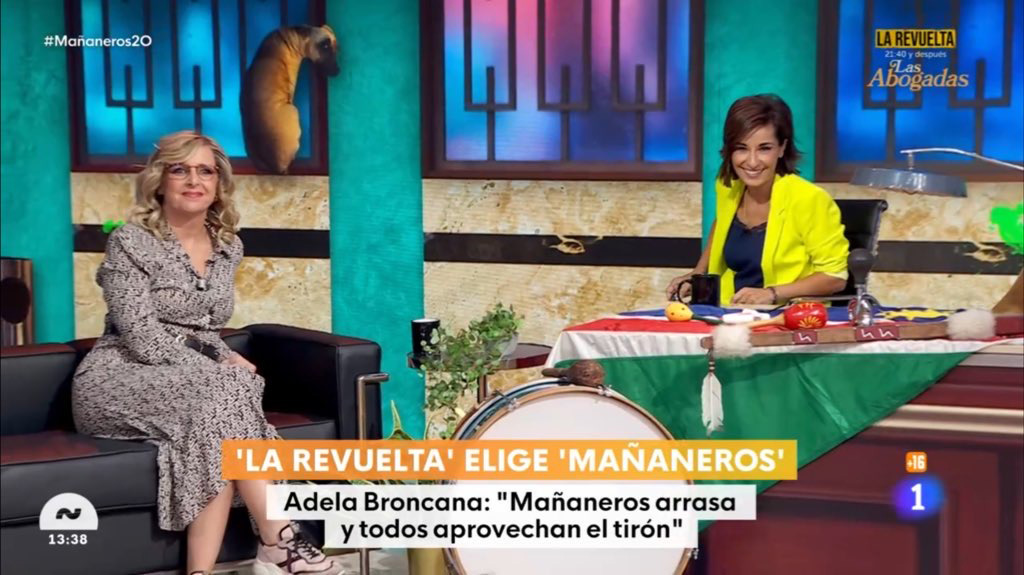 The second major application of this support is elaboration of scenarios to contextualize the news. These are possibilities very close to those of the XR content que recientemente suelen salpicar los informativos. Y es que todo tiene que seguir formando parte de la identidad del formato: “Si la noticia es las campanadas de fin de año, ese día recreamos la Puerta del Sol y los colaboradores, de alguna forma, se trasladan al lugar de la noticia. También hemos recreado el plató de The Revolt, y en verano teníamos la sección “Hola, Mañaneros” en la que los colaboradores se iban al chiringuito del programa en la última hora, otorgando un tono más fresco para dar paso a directos y temas propios del verano”.
La creación de grafismo para pantallas LED
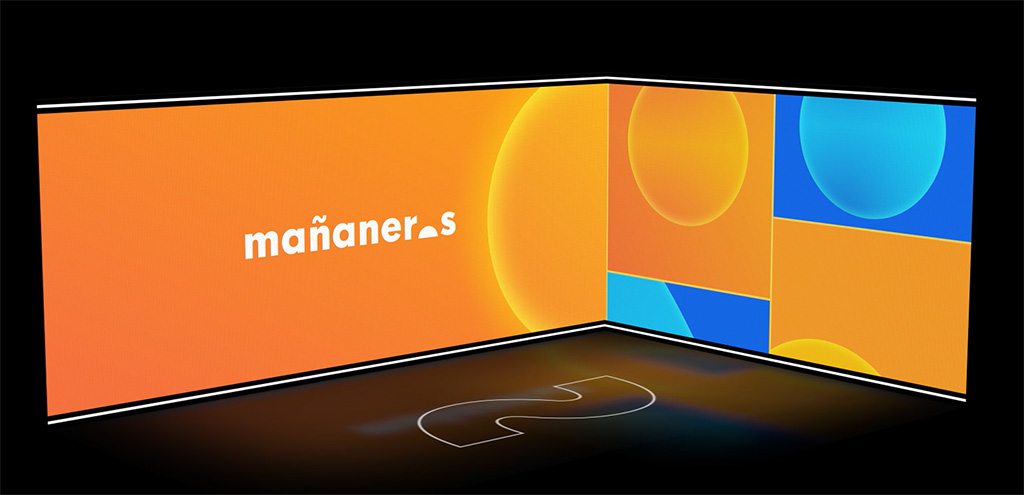
The team of Mornings parte de una composición de grandes dimensiones en After Effects to create the different contents for the LED screen of the format. Its resolution, 4,704 x 1176 pixels, is divided into four modules. Depending on the space on the set in which a news story is going to be developed, García and his colleagues are in charge of one area or another: "I love After Effects. It is the best software we have: it gives us many possibilities to design headers, bumpers, curtains and other elements.”
The content generated with the software Adobe are sent to the graphics system Chyron for integration on screen. (…) The tool chosen by RTVE is the one that offers the “best and simplest workflow”.
The content generated with the software Adobe are sent to the graphics system Chyron for integration on screen. García has been able to work with other systems, such as Vizrt (The Sixth) or Avid Maestro (Telemadrid), but considers that the tool chosen by RTVE is the one that offers the “best and simplest workflow.” In all cases, it is essential for the graphic designer to carry out a study of technical needs of each of the software, with special attention to the specifications of coding.
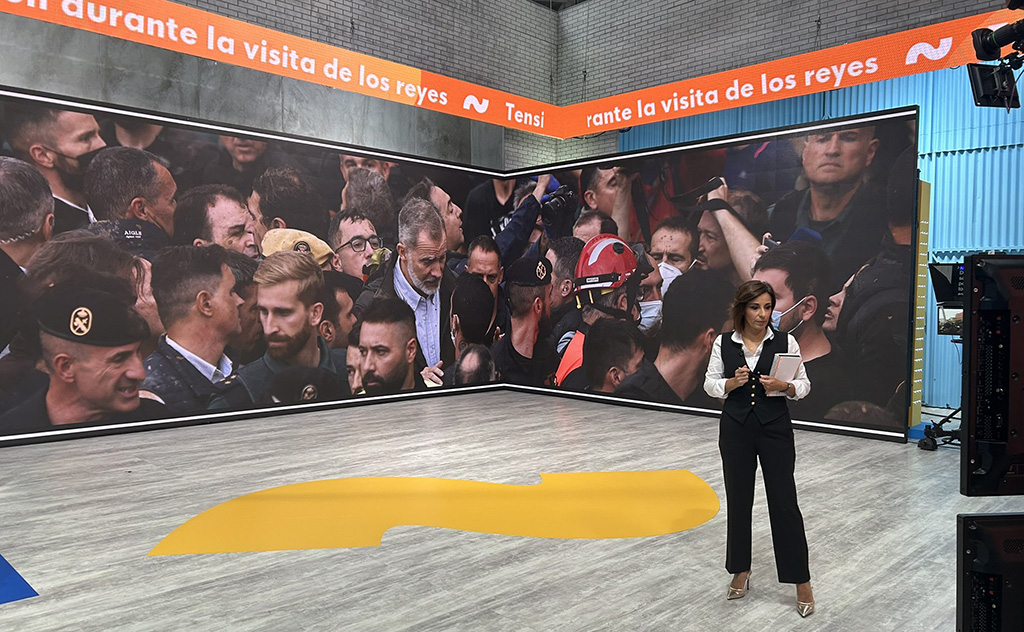
 Additionally, it is necessary to have resolution material to be able to introduce the elements organically, avoiding possible sharpness problems. García and his colleagues do not use tools of Image rescaling AI, an increasingly widespread trend. Everything you need from the image bank Getty y del propio archivo de RTVE: “A partir de ahí, vamos componiendo y diseñando la pantalla. Es enorme, entonces tenemos que ver cómo componer y dar forma a la noticia”. A este respecto, el collage editorial es una de sus mejores herramientas: “Recuerdo la primera vez que los Reyes visitaron la DANA de Valencia; de hecho, retrasaron el programa por lo que estaba sucediendo y lo cubrió el 24 Horas. Muchas veces tenemos que estar al loro de lo que va entrando en nuestro banco de imágenes en tiempo real. Con esas posibilidades, fuimos componiendo hasta dar forma al collage”.
La gestión de gráficos desde realización
La mayoría de gráficos que aparecen en pantalla nacen del flujo de trabajo previamente descrito, si bien en ocasiones, desde realización, se utilizan una serie de plantillas que sirven para implementar vídeos o conexiones en directo: “En realización tienen una pantalla que, dependiendo del número de directos que se quieran lanzar, ponen una u otra. Esto se utiliza mucho en la sección “A esta hora”, que es una ronda de directos muy picaditos”.
Otra opción para lanzar vídeo en directo es la utilización de un sistema de coordenadas que servirá para introducir la conexión en directo en la posición adecuada de la pantalla LED del plató: “Les damos un valor de X, Y y escala para que lancen la señal en el lugar en el que nosotros queremos. Esto nos permite jugar con los diseños que hemos hecho en After Effects”.

Aprendizaje y precauciones para gráficos en pantallas LED
Ensayo y error. Así define García cómo ha sido el proceso de aprendizaje para llevar el grafismo a las pantallas LED de grandes dimensiones. Aunque el equipo contaba con una amplia experiencia en la gestión de gráficos para todo tipo de soportes, fue al face the set and to the contents of Mornings when they realized which were the most appropriate elements: “In Mornings "We've all been around since before the program started, and there have been a lot of things that have been discarded because visually they don't work or they don't convey what we had initially imagined."
One of the main problems encountered García and the team Miss Motion is the management of proportions of elements displayed in comparison to the on-screen presenters. To address this issue, they have created references that translate meters to pixels with which they can adapt the elements to the staging: “It is something that we work on a lot in the actings: if we have to put a sofa, this way we avoid it being double the size size of the presenter, something that, especially at the beginning, has happened to us.”
He color space and the palette are chosen beforehand, but the set lighting or the balance camera can vary from day to day. In order to maintain continuity, the graphics team has a study sign in which they can check if there is a correspondence visual exact.
Another relevant issue is the display of colors on screen. The color space and palette are chosen in advance, but set lighting or camera balance can be vary from day to day. In order to maintain continuity, the graphics team has a study sign in which they can check if there is a correspondence visual exactly what it had been designed with: "The color profile that our monitors have is not the same as what will be there, so many times we have to change things on the fly. This also depends on the time available and the workload."
This improvement purpose extends to the current list of requests that the graphics team receives: "We have a document in which, when they ask us for graphic material, they give us a note about talent and scenography. If there is going to be one or two presenters, a table in front... Everything adds a context so that we can compose the elements in a more organized way."
An unstoppable trend
Las pantallas como soporte, más allá de aquellas que habilitan XR environments, se muestran como una opción atractiva, y cada vez más rentable, para transformar y aportar versatilidad a la escenografía de todo tipo de formatos. El futuro es prometedor, y el graphics tendrá que seguir adaptándose para sacar su máximo partido.
“El plató de Informativos Telecinco, que han sido los últimos en sumarse a estas pantallas, ahora cuenta con un soporte que ocupa casi todo el espacio. También tenemos casos que están usando estas pantallas como el propio decorado del plató, como es el caso de Conspiranoicos. In a few years this trend will evolve both visually and technically. I hope we have many possibilities, because that would be more work, and work is always good,” García concludes.
A report by Sergio Julián Gómez
Did you like this article?
Subscribe to our NEWSLETTER and you won't miss anything.
Related articles
 RTVE's A3 studio in Torrespaña integrates Alfalite Nepix screens
 Audiovisual training is transformed by looking at the big broadcasters: the case of João de Deus Secondary School
 Alfalite signs an agreement with wTVision to offer an integrated LED screen and graphics solution
 AJA reveals seven major updates at NAB 2024 to remain at the forefront of standards, formats or protocols
 RTVE returns to great historical fictions with the filming of 'Ena'
 RTVE's fiction formats showcase lands in Toledo
 Ross returns to NAB 2023 with great news: new mixer, LED screens...
 More screens and more graphic resources to bring information closer to the RTVE Territorial Centers
 Atresmedia implements new larger and more immersive hybrid advertising formats
 In the recesses of true crime: the case of 'Lucía en la web' (RTVE Play)
 RTVE and Tokyo 2020: New set, innovative formats, voice assistants and five signals via RTVE Play
 El corto interactivo ‘Tu primer día en El Caso’, del LAB de RTVE.es, Delfín de Oro en los Cannes Corporate & TV Awards
 The Corporation is committed to new digital formats with RTVE Digital
 Christie's new Duo solution will make it easier for exhibitors to offer 2D and 3D on large screens