





Virtual production in the audiovisual sector and its relationship with intellectual property
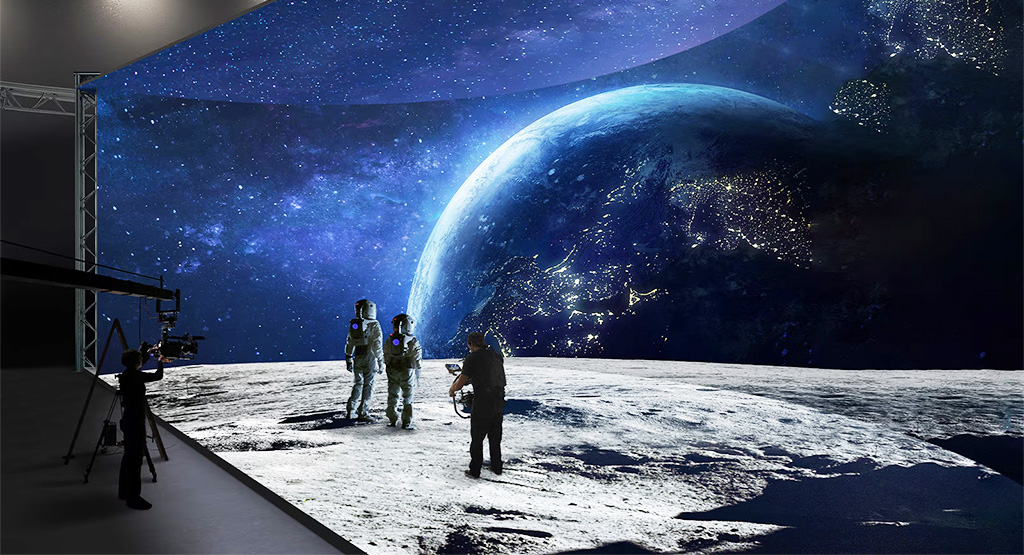
In this forum, Mario Arcos Miró, lawyer in Bardají & Honrado, analyzes the recreation of people, scenarios and protected works in the contexts of virtual production, an area that poses unprecedented challenges for intellectual property.
Currently, there is a great and rapid advance in the techniques of audiovisual production that use systems and tools artificial intelligence. In this way we can create and transform all kinds of elements intended for appearance in audiovisual works. In this article, a brief analysis will be made of these new audiovisual production techniques, and the possible implications and collisions that they may have with our intellectual property protection system.
To begin, we must clarify what is meant by virtual production. Virtual production “uses technology to bridge the digital world with the physical world in real time” by combining traditional film techniques with the latest digital technology. For a virtual production, or part of it, to be considered a virtual production, it must meet, at least, the following requirements:
- Previs/techvis: We know this as the technical preview of a location or scenario, which is used to mark the limits or scope of the recording prior to filming.
- ICVFX: This term refers to the possibility of previewing the virtual elements added to the scenario in real time on the camera.
- Simulcam: It occurs during filming, and allows you to view the final result of the integration, giving the sensation of recording in the same real location.
Therefore, one of the advantages and characteristics of virtual production is that it allows us to include in the audiovisual work virtual elements, such as works of art, parts of sets, people, entire locations, etc. These elements that are included in the audiovisual work through virtual production can be real or not, that is, they may have been created “ex new” or, on the contrary, being elements that exist in the real world, but are included in the work through virtual production techniques.
It is of great interest to carry out a study on the relationship and possible collision between the intellectual property rights, and the inclusion of existing elements in audiovisual works through the use of virtual production tools, and for this we are going to analyze some of these elements.
1. Works located on public roads
We will begin by analyzing in our national regulation and, therefore, community, the possibility or not of including works protected by copyright in audiovisual works. We must take into account the freedom of panorama and the limit established in article 35.2 TRLPI: “Works permanently located in parks, streets, squares or other public thoroughfares can be reproduced, distributed and communicated freely through paintings, drawings, photographs and audiovisual procedures”, as well as respect for the now well-known three-step rule contained in article 40 TRLPI. It should be noted, first of all, that, for the inclusion of a existing element through virtual production tools In an audiovisual work, a prior process of capturing data on said element is necessary, in order to be able to recreate it virtually.
Therefore, we can find two different scenarios in said prior data collection:
- In the event that the work that you want to include through the virtual production goes to make identical to its real appearance, we consider that an act of reproduction, so it would be included within the limit of article 35.2 TRLPI.
- In the event that the work that is included in the audiovisual work through these virtual production tools has included modifications, we would be facing an act of transformation of the original work. As we know, the limit of article 35.2 TRLPI includes acts of reproduction, distribution and public communication, but not transformation, so, in principle, said inclusion requires prior authorization from the rights holder.
It is worth remembering that, according to the predominant doctrine, in order for us to say that an act of transformation is taking place, a transformation must take place. formal modification of the pre-existing work, that said modification must be relevant and also be provided with originalityOn the contrary, we would also find ourselves facing an act of reproduction. In this sense, it is interesting to reflect on the fact that virtualization processes on pre-existing works that have been carried out by artificial intelligence lack the human factor, so could we consider, for this reason, that they cannot be considered a derivative work? It seems that it is not very logical to reach this conclusion, and the relevance of the modification in each case, regardless of whether said modification has been carried out by artificial intelligence, in order to correctly assess the need or not to request authorization from the rights holder.
2. Creation of people and characters
First of all, we are going to make a small introduction about the different techniques that exist when introducing people and characters in audiovisual works through virtual production tools. In this sense, we can distinguish:
Motion capture: In this technique, the appearance of the character is created artificially, but not the movement, which is captured through a real actor, placing sensors on his body. It is the technique that was used to create the character of Gollum in the well-known movies of The Lord of the Rings, For example.
In this case, what is fixed in the audiovisual work is the interpretation of the underlying actor, since their movements are being captured. Therefore, and in accordance with what is established by the TRLPI, this interpretation is susceptible to protection, therefore, generates rights of which, in principle, the actor will be the owner, and which will need to be transmitted to him by the production company, in order to exploit said performance.
Deepfake: is presented to a real person, recreating their appearance in a very realistic way, in situations that have never occurred, through generative AI tools. This technique has a great danger if used in contexts of misinformation, but for the audiovisual sector it can present important advantages. In this sense, it must be emphasized that the Artificial Intelligence Regulations, which has not come into force in its entirety, in its article 50.4 establishes the obligation of those responsible for the deployment of an AI system, make public the fact that we are dealing with content that has been created using artificial intelligence tools. An exception to this obligation is established in the case of said content being part of a manifestly creative, satirical, artistic or fictional work, program or similar, limiting the obligation to make public the existence of this content generated through artificial intelligence tools, in a way that does not hinder the exhibition or enjoyment of the work, indicating only that said communication must be made in a clear and distinguishable manner.
In the case of the deepfakes, there are three categories of rights involved:
- Performance rights of the underlying actor or actress. It is necessary that there be a transfer of rights from the underlying actor, over their performance, to the producer.
- Rights associated with the person actually recreated. In accordance with the jurisprudence of the Constitutional Court, authorization from the real person recreated will be necessary for the use of his or her image.
- Rights over archival audiovisual materials that have been used to feed the artificial intelligence tool for the creation of the deepfake. By training the artificial intelligence tool with archive images of the person to be recreated, an act of reproduction of said material is taking place, in addition to the need to carry out acts of transformation, to carry out the acts of manipulation or alteration of the image necessary to be able to recreate the image of a person, for which authorization will be required, since we can hardly consider these acts included in any of the exceptions of our TRLPI. A part of the doctrine currently considers that, depending on the operation of the artificial intelligence tool, it could be considered that no act of reproduction or public communication is taking place because it is considered that the copying of the materials does not occur, or if it does occur, the copies that are produced are of such a short duration that they cannot be considered reproduction.
- It is interesting the case of deceased people which, through these techniques, are included in new audiovisual works. In this case, jurisprudence has established that the right to the protection of one's own image is extinguished upon death, but the protection of this image survives through respect for its legacy or memory, since, as stated in article 4.3 LO 1/1982 “The spouse, descendants, ascendants and siblings of the affected person who were alive at the time of death will be entitled to seek protection.” It is a delicate situation in which the study must be carried out case by case, taking into account that authorization from the heirs or legitimate person is always a guarantee, although in some cases it may not be necessary.
Full virtualization: creation of actors that do not exist through AI tools. Depending on technological evolution, it may or may not be necessary to have the interpretation of underlying actors whose interpretation is added to the virtual image. What is not necessary is to have a real person whom you want to recreate, as in the cases of deepfakes.
In this case, as previously stated, we would have to focus on the ownership of materials with which the artificial intelligence tool is fed, and analyze whether or not it is necessary to obtain the corresponding authorization from the holders of the rights to said materials.
3.Historical heritage of the Spanish State
In Spain there is no specific regulation regarding the acts of reproduction, recording, digitization or transformation of works belonging to the Spanish Historical Heritage through artificial intelligence tools, without prejudice to the regulation that is carried out from the perspective of intellectual property rights that may fall on this type of works. Unlike Spain, in other surrounding countries this has been carried out. regulation, as is the case of Italy, where the obligation to pay a canon to the government to be able to commercially exploit those works that are property of the government, regardless of whether said works have already entered the public domain.
The virtual production poses unprecedented challenges for intellectual property, which require reinterpret the traditional limits of the TRLPI in light of artificial intelligence technologies.
By using these techniques, you can recreate locations completely, which can produce different effects. On the one hand, in my opinion, this can somehow lead to a “democratization” of the audiovisual sector, To the extent that these techniques reduce costs, they could allow small producers to recreate scenarios where, for budgetary reasons, they would never be able to record. But, on the other hand, the sector is concerned about the fact that possibility of recreating these scenarios Without the need to be there in person, it can lead to a decrease in income derived from on-site recording. Given this, they propose two possibilities: a more restrictive one aimed at choosing limit the capture of images and their subsequent processing with the aim of its inclusion in an audiovisual work, and on the other hand a more option permissive, allowing it, but establishing the obligation to identify the location, so that the territory is promoted.
Ultimately, the virtual production poses unprecedented challenges for intellectual property, which require reinterpret the traditional limits of the TRLPI in light of artificial intelligence technologies. The development of clear legal, administrative and doctrinal criteria will be essential to guarantee a balance between innovation and protection of rights.
Mario Arcos Miró
Lawyer in Bardají & Honrado
Did you like this article?
Subscribe to our NEWSLETTER and you won't miss anything.
Related articles
 The transfer of intellectual property rights: risk or opportunity?
 The new audiovisual ecosystem will be a challenge for intellectual property
 Academia TV and SGAE organize the meeting “Intellectual property in the new Spanish audiovisual ecosystem”
 The Second Section of the Intellectual Property Commission processed a total of 152 procedures in 2018
 Vitelsa launches the new production center of the EU Intellectual Property Office
 Established the First Section of the Intellectual Property Commission
 The Council of Ministers approves the legal regime of the First Section of the Intellectual Property Commission
 In 2013, more than 51 million euros of items that violated intellectual property rights were seized
 Partial reform of the Intellectual Property Law
 EGEDA and Televisa consolidate their alliance for the management, administration and defense of intellectual property rights
Televisa contracts with EGEDA for the global management of its intellectual property rights
EGEDA and Televisa consolidate their alliance for the management, administration and defense of intellectual property rights
Televisa contracts with EGEDA for the global management of its intellectual property rights
 The European Commission takes measures to strengthen intellectual property rights
 The Television Academy creates a platform for debate on intellectual property
 Seminar: A reform of the Intellectual Property Law?