





Blackmagic takes a step forward in IP with the new URSA Cine 12K LF 100G and URSA Cine Immersive 100G cameras
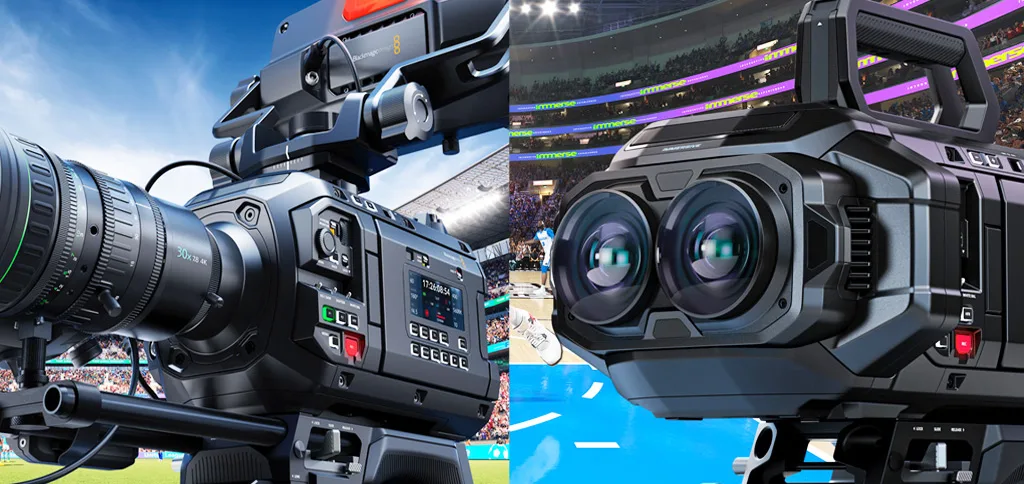
NAB 2026 (April 19-22, Las Vegas) will host the world premiere of the new cameras Blackmagic URSA Cine 12K LF 100G and URSA Cine Immersive 100G, two systems designed to be compatible with SMPTE 2110 signal transmission while providing cinematic-look coverage for live productions and immersive capabilities, respectively.
The new Blackmagic URSA Cine 12K LF 100G integrates technology Ethernet 100G to transmit signals SMPTE 2110 during live productions at a maximum frequency of 440 f/s. Starting from the cinematographic features of the URSA Cine 12K LF, including its large format RGBW sensor (36 × 24 mm), the new model includes a significantly faster network connectivity, optimized for live film productions.
On the other hand, Blackmagic Design presents the Blackmagic URSA Cine Immersive 100G, a camera that has been designed to carry out live productions in format Apple Immersive Video. Includes two sensors RGBW 8K × 8K, a dynamic range of 16 steps and connectivity Ethernet 100G to provide the bandwidth needed to stream immersive live images for the first time.
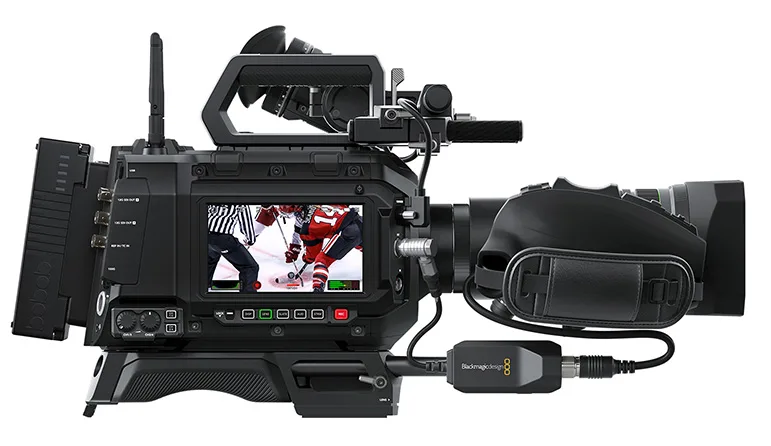
Cinematic characteristics in 2110 environments: URSA Cine 12K LF 100G
The new URSA Cine 12K LF 100G of Blackmagic stands out for its capabilities IP connectivity. By choosing the mode to transmit live SMPTE 2110 signals, the unit instantly transforms into a studio camera for live broadcasting. This model transmits these signals in real time thanks to its connection Ethernet, which supports a maximum resolution of 2160p60 with cinematic quality and 16 steps of dynamic range. Additionally, the 100G version broadcasts live to a maximum frequency of 440 f/s, which allows sports replays to be broadcast in slow motion.
These characteristics are combined with an image treatment that responds to the latest trends in cinematographic broadcasting thanks to a sixth generation colorimetry from Blackmagic that includes numerous improvements to the model's advanced sensor BEAR Who, with “exact” color reproduction and natural, pleasant skin tones. Camera processing has also been redesigned to use three-dimensional conversion tables (LUTs) for cinematic and video color spectrums or extended video, so the user can customize the images by uploading their own table.
The tables are applied after the color adjustment, so that corrections are made over the full color range of the digital negative. It is possible to transmit images in different color spaces by using preloaded tables (such as Rec. 709, Rec. 2020 y PQ) and even modify the compression of the color spectrum. The camera also includes two LUT 3D for various outputs, plus another exclusive additional one for signals SMPTE 2110.
The URSA Cine 12K LF 100G, with recording in format Blackmagic RAW a 80 f/s en 12K, 144 f/s en 8K y hasta 240 f/s en 4K, also has a mount B4 optional that allows you to install television lenses that adapt to the main needs of live productions, have electronic control and offer high response speed. The optical elements of the frame have been optimized for the sensor RGBW, while the center crop mode provides the possibility of achieving a UHD definition with high frame rates. The optional B4 control cable makes it easy to connect the 7-pin EXT port on the camera to the 12-pin Hirose interface on the lens.
Likewise, the BEAR Who can be converted into a camera for live productions by adding a visor of 7 inches. This has a touch screen, so it works as an extension of the camera and allows access to all the menus. Additionally, it includes a visor and controls for brightness, contrast, and focus indicator. Installation is simple, as it connects and is powered through the camera's front USB-C port.
Another key feature of the new Blackmagic URSA Cine is its calibrations based on the primary correction tools of DaVinci Resolve, which can be used instantly during live productions.
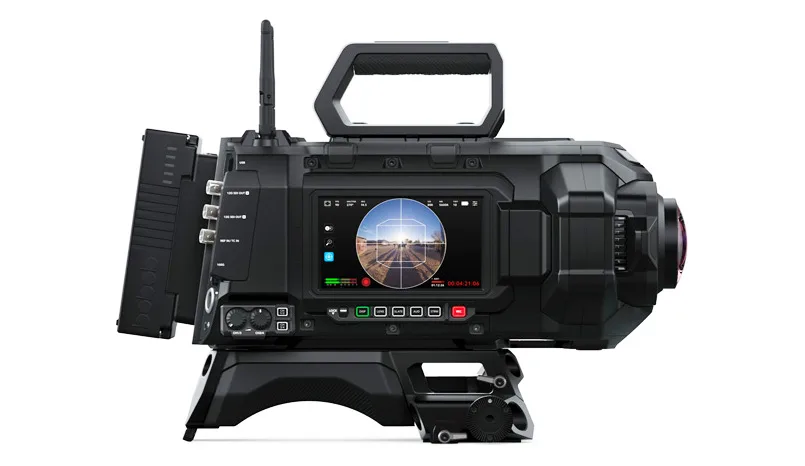
Immersiveness and directness, united: URSA Cine Immersive 100G
Blackmagic's other big bet for NAB 2026, the model URSA Cine Immersive 100G, has new sensors designed to capture images of extraordinary quality, with a 8K × 8K resolution for each eye. This new configuration of of RGBW sensors It is based on the same camera design BEAR Who and provides larger photosites that provide a 16 steps dynamic range.
Its “exclusive” system RGBW provides an equitable amount of red, green and blue pixels, in order to achieve “exceptional” chromatic supersampling. In other words, the camera has been optimized to obtain vivid colors at all resolutions, as well as providing flexibility even at the high frequencies required by immersive live images.
The device Blackmagic URSA Live Encoder allows you to use the model Blackmagic URSA Cine Immersive 100G during live productions. The system encodes the images in format ProRes to transmit them as signals IP SMPTE 2110 through the port Ethernet 100G. Additionally, since the camera's data transfer rate remains below 50 Gb/s, it is possible to combine signals from two units into a single connection.
The model URSA Cine Immersive 100G was recently used in Spectrum Front Row, a series of matches Lakers produced in format Apple Immersive during the 2025-2026 season. These meetings are now available on demand through the applications Spectrum SportsNet y NBA for Apple Vision Pro devices.
This model joins the line Blackmagic URSA Cine Immersive, which have been used in various high-profile productions, including MotoGP: Tour De Force, Debut at the BBC Proms, a documentary about Real Madrid to be released soon and the recent launch of NASA's Artemis II mission.
Did you like this article?
Subscribe to our NEWSLETTER and you won't miss anything.
Related articles
 Blackmagic Design's URSA Cine cameras enhance the visual impact of the video clip 'Love', by Crazy Ken Band
 The Chinese production company Media Storm uses Blackmagic URSA Cine 17K 65 cameras and 2110 IP converters
 Creating advertising campaigns for Apple Vision Pro with URSA Cine Immersive (Blackmagic)
 Castaic launches a 100% Blackmagic studio: URSA Broadcast G2 cameras, ATEM mixers...
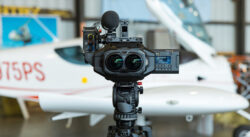 Rogue Labs uses URSA Cine Immersive (Blackmagic) to create content aimed at Apple Vision Pro
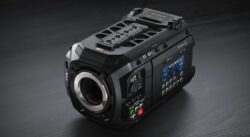 Blackmagic Design will market only the body of the Blackmagic URSA Cine 12K
 Blackmagic URSA Cine Immersive: first commercial camera system for Apple Immersive Video
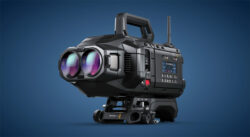 Blackmagic introduces URSA Cine Immersive camera: 8K stereoscopic 3D for Apple Vision Pro
Blackmagic Unveils URSA Cine Immersive Camera: 8K Stereoscopic 3D for Apple Vision Pro
Blackmagic introduces URSA Cine Immersive camera: 8K stereoscopic 3D for Apple Vision Pro
Blackmagic Unveils URSA Cine Immersive Camera: 8K Stereoscopic 3D for Apple Vision Pro
 Pyxis 6K: Blackmagic Design's latest step into box-style cinema cameras
 The Blackmagic URSA Broadcast G2, at the heart of the immersive concerts of Bizarrap in Buenos Aires
 Pandax covers the anniversary of Tecnópolis with 4K URSA Broadcast cameras (Blackmagic)
 Ed Sheeran records a virtual concert with Blackmagic URSA Mini Pro 12K cameras
 Chile's Channel 13 updates its studio cameras with Blackmagic Ursa Mini 4K