





All the secrets of the 2010 World Cup, revealed
Although traditional league matches work with an average of between 12 and 18 cameras, the 2010 South Africa World Cup matches will be followed with no less than 29 to 32 cameras in high definition and in numerous matches... in stereoscopic. In this article we reveal all the secrets of how in just ten years the way of producing the beautiful sport has been revolutionized by doubling the number of cameras used for each match, generalizing the new super motion and hyper motion systems, fully entering high definition and 3D, and forgetting the tape in favor of advanced multi-platform production environments that allow constant access to all matches, multiple entrances, and all camera angles to ensure the greatest spectacle in the world.
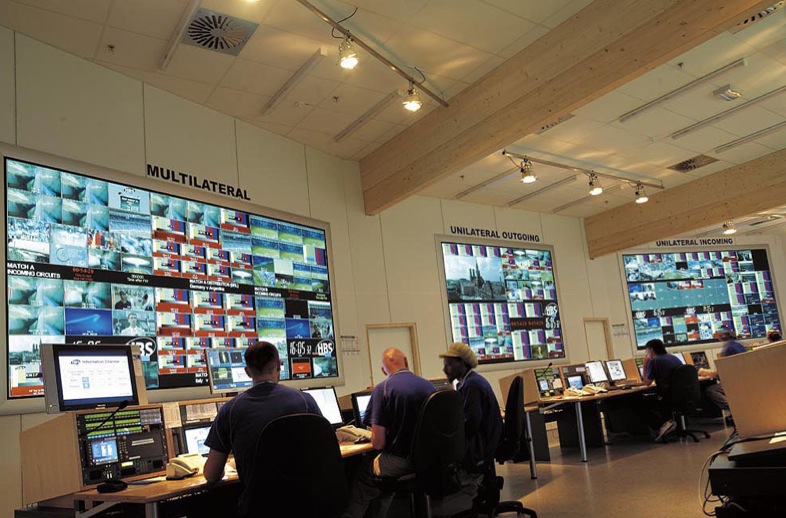
With less than three months to go until the opening match of the World Cup in South Africa that will pit the hosts against Mexico, the International Broadcasting Center (IBC) begins a frenetic race against the clock. Once the civil works were completed at the beginning of the year, the IBC has begun the integration and fine-tuning of the temporary installations of a complex infrastructure that will provide signals to television stations around the world. At this time, the heating, ventilation and air conditioning ducts are being finalized in the IBC. These days, the multilateral areas have begun to be configured, while the media with license rights (LMR) will be able to access the venue starting on May 10.
How will the IBC configure a World Cup entirely in high definition, without tapes, in 5.1 sound and with the production of numerous matches for the first time in stereoscopic and thousands of signals satisfying the enormous multiplatform demand?
Como ya ocurrió en los Mundiales de 2002 y 2006, Host Broadcast Services (HBS), filial de Infront Sports&Media, será la encargada de producir las señales internacionales de radio y televisión, así como de brindar otros servicios e instalaciones para los broadcasters acreditados en el Mundial de la FIFA. También tiene la misión de construir y operar por adjudicación de la FIFA el IBC. HBS se ocupará de organizar las operaciones y la infraestructura de radiodifusión. Entre sus tareas están la producción y transmisión de las señales internacionales de audio y video, así como la facilitación de los servicios y las instalaciones necesarias para los poseedores de los derechos y licencias a fin de satisfacer sus requerimientos de producción. De esta manera, los broadcasters poseedores de derechos de todo el mundo pueden utilizar las señales procedentes de cada una de las sedes, añadir sus comentarios y personalizar la emisión que enviarán a sus propios países. Las transmisiones unilaterales son producidas por los radiodifusores poseedores de derechos, y son utilizadas para complementar la cobertura de broadcaster local.
Over the past few years, HBS has implemented drastic changes in the way it manages the broadcasting of major sporting events from the host country.
Among the numerous partners that HBS will have to cover the World Cup, this time we will focus on EVS Broadcast Equipment, the Belgian company that has revolutionized the live streaming industry with its innovative live slow motion system.
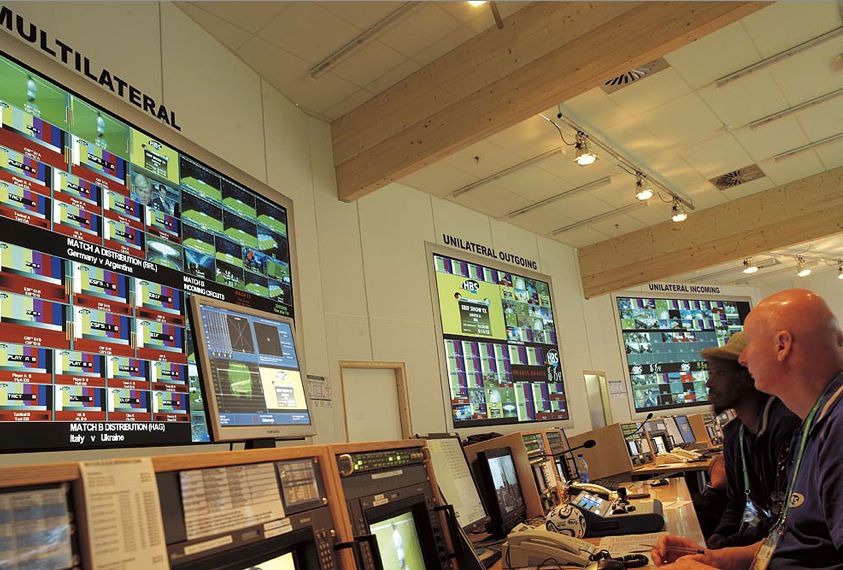
HBS and EVS: a decade of innovation
Over the past ten years, these two companies have cooperated closely to advance the field of broadcasting major sporting events from the host country. The long-term collaboration between HBS and EVS has meant a true revolution when it comes to spreading this type of sports competitions around the world.
An example of this is the innovative Media Server produced by EVS, which was first used by HBS during the 2006 FIFA World Cup. It was the first of its kind and significantly raised the bar in terms of reliability, connectivity and speed, to the point that it was described as “the sensation of the championship” by many broadcast companies. For the 2010 World Cup, it will be called FIFA Max Center and will allow FIFA media rights licensees to access recordings of the 2010 FIFA World Cup from a dedicated system where they can view and exchange content, register and access complementary color material collected by FIFA TV ENG staff.
Another example is found in the Clips Compilation Channel, which allows broadcast companies to access content generated in matches that are not part of the main match entry. The live slow-motion machines generate more than 1,500 clips per match, and only a portion of them make it to the main entrance. Under normal circumstances, 'unseen' angles are broadcast during half-time after the first half and just after the match, but in many cases the material arrives too late to be included in live studio programming. The Clips Compilation Channel makes it easy to access these 'unseen' clips instantly and streams the best slow motion angles to the Media Server.
Transmissions over the years
The host country broadcasting industry has changed considerably over the past ten years. This field has become so sophisticated in recent years that the expertise of specialized companies has become practically indispensable. This vital task, which once represented a real burden for the transmission companies of the host country, has now become a logical and profitable business. As the complexity and sophistication of transmission from the host country increases, the more important it becomes to rely on experience.
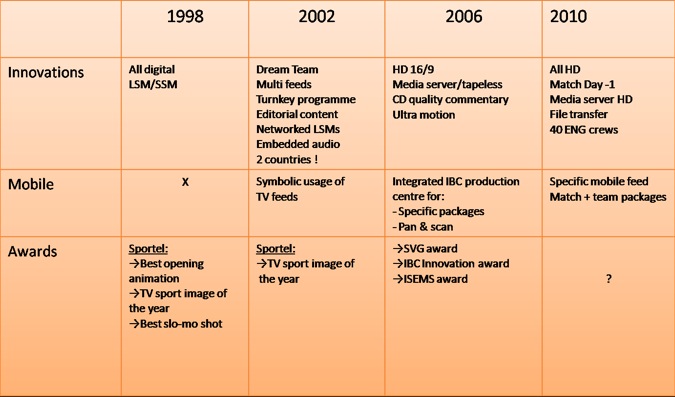
Among the most impressive achievements of HBS and EVS is the first all-digital broadcast as host of a FIFA World Cup (specifically, the 2002 Korea-Japan) with their original “multi-entry” services. Another important achievement occurred in 2006, during the FIFA World Cup in Germany. This sporting event became the first to enjoy full coverage in HD, and allowed the incorporation of the Media Server and the Clip Compilation Channel, which promoted the transmission and sharing of content in a tapeless environment.
In 2008, HBS France produced the first international mobile signal with signals from the French first division football. This year also saw stereoscopic 3D coverage of the IIHF World Championship offered for the first time. The three-dimensional experience was repeated in April 2009, during the soccer match between Olympique Lyonnais and Paris Saint-Germain FC.
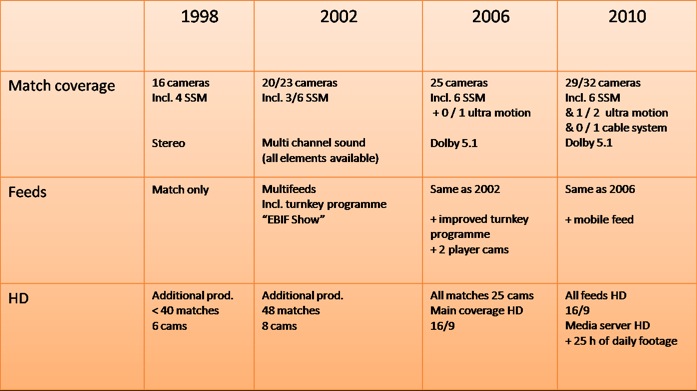
The technological progress that HBS and EVS have managed to achieve over the last ten years is actually the most significant of the last half century. This progress is reflected in aspects such as the doubling of the number of cameras used for each match, the new super motion and hyper motion systems), the arrival of high definition and now stereoscopy, and the incorporation of tapeless environments with the media server as the heart, allowing constant access to all matches, multiple entries, and all camera angles produced by the broadcast company for multilateral coverage. In this way it is possible to continuously access all matches, multiple entries, and all camera angles produced by unilateral broadcast companies. Giant steps have also been taken in the exchange of content between transmission companies, as well as between transmission companies and the broadcaster as host (through the Media Server “Stock Exchange”, as it is known in the sector), finally highlighting the introduction of dedicated mobile transmission and simultaneous and real-time access to remote control and Internet consultation.
From capture to playback
As the host country for the 2010 World Cup in South Africa, HBS has decided to renew its collaboration with EVS to provide instant tapeless technology and support services during the production of this major international event.
EVS technologies will be used at different levels of broadcast production, such as the live production of the 64 outdoor matches, where EVS systems will be used to generate live slow, super slow and ultra slow motion replays, as well as the compilation of best clips and the creation of highlights.
EVS also provides a multi-input capture and all-HD media sharing solution from one media server; The solution is based on an advanced XT[2]+ network infrastructure, which offers instant access to any content recorded during the competition, with advanced search and query systems in low resolution. This allows streaming companies to easily exchange audiovisual content. The content recorded and logged on the media server covers 9 different inputs from the field, as well as ENG files from 40 reporting teams.
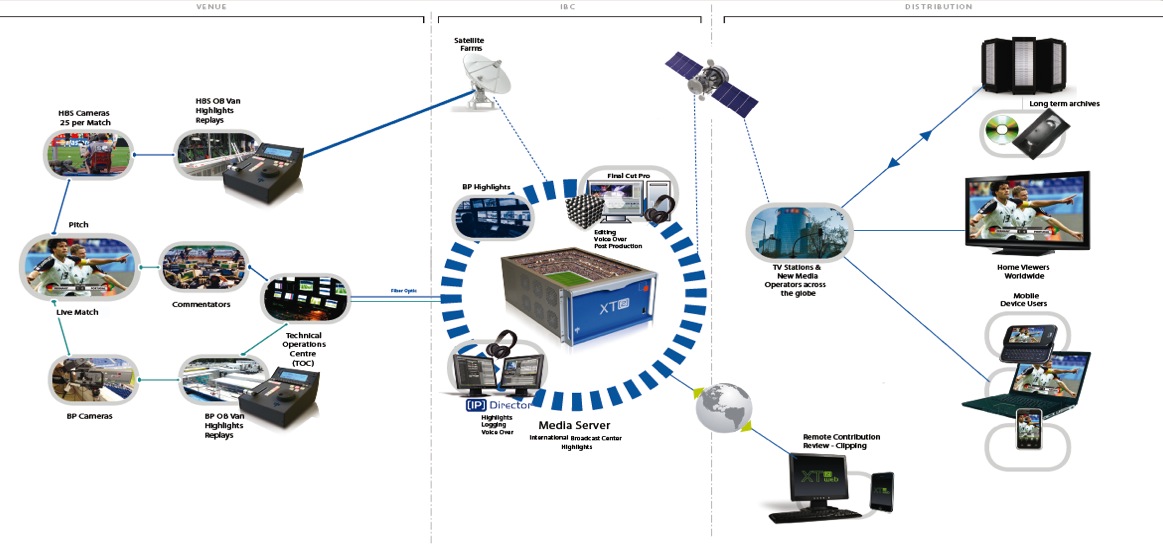
In order to maximize remote access to content, HBS has decided to introduce the Internet-based server system that HBS already uses for the production of France's top football division. The system (known as EVS
Xedio, EVS' editing solution, will be the tool used by HBS editing teams for the production of 24/7 news programs, providing remote access to ENG files via advanced web-based production systems.
In addition, EVS will collaborate with HBS to provide different broadcast companies (known in FIFA jargon as “Media Rights Licensees”) with navigation tools to access, consult, trim and import material for their own production staff.
Last but not least, EVS systems will handle dedicated mobile input capture with live streaming over Apple XSAN and FCP editor for instant broadcast to mobile network services.
Production at the sites
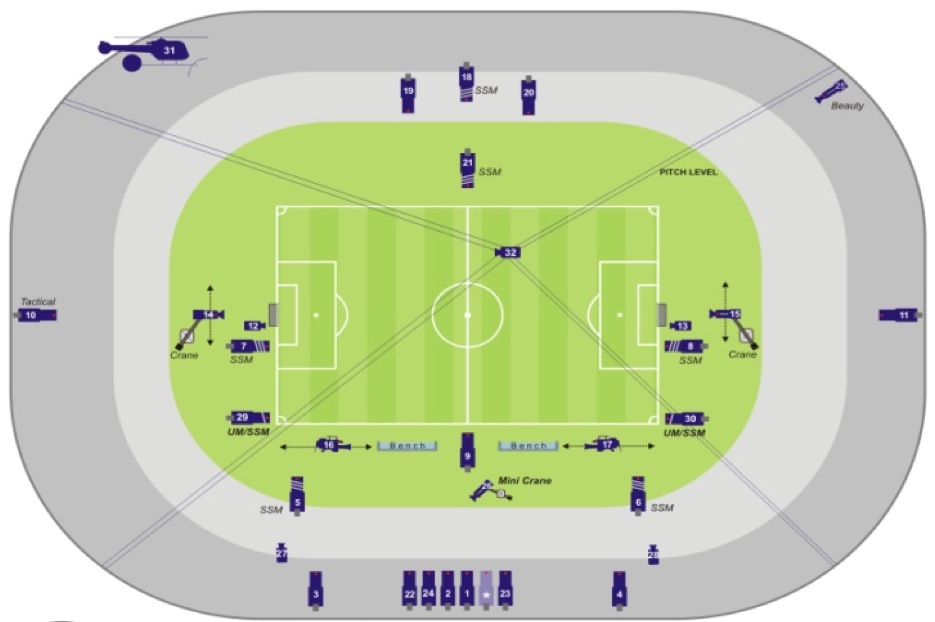
While traditional league matches are recorded with an average of between 12 and 18 cameras, World Cup matches will be followed with no less than 29 to 32 cameras. In addition to the standard cameras, HBS will handle a series of super motion and ultra motion cameras. In order to ensure the production of live replays, slow-motion action replays, highlights and close-ups during a live football match, all cameras will record to EVS video production servers installed on adjacent mobile units during the event.
World 2010 camera plan
Standard plan for 29 cameras (25 in the 2006 World Cup)
- 2 box cameras
- 1 mini crane
- 1 Ultra Motion
Up to 32 cameras for certain matches
- Special cameras
- Overhead coverage
- 1 additional Ultra Motion
- cable systems
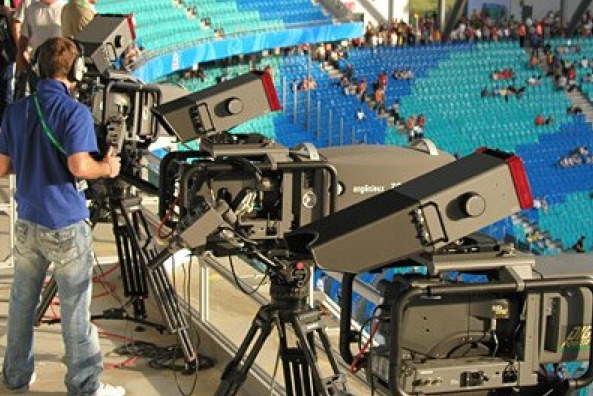
The first World Cup in 3D
FIFA will produce a 3D World Cup for the first time in history. Thanks to an agreement reached with Sony, up to 25 matches at South Africa 2010 will be produced using professional Sony cameras, providing coverage of the action with unprecedented depth, vibrancy and excitement to viewers around the world.

Multi-camera recording
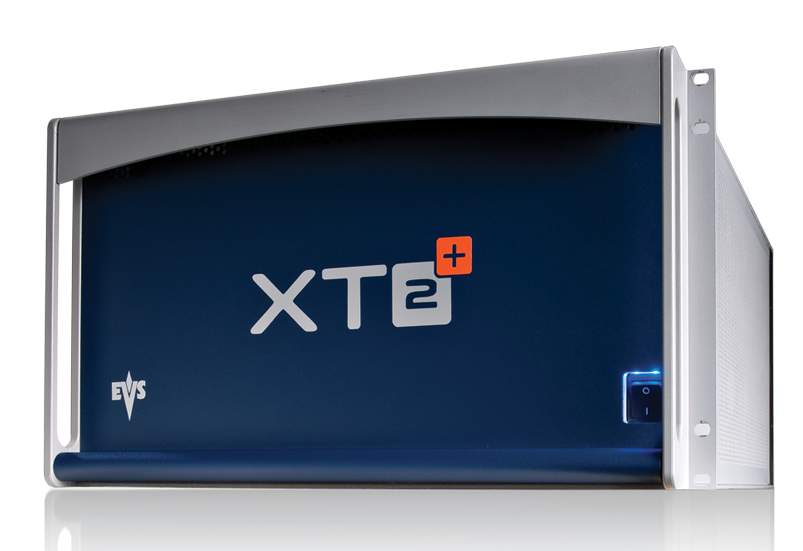
Around 130 XT[2]+ servers will be deployed in the fleet of OB vans working at the various sites in South Africa. These advanced digital video recorders manage the acquisition of all the cameras surrounding the playing field. They are based on a loop recording process, so not a single shot is lost. Its live-oriented architecture (with a high degree of redundancy and fault tolerance, to avoid interruptions in the flow) guarantees a maximum degree of control for instant replays, highlight editing, compilation of the best clips and graphic overlays managed by the production team outdoors during matches. Each server can simultaneously capture and monitor multiple inputs (up to six inputs per server).
During the production of a match, all the XT servers installed on the OB units are interconnected, allowing operators and production teams to exchange content and control the audiovisual material recorded on this XT[2]+ network. All XT[2]+ are brought together by a dual content sharing network (on the one hand, the high-bandwidth SDTI XNET[2] network, and on the other, the standard Gigabit Ethernet network). Any entry recorded on one server can be viewed, trimmed, and played back from any other server. This allows operators to exchange clips and highlights with other operators, in order to gather the best footage and action which will then be transferred to the international broadcast center in Johannesburg.
 Durante la producción de los partidos en las camionetas OB, los numerosos canales In & Out XT serán controlados por múltiples sistemas, como el controlador remoto MulticamLSM para todas las repeticiones de cámara lenta, super motion y ultra motion en directo, así como el recorte de acciones multicámara, creación de highlights y planos cortos. Además, los equipos de producción de HBS manejarán los controladores LSM de EVS para marcar las posiciones de fuera de juego de los jugadores mediante la superposición gráfica de una línea virtual de fuera de juego, que se ha incorporado recientemente al sistema. En total, se emplearán más de 150 controladores LSM, manejados por operadores de LSM altamente cualificados y seleccionados por la producción de HBS para las operaciones de cámara lenta y otros tipos de repeticiones en directo relacionadas.
For its part, the IPDirector for multi-camera capture and the XT[2]+ network for network control, query and registration operations. Additionally, HBS will use IPDirector's non-linear editing module IPEdit to create highlights and compile clips. With IPEdit, HBS editors will enjoy instant access and control of XT[2]+ recording channels, without the need for content transfer, encoding and decoding. The IPDirector also serves to handle the transfer of clips and sequences to third-party post-production systems used by HBS.
Live editing operations
A total of 150 MulticamLSM systems will be used at the different sites, intended to manage all live replay operations, such as slow motion, super motion (3-phase cameras) and ultra motion (EVS is used for all Ultra Motion camera sequence replays with up to 1000 frames per second). In addition, HBS LSM operators will use the system to create on-the-fly highlights and short shots that will play during dead periods or to illustrate interesting actions that occur during the match (such as goals, tackles or crowd reactions).
Compilation of the best clips and quasi-live non-linear editing
HBS production will be in charge of compiling the best sequences and replays at the locations during the matches. These sequences compiled as a single entry (known in FIFA parlance as a “Clip Compilation”), will be transferred to the IBC and transferred to the media server so that all HBS and licensee production teams can access them. Clip creation and compilation by HBS teams on the mobile units will be handled with EVS's MulticamLSM and IPDirector tools for clip creation and playlist management. The clip compilation will bring together the best actions recorded on the XT[2]+ servers during the match, such as multi-camera goal angles, crowd reactions, as well as super motion and ultra motion sequences.
In order to facilitate the collection of the best actions, replays and clips, HBS teams working on OB units with IPDirector software will have real-time access to all logs created by HBS teams using the IPLogger interface at the Johannesburg IBC.
The EVS IPEdit tool (IPDirector's new non-linear editor) will be used by the OB team for the production of highlights and pre-match sequences, with transition effects based on a comprehensive non-linear editing solution. With direct integration and control of XT[2]+ servers, editors will be able to access multi-camera input instantly and add sequences and clips with a simple drag-and-paste. IPEdit will allow editing in short format, such as the creation of highlights and short shots. Because IPEdit also allows access to multiple channels across the entire media network (up to two chronological sequences can be created per XT[2]+ server), HBS gains speed and efficiency.
EVS technology on sites
- 130 servidores HD XT[2]+
- 150 MulticamLSM remote controllers for live slow motion, super motion and ultra motion replays, as well as creating offside lines
- 20 IPDirector for capturing, consulting, highlight editing and content management
- 20 XF removable storage platforms[2]
- 32 Xedio Media Dispatcher (for trimming, editing and sending ENG P2 files)
Creation of live virtual offside lines
For the very first time, HBS will introduce the creation of virtual offside lines in international entry. The creation of the offside line overlay graphic will be managed by the EVS EPSIO system. This new solution will allow LSM operators (using standard EVS LSM remote controllers) to instantly generate an overlay graphic with automatic field boundary recognition. The operator only has to manually adjust the offside line with the thumbwheel on the LSM remote control. Thanks to a calibration wizard (requiring a single use for each event), through which each camera sends images of the pitch with predefined angles to the system, EPSIO is able to instantly and automatically recognize the pitch during actions, and virtually draw offside lines within the boundaries of the pitch. This one-second operation can be selected with a single button. The special preview of the graphic overlay will ensure the availability of offside lines when the director decides to replay the action.
Remote consultation and transfer to/from the IBC
In order to increase the availability of multi-camera angles for production teams located in the IBC, complementary IPDirector (IPBrowser) query stations have been added; These will allow you to navigate and consult unseen camera angles once the match is over. The IBC IPBrowser will be connected to the IPDirector database located in the OB van at the site in question via an Ethernet line. IBC operators will be able to view each clip, as well as its related (unseen) camera angles. The operator will be able to return the clip in high resolution to the IBC for news preparation and editing.
The FIFA MAX media server (Media Asset EXchange)
To expand the creative capabilities of broadcast companies during major sporting events, HBS introduced the EVS Media Server in 2006, which offered HBS production teams and broadcast companies 24/7 access to all recorded content, such as director's selection, multi-camera angles, camera ISO and compilations of best clips. Additionally, ENG recordings were instantly available for production and post-production operations.
Figures and data from FIFA MAX / Media Server
- 3,000 hours of HD content
- 50 HD XT[2]+ (DVCPRO HD) servers, offering a total of 360x300GB = 1900 h @ 108 Mbps
- Capture of 18 live entries
- XStore content store[2] 220×300 GB = 1100 hours of high resolution content
- 140 IPDirector for registration, consultation and content management
- 6 XF[2] removable storage drives
- 32 Xedio Media Dispatcher (P2 file selection, trimming and transfer)
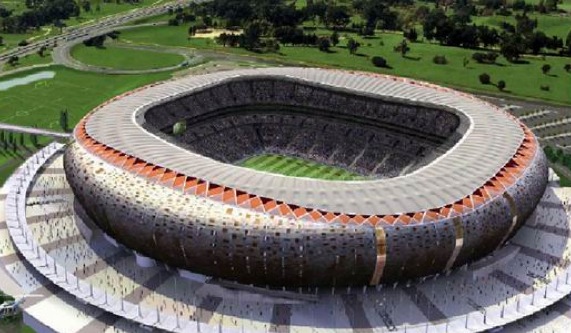
The Media Server is a group of fully integrated EVS production servers. Built on EVS instant tapeless technology, the media server combines optimized hardware (XT[2]+ servers) with software solutions to handle content sharing and distribution with maximum speed and security, including indexing (based on intelligent logging systems) of incoming input and content, backup copies and archiving of audiovisual content.
For the World Cup in South Africa, the EVS media server, known as FIFA MAX (Media Asset eXchange), will manage the capture and exchange of no less than 3,000 hours of HD content.
During the competition, HBS production teams and media rights licensees will be able to access material such as match entries, clip compilations, ENG materials and briefs, special content, FIFA tool series, city profiles, analysis and statistical sequences, match summaries, World Cup update programs, selections of isolated camera recordings, team training sessions, interviews and press conferences, MD-1 highlights, musical sequences, media exchange for licensees...
During each match, 11 HD
The production of two simultaneous matches at the beginning of the competition means that the system has had to be optimized to be able to support the capture of 2 x 9 entries simultaneously.
Registration operations
HBS teams log recorded content to the EVS media server through EVS IPDirector systems.
In total, eight recording stations will be used to add descriptive tags (records) to audiovisual inputs recorded on the FIFA MAX media server. Two registrars will be dedicated to CSF registration operations and clip collection in each match (in case of 2 simultaneous matches, 4 in total). Three stations will be dedicated to the registration of ENG material and the provision of content for licensees imported from the system. Another station will also be dedicated for supervisory duties.
ENG operations, capture and query over the Internet
HBS will have a total of 40 ENG teams that will be organized into 32 teams that will follow each team on the field of play and 8 teams throughout the host country, which will collect content related to the World Cup, such as content related to matches and fans, South African culture, places of interest and events on the field.
All equipment that works with video cameras Panasonic P2 will send their edited raw takes and shorts to the International Broadcast Center on a daily basis; Shots will be recorded immediately and made available on the media server for viewing and downloading by HBS production teams and licensees. Raw take operations will be handled using EVS's Xedio Media Dispatcher system, to select, group, trim, register and export P2 files, in the appropriate format, to the Media Server in Johannesburg. In total, between 20 and 25 hours of content will be produced and shared each day.
In order to increase the availability of ENG cuts for licensees, HBS has developed a new Internet solution that offers web browsing and download functions for streaming companies. TV and Radio Licensees are new clients who will use the new services developed with the EVS XT[2]Web platform. This platform combines transmission technology with a web-server system that is currently being used by clubs, referees and disciplinary commissions of the French First Football Division.
The XT[2]Web system will allow remote viewing of video and audio content over the Internet, as well as downloading edited ENG content for broadcast companies that have opted for the services of TV or radio licensees. Once captured on the media server, edited ENG content and its associated metadata (records) are automatically sent to a secure Internet server in proxy format (MPEG4 H264). Licensees located abroad will be able to view hours of edited ENG content using descriptive metadata keywords to facilitate search. Once they have found and selected the content (audio/video or audio only) and placed it in their basket, licensees have the option to order the high-resolution file in SD or HD format. The transfer operation will be managed automatically by the SmartJog system associated with the EVS media server and database. High resolution audio files can be imported locally using the XT[2]Web solution.
Capture and broadcast live tickets to mobile
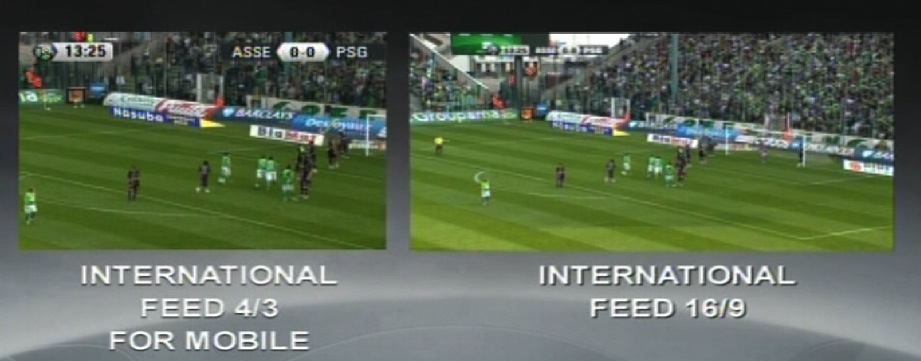
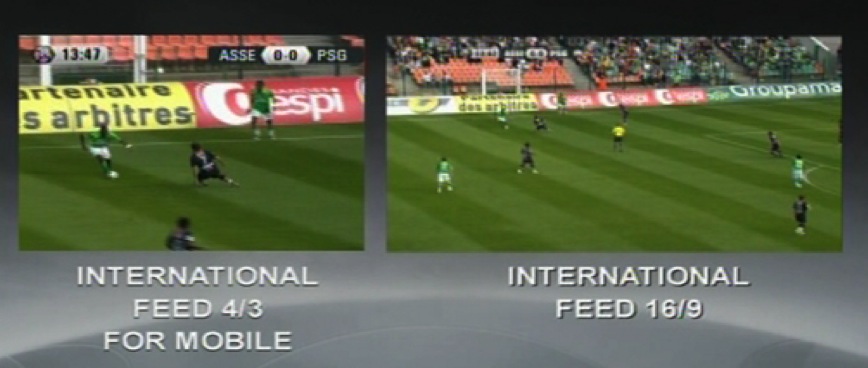
HBS will manage the production of a mobile ticket that will be offered to FIFA mobile subscribers via Telco networks. In order to provide high-quality recordings, HBS will provide a dedicated mobile input. A dedicated production team will work on the production of the mobile entry. A special mobile production will replace the main camera input with a dedicated camera (which will also film from the main platform) in order to offer shorter shots and actions with greater visibility on mobile devices.
HBS mobile production will consist of a clean input produced on site (using a dedicated mobile camera mixed with other angles and at an angle that fits a small mobile screen), an input that is sent to the IBC (dedicated to the production of mobile packages as well as a raw version that is produced for distribution) with mobile specific graphics intended for dedicated distribution.
Dedicated mobile input produced on site will be captured by the media server with live streaming to the Apple XSAN server; This will allow an FCP editor working in mobile content production (voice-over, editing and team-specific presentation) to work on editing during live production.
Consultation and exchange of content
To take full advantage of the FIFA Max Media Server's sharing capabilities, licensees can choose from multiple query sources and import configuration options, such as EVS IPDirector for low-resolution Media Server querying, creating clips, and importing high-resolution HD clips (DVCPRO HD) locally. Depending on the option, a dedicated HD
Did you like this article?
Subscribe to our NEWSLETTER and you won't miss anything.
Related articles
 RTVE promotes 'RNE for all', the first world radio experience for the deaf
 The secrets of Studio X Beyond, revealed with Brompton, Disguise and AOTO
 Stephen Nuttall will bring to ISE 2023 all the secrets of the television production of the Copa América de Vela
 Zero Density reveals all the secrets of its demo for IBC 2022
 Gol Televisión will offer all the World Cup matches on multiscreen
 All the technical secrets of the Eurovision Song Contest in Malmö
 'The High Definition video signal': a book to learn all the secrets of HD
 All the secrets of 'John Carter', Disney's latest blockbuster
 The increase in competition in all segments of activity marked 2010 according to the CMT Annual Report
 Audiovisual Panorama, world leader in 2010 among specialized media
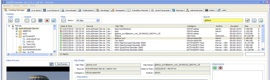 VsnIPTransfer facilitated video sharing during the 2010 World Cup
 The secrets of Ferrán Adrià through Panasonic cameras
 Pro Studio Series 2009: all the secrets of Final Cut and Logic in Madrid
 Come with SABC at the 2010 World Cup in South Africa