





Softimage 2011: more flexible, faster and efficient animation
The automatic lip synchronization in Face Robot and the innovative rigs with Interactive Creative Environment (ICE) kinematics, present in the 2011 version of Softimage, set a new benchmark for the character animation sector.
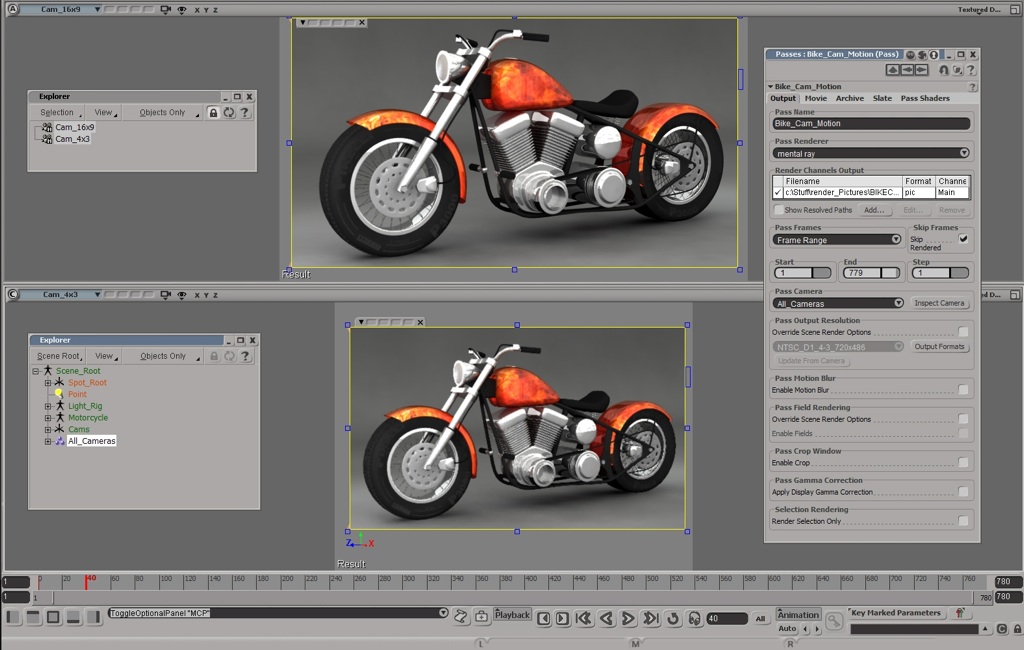
A complete 3D application with a unique GigaCore multithreaded architecture and innovative tools such as the Interactive Creative Environment (ICE) and Face Robot facial animation could define the new Softimage 2011 from Autodesk. Thanks to its easily programmable effects simulations, advanced character rigs and lip-sync facial configurations, the 2011 version is an ideal companion for the Maya and 3DS Max systems.
Among the new features of the new 2011 version of Softimage are the Rendering Sandbox that allows you to automatically host shaders and renderers without the need to build a custom shader user interface (UI) or any other tool, and the ICE Kinematics that helps create advanced rigging elements with custom inverse kinematics, splines, constraints and dynamic queues. ICE's graph-based visual structure eliminates trial/error and facilitates analysis of rig construction, facilitating troubleshooting and debugging of the rig.
Also worth noting is the automated lip syncing in Face Robot that helps speed up facial animation based on an audio file. It also includes a new view dedicated to controlling visemes and phonemes with function curves that help modify their contribution.
Mental Ray
The 2011 version has also introduced improvements in rendering. The new Mental Ray 2011 renderer offers improved stability and faster renderers. Up to one hundred mental ray shaders make it easier to simulate a wider range of materials. It saves time rendering multiple cameras for each step, and the new Camera and Render Slate features display useful information in the viewport or renders.
Review, on the other hand, the hundred new ICE compounds that cover several areas: Kinematics, selections, curves, debugging, deformation effects, hull deformers, peeling, Verlet integration, geometry queries, mathematics, particle emissions, particle getters and setters, testers, filaments and filament dynamics.
Finally, PhysX 2.83 helps artists create gill-free warps on the ICE with the latest Nvidia PhysX rigid body library. It offers new support for springs and dampers offering faster performance when an Nvidia Cuda-enabled graphics processing unit (GPU) is optionally added.
The English and Japanese versions of Softimage 2011 will be available in April 2010.
Did you like this article?
Subscribe to our NEWSLETTER and you won't miss anything.
Related articles
 Nxtedition adds powerful tools for faster, more flexible storytelling
 Fastly Delivers Faster, More Flexible Edge Observability
 Glass-to-Glass technology: Panasonic's proposal for faster, more flexible and profitable production
 Quick guide to understanding UI and UX: The case of Filmin
 Disney+ bases its rapid global expansion on the AWS cloud
 5G adoption is four times faster than 4G LTE deployment
 The animated film 'One more day alive' was awarded a Goya for its commitment between animation and real image
 Mexico proposes a more efficient use of the 700 MHz band
 HP bets on high-performance equipment, animation and 3D printing at SIMO Network 2011
 Itelsis launches a more compact and efficient range of transmitters, gap-fillers and regenerative
The satellite is postulated as the most efficient means for the development of HD and 3D
Itelsis launches a more compact and efficient range of transmitters, gap-fillers and regenerative
The satellite is postulated as the most efficient means for the development of HD and 3D
 Autodesk Forum 2010: The latest for film animation
 Miranda Kaleido-Modular: a space-efficient and energy-saving multi-screen
 Maya, Softimage, Mudbox and Motion Builder, 2010 editions