





Audiovisual piracy will mean the loss of 86,000 jobs in Spain
According to the report 'Building the digital economy: the importance of defending employment in the creative industries of the European Union', Spain will have lost more than 86,000 jobs by 2015, at a sustained average of 10,600 jobs annually, due to illegal trade and free distribution of films, series and music on various media.
 According to a study on the development of the digital economy and creative industries, carried out by TERA Consultants with the support of the International Chamber of Commerce, piracy will be one of the main problems that the sector will have to face. Unlike previous works in this field, this study combines a broader definition of the primary creative industries (film, television, music, publishing and advertising) also adding the secondary ones (televisions, music playback devices, etc.) achieving a more complete vision.
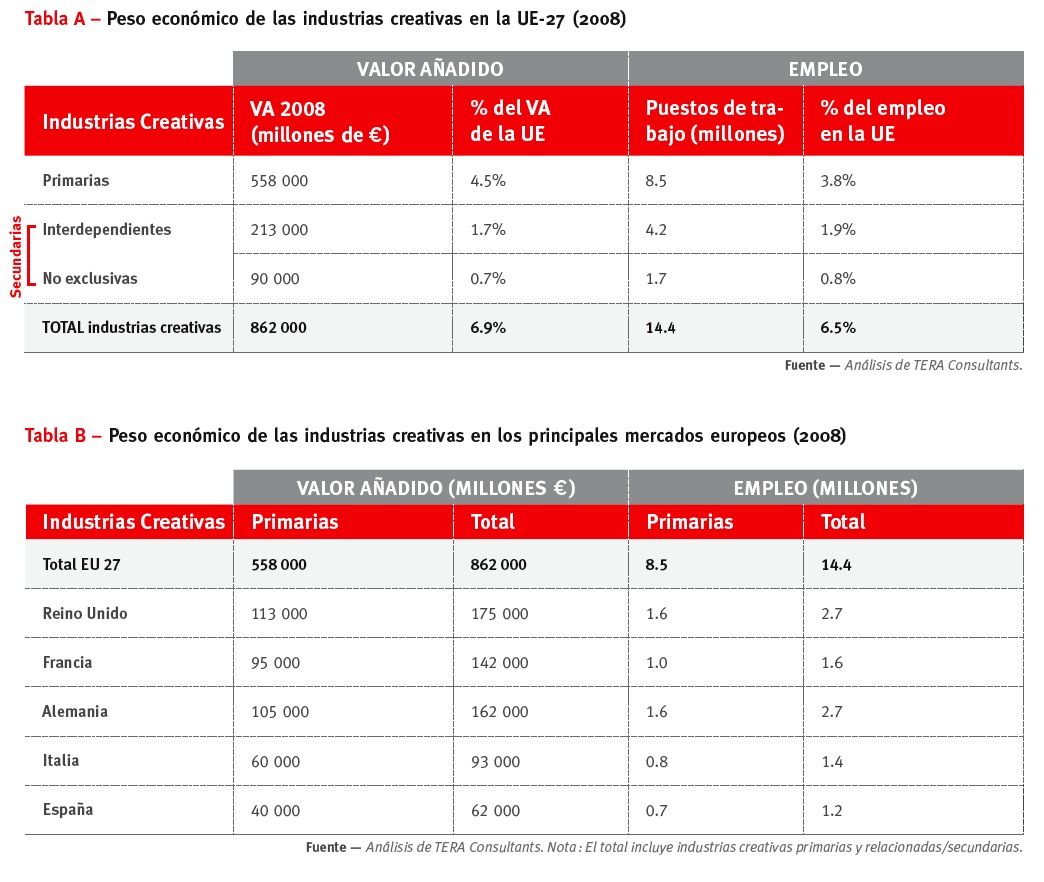
As reflected in Tables A and B, it is estimated that the primary creative industries in the 27 countries of the European Union generated almost 560 billion euros of added value to GDP B in 2008. This contribution represented approximately 4.5% of the total European GDP B in the same year. The value added by the total creative industries (primary creative industries and secondary creative industries), also reflected in Tables A and B, was approximately 860 billion euros in 2008, that is, around 6.9% of GDP B.
The creative industries also account for considerable employment across Europe. As Table A shows, jobs in the primary creative industries in the 27 EU countries amounted to around 8.5 million in 2008, 3.8% of the total European workforce. The total number of workers employed by the creative industries (primary creative industries plus secondary creative industries) was approximately 14 million, 6.5% of the total European workforce.
Consequences of piracy
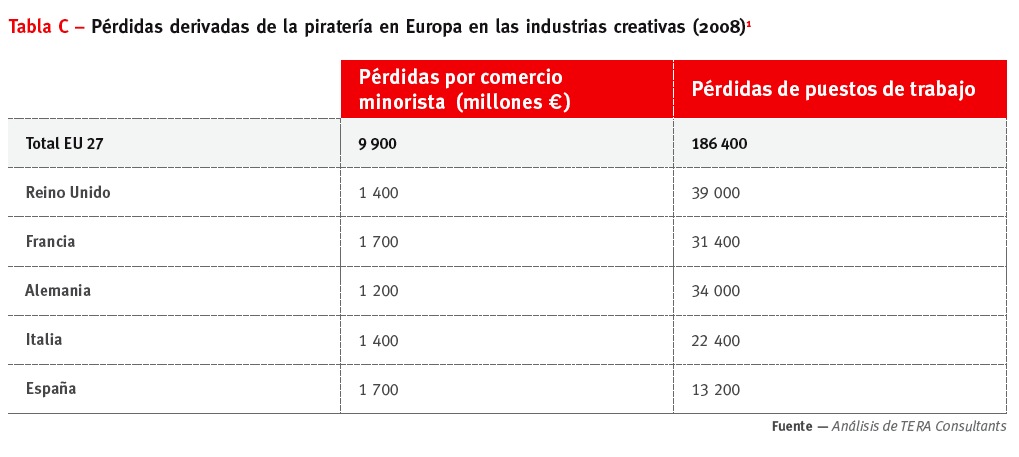
One of the main objectives of the study was to evaluate the economic consequences of piracy in the creative industries (mainly digital piracy). This study focuses on retail revenue losses and job losses in the creative industries most affected by piracy, especially those that produce and distribute films, television series, music recordings and software. The study also assesses retail revenue losses and job destruction in the five largest EU markets (UK, France, Germany, Italy and Spain), which collectively account for approximately 75% of European GDP. When collecting data for this study, the authors relied primarily on data related to digital piracy. For markets where the transition to digital entertainment is less advanced, the data also includes residual physical piracy.
Table C shows that in 2008 around €10 billion and more than 185,000 jobs in the creative industries were lost in Europe due to piracy.
Two hypotheses between now and 2015
The growth of broadband penetration and the digitalization of products in the creative industries will accelerate in the coming years, while physical piracy will represent a decreasing share of total piracy. Without effective and permanent action, these trends will facilitate the continued expansion of digital piracy in Europe. This study presents two assumptions for forecasting piracy losses through 2015, both based on Cisco Systems' Internet traffic forecasts and assuming no action is taken to address the piracy problem.
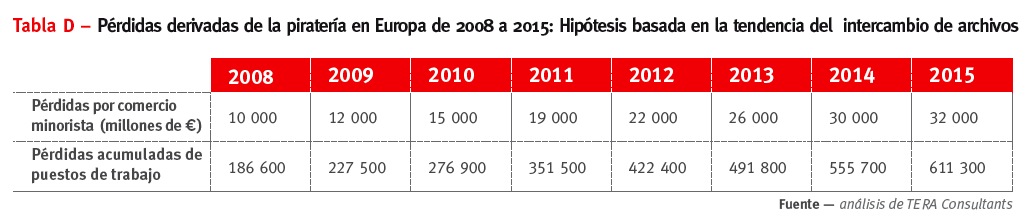
The first hypothesis assumes that digital piracy will grow in tandem with file-sharing traffic, resulting in a conservative estimate of losses. From 2008 to 2015, file sharing traffic in Europe is expected to grow at an annual rate of 18%. Consequently, if losses from digital piracy grew at this rate, income losses from music recordings, films, television series and software would be around 32 billion in 2015 (Table D). If there are no major changes in government policies and taking into account the year-on-year increase in piracy, the jobs destroyed in a year would not be created again, resulting in an increase in job losses in the sector. This means that job destruction in the EU will reach 610,000 jobs in 2015, a considerable difference compared to just over 185,000 in 2008.
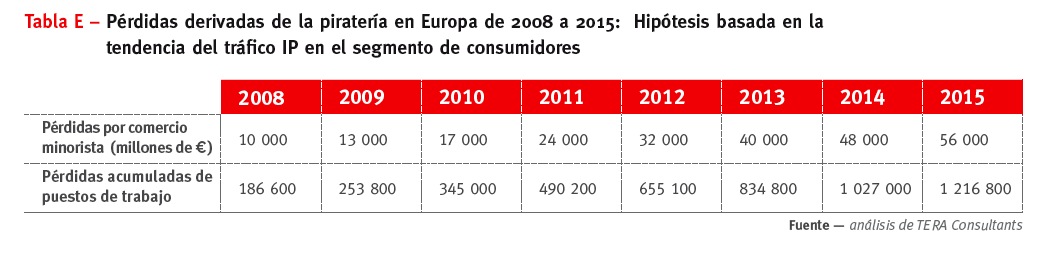
Hypothesis two of the study assumes that the growth of digital piracy will follow global trends in IP traffic in the consumer segment in Europe (for example, communication over IP). This scenario includes streaming and file sharing, which helps put a cap on the impact of digital piracy.
From 2008 to 2015, IP traffic in the consumer segment is expected to grow at a rate of 24%. If digital piracy in Europe reflected this growth rate, the result would be losses in the music recording, film, television and software industries of 56 billion in 2015, compared to approximately 10 billion in 2008. Without major changes in government policies and taking into account the year-on-year increase in piracy, the jobs destroyed in one year would not be created again, resulting in an increase in losses of jobs in the sector. This means that job destruction in the EU will reach 1.2 million jobs in 2015.
Did you like this article?
Subscribe to our NEWSLETTER and you won't miss anything.
Related articles
 The Alliance against Audiovisual Piracy (AAPA) renews its management team after the recent elections
 Netflix, Prime Video and RTVE Play defeat piracy and dominate streaming in Spain
 AtomoHD, the largest audiovisual piracy service in Spain, falls
 Filming in Tenerife in 2022 generated more than 9,633 jobs
 The new audiovisual ecosystem will be a challenge for intellectual property
 Strike by the National Police against international audiovisual piracy on IPTV
 The EBU will analyze in the 5G Virtual Forum the change in audiovisual consumption that 5G will bring
 LaLiga and Dorna unite against audiovisual piracy
 What advantages and risks will 5G mean for the audiovisual sector?
 Eurojust, Europol and Audiovisual Anti-Piracy Alliance (AAPA) join forces against audiovisual piracy
 Historic ruling against audiovisual piracy
 Piracy breaks records in Spain, seriously damaging the cultural and content industries
 OTT TV will represent revenues of 42.34 billion dollars in 2020
 The revolution that Big Data will mean in Information Security