





COFDM in fiber optics
In large SMATV collective antenna installations, for example a university campus or a large hospital, fiber optics are emerging as the ideal solution to transport signals free of leaks or interference.
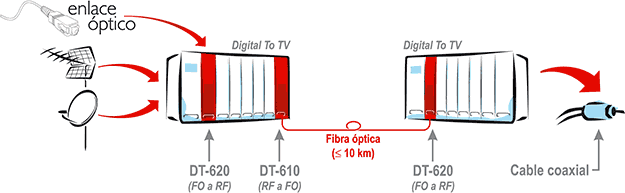
One of the major limitations of TV distribution systems over coaxial cables is that RF losses increase with the frequency and length of cable used. In applications where it is necessary to transport RF signals over long distances, from one point to another, coaxial cable is not the most appropriate solution. Very often the use of long lengths of coaxial cable involves using in-line RF amplifiers so this solution is sometimes somewhat expensive and cable degradation remains inevitable.
In this type of applications that we can describe as “large collective antenna installations” SMATV (for example a university campus where it is necessary to carry the signal from the main building to other buildings), it appears that fiber optic cables are the ideal solution. Fiber optic cables have very small losses compared to coaxial cable. As it is a non-metallic cable, problems with leaks or interference with RF signals are absent, which makes optical fiber the most suitable solution for transporting RF signals through a “noisy” RF medium.
Solutions
For this type of installations, companies such as Promax They have specific solutions.
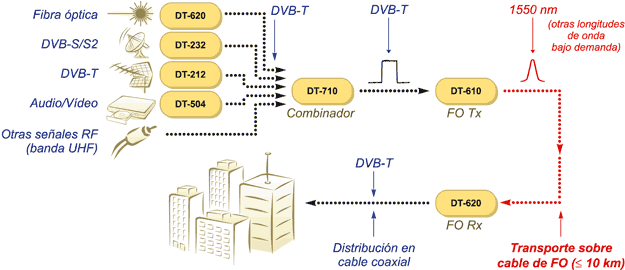
Thanks to its DT-610 module it is now possible to easily transmit the DVB-T (COFDM) channels generated by the Digital to TV headend, in a fiber optic cable, covering distances of up to 10 km, using a wavelength of 1550 nm (other wavelengths are provided upon request).
On the opposite side of the fiber, another headend containing a DT-620 module can receive this optical signal and recover the original DVB-T RF signal with hardly any distortion. This RF signal can then be distributed back into a coaxial cable network if necessary.
Did you like this article?
Subscribe to our NEWSLETTER and you won't miss anything.
Related articles
 Latin America depends on fiber optics for the consolidation of 5G and AR
 Altice divests part of its fiber optic business
 The fiber optic network closes 2015 with more than 3 million lines
 Telefónica aims to bring fiber optics to 97% of homes in 2020
 Promax Prolite-40B: much more than a fiber optic splicer
 Orange will invest 300 million euros in a fiber optic network
 Camera Corps to introduce fiber optic link at IBC 2011
Bolivia and Paraguay promote Internet interconnection through fiber optics
Camera Corps to introduce fiber optic link at IBC 2011
Bolivia and Paraguay promote Internet interconnection through fiber optics
 New fiber optic multiplexers from CSI
 New range of fiber optic extenders from Pínanson
Pinanson HDTV-SMPTE Fiber Optic Connectors
New range of fiber optic extenders from Pínanson
Pinanson HDTV-SMPTE Fiber Optic Connectors
 Promax solutions for fiber optics in accordance with the new ICT law
 New 3G/HD/SD-SDI fiber optic receivers to HDMI, DVI, VGA and CSI components
 Copperhead 3200: a robust fiber optic link