





'Men in Black 3', a new production and visual effects challenge for the men in black
The Men in Black films are always a challenge for production design, stretching the boundaries of reality while remaining in the realm of the possible, but producer Bo Welch had an additional challenge this time as he would have to design two worlds: one in 2012 and the other in 1969.
In Men in Black 3, Agents J (Will Smith) and K (Tommy Lee Jones) have returned… in time. In his 15 years with the Men in Black J has witnessed inexplicable things but nothing, not even the aliens themselves, has baffled him as much as his ironic and reserved companion. But when K's life and the fate of the planet are in danger, Agent J must travel back in time to fix things.
Columbia Pictures, in association with Hemisphere Media Capital, produces the continuation of the popular saga under the direction of Barry Sonnenfeld.
The film stars Will Smith, Tommy Lee Jones, Josh Brolin, Jermaine Clement, Michael Stuhlbarg and Emma Thompson. Directed by Barry Sonnenfeld and produced by Walter F. Parkes and Laurie MacDonald, the film is written by Ethan Cohen.
The executive producers are Steven Spielberg and G. Mac Brown, while the director of photography is Bill Pope, with Bo Welch directing production. The editing is the work of Bob Zimmerman, while the music was composed by Danny Elfman.
Visual effects
One of the legends of visual effects at Sony Pictures Imageworks, Ken Ralston, winner of five Oscars for his work, has faced the challenge, together with Jay Redd (effects supervisor on Monster House) of once again making the audience vibrate in the movie theater with the new installment of Men in Black.
When Men in Black 3 began filming, the Sony F65 was still taking its first steps and although it is a Columbia film, the camera finally chosen was the ARRI Alexa with Zeiss Master Prime optics and Angenieux Optimo Lenses. For second units and certain sequences,
Arricam LT, Arricam ST y Arriflex 235.
The entire laboratory and digital intermediation process has been carried out at EFilm (Hollywood), working with Kodak material in 35 mm. The mediation and master have been carried out in 4K, while the digital capture has been carried out in ARRIRAW format.
Ralston explains that while several sequences in the film represented exciting visual effects challenges, from building a prison on the moon to recreating the launch of Apollo 11, the biggest challenge was getting a look that fit the film directed by Barry Sonnenfeld. “Barry has a very particular style,” Ralston says. "It's very graphic, very typical of his films. Our designs had to be stylized, they had to exist within his world but, at the same time, they had to be believable – even when something incredible was happening."
“Barry's sensitivity and whimsical approach to the material allowed us to play a little more with what you'd expect to be real,” says Redd.
A good example is the time jump. To return to 1969, Agent J jumps from the 61st floor of the Chrysler Building. “Ken and I stood at the top of the building to take reference photos,” said Redd. Looking from the 61st floor to the street, they began to wonder, how long would it take for Agent J to fall in real life? Turns out it's only a few seconds. To stretch Agent J's fall into a two-minute sequence, Ralston would have to not only play with physics but also convey the idea that J is traveling through time. "It's a big challenge to show viewers what time travel looks like. I think our building is around 800 stories, but no one will notice - it's our job as artists and filmmakers to create the illusion that what's happening could actually happen in real life," says Redd.
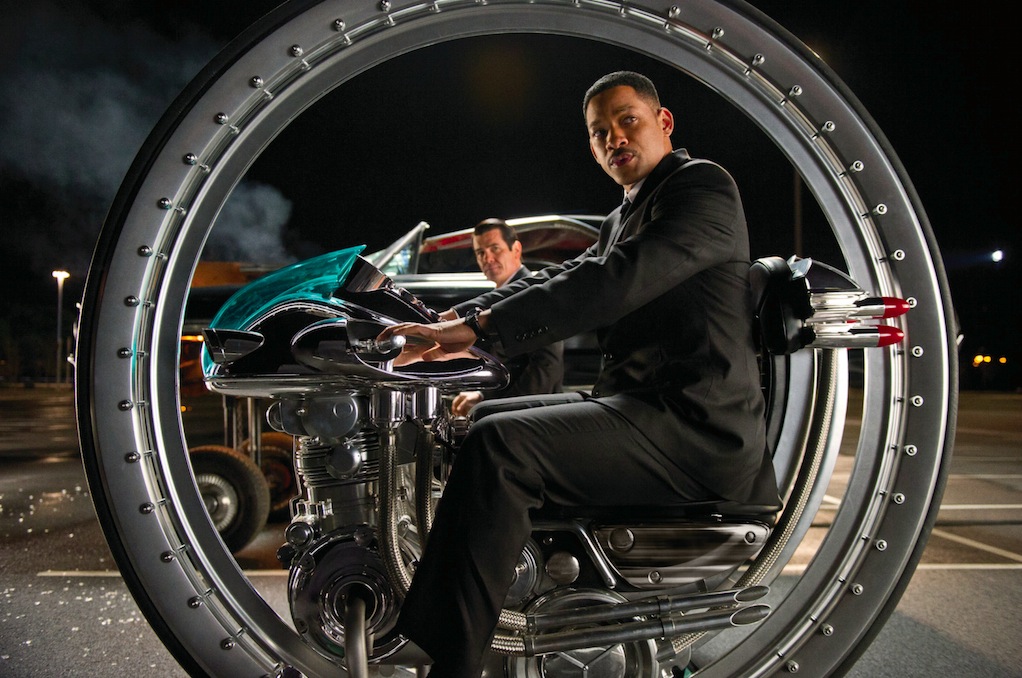
Ralston was one of the first people to join Sonnenfeld to work on the film, and he ended up working closely with each of the department heads and directors, from production to costumes to mechanical effects, to help each benefit from the visual effects when necessary. For example, production manager Bo Welch designed the unicycles that J and K used to chase Boris through Queens in 1969 – they then passed the baton to CG artists on Ralston and Redd's team, who created the unicycles on the computer – some sequences were completely CG – and recreated New York in the 1960s as a backdrop for the elaborate chase sequence.
But perhaps no collaboration was closer than Baker's with the makeup effects team. “Rick and I met when we were 17, doing commercials – I've known him forever, but we'd never worked together,” Ralston says. “It was a lot of fun to be around him and work together.”
The collaboration ranged from the simplest to the most extensive. “You never know which of the aliens Barry will take for a close-up,” Ralston says. “We could take some of the aliens and add little details – some extra animation around the eyes, some winking, antennae movements, an extra limb.” But Baker and Ralston also worked together to create Boris the Animal. “Rick designed a really cool idea, where the head and a lot of the facial features look like closed fingers or claws,” explains Ralston. "When he loses his temper or gets really angry, all those fingers open up and you can see all these strange things inside his head. Rick created the creature, and we talked all the time about what we could do with it, because there would come a point where we would take control and amplify his work."
Ralston and Redd's teams also created several digital sets, from the prison on the moon that (ultimately) couldn't hold Boris, to Shea Stadium in 1969 (which ultimately couldn't hold the Mets either - the stadium was demolished in 2009 when the team moved to Citi Field). “The prison break is a very good way to start the film,” Ralston said.
The film's most elaborate digital set appears in the climax, when J and young K chase not one, but two Borises through the structure that held the rockets that would launch the Apollo 11 mission to the moon. The trick for this sequence was making a faithful digital recreation of an iconic event that everyone has seen hundreds of times, while creating everything the director needed to tell the story. "Reality is great, but sometimes reality can be boring. The Men in Black movies are about creating an amplified reality, a fantasy reality. We started with reality, then tried to go beyond it but still maintain the feeling of being in the real world," says Redd. “We had to keep the iconic image of the Apollo 11 launch but, for dramatic reasons or pacing, we may have changed things – the number of floors in a tower, the amount of smoke there is at any given time, how far the beach is from the rocket.”
“We try to make you believe that there are two agents and two Borises running around fighting each other,” Ralston says. "We all have the smoke around us, the steam, the vents, the cool angles of the rocket. The lighting has to have a certain quality. Everything is stylized so that it feels like part of the movie, but we also feel like they are really there."
Redd adds that the way the director – a successful cinematographer in his own right before his transition to directing – helped give the sequence a unique Men in Black-flavored feel. “Barry's shooting style, wide lenses and lots of light, adds a sense of comedy while retaining a sense of tension and pace,” adds Redd.
The demands of the film required close coordination between Baker and Ralston, each a legend in their respective fields of makeup and visual effects and having known each other since their teens. “I was excited to work with Ken,” Baker admitted. “I thought, 'Now we can make a beautiful marriage of our techniques.'” Knowing each other so well, Baker and Ralston were able to decide whether makeup, animatronics, or computer generation provided the best solution for each challenge in each particular case.
And the one who puts it all together is director Barry Sonnenfeld. Josh Brolin assures that "there would be no Men in Black without Barry. He brings a style and energy that makes this franchise what it is. You couldn't ask for a more perfect choice to direct these films. You see him directing a scene and he is really immersed in it, viscerally immersed."
“Barry has a very, very good visual sense – I think because he used to be a Production Director,” says Rick Baker. "But perhaps his greatest skill as a director is being open to the ideas of those around him. He hires people who he believes and knows are good and talented - and he genuinely wants to know their opinions on the work they are doing."
Yesterday and today
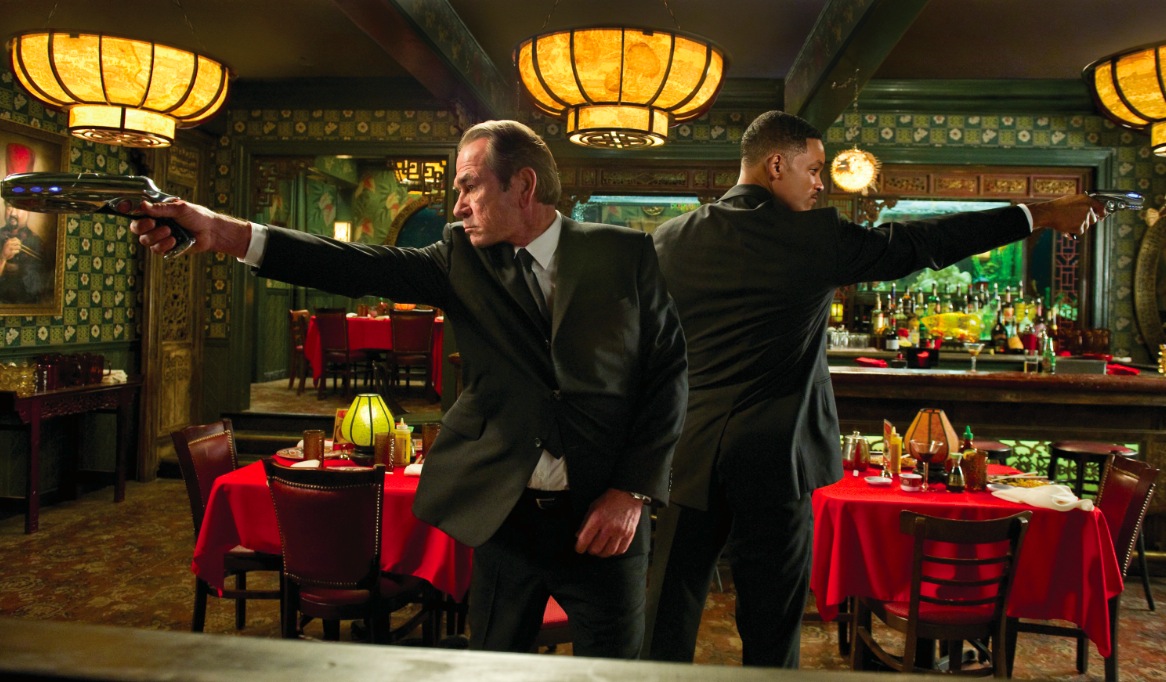
The films of Men in Black are always a challenge for production design, stretching the limits of reality while remaining in the realm of the possible, but Welch had an additional challenge this time as he would have to design two worlds – one in 2012 and the other in 1969.
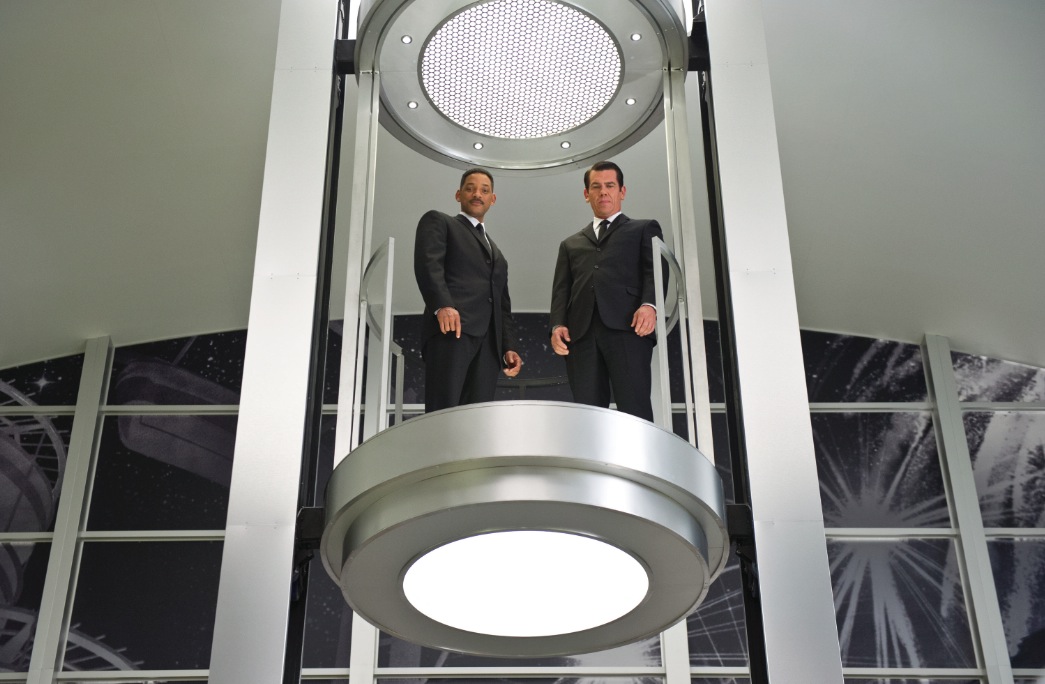
Since what is taken for granted is that the men in black have remained in the same space for 40 years (and that space has been updated with the times), Welch created the headquarters set of The men in black for scenes in the first act, and then, during the film's holiday hiatus, he redesigned the set for 1969. “We changed every square inch,” he says.
On their first day back on set, the actors found themselves with a pleasant surprise. “I walked into headquarters in 1969 and it was magical,” Smith says. “Bo has been able to create and recreate the quintessential Men in Black look – I'm thrilled to be on his team.”
To keep the tone in line with the rest of the film, Welch says he never went for easy laughs. "I'm not designing things to be funny. They just happen to be funny," he says. "I tried to go back to 1969 and asked myself, 'What would it really be like? If you stay too far ahead, you haven't taken advantage of the joy and fun of traveling in time. I learn from the material itself and, in this case, the year 1969 gives you a vast and immense source of inspiration to generate the props, the sets, the weapons, the vehicles.'
One of the major set pieces for which Welch required close interaction with special effects supervisor Ken Ralston was the Apollo 11 launch to the moon on July 16, 1969. “I see a lot of films where the explosions and effects feel very digital, like in a video game,” Sonnenfeld says. "To me the best effects are the ones where you don't even realize they're effects. That's what Ken is very good at - his effects are focused on reality. He watches the way I direct the scenes and works with Bill Pope, the director of photography and Bo, and we all work together as a team with a singular, unified point of view."
Welch and props manager Doug Harlocker also researched Andy Warhol's Factory. “One thing Bo discovered was that Andy put up aluminum foil in his house, so we did that too,” says Harlocker. The prop master also created pieces that reflected the pop-art aesthetic of that period. “They had interesting buffets that were more artistic than culinary, so we sculpted a big pig and placed it on a bed of apples, as if it were bleeding fruit,” he says.
Recreating New York in 1969 also required the expertise of Welch and Ralston. “New York has changed a lot in the last 40 years,” Welch says. “We chose our exteriors carefully, and then augmented them with ambience and signage.”
The filmmakers were also responsible for the reconstruction of Shea Stadium, presenting it in its glory days in 1969, and Harlocker was responsible for helping give the stadium its authenticity: “Shea Stadium flags or buttons, boxes of firecrackers from the era, the specific cardboard cups in which the beer was served – we had to generate all of that or obtain it through collectors.”
Aliens
Rick Baker's clever aliens are a vital part of Men in Black, so it's no surprise that the legendary artist returns for Men in Black 3. Baker finds it especially satisfying to work on the Men in Black films because they inevitably require him to design in so many different ways: "Some films are strictly makeup – for example, for age. Others require fake heads or bodies. Others we do animatronic characters and puppets. The Men in Black films include all of those things. We ended up doing about a hundred aliens for this film and a whole story could have been written about each one of them. them.”
Sonnenfeld says Barker's sensibility blends perfectly with the "direct and realistic" tone of the rest of the film. “We don't want to design crazy, weird aliens,” he says. If they are funny, we want it to be a product of a certain humor in the observation, of their attitude or of the viewers themselves thinking, 'Oh, how interesting.'"
Production director Bo Welch says that before finishing his sets he looks at Baker's creations to make sure everything comes together. “He designs fabulous aliens and I design an environment that highlights them,” he says. “We used a very rigorously controlled palette, so that the textures, shapes and colors of the aliens can breathe and be seen and enjoyed in all their glory and splendor.”
For the 1969 sequence Baker suggested the idea of making the aliens “retro” – inspired by the aliens seen in 1960s science fiction. “The challenge in the first Men in Black, which is still the same, is to make the aliens look like nothing seen before,” Baker confirms. This time, Baker offered a unique solution to the filmmakers: "Let's make aliens similar to the ones we've seen before, just a better version. Let's imagine that the guys who made the alien movies back in the '50s and '60s actually saw aliens and based their designs on that. They really liked the idea. That's where I really had fun with this movie - making my version of the classic sci-fi aliens."
How does one design a “retro” alien? “A lot of brains and veins, things like that,” he says. "We had one based on a fish, definitely from an aquatic world. I make a cameo in the film, playing the alien with the brain exposed. In comparison, our 2012 aliens are much more stylized and polished."
Of course, Baker designed the main alien: the villain, Boris the Animal, played by Jermaine Clement. Baker designed a badass biker costume, complete with glasses that appear to be embedded deeply in Boris's eye sockets. “I had the opportunity to transform Jermaine into something he really isn't,” Baker says. “He is actually a very gentle man but, in disguise, he is much more menacing – and, I am told by the women on the set, sexy.”
“When I first arrived, Rick Baker sat me down and said, ‘Are you claustrophobic?’” Clement recalls with a laugh. “”He asked me all these questions – I'm not sure if he meant to scare me, but I did get a little scared. He also mentioned that many of the people who do characters with makeup effects do it only once in their careers. And for good reason: on his first day on set, Clement spent eight hours in makeup (a total that could be reduced to three or four hours once they got into the rhythm).
Of course it's not all aliens and monsters. Makeup artist Christian Tinsley was tasked with making Josh Brolin look more like Tommy Lee Jones: the actor was given a mold of Tommy Lee Jones' nose that was found in the studio's archives from 20 years ago.
[youtube]http://www.youtube.com/watch?v=wqwmM1-7rSA[/youtube]
Did you like this article?
Subscribe to our NEWSLETTER and you won't miss anything.
Related articles
 PFX resurrects 'Grab it as you can': more than 100 shots with visual effects
 The Foundry presents Nuke Stage, a new application designed for virtual production and in-camera visual effects
 U-tad launches its first Degree in visual effects
 Sony will demonstrate its proposal for in-camera visual effects at ISE 2023
 Malditomaus creates the visual effects for 'Spiral' with Fusion Studio
 Twin Pines Takes Visual Effects to a New Level with 'Zipi and Zape and Captain's Island'
 Gonzalo Carrión, CEO of La Bombilla, new coordinator of the Visual Effects Area at Trazos
 The Academy recognizes the visual effects and photography of 'Grupo 7'
 Free Your Mind in the 3D visual effects of 'Torrente 4'
 Serena surprises with the visual effects of the Cuatro promos for the World Cup
 'Alice' in the land of 1,700 sequences with visual effects
 'I have a question for you': a new technical challenge for TVE
 Eyeon Generation 2.0, more visual effects with 3D support
 GI Joe: six studios united around Autodesk to create the most impressive visual effects