





The ICAA confirms that it will call the most important lines of aid for the industry
The general director of the Institute of Cinematography and Audiovisual Arts (ICAA), Susana de la Sierra, confirms during a colloquium organized by the Galician Audiovisual Cluster (CLAG) that in 2013, like the previous year, there will be aid from the Official Credit Institute (ICO).
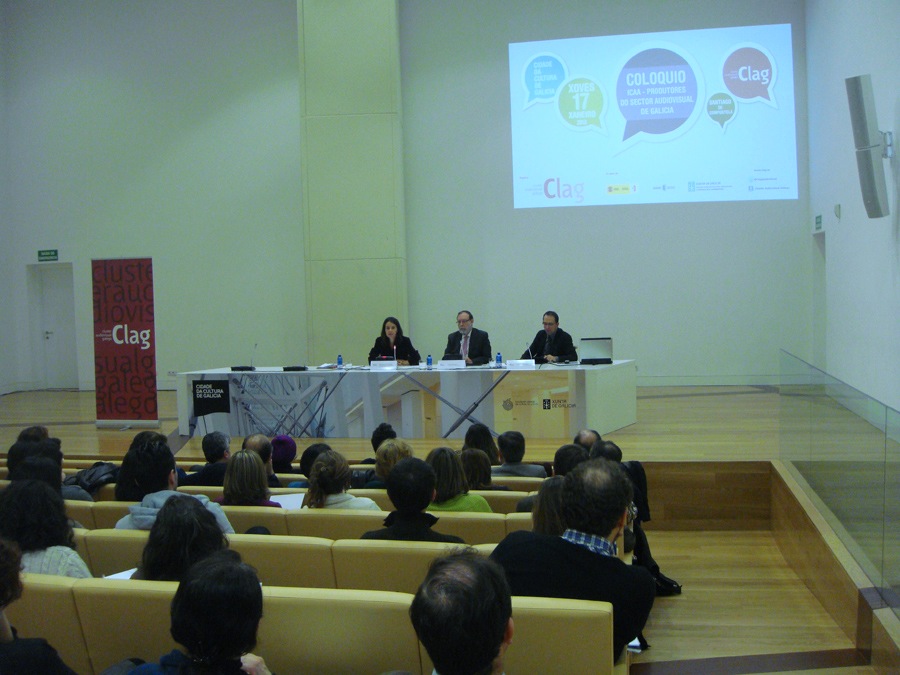
The most important lines for the promotion of the audiovisual industry, fundamentally amortization and new projects, will be called this year. This was announced last week in Santiago by the general director of the Institute of Cinematography and Audiovisual Arts (ICAA), Susana de la Sierra, during the colloquium held with producers of the Galician audiovisual sector, organized by the Galician Audiovisual Cluster (CLAG) with the support of the General Secretariat of Culture and the Axencia Galega das Industrias Culturais (AGADIC).
Those in charge of opening this meeting, held in the City of Culture, were the president of CLAG, Andrés Barbé, and the general secretary of Culture, Anxo Lorenzo. More than sixty professionals participated in the colloquium, among whom were the heads of many of the most relevant companies in the Galician audiovisual industry.
Anxo Lorenzo assured that in these "difficult and complicated" times for professionals in a strategic sector such as the audiovisual sector, "it is more necessary than ever to dialogue, listen and offer alternatives for new models that better adapt to the current situation."
Furthermore, the general secretary recalled that "AGADIC is already planning the new calls for subsidies for 2013 aimed at audiovisuals", and announced that this week "it could be known who will be the new person in charge of the Agency."
For her part, the general director of the ICAA explained during her speech the upcoming lines of aid from her department to Spanish cinematography and took stock of her institution's activity in the past year.
Susana de la Sierra was also pleased that "according to the provisional data available to the ICAA, the performance of Spanish cinema at the box office in 2012 has been spectacular."
An evolution that has no relation to the 36% cut experienced in the Institute's budget for 2013 and a reduction of ten million euros in the Cinematography Protection Fund, endowed with 39 million for this year.
Calls for aid for 2013
Susana de la Sierra indicated that one of the handicaps in the configuration of the aid lines for 2013 is the determination of the amount that this year will have to be paid for films released in 2011, charged to the Cinematography Protection Fund. Based on this figure, the number of aid lines that we can obtain in 2013 will be analyzed, he indicated.
The director confirmed that this 2013, like the previous year, there will be aid from the Official Credit Institute (ICO) and that, as a novelty, this year an additional subline will be opened for animation productions, thus responding to a request from the Spanish Federation of Associations of Animation Production Companies Diboos.
In this sense, the head of the ICAA assured that they are preparing the different calls, and although she did not advance a date, she said that "these will come out as soon as possible."
Susana de la Sierra also delved into the work carried out by the Commission to Study a New Film Financing Model, established last December and structured around four lines of work: tax incentives, the reform of the so-called amortization aid, the financing of the film industry by television and telecommunications operators, and the new work models.
Tax incentives and private financing
In relation to the issue of tax incentives in the film industry, the general director believes that "measures such as increasing the deduction percentage, its application to other production models or the creation of a specific corporate type similar to the French model will contribute to making these incentives more attractive and attracting private investors." For Susana de la Sierra, tax incentives do not replace film aid, although, she clarified, a reform of amortization aid is necessary, which will be debated within the framework of the Commission for the Study of a new Film Financing model.
On the other hand, the head of the ICAA confirmed to the attendees that the obligation for television stations to invest in Spanish cinema is one of the issues that will be addressed by the Commission, where the need to adapt a modification to this system will be evaluated. The director was convinced of the importance of television support, including promotional support, for films. She also spoke about the commitment made by her department to other lines of work such as the promotion of “experimental” cinema, the training of younger audiences, and its support for new filmmakers and the role of women in audiovisuals.
In the area of internationalization, Susana de la Sierra recalled the existence of two co-production agreements with Israel and India, to which a new agreement with China will be added very soon. And he highlighted the interest of other countries such as Brazil and Colombia in carrying out collaborations of this type. After the intervention of the general director, a debate was held in which the participants raised various aspects that concern audiovisual professionals, such as financing problems, the "bad" results obtained by Galician productions in the evaluation commissions of the latest ICAA calls, or the serious damage that piracy is causing to the audiovisual industry, among others.
Did you like this article?
Subscribe to our NEWSLETTER and you won't miss anything.
Related articles
 ICAA calls for new aid for the production of feature films on the project
 The ICAA grants aid worth 54 million euros for the production of feature films
 ICAA will allocate 16 million euros to the new call for selective aid for feature films
 The ICAA grants aid of 15 million euros to 47 projects for the production of feature films
 The ICAA calls for aid for the production of short films on the project
 ICAA calls for selective aid for the production of feature films based on project
 The Council of Ministers authorizes the ICAA to call for aid to movie theaters
The ICAA calls for selective aid for the production of project-based feature films
The ICAA unlocks cinema aid
The Council of Ministers authorizes the ICAA to call for aid to movie theaters
The ICAA calls for selective aid for the production of project-based feature films
The ICAA unlocks cinema aid
 The Ministry of Digital Agenda will call for aid to the video game sector through Red.es
 The ICAA publishes its grants for feature films on projects
The ICAA allocates 33 million euros to aid the amortization of feature films
Industry will allocate 52 million to aid to promote the extension of high-speed broadband
The ICAA publishes its grants for feature films on projects
The ICAA allocates 33 million euros to aid the amortization of feature films
Industry will allocate 52 million to aid to promote the extension of high-speed broadband
 The ICAA grants aid for the amortization of feature films 2013