





Cuba launches a DTT pilot project under the DTMB standard
To test signal transmission and reception in homes, set top boxes have been distributed in specific neighborhoods of Havana.
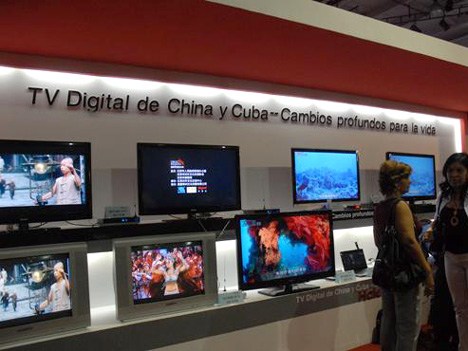 These days Cuba is carrying out digital television tests in areas of Havana, using the Chinese standard for Digital Terrestrial Multimedia Transmission (DTMB).
For signal transmission tests and reception in homes, set top boxes have been distributed in specific neighborhoods of Havana, in order to achieve adequate geographical dispersion and different reception conditions within the entire area of the Cuban capital.
This equipment that allows receiving and viewing the digital signal on current televisions was donated to Cuba by the Chinese government, as part of an agreement signed between both countries.
The purpose of the authorities is to introduce digital TV progressively and by region on the island, in accordance with the “economic possibilities” and “in line with technological evolution” at an international level.
Cuba began to look towards the so-called Digital Terrestrial Television (DTT) in 2009, when it hosted an event for this transition, which was attended by representatives of the European digital standards, the Japanese one with its Brazilian variant, and the Chinese one.
The island's specialists pointed out at that meeting that the selection of the standard was the first step in the implementation of the new support on the island, for greater quality of transmission and reception of signals.
The future possibility of increasing the number of channels, improving the reach of television in silent areas or where reception is currently poor, as well as providing other services that would be impossible with the analog signal, are also part of the objectives.
The move towards the digital system requires, in addition to a strong technical investment in transmission, changes in signal reception, either with the acquisition of new televisions or equipment to decode the digital signal.
Cuba has five national television channels and 15 provincial ones, all state-owned, as well as an international signal, Cubavisión Internacional. Since January, the Latin American television channel Telesur has also been broadcast free-to-air.
Did you like this article?
Subscribe to our NEWSLETTER and you won't miss anything.
Related articles
 Eurovision Washington launches a pilot system for remote content production and delivery with VSN technology
 Telenor launches Scandinavia's largest 5G pilot project in Norway
 South Korea launches first emergency alert service under ATSC 3.0
 Movistar+ launches a personalized advertising and segmentation project in linear consumption
 Sky launches a new OTT project based on Cisco technology in the United Kingdom
 KPN Telecom launches a pilot in 4K UHD
 The Norwegian NRK launches the largest multisite MAM project with Tedial Evolution
 The EBU, together with VRT and several partners, launches a pilot experience of the first fully IP study
 Second connected television pilot test, within the European TV-Ring project
 First LTE-A+ Broadcast pilot project in France to Italy
 Kabel Deutschland tests the DVB-C2 standard in Germany
 The RAI launches a test pilot under DVB-T2 and T2-Lite standards
 Abertis Telecom begins pilot tests of the DVB-T2 standard
 First official DTT broadcast in Colombia under DVB-T standard