





David A. Smith gives a masterful seminar in Madrid and Barcelona
Madrid y Barcelona acogen esta semana el seminario ‘Desde la ingesta al iPad’, organizado por Rohde & Schwarz e impartido por uno de los profesionales con más reputación mundial en codificación y flujos de trabajo. Los últimos formatos de compresión, como JPEG2000 y HEVC/H.265, el Media Asset Management, los sistemas de edición, playout y compresión, la transmisión de RF, los sistemas de entrega por IP tales, las aplicaciones para social TV o la irrupción del HbbTV centran este seminario.
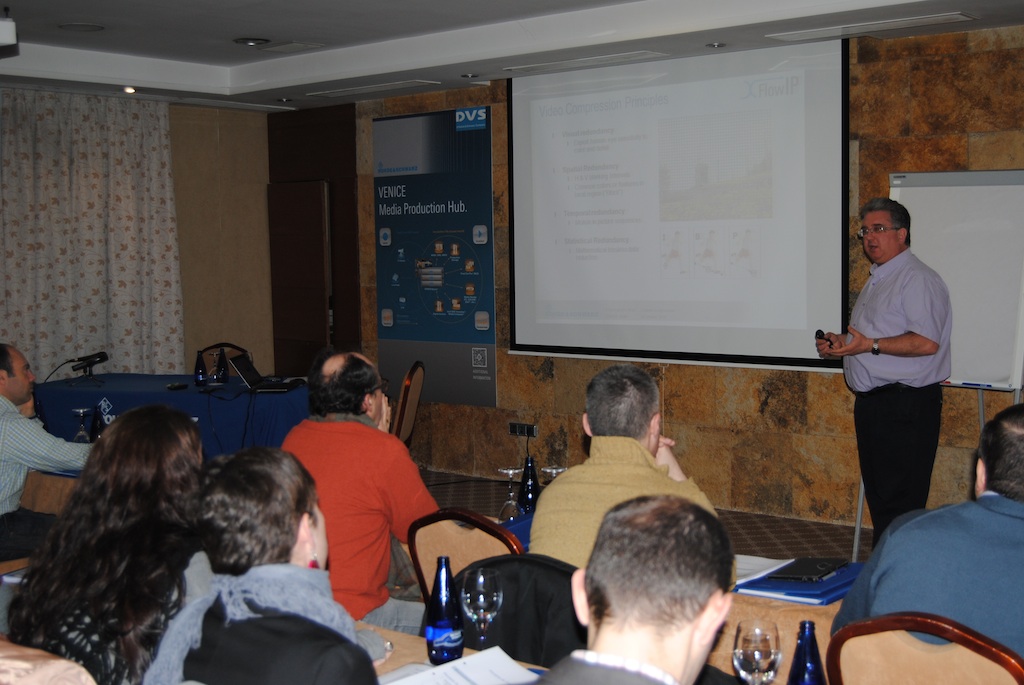
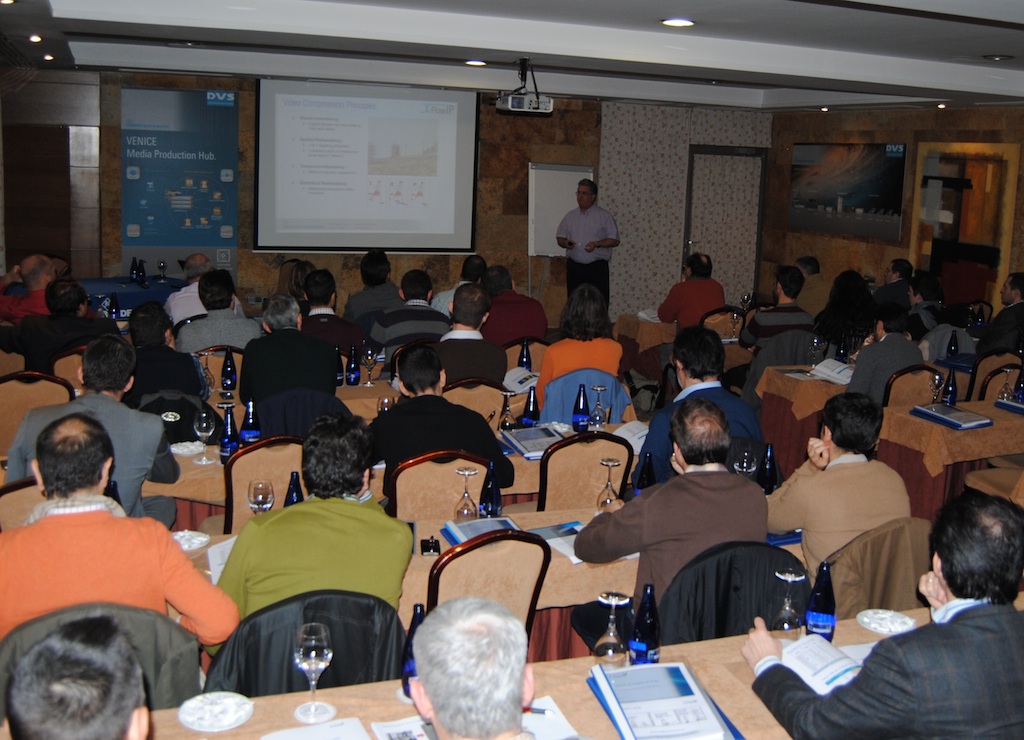
Bajo el título de Desde la ingesta al iPad, Rohde & Schwarz ha organizado este martes en Madrid, y el día 13 en Barcelona, un interesante seminario en el que se ha analizado la cadena completa de aplicaciones IT-broadcast y las tecnologías necesarias para el broadcaster de éxito del futuro.
El seminario ha estado impartido magistralmente por David Smith, responsable de ventas, marketing y desarrollo de producto en el área de broadcast, cabeceras y multimedia en R&S y autor de varios ensayos y artículos técnicos, además de ser un experimentado ponente en conferencias, seminarios y cursos de formación en todo el mundo.
Las altas resoluciones de vídeo como el 4K, la compresión HEVC y los sistemas de entrega en MPEG-DASH son sólo algunas de las innovaciones que se introducirán rápidamente en los próximos años. Las decisiones tomadas hoy sobre los formatos de cámara, los flujos de trabajo basados en archivos y los sistemas de codificación y entrega afectarán directamente la calidad de nuestra transición al paradigma IT-broadcast del futuro. De ahí que este seminario analice cada uno de los diferentes aspectos que influyen en una emisión multidispositivo.
Nuevos formatos de compresión
Las primeras sesiones se han en el impacto de los últimos formatos de compresión, tales como JPEG2000 y HEVC/H.265, en el Media Asset Management, los sistemas de edición, playout y compresión. La transmisión de RF y sistemas de entrega por IP tales como DVB-T2 o MPEG-DASH, aplicaciones para social TV o la irrupción del HbbTV completan este seminario.
David A. Smith ha destacado que frente a los formatos de archivo conocidos hoy, tanto a nivel de codificación como wrapper o contenedor (XDCAM, DNxHD, AVC-intra, ProRes…) estamos viviendo el despegue de interesantes propuestas como los formatos de producción basados en H.264 y compresión intra e interframe con una tasa típica de datos de 100 Mbps como el XAVC impulsado por Sony o el AVC LongG propuesto por Panasonic, o el nuevo formato para distribución HEVC/H.265.
En este complejo mundo que se abre ahora, Smith ha subrayado el papel que iniciativas como el Framework For Interoperable Media Services (FIMS) pueden tener para simplificar los sistemas multicomercializador. Desarrollado por AMWA y la UER, participan en él empresa como Sony, IBM, Avid, Snell, Oracle, Quantel, Cisco o la propia Rohde & Schwarz.
“Coexisten un tremendo número de formatos de archivo, códecs y contenedores para almacenar datos de vídeo digitales. Cabe reseñar la ausencia de un estándar general para el intercambio de datos de vídeo digitales y, sinceramente, no existe una solución disponible para una distribución sencilla y una transferencia de versiones b2b (idioma, subtítulos, inserciones de vídeo..)”, ha asegurado Smith.
Sin embargo, ha destacado el papel que está jugando el próximo Formato de Máster Digital (IMF), llamado a ser el sucesor de la cinta HDCAMSR basado en archivos. Este estándar SMPTE utiliza compresión intermedia minimizando el almacenamiento y guarda el material únicamente con las diferencias ejecutadas y no versiones enteras. Este aspecto es especialmente importante a la hora de editar o modificar contenidos para aerolíneas, por ejemplo, crear versiones censuradas, incorporar escenas adicionales (director’s cut), inserción de publicidad customizada o en general llevar a cabo cualquier edición que modifica la duración. R&S ya incluyó el IMF en su suite Clipster v5.7 en junio del año pasado.
En lo que a almacenamiento para broadcast online, Smith considera que es importante contar con más de una copia del contenido clave, así como la posibilidad de añadir terabytes adicionales según crezca la operativa. Todo ello, sin fallos de arquitectura y con suficiente ancho de banda para ingesta, codificación, navegación en alta y baja resolución, y edición.
“En entornos broadcast, el workflow es cada más importante que el rendimiento de cada equipo por separado”, ha asegurado Smith. Con esta filosofía, Rohde & Schwarz presenta en este Seminario diferentes soluciones como Clipster (postproducción), almacenamiento (DVS-SAN, SpycerBox), servidores (Venice, Pronto4), gestión (Spycer) o pantallas gigantes (Atomix).
Coding
Desde el punto de vista de la codificación, David A. Smith se ha detenido en las posibilidades que brinda el nuevo estándar JPEG2000, que aporta mejoras sustanciales respecto al JPEG original. Este formato resulta especialmente indicado para edición y contribución ya que proporciona una compresión de muy alta calidad en tasa de bits media a alta (50Mb/s+) y presenta una estructora solo I-frame. Ya que contiene de origen los proxies de baja y alta resolución, es idel para la navegación de contenidos basada en red y la edición first-pass. En cuanto a interoperabilidad, crece día a día su soporte como códec para Interoperable Media Packages (IMF). Sin embargo, Smith, reconoce que el JPEG2000 no sería la opción adecuada para distribución ya que tendría aplicaciones DTH, OTT/IPTV o MPEG-DASH.
El ingeniero de Rohde & Schwarz ha hecho también un repaso a las ventajas de la codificación de vídeo de alta eficiencia con HEVC/H.265. Este estándar reduce la tasa de bits hasta en un 50% con respecto a su antecesor H.264 gracias a un mayor tamaño de bloques, mejores opciones de vectores en movimiento y una codificación entrópica CABAB mejorada. También supone una mejora en la calidad de imagen ya que utiliza filtros In loop deblocking y Sample Adaptative Offser (SAO), muestreo de un cuarto de píxel y filtros de 7-8 taps. Smith se ha detenido en el soporte que el H.265 ofrece a un procesado multithread/paralelo de slices, tiles y wavefront, posibilidad de configuración de parámetros del sistema para codificación multiregión y decodificación a baja latencia.
Por lo que respecta a aplicaciones en Ultra Alta Definición, Smith ha destacado que el HEVC es probablemente la única solución comercial para 4K y 8K. Rohde & Schwarz ya presentó soluciones 4K sobre este estándar en IBC 2013. “En realidad, la principal aplicación quizás sea HD y SD vía HEVC ya que podríamos conseguir el doble de número de servicios por la mitad del coste de transmisión. Tampoco hay que olvidar que Mobile Tv e Internet Tv tienen una creciente importancia para HEVC con una calidad y resolución significativa y la consiguiente reducción de la tasa de bits con HEVC”, ha destacado.
En este momento, SES-Astra, Eutelsat e Hispasat ya cuentan con canales de prueba UHD con HEVC. En consumo, los nuevos televisores de Samsung, por ejemplo, ya dan soporte HEVC. En este sentido, Italia ha regulado que a partir de 2015 todos los televisores y STBs de alta gama deberán contar con un decodificador HEVC.
Este seminario ha abordado también las posibilidades que aportan otros códecs alternativos como el VP9 de Google. Sucesor del VP9, fruto de la compra de la compañía especializada en compresión On2 Technology, VP9 presenta unos macrobloques y DCTs similares a los del HEVC, aunque en este caso con una mezcla arbitraria de predicción Inter e Intra y del filtros edge/loop. Según Smith, el VP9 resultaría tan eficaz para 4K como el HEVC pero menos complejo. Los tests indican aproximadamente un 5% más de tasa de bits que el HEVC.
More information here, e inscripciones en este mail o en teléfono 91 334 10 70.
Did you like this article?
Subscribe to our NEWSLETTER and you won't miss anything.
Related articles
 Ross offers a master class dedicated to the cloud universe in Madrid
 The FC Barcelona-Atlético de Madrid will have a Multi-Camera Fan Signal
 David Victori shoots his new feature film 'You won't kill' in Barcelona
 The prestigious documentary filmmaker Frederick Wiseman will visit Madrid to give a seminar at the ECAM
 AEQ organizes a new seminar in Barcelona on the potential and uses of Dante
 Madrid hosts the first edition of the Concept Art NonStop seminar
 The legendary Walter Murch visits Madrid to give a seminar at the ECAM
 The Blackmagic European Tour stops in Barcelona and Madrid
 EVS will present its new 4K and IP mixer in Madrid and Barcelona
 Lexon will present the SSL Live console in Madrid and Barcelona
Quantel Pablo Rio Roadshow 2013, in Madrid and Barcelona
Lexon will present the SSL Live console in Madrid and Barcelona
Quantel Pablo Rio Roadshow 2013, in Madrid and Barcelona
 Robert Scovill teaches a masterclass on live sound
 EVS “Newsroom in a Box” Tour in Madrid and Barcelona
 Dimasa will present the news from DataVideo and NEC in Barcelona and Madrid