





Television professionals remember the figure of Adolfo Suárez
Jesús Hermida, Manuel Campo Vidal, Pedro Erquicia, Rosa María Mateo and Fernando Ónega highlight his figure and his link with television.
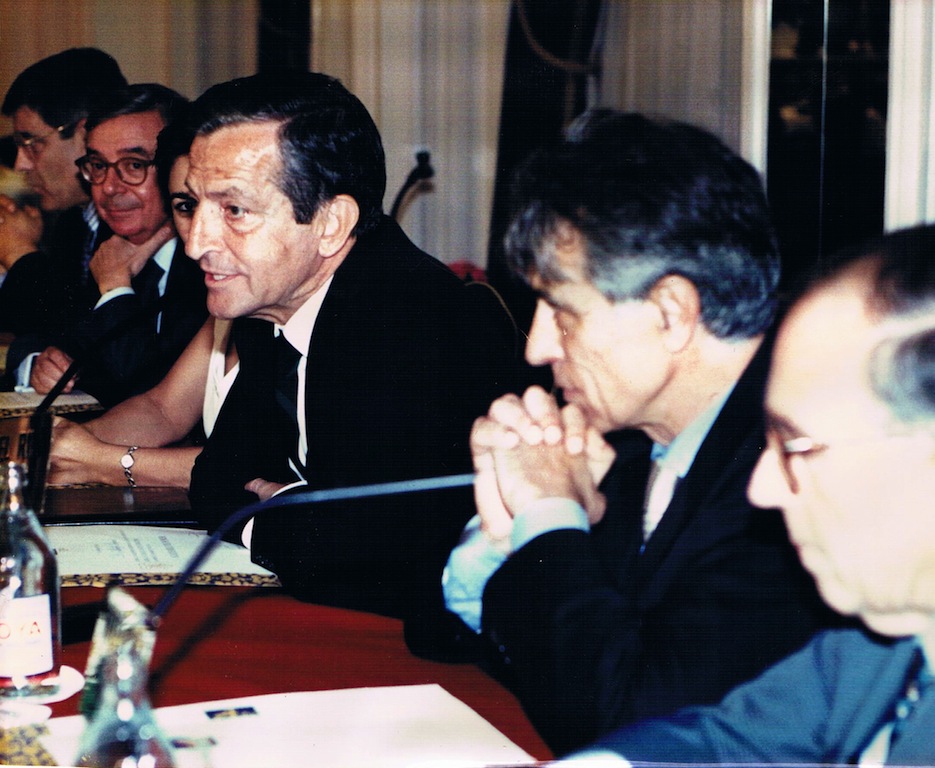
After hearing the news of the death of the first president of democracy, the world of television also wanted to remember the figure. Adolfo Suárez was named the first honorary member of the Spanish Academy of Television Sciences and Arts on June 20, 1997 “for his special connection to television and his defense of freedom.” Suárez then recalled, at an event held at the Ritz Hotel, his work on Spanish Television as “the most beautiful stage of my life” and stated that “in democratic life no one is in possession of the truth.”
Jesús Hermida, founder and first president of the Academy, today especially remembers that presentation ceremony of the Television Academy: "All of us who participated in that foundation agreed that for the "official baptism" we needed a godfather who was not only notable but significant. And that would have to be Don Adolfo Suárez, who agreed to preside over the event and encouraged us to together make the best television possible for the benefit of society." Hermida has also highlighted his special bond with this medium: "As director of TVE, I remember him as ambitious to succeed, decisive and dynamic. Already as general director of RTVE, he took brave initiatives in the general current of his time, always thinking about what he believed in and that he felt obliged to defend."
The current president of the Television Academy, Manuel Campo Vidal, wanted to highlight that Suárez has been "an exceptional character who piloted the Spanish Transition and who understood like few others the power of television. His alliance with communication, his capacity for seduction and his personal courage were decisive in advancing the difficult process that managed to take Spain from dictatorship to democracy. I believe that our country owes him a tribute and I would invite the mayors to put a street with his name explaining to young people the values of coexistence and harmony that Adolfo Suárez embodied.”
The academic and journalist Pedro Erquicia has recalled his television beginnings in 1965: "He as director of Programs in Prado del Rey, me, a journalism student, as an intern at the Paseo de la Habana Informatives. He exuded a desire for the ball, for a fight. That desire for life that has allowed him to summarize his days in silence. We met again in 1973 when he was general director of RTVE and Informe Semanal was born on the last Saturday of March that year. In the 43 months he held the position, he promoted new ways of making television and incorporated new professionals into the medium, which had only been in existence for sixteen years.
"The last time I saw him was at the wedding of a mutual friend before the degenerative disease began to do its devastating work. He was the Adolfo whose image had been projected throughout the country, the politician who managed to get us to vote freely after 40 years of democratic starvation," he points out.
For her part, journalist Rosa María Mateo has highlighted that during her time at TVE "she caused a sensation among the women in the editorial office due to her attractiveness. Later, we were all surprised at that time that someone so young was named President of the Government. Without a doubt, he was a charismatic character, in the short and long distance, and thanks to him we were able to have a smooth transition towards democracy. For that alone, we Spaniards owe him eternal gratitude."
For the academic and journalist Fernando Ónega "he was the right man for a transcendental moment in Spain. He achieved what he wanted: to replace a dictatorial regime with a democracy. And he did it in record time and with the safeguarding of civil peace, which was his obsession. His great historical merit is having carried out a revolution that ended, for the first time in history, without winners or losers."
The Television Academy has joined in the pain and sadness over the loss of a key person in the History of Spain by sending a warm and affectionate message of affection to all his family and friends.
Suárez, protagonist of the Transition
Born in Cebreros (Ávila). He studied law at the Complutense University of Madrid, holding various positions in the State Administration after his degree. He was director of the Ente Radiotelevisión Española between 1969 and 1973, one of the golden eras of the medium in Spain. Undisputed protagonist of the Spanish democratic transition, he was appointed President of the Government in 1976 at the proposal of King Juan Carlos. In 1982 he left UCD, creating a new political group, Centro Democrático y Social, with which he obtained the title of deputy in 1982 and 1986.
In September 1996, he was awarded the Prince of Asturias Award for Concord, unanimously by the 18 members of the jury and in recognition of his political work during the Spanish transition, also valuing his important personal contribution to democratic coexistence in Spain. In June 2007, the Council of Ministers approved a royal decree by which the Head of State awarded the Collar of the distinguished Order of the Golden Fleece to Adolfo Suárez, coinciding with the celebration, on June 15, 2007, of the 30th anniversary of the first democratic elections after the Franco dictatorship.
Did you like this article?
Subscribe to our NEWSLETTER and you won't miss anything.
Related articles
 Canon will present its most recent innovations for television and film professionals at IBC
 Alejandro Echevarría, honorary president of Mediaset España and key figure for private television in Spain, dies
 The Television Academy announces the professionals and programs finalists for the 2020 Iris Awards
 The Television Academy recognizes the professionals behind the cameras with the 2018 Talent Awards
 Spanish Television will present Playz to the professionals gathered at MIPTV 2018
 The Television Academy announces the professionals and programs finalists for the 2017 Iris Awards
 The RTVE Institute participates in AULA with its training plan and the experience of professionals in their radio and television workshops
 The Television Academy and the UNED sign an agreement for the training of audiovisual professionals
 Professionals remember Manuel Martín Ferrand at the Television Academy
 The RTVE Institute presents its training offer in a classroom where professionals will teach how television is made
 Professionals debate the new television and the hybrid revolution
 The Prince and Princess of Asturias preside over the tribute to professionals in the history of television
 “Adolfo Suárez, the president”, political-fiction on Antena 3
 Antena 3 Films and Europroducciones are preparing a new miniseries about Adolfo Suárez