





Ericsson reaches 25 Gbps with its 5G radio prototype
Ericsson's 5G radio prototypes use MU-MIMO and beam tracking to deliver over 25 Gbps data transfer, while ensuring range and continuity across high-speed, high-frequency fully mobile connections.
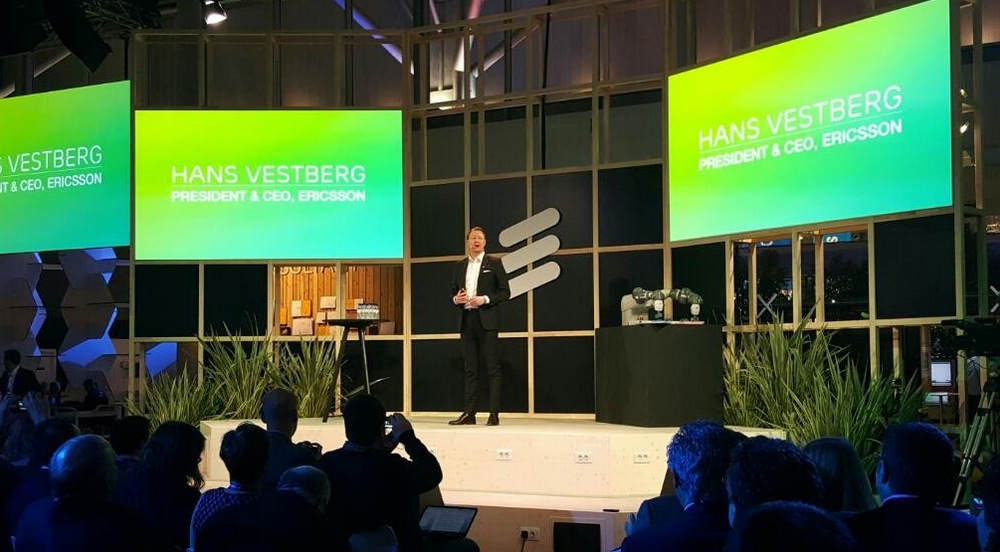
At the Mobile World Congress, which opens today in Barcelona, Ericsson is carrying out real-world demonstrations of 5G radio prototypes.
Ericsson's 5G radio prototypes use MU-MIMO (Multi-User, Multiple Input, Multiple Output) and Massive MIMO to increase downstream transfer. They also use advanced beam control, required in millimeter wave bands to ensure high performance and reliability for those using the network on the go.
Seizo Onoe, Executive Vice President and Chief Technology Officer of NTT Docomo, said: "We are delighted that Ericsson's 5G radio prototypes have made this great achievement possible following the long-standing 5G technical collaboration between Ericsson and Docomo. Both companies are already carrying out joint field tests to understand the real behavior of 5G in the field. This will allow us to plan the new improved services that we will be able to offer with 5G. We will be well placed to highlight our commercial 5G capabilities in 2020.”
Dongmyun Lee, KT's chief technology officer, adds that "thanks to our work with Ericsson, KT is well positioned to anticipate new 5G services at the 2018 Olympic Games in PyeongChang. We appreciate that Ericsson is allowing us to test 5G capabilities with advanced features such as beam control, MU-MIMO and Massive MIMO, which we will need for our 5G commercialization plans."
Ericsson's 5G radio prototypes are already delivering a mobile experience of more than 12 Gbps per user in real network environments, with downstream transfer of more than 25 Gbps with MU-MIMO. The actual demo for NTT Docomo and KT took place indoors at the Ericsson campus in Kista, Sweden, and is also shown at MWC in Barcelona. Each 5G radio prototype (the size of a carry-on suitcase) can support the equivalent of 40 LTE operators.
Arun Bansal, vice president and head of Ericsson's Radio business unit, said: "Ericsson enables our major operator customers to experience advanced 5G features, achieving real performance milestones. With 5G radio prototypes we are supporting MU-MIMO, Massive MIMO and beam control to make more bandwidth commercially available in millimeter wave spectrum.
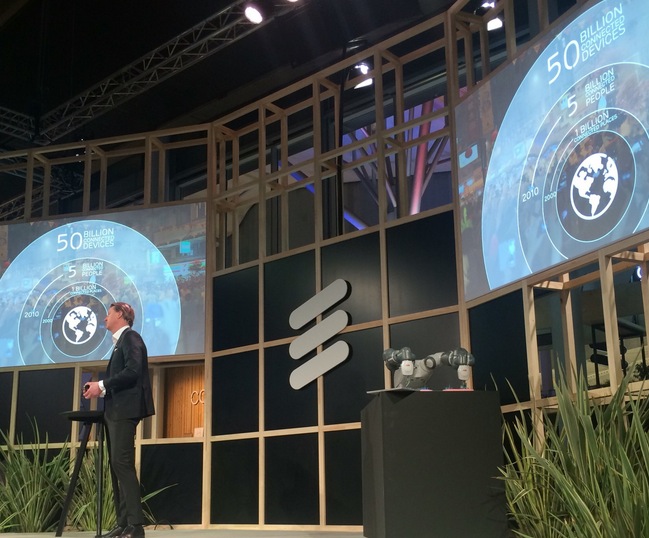
Impact of 5G
The multi-gigabyte per second speeds offered by the radio prototypes can not only meet the growing demand for mobile broadband and video on smartphones and other mobile devices, but also offer a viable and efficient alternative to residential fiber connections. 5G will also impact the Internet of Things, enabling new applications for smart vehicles and transportation architecture, remote control of heavy machinery in hazardous environments, remote surgery, and new levels of human-IoT interaction including immersive augmented reality and immersive gaming.
The development of 5G will include an evolution of the current LTE (Long Term Evolution) and the addition of new radio access technologies, often at higher frequencies.
These higher frequencies have a shorter transmission range than current mobile networks and mitigate potential adverse effects on performance and reliability such as vegetation or weather conditions.
Ericsson's 5G radio prototypes use Multi-User MIMO to transmit data to multiple devices using the same time and frequency resources, thus increasing the system's spectral efficiency. Massive MIMO, a combination of MIMO and beamforming with a large number of antenna elements, improves both transmission and energy efficiency. With beam control, Ericsson's 5G radio prototypes monitor the position and movements of a device and direct one or more beams in the best direction for said device in real time, ensuring always reliable connections. These beams can come from multiple transmission points.
5G will impact the entire mobile network and associated ecosystem, from devices to radio access, core and cloud. Ericsson's 5G radio prototypes are radio access products that can be installed indoors or outdoors, allowing operators to test their 5G services in their own network environments. The prototypes use technological innovations that facilitate the laboratory tests and the real indoor and outdoor tests of phase one of the award-winning Ericsson test bed, already deployed in Japan, Korea, the United States and Sweden.
Did you like this article?
Subscribe to our NEWSLETTER and you won't miss anything.
Related articles
 Nokia, Elisa and Qualcomm reach 5G uplink speeds of more than 2 Gbps
 Andrés Vicente, new president of Ericsson Iberia and CEO of Ericsson Spain
 Deutsche Telekom and Ericsson exceed 100 Gbps in a microwave link
 NovelSat presents a compact IP satellite multi-receiver that offers up to 2 Gbps per unit
 Telefónica achieves speeds of 1 Gbps. with 4.9G technology over the existing network in a real environment
 Orange and Ericsson achieve speeds greater than 15 Gbps and 4K video in real time over 5G in Spain
 Vodafone aims to reach 350 Mbps in 4G and 1 Gbps symmetrical in fiber next year
 Ericsson achieves a connection greater than 7 Gbps over 5G in a moving vehicle
 Akamai allows Sky Italia to manage traffic peaks of hundreds of Gbps in the distribution of its online content
 Telefónica and Cisco complete a connectivity test at 100 Gbps and 4,000 kilometers with IPoDWDM technology
 Microsoft develops a prototype of an autostereoscopic display
 UTPro HDMI: AMX unveils its 10 Gbps matrix over Cat 5
 PlusPAK: Barco's first 3 Gbps mixer
 100 Gbps at more than 1,000 kilometers