





Deutsche Telekom and Ericsson exceed 100 Gbps in a microwave link
The microwave link at a distance of more than 1.5 km achieves performance ten times higher than current commercial solutions.
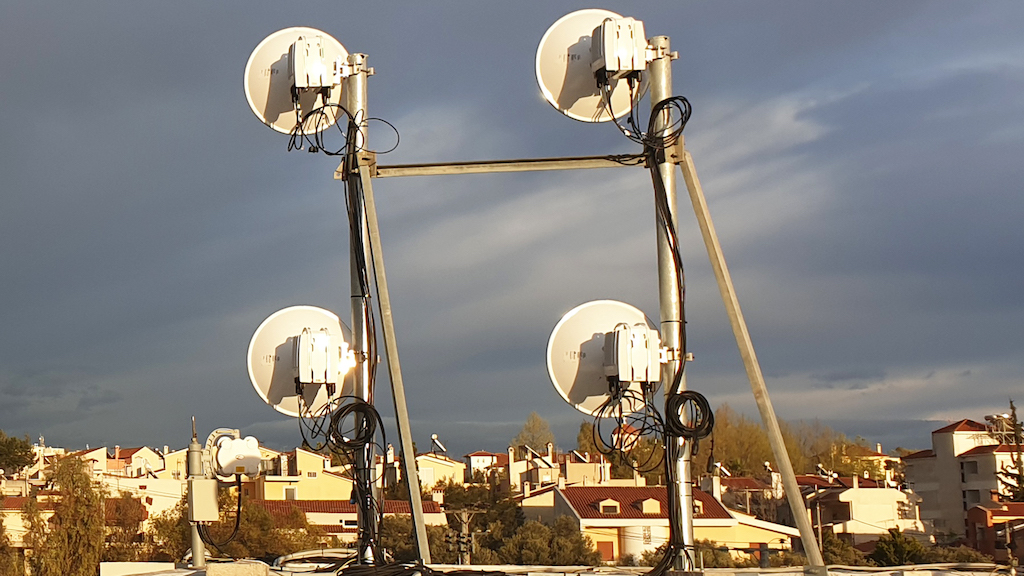
Ericsson y Deutsche Telekom have reached a unprecedented data transmission speed by overcoming the 100 Gbps on a microwave test link of more than 1.5 km.
Carried out at the Deutsche Telekom Service Center in Athens, the joint innovation project represents a great technical advance, since it reaches processing speeds more than ten times faster to those of current commercial solutions over a similar 70/80 GHz millimeter wave spectrum.
Alex Jinsung Choi, senior vice president of technology strategy and innovation at Deutsche Telekom, states that "advanced backhaul solutions will be needed to support high data throughput and improved customer experience in the 5G era. This milestone confirms the viability of millimeter wave microwave spectrum as an important extension of our portfolio of high-capacity, high-performance transport options for the 5G era. In addition, it represents a game-changing solution for future fronthauling capabilities."
Per Narvinger, director of product networking at Ericsson, states that "this trial signifies the successful establishment of real fiber-in-the-air capabilities using microwaves. This means that microwave will become even more relevant to communications service providers in creating redundant networks as a backup for fiber, or as a way to close a fiber ring when fiber is not a viable solution. With these high capacities, microwave is established as a key transport technology, capable of meeting the performance requirements of 5G."
In addition to confirming the potential of microwave technology in the millimeter wave spectrum (70/80 GHz and above) as a 5G solution and beyond front-haul and backhaul solutions, the trial demonstrated the importance of applying efficient spectral techniques, such as MIMO (multiple input, multiple output) in wireless backhaul technologies to address future 5G radio access demands.
Technical equipment
The main technological advances included a MIMO with 8x8 line of sight with cross-polar interference cancellation configuration using commercial radios MINI-LINK 6352 and a channel bandwidth of 2.5 GHz in the E band (70/80 GHz) capable of transmitting eight independent data streams over the radio path. This corresponds to a revolutionary spectrum efficiency of 55.2 bps/Hz at peak.
During testing, transmission rate measurements consistently remained above 100 Gbps, with telecom-grade availability (greater than 99.995 percent), with peak rates reaching 140 Gbps.
In late 2018, Ericsson and Deutsche Telekom broke the 40 Gbps barrier with commercial equipment, including Ericsson's MINI-LINK 6352 solution, which currently provides 10 Gbps capacity on a 2000 MHz channel. To increase performance more than 10 times, this test used a 2500 MHz channel and pre-commercial baseband and MIMO processing equipment, as well as radios MINI-LINK 6352.
Did you like this article?
Subscribe to our NEWSLETTER and you won't miss anything.
Related articles
 Accedo and Deutsche Telekom advance the new generation of immersive sports streaming
 Sony and Deutsche Telekom sign an agreement to enhance audiovisual coverage on 5G
 Nokia, Elisa and Qualcomm reach 5G uplink speeds of more than 2 Gbps
 Plazamedia produces Euro 2020 for Deutsche Telekom using MediorNet by Riedel
Plazamedia produces Euro 2020 for Deutsche Telekom relying on Riedel's MediorNet
Plazamedia produces Euro 2020 for Deutsche Telekom using MediorNet by Riedel
Plazamedia produces Euro 2020 for Deutsche Telekom relying on Riedel's MediorNet
 Cellnex joins forces with Deutsche Telekom to add 3,150 sites in the Netherlands
 Deutsche Telekom and MediaKind carry out the first 360º multi-camera streaming in 6K
 Orange and Ericsson achieve speeds greater than 15 Gbps and 4K video in real time over 5G in Spain
 Ericsson, Verizon and Qualcomm overcome the gigabit per second barrier in LTE for the first time in the US.
 ABonAir AB405: a low-cost wireless microwave link with a range of up to 750 meters
 Ericsson achieves a connection greater than 7 Gbps over 5G in a moving vehicle
 Ericsson reaches 25 Gbps with its 5G radio prototype
 Deutsche Telekom renews contract with Norigin Media for its streaming services
 SVP launches new H.264 microwave link