





The Film Academy awards the Second Chomón Prize to Solid Angle
The company that develops Arnold, photorealistic image synthesis technology, recognized with the award that recognizes the merit of technical contributions that have benefited the film industry.
The Second Chomón Prize 2016, awarded by the Academy of Cinematographic Arts and Sciences of Spain, has gone to Solid Angle.
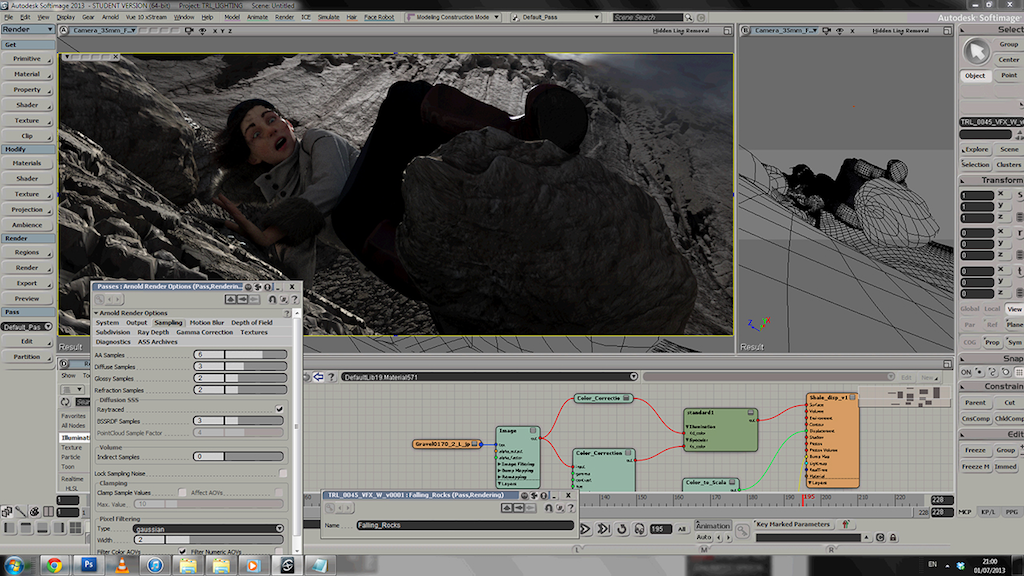
This Spanish company developed the Arnold photorealistic image synthesis technology, responsible for a large part of the images in animation and special effects blockbusters in recent years. Star Trek Into Darkness, Pacific Rim, Alice in Wonderland, Thor, Iron Man 3, The Avengers, Hotel Transylvania, Gravity y guardians of the galaxy These are, among many others, some of the productions in which this technology has been used, led in its development by the Spanish Marcos Fajardo.
Fajardo states that "what began as an experiment as a computer science student has become a professional tool that is used in most animation and visual effects studios. All this is science and patience, a mathematical simulation of the transport of photons using statistical techniques that date back to the Manhattan Project in the 1950s. The merit of Solid Angle is to transfer mathematical complexity to a computer program that is very fast and easy to use by digital artists. After 17 years of work, we have managed to give our company a global profile, only 2% of our sales are in our country.”
Among the latest works in which Arnold has been used, stands out Star Wars: The Force Awakensza “My interest in special effects began as a child with mockups of star wars, so in a way we have come full circle, and after this I wonder where else we can go. For me it is a pride to say that our technology has been used in about 300 shots of this film,” says Fajardo.
Currently, Solid Angle is immersed in new projects such as Independence Day 2 y Trollhunters, an animated series developed by DreamWorks, which can be seen on Netflix, and will be directed by Guillermo del Toro and the Spanish Rodrigo Blaas.
Complex 3D scenes
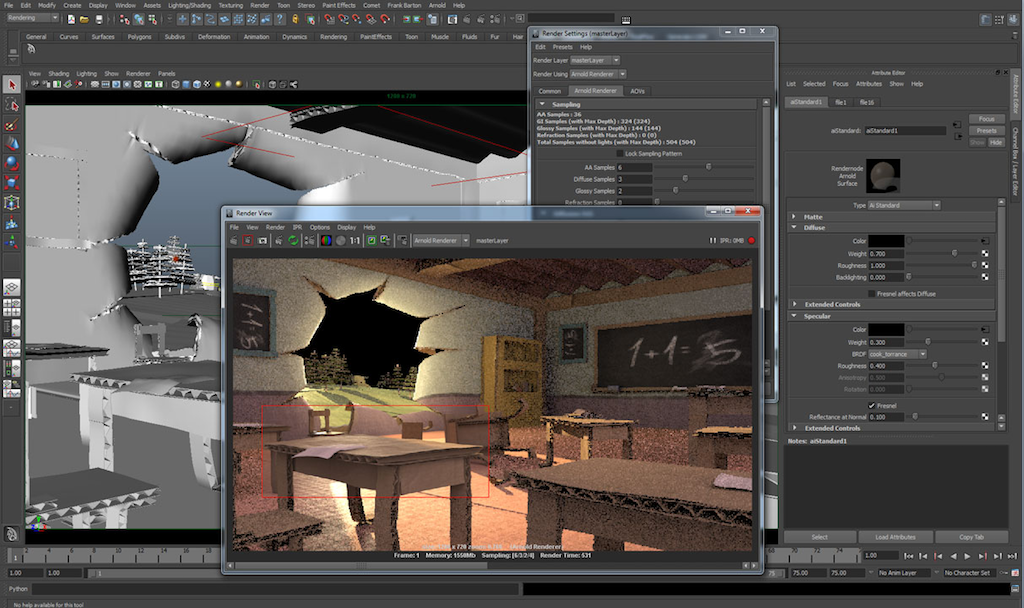
Arnold is a lighting simulation software, or renderer, that, by solving the integral radiance equation using Monte Carlo statistical methods, generates images indistinguishable from reality based on the geometric description of a three-dimensional scene. Arnold was specifically designed to process as efficiently as possible the increasingly complex 3D scenes needed in animation and special effects for high-budget film productions.
This system optimally uses the technology known as ray tracing, standing out among its competitors for its ease of use, speed, robustness and ability to render the most complex images using the minimum possible memory. In our country, this technique has been used for the animated feature films Justin and the Sword of Valor, Futbolín, Mortadelo y Filemón contra Jimmy el Cachondo, Torrente 5: Operación Eurovegas and the Pocoyo series, among other productions.
Marcos Fajardo, software architect and researcher at the Institute for Creative Technologies (ICT) at the University of Southern California, studied systems computing at the University of Malaga. The software was developed over the past 15 years, but the research and development team that Fajardo once led made notable advances in the three-year period in which the founder worked at Sony Pictures Imageworks in Culver City, California. Since then, all films produced by this company and by Sony Pictures Animation use Arnold.
The Solid Angle company, which today employs more than 25 professionals, was founded in Madrid at the end of 2009 with only two employees. Although today the development headquarters is located on Madrid's Gran Vía, sales and support tasks are carried out from the subsidiary opened in London's Soho, exporting more than 95% of its technology to the main 3D animation and visual effects markets in the world in Los Angeles, San Francisco, New York, the United Kingdom, Canada, Germany and France.
Did you like this article?
Subscribe to our NEWSLETTER and you won't miss anything.
Related articles
 The Film Academy awards the Elías Querejeta Prize to Esther García
 The Film Academy awards the International Goya to Richard Gere
 The TV Academy awards 'Cifras y Letras' the Iris Prize of the Specialized Press 2024
 Javier Valderrama and Toni Hernández, Segundo de Chomón 2024 award for their work in the field of lighting
 The Film Academy awards Juan Mariné the Goya of Honor 2024
 The Film Academy awards its 2023 International Goya to Juliette Binoche
 The Television Academy awards José Luis Balbín the Jesús Hermida Lifetime Achievement Award
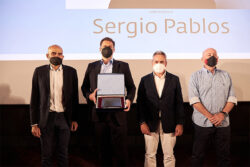 Sergio Pablos, founder of the SPA animation studio, receives the Second Chomón Prize 2021
 Sergio Pablos, awarded the Second Chomón Prize 2021
 The Film Academy will present the 2019 Second Chomón Prize to Alfredo Díaz 'Fredy'
 Marcos Fajardo, founder of Solid Angle, will receive the special prize from Summa3D
 Juan José Mendy, founder of Iskra, Second Chomón Prize of the Academy
 Sgo will receive the Second Chomón Prize from the Film Academy
 The Val del Omar Archive, Second Chomón Prize from the Academy