





Bitmovin Video warns about widespread latency and fragmentation issues across codecs, formats and devices
El informe ‘Video Developer Report’, elaborado por Bitmovin, analiza el estado de la codificación partiendo de las opiniones de 456 desarrolladores de vídeo entre broadcaters, editores, servicios de streaming OTT, plataformas de vídeo online y plataformas de medios sociales de 67 países.
Bitmovin, empresa centrada en la tecnología de vídeo online, publica anualmente el informe Video Developer Report, que revela una instantánea de las principales tendencias y problemas de la tecnología de vídeo. El estudio se basa en las opiniones de 456 desarrolladores de vídeo between broadcasters, publishers, OTT streaming services, online video platforms and social media platforms from 67 countries.
Stefan Lederer, CEO of Bitmovin, emphasizes that "the online video industry is booming, with new services launching every day. The Video Developer Report reveals how developers are building services, their plans for the future and the main problems they face. As this is the second edition of the report, we can see how these trends evolve. We found the insights extremely valuable and we are delighted to be able to share them with video developers around the world."
Latency
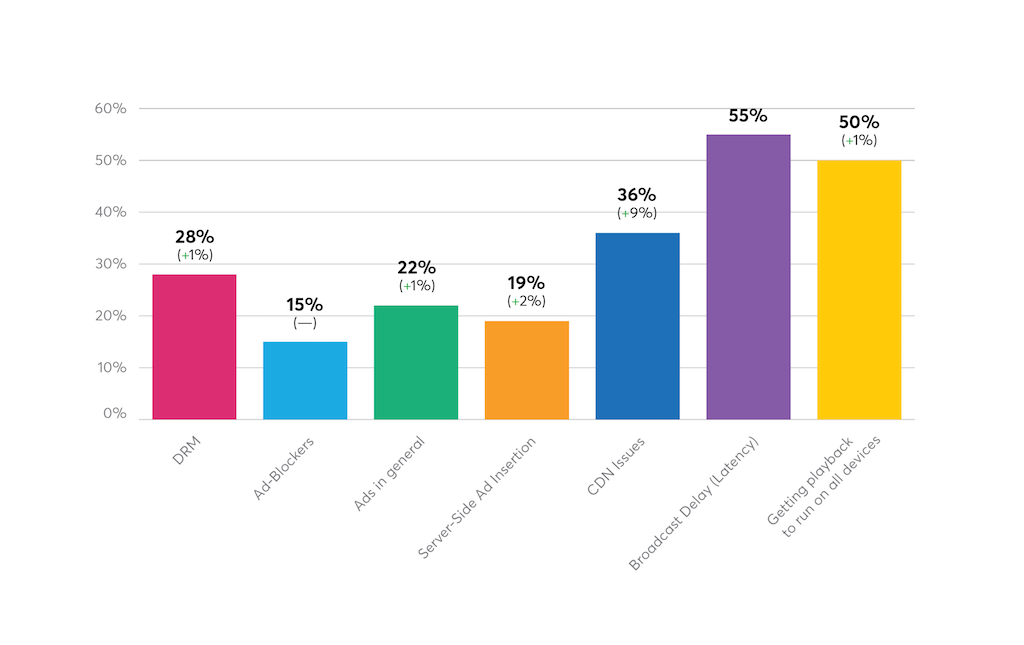
Latency and device playback are major technology concerns. Latency is the biggest problem experienced today today with video technology, according to more than half of respondents globally (55 percent) and nearly three-quarters based in Latin America (74 percent). Delivery delays can be a particular problem for online streaming compared to traditional broadcasters, especially for live sporting events.
The next most common problem is ensure playback on all devices, noted as a headache by half (50 percent) of global respondents, almost exactly the same percentage (49 percent) as in last year's Bitmovin survey.
A future multicodec
92% of those surveyed in the study use H.264/AVC, which dominates current use in video coding. H.265/HEVC adoption has expanded rapidly, to nearly half of respondents (42 percent), compared to less than a third (28 percent) in 2017.
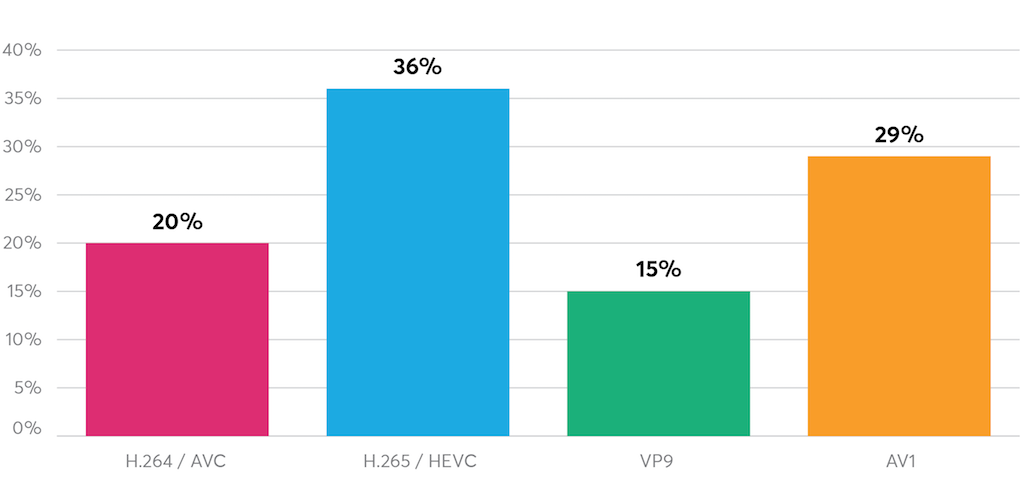
More than a third of respondents (36 percent) plan to deploy H.265/HEVC in the next twelve months. This represents a 40% decrease from the 2017 survey, reflecting a trend toward using a wider range of next-generation codecs in the future.
For his part, the AV1 has gained significant momentum, with almost a third (29 percent) of respondents planning to use the codec in the next year. This is more than double the planned usage rate (14 percent) seen in the 2017 Bitmovin Video Developer Report. 15 percent plan to use VP9, down 18 percent from 2017.
Continuous fragmentation
HLS and MPEG-DASH remain the most popular streaming options, used by 82% and 61% respectively. However, there is also considerable fragmentation, with RTMP used by a third (33 percent) and Smooth Streaming (27 percent) and Progressive Streaming (23 percent) each used by around a quarter. MPEG-CMAF usage has nearly doubled since last year (from 6 to 10 percent) and nearly a quarter (23 percent) plan to implement the format in the next 12 months.
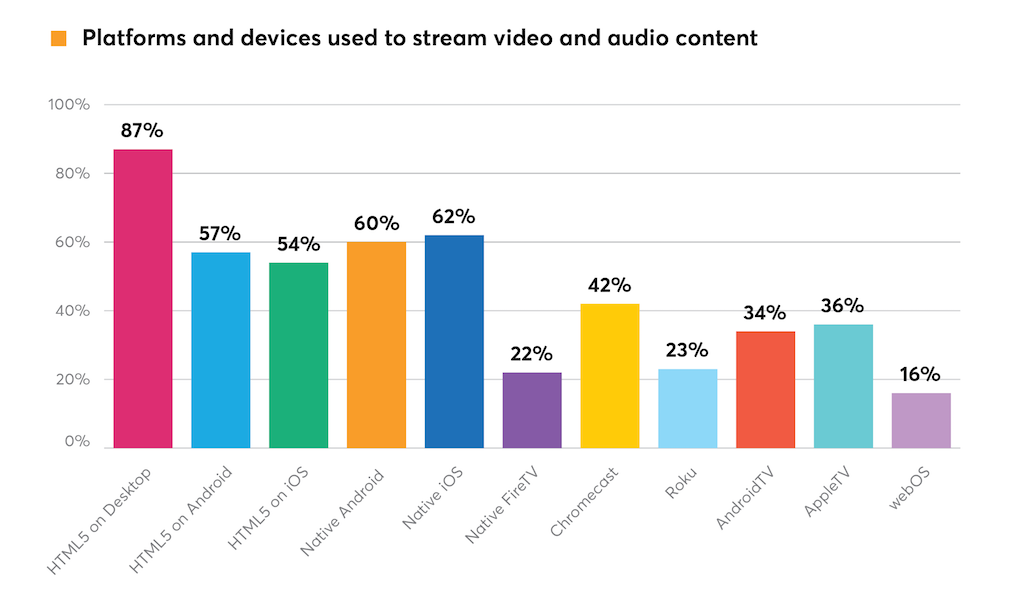
HTML5 through the browser is by far the most widely used format for video and audio delivery, and 87 percent of respondents use it today. Currently, Apple iOS is the most supported native platform, with 62 percent versus 60 percent for Android globally. The trend is consistent across most regions of the world, with 65 percent (vs. 63 percent) respectively in APAC, 64 percent (vs. 59 percent) in North America, 63 percent (vs. 59 percent) in EMEA and 63 percent (vs. 63 percent) in LATAM.
En cuanto al soporte para dispositivos de televisión de consumo, Chromecast es el líder actual, con el apoyo del 42 por ciento de los encuestados, en comparación con el 36 por ciento de Apple TV, el 34 por ciento de Android TV y el 23 por ciento de Roku. Es probable que Android TV vea el mayor impulso en los próximos 12 meses, con el 17 por ciento de los desarrolladores que planean mudarse para añadir soporte, en comparación con el 16 por ciento para Apple TV, el 11 por ciento para Chromecast y el 10 por ciento para Roku.
DRM
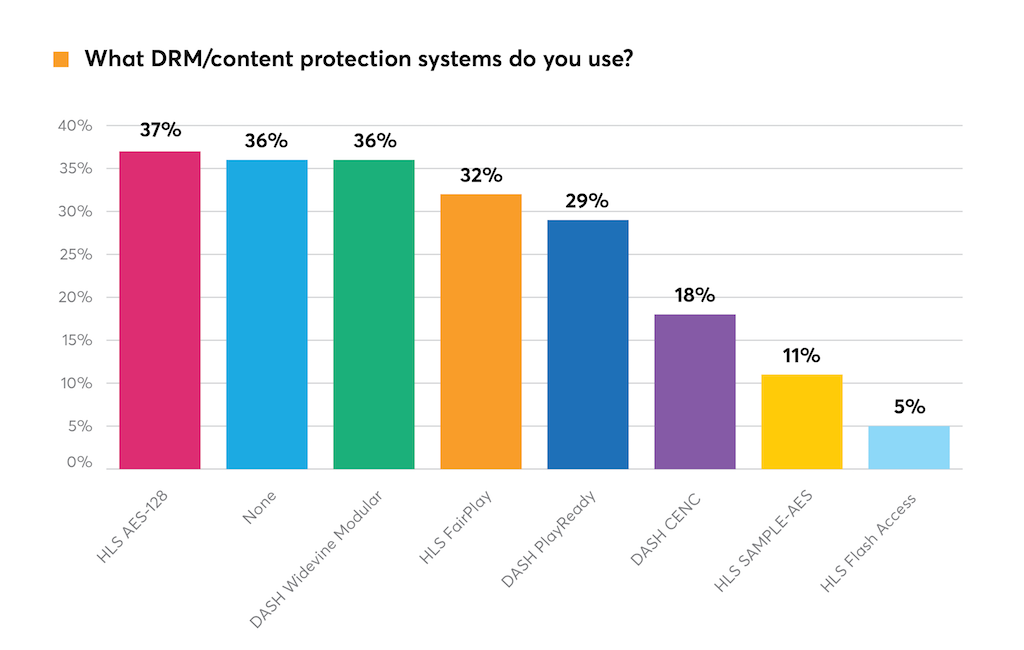
He uso de DRM está aumentando rápidamente. Más de uno de cada tres (36 por ciento) encuestados dijeron que no están utilizando ningún sistema de protección de contenido o DRM, alcanzando un máximo del 40 por ciento de los encuestados en EMEA.
Esto representa una rápida aceptación desde la encuesta de Bitmovin de 2017, en la que dos tercios de los encuestados a nivel mundial (65 por ciento) dijeron que no estaban utilizando DRM en absoluto. Esto podría reflejar un cambio de contenido premium de los servicios tradicionales de cable y satélite a OTT/entrega en línea.
Did you like this article?
Subscribe to our NEWSLETTER and you won't miss anything.
Related articles
 Bitmovin Stream Lab MCP Server: AI for Video Playback Testing
 Bitmovin Observability Lands on Akamai Cloud Video Playback Solution
 Bitmovin introduces Agentic AI Hub, its biggest commitment to video automation and personalization
 Bitmovin develops a solution for real-time monitoring of video transmission
Akamai and Bitmovin develop AMP2, a video playback solution that takes its first steps at IBC 2025
Bitmovin develops a solution for real-time monitoring of video transmission
Akamai and Bitmovin develop AMP2, a video playback solution that takes its first steps at IBC 2025
 IAB Spain sheds light on Connected TV formats with an Advanced Guide
 Mariano Barroso warns about the “resounding effect” of the coronavirus in the world of cinema
 Appear TV improves RTVE's low latency video network
InStream Mobile: Low Latency HD Video for Mobile Devices
Appear TV improves RTVE's low latency video network
InStream Mobile: Low Latency HD Video for Mobile Devices
 8 billion connected video devices in 2017
 Sony NXL-IP55: HD production over IP with ultra-low latency
 Increasing video consumption on different devices does not offer benefits
 RTVE carries out a study on the use of mobile devices in children
 Problems between signals and formats? Crystal Vision has a solution