





La producción de deportes en 4K HDR centra la segunda jornada de la 4K Summit 2018
La mañana de la segunda jornada de la 4K Summit, que se celebra hasta el próximo viernes en el Polo de Contenidos Digitales de Málaga organizada por Media Media con Panorama Audiovisual como media partner, ha estado dedicada a la producción deportiva.
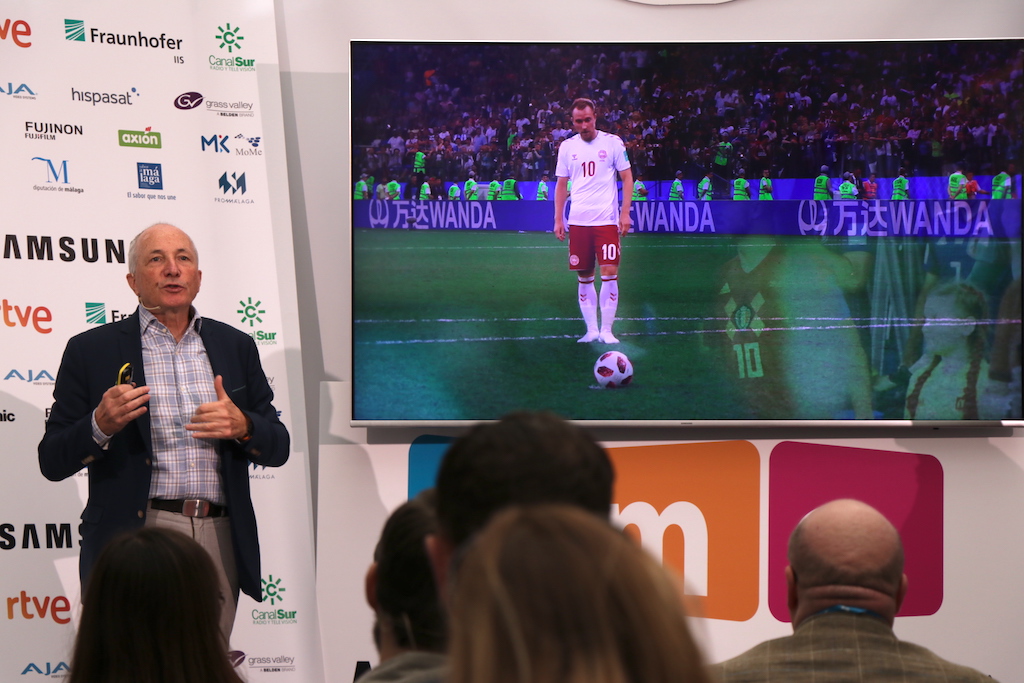
El CEO de la productora francesa Host Broadcast Services (HBS), Francis Tellier, que en colaboración con la FIFA organizó la cobertura televisiva de la Copa del Mundo de Rusia 2018, ha sido el encargado de abrir la segunda jornada de la 4K Summit que se celebra en Málaga compartiendo con los presentes algunos aspectos clave de la producción de deportes en directo en 4K-UHD.
Tellier ha destacado que más allá de lograr cuatro veces más calidad que la HD, la UHD HDR supone un color vibrante de efecto casi hipnótico.
Con motivo del Mundial, HBS produjo más de 6000 horas, con 64 señales en directo MD-1 (en HD -1080p y 1080i-, 4K SDR y HDR) y alguna experiencia pionera en relación a la realidad virtual.
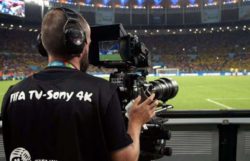
Los partidos se produjeron con 37 cámaras, incluyendo 8 UHD/HDR y 8 SSM, incluyendo en la realización grafismo full 16/9 y audio inmersivo 5.1
El Mundial se concibió como un evento multiformato, todos los partidos se produjeron bajo un esquema híbrido UHD/HDR y 1080p/50 SDR produciendo 16 señales simultáneas en 1080p/50 y 1080i/50. En la producción UHD HDR se emplearon dos capas paralelas: una capa principal en 1080p/50 SDR REC.709 con gráficos HD y una segunda capa enriquecida UHD 2160p/50 HDR BT2020 2SI sin grafismo. La captación se llevó a cabo con las cámaras HDC-4300 de Sony.
Un total de 33 broadcasters se suscribieron a las señales UHD del Mundial de Rusia. Entre ellas, Fox Sports BBC, BeIn Sports, Globo, TF1, NOS, Televisa, tF1, RTP, ORF, NHK, CCTV, Telemundo…
La experiencia de Sony
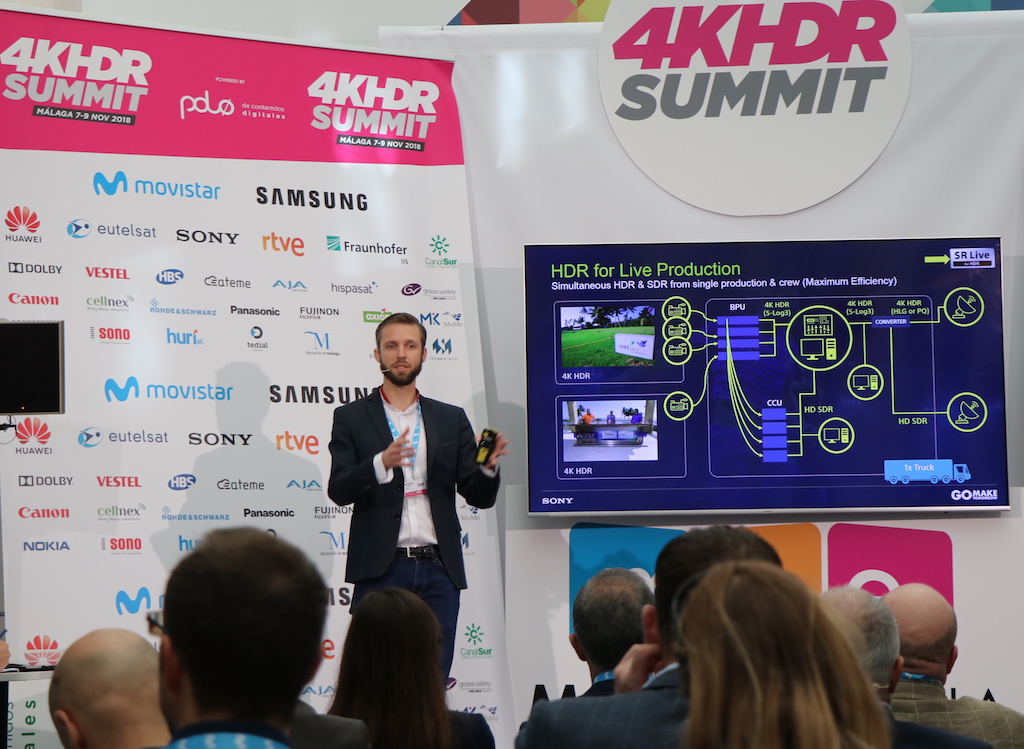
Norbert Paquet, Head of Product Management, Sony, ha analizado la respuesta que está dando la multinacional japonesa a la producción de 4K principalmente en eventos en directo.
“El directo impone muchas restricciones a la hora de trabajar en 4K”, ha reconocido.
Este año ya habrá en todo el mundo 80 millones de televisores preparados para 4K. De ellos, poco más de la mitad son compatibles con HDR por lo que es importante trabajar en paralelo con HDR y SDR. Y esta producción debe llevarse a cabo en tiempo real y desde una misma unidad móvil.
“Para ello, es necesario optimizar tanto la infraestructura técnico como de personal de cara a producir HDR y SDR de forma simultánea. Podemos simplificar las operaciones de shading y painting, generando un formato master para la creación de lo mejor en HDR, que pueda fácilmente convertirse para distribuir estándares en un ‘as-Seen’”, ha señalado.
“Todo sale de la cámara con una única luz que transformamos en electricidad. El HDR permite abrir el iris, pero genera problema en SDR. Lo que Sony propone es trabajar con una cámara de alta gama como la HDC-4300 y contar con dos procesadoress (BPU 4000 y 4500) empleando uno para procesar el HDR y otro para la señal SDR”.
Sony recomienda trabajar con S-Log 3 para producción ya que “está diseñdo para capturar todo dede el sensor de la cámara y resulta, además muy eficiente en sistemas a 10 bits.
Paquet ha destacado por otro lado que “lo importante en cualquier caso es no comprometer el SDR. Para ello, podemos llevar a cabo el painting y control en tiempo real en SDR y HDR para un ajuste artístico pero con un control de ganancia separado”.
El ejecutivo de Sony ha comentado en la 4K Summit que para el Mundial de Rusia, HBS empleó un total de 370 cámaras Sony y una treintena de mezcladores, además de tecnología Ojo de Halcón (Hawk-Eye Goal-Line) y Video Assistant Referee (VAR), realidad virtual para PSVR Live.
Paquet ha cerrado su intervención comentando la experiencia que Sony está llevando a cabo con la Unión Europea de Radiodifusión para la producción de vídeo en directo 2160p100 con HDR y audio inmersivo con cuatro cámaras HDC-4300.
Panel de expertos
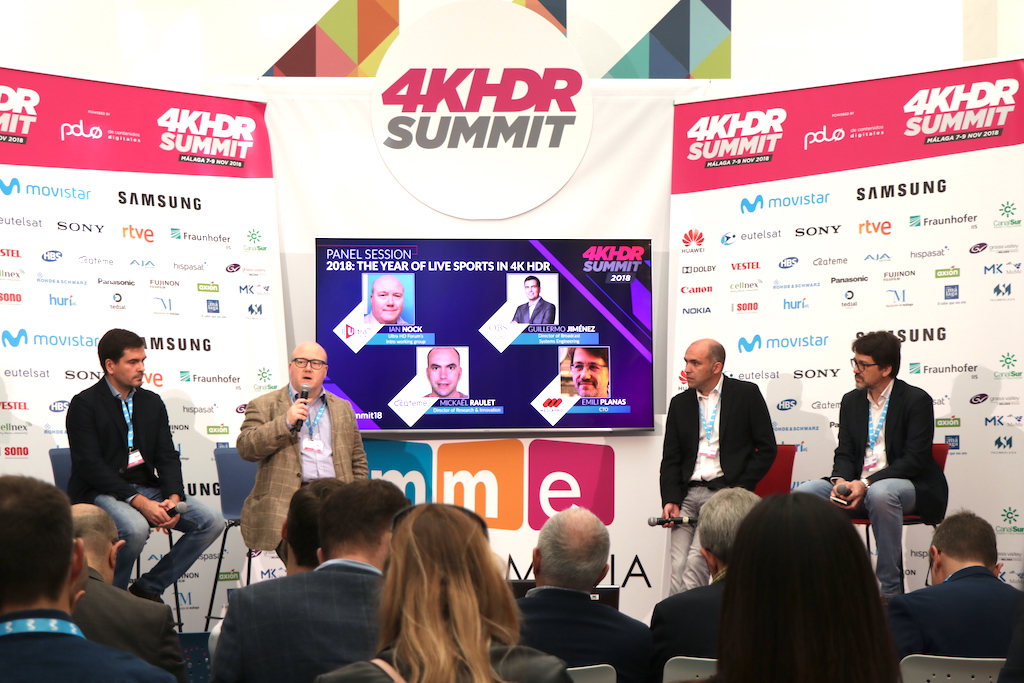
Posteriormente un panel de expertos en el que han participado Ian Nock (Ultra HD Forum), Guillermo Jiménez (OBS), Mickaël Raulet (Atem) y Emily Planas (Mediapro) ha puesto en común su experiencia en torno al 4K HDR.
Ian Nock ha reconocido que “el Mundial de Rusia en HDR fue una buena experiencia en general para todos los broadcasters, pero no hay que obviar que también hubo algunos problemas relacionados con la incompatibilidad de los televisores para decodificar la señal”.
“Hubo cierto efecto wow de asombro al ver imágenes en HDR pero solo se conseguía este realismo solo en los días de sol”, ha señalado.
“Existe un deseo de ganar en color y veces los usuarios se decepcionan con colores con menos efectos. La hierba no tiene un efecto HDR al natural, y hay mucha diferencia entre SDR y HDR. Una cosa es lo que le gusta a los consumidores y otra lo que sería correcto…, y debemos estrechar esta brecha”, ha subrayado.
Por su parte, Emili Planas ha destacad que “no necesitamos 8K, sino mejores imágenes y no más píxeles. Más no es mejor. Los fabricantes deberían centrar sus esfuerzos en mejorar el color, la ratio de contraste y calidad productiva en sus televisores”.
“El televisor, el dispositivo y el cableado HDMI, debe ajustarse y configurarse correctamente para que el HDR consiga una experiencia mejorada”, ha comentado.
Mediapro cuenta con una experiencia de más de cien partidos producidos en HDR con un único flujo de trabajo para salir en HD y 4K SDR y HDR. Actualmente, producen dos encuentros de LaLiga cada jornada con alto rango dinámico. “Enseguida nos dimos cuenta de que más píxeles requerían un esfuerzo enorme para incrementar el ancho de banda, lograr más capacidad de almacenamiento y distribución sin mejorar necesariamente la experiencia en una pantalla tipo en casa del espectador”, reconoce.
Mickaël Raulet ha centrado su intervención en los problemas que surgen en cuanto a la contribución y distribución de señal al coexistir varios estándares de alto rango dinámico. También ha compartido con los asistentes a la 4K Summit sus sensaciones de la experiencia llevada a cabo junto a Sony en el último Roland Garros producido en HDR.
Ha concluido afirmando que “hay que conseguir los colores adecuados con televisores no capacitados para BT2020. El reto es que en HDR hay tanta variedad que los televisores tienen que soportar muchas configuraciones diferentes”.
Por último, Guillermo Jiménez ha comentado que en el caso de la producción de los Juegos Olímpicos el hecho de que haya diferentes estandarizaciones en 4K supone un problema debido a la escala de un proyecto como este y el ingente número de señales que se producen.
“Desde el punto de vista del espectador, existen diferencias enormes entre diferentes zonas del mundo. Incluso las que están avanzando en 4K, avanzan en diferentes formatos, unos se preocupan más por la resolución y otros quieren más calidad con HDR”, ha comentado.
“En el caso de los Juegos Olímpicos, debemos buscar siempre un campo común en el que se sientan cómodos todos los broadcasters que emiten la señal. En el caso de los Juegos de Invierno de Pyongyang solo produjimos en HDR determinados deportes y las ceremonias de apertura y clausura”.
Jiménez ha subrayado por último que Tokio 2020 representará de nuevo un reto muy importante ya que se incorporarán cinco nuevas disciplinas olímpicas. OBS trabajará con 64 unidades móviles, pero no ha precisado qué señales se producirán finalmente con alto rango dinámico.
Did you like this article?
Subscribe to our NEWSLETTER and you won't miss anything.
Related articles
 La IA y la computación en nube centran la segunda jornada de la 4K HDR Summit
 wTvision centra su presencia en NAB 2025 en producción remota y entornos virtualizados
 Mediapro México produces four Fox Deportes formats from its new production center
 Matrox centra su presencia en NAB 2022 en la producción remota
 Los desafíos presentes y futuros del UHD protagonizan la segunda jornada de la 4K-HDR Summit
 La productora TVN mejora la producción en HDR de deportes en directo gracias a Sony
 Sony, Verizon and NBC Sports test 5G in live sports production
 Madrid acoge la segunda edición de SportsPro OTT Summit 2018
 El primer gran año de los deportes en vivo en 4K HDR, en la 4K Summit
 Ikegami centra en el HDR su estrategia de cara a IBC 2018
 EVS y HBS Academy organizan nuevas sesiones de formación sobre producción de deportes en directo
 Hawk-Eye pretende revolucionar la producción de deportes en directo a pequeña escala
 EVS centra su presencia en Las Vegas en cuatro pilares: deportes, entretenimiento, informativos y media
 Barcelona, sede de la Segunda Jornada Radio 2.0