





Crystal Vision will show more applications with IP/SDI video delay and color correctors at IBC 2019
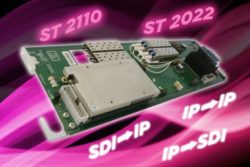
It will release the latest software applications for its flexible Marble-V1 media processor hardware, with Marble's combination of SDI and IP I/O, making the transition between SDI, ST 2022 and ST 2110 easy.

At Stand 2.B59 of IBC 2019, Crystal Vision will release the latest software applications for your flexible hardware Marble-V1 media processor, with the combination of SDI and Marble IP I/O, making the transition between SDI, ST 2022 and ST 2110 easy.
Each software application can operate with IP, with SDI, or with IP and SDI at the same time, providing the easiest possible upgrade from SDI to IP, as well as being perfect for mixed SDI and IP installations.
These applications, which can be replaced as needs change, offer functionality such as video delay, synchronization, color correction, IP to IP processing and gateways, with different versions available to assist those working in an IP, SDI or mixed SDI/IP environments. The rest of the interface and range of coding products, including the delay generator Cleanit and the Sapphires 3 chroma keyer in real time, will be available for demonstration at the new Crystal Vision location in front of Hall 2.
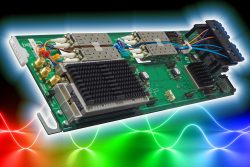
A card housed in the frame Vision, the flexible media processor Marble-V1 with a powerful CPU/GPU processor, six bi-directional SDI connections, four 10GbE SFP+ network interface ports, and eight discrete bi-directional AES stereo channels. Marble-V1's functionality comes from the installation of a software application, with applications purchased with hardware that can be replaced with different applications as needs change, helping broadcast engineers make the most of their budgets.
Initial applications for Marble-V1 were IP gateways and IP-to-IP gateways to make adjustments to IP flows. Now joined by 4 more applications that provide powerful solutions for a wide range of IP and SDI video delay and color correction requirements.
Video delay
Crystal Vision will launch two video delay software applications at IBC: the VIVID1-IPSDI single channel and VIVID2-IPSDI dual channel. Both software applications can work with IP, with SDI, or with IP and SDI at the same time. This makes them equally suitable for IP environments, for SDI installations that will soon switch to IP, and for mixed SDI and IP installations where the video delays can be connected to both the SDI section and the IP section on any combination of SDI and IP inputs and outputs. The applications work with SMPTE ST 2022 and ST 2110 video.
They are ideal for matching any extended 3Gb/s, HD or SD system delays, such as those caused by virtual studio graphics, MPEG encoders and decoders, audio processing, HD radio links and satellite links. VIVID1-IPSDI provides up to 800 frames of video delay, which is 16 seconds in 3Gb/s and 32 seconds in HD and SD. VIVID2-IPSDI provides up to 400 frames of video delay per channel, so eight seconds in 3Gb/s and 16 seconds in HD and SD.
Both applications include a frame storage synchronizer that allows engineers to delay and synchronize at the same time. These are not the industry's first video delays to offer IP connectivity, they also introduce an SDI video delay to the Vision frame system for the first time (with the easiest upgrade path possible), as well as include IP to SDI and SDI to IP gateway functionality.
Color correction
Also making their debut at the Crystal Vision Booth are two color correction software applications, the single channel COCO1-IP and the double channel COCO2-IP. Like video delays, color correction software applications can work with IP, with SDI, or with IP and SDI at the same time, offering easy SDI to IP upgrade, as well as being perfect for mixed SDI and IP installations as well as IP-only environments. The applications work with SMPTE ST 2022 and ST 2110 video.
Ideal for manipulating colors to correct camera or lighting problems or to standardize images taken at different times, it functions for adjusting colors on injection monitors, positioning before an encoder to establish the range of colors to be transmitted, and correcting computer-generated or post-production outputs.
The apps offer a wide range of color correction tools including RGB Gain, RGB Lift, YUV Gain, YUV Lift, Video Gain, Chroma Gain, Chroma Hue, and overall and individual RGB Gamma adjustment, while also including a legalizer. The COCO1-IP and COCO2-IP are the Broadcast industry's first IP color correctors, giving the Vision frame system an SDI color corrector for the first time (with support for even more SDI video standards – 31 – than the Indigo frame version) and also including IP to SDI and SDI to IP gateway functionality.
Other products on display at the Crystal Vision booth include the new Cleanit audio and video delay generating system, which allows the transmission of live content to be delayed by up to 20 seconds (in HD), giving the operator time to react and prevent the transmission of unwanted messages or inappropriate video or audio material.
Available for purchase or short rental periods, Cleanit has already been used for a wide range of applications, from television broadcasts to webcasting of eGaming events. IBC is also giving visitors the opportunity to try out the Safire 3 real-time chroma keyer, with its simple and intuitive workflow for setting up a key, support for resolutions from SD to 1080p, and features like lighting compensation, color correction, and video delay to help resolve common issues.
Did you like this article?
Subscribe to our NEWSLETTER and you won't miss anything.
Related articles
 Crystal Vision introduces M-Safeswitch-2, its first dual-channel routing application
 Crystal Vision develops a color corrector with IP connectivity
 Crystal Vision to Demonstrate Flexible IP Platform and Delay Elimination in SDI at NAB
 Crystal Vision debuts new IP gateways at IBC
 Crystal Vision begins 2017 by expanding its family of IP products
 Dock10 uses Eyeheight color correctors in its latest productions
 Crystal Vision improves chroma key with the new Safire 3
 Crystal Vision expands its family of synchronizers with SYN-A 3G
 Crystal Vision CoCo 3G: color correction and multi-format legalizer
 Crystal Vision technology at BBC's new W1 center
 Crystal Vision in the largest video-art installation in Europe
 Seamless conversion with Crystal Vision
 Crystal Vision Eases the Transition to HD in ORF
 Snell will show its popular Kahuna in 3D applications at NAB