





Fujitsu optimizes AI-based video recognition with high-quality compression technology
Los datos de vídeo de gran volumen y ultra alta definición se comprimen a 1/10 del tamaño de datos de la tecnología de compresión convencional, para un análisis optimizado en la nube, usando una nueva técnica.
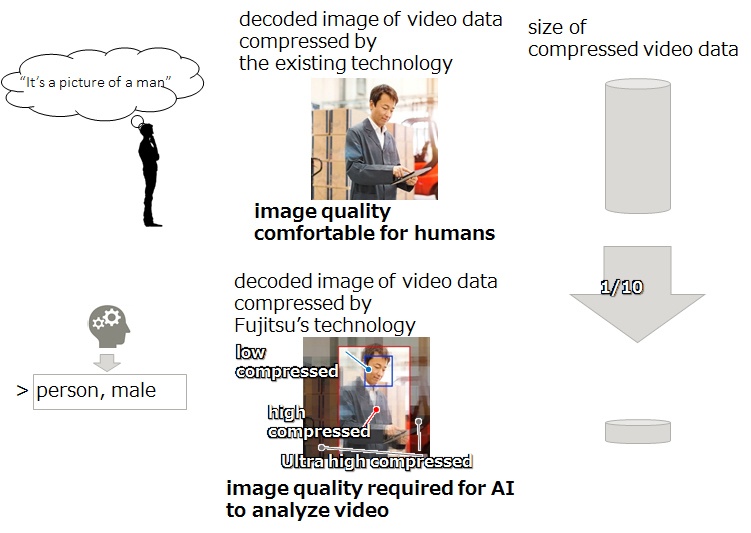
Fujitsu Laboratories ha desarrollado una tecnología para comprimir datos de vídeo de máxima definición y gran volumen al tamaño mínimo necesario, para las aplicaciones de reconocimiento de vídeo de artificial intelligence (AI). Esta tecnología puede comprimir los datos de vídeo a sólo una décima parte del tamaño de los datos preparados con la tecnología de compresión convencional, destinada a la confirmación visual por humanos.
En los últimos años, ha habido un fuerte aumento en la demanda de análisis de IA de datos de video en varias áreas de negocios. Se espera que la expansión del sistema de comunicaciones móviles de 5G , en particular, contribuya a un explosivo incremento en el número de imágenes de video de ultra alta definición capturadas por cámaras, así como muchas imágenes tomadas en la calle y en líneas de producción.
Al desarrollar esta nueva tecnología de compresión, Fujitsu se centró en una importante divergencia en la forma en que la IA y los humanos reconocen las imágenes. Es decir, la IA y los humanos tienden a diferir en las áreas de la imagen que se enfatizan como importantes, a la hora de reconocer personas, animales u objetos en los datos de video.
Por ello, la compañía ha desarrollado una tecnología para analizar automáticamente las áreas bajo los valores de IA y comprimir los datos al tamaño mínimo que esta puede reconocer. Esto hace posible analizar una gran cantidad de datos de video sin comprometer la precisión del reconocimiento y, al mismo tiempo, reducir significativamente los costes operativos y de transmisión de datos. También se anticipa que la tecnología permitirá a los usuarios analizar la información de los videos de forma más avanzada, combinando múltiples datos de video almacenados en la nube, datos de sensores y de rendimiento, como los de ventas.
Antecedentes y desafíos
En los últimos años, la tecnología para analizar imágenes usando IA se ha desarrollado rápidamente y se espera que sea una de las fuerzas impulsoras de la transformación digital en muchas empresas de diferentes sectores. Con la llegada de los sofisticados servicios móviles 5G en 2020, la demanda de análisis de IA aumentará aún más, acompañada por el uso creciente de cámaras 4K y 8K de ultra alta definición y grandes cantidades de datos de video para aplicaciones que incluyen análisis de comportamiento en industrias manufactureras y de retail.
A pesar de esto, las demandas de procesamiento para técnicas de aprendizaje profundo utilizadas para el análisis de imágenes presentan desafíos considerables. Una técnica efectiva para asegurar la potencia tecnológica para hacer frente a estas tareas, es procesar en conjunto con la nube, pero dado que los datos de video a menudo requieren muchos recursos, existe la necesidad de tecnología de alta compresión que pueda transmitir todos los datos de video al cloud sin comprometer la calidad, para que el ancho de banda de la red no se sobrecargue.
The technology
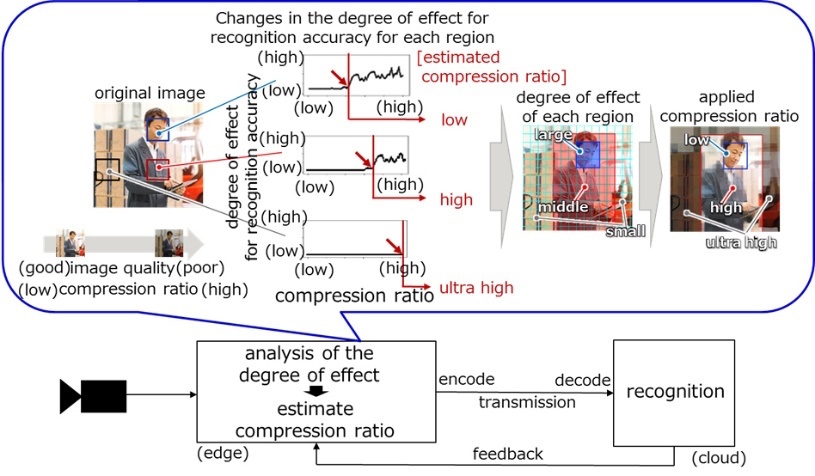
La compresión de video reduce la calidad de la imagen dependiendo de la tasa de compresión, y si el área en la que se enfoca la IA se comprime excesivamente, la precisión del reconocimiento disminuye. Fujitsu ha desarrollado una tecnología de compresión de video que analiza automáticamente el área de un objeto reconocido por la IA como material de análisis en una imagen de 1 marco de datos de vídeo, comprimiendo la imagen con la calidad mínima requerida para el reconocimiento de cada área. Al aplicar esta tecnología, el tamaño de los datos de video se puede reducir significativamente, en comparación con las tecnologías de compresión convencionales, manteniendo la precisión del reconocimiento
La tecnología para estimar automáticamente la ratio de compresión sin afectar la precisión del reconocimiento de IA
El efecto de la degradación de la calidad de imagen específica de la compresión en la precisión del reconocimiento se analiza para cada área. La ratio de compresión que no afecta la precisión del reconocimiento se estima automáticamente en función de los resultados del reconocimiento de IA. El grado de importancia de las características en el proceso de reconocimiento por parte de la IA se determina para todas las áreas, agregando los efectos en los resultados de reconocimiento, cuando se cambia la ratio de compresión de toda la imagen y también la calidad de la imagen. La tasa de compresión inmediatamente antes de que la precisión del reconocimiento se deteriore rápidamente en cada área, se estima como una tasa de compresión que no afecta la precisión del reconocimiento.
También retroalimenta los resultados de IA de imágenes sucesivas para aumentar la compresión al máximo que la IA puede reconocer. Al hacerlo, la tecnología logra una alta compresión de imagen, a la vez que mantiene la precisión del reconocimiento de IA.
Planes futuros
La tecnología recientemente desarrollada se aplicó a imágenes de video tomadas por una cámara 4K de múltiples trabajadores empacando en una fábrica. Se confirmó que el tamaño de los datos podría reducirse a 1/10 del tamaño de los datos de la tecnología de compresión convencional, sin un deterioro en la precisión del reconocimiento. Se espera que esta tecnología se use para aplicaciones que no requieren un rendimiento estricto en tiempo real, así como para el análisis de datos de video avanzados que combinan múltiples datos de video almacenados en la nube, datos de sensores y datos de rendimiento, como los de ventas.
Fujitsu Laboratories está evaluando esta tecnología en una variedad de casos y está llevando a cabo una investigación y desarrollo adicionales para mejorar aún más el rendimiento de la compresión. La multinacional espera comercializar esta tecnología para fines del año fiscal 2020 e introducirla en una variedad de aplicaciones para diferentes industrias, incluida su plataforma de servicio COLOMINA, una solución de Industria Manufacturera.
Did you like this article?
Subscribe to our NEWSLETTER and you won't miss anything.
Related articles
 Limecraft proposes the concept of Media Intelligence versus Artificial Intelligence
 Wondershare Filmora bases efficiency in video editing on Artificial Intelligence
 Watchity develops an R&D project to create the first virtual director based on Artificial Intelligence
 The O Couto stadium in Ourense installs an automatic production system based on artificial intelligence and 5G
 Technology and precision to cover the 4M election night on RTVE with Artificial Intelligence
 Cinfo, Orange and TVG will develop a new project based on artificial intelligence and 5G
 Star Comunciaciones se une a Soliton para ofrecer streaming de vídeo en alta calidad
 Sony takes advantage of artificial intelligence to facilitate video production
 Agama uses artificial intelligence and machine learning to improve quality in OTT services
 Shure will make it easy to capture high-quality video and audio with the ShurePlus Motiv Video app
 Video compression with EyeQ technology will focus Harmonic's presence at IBC
 Siemens and Microsoft take advantage of artificial intelligence in the field of video streaming
 IBM develops interesting applications based on artificial intelligence for cloud video
 ADVC-HDM1 – Grass Valley High Quality HD Video Conversion