





The Government will favor financing lines for Culture worth 780 million euros
Tax incentives will increase to film and audiovisual production and film exhibition will be supported.
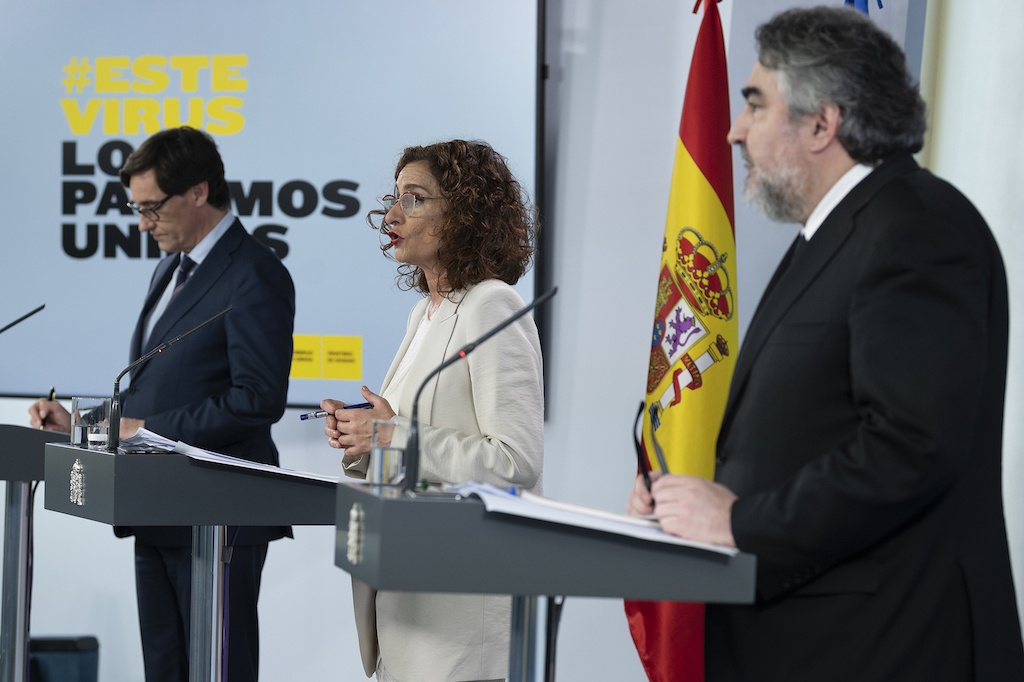
This Tuesday, the Council of Ministers approved a Royal Decree-Law that includes a package of measures aimed at supporting the cultural sector to face the situation derived from COVID-19 and that represents a budgetary investment by the Ministry of Culture and Sports of 76.4 million euros, without taking into account the impact of fiscal measures such as incentives for patronage or the improvement of the incentive regime for audiovisual production in corporate tax.
In this way, the Government fulfills its commitment to leave no one behind, strengthening the cultural sector to face the de-escalation process that has just begun.
Among the measures regulated by the Royal Decree Law, a extraordinary access to unemployment benefits for Culture workers, who due to their intermittency had not been covered by the coverage mechanisms established to date.
In this way, for example, artists will be able to access extraordinary unemployment benefits for a period of up to 180 days, depending on the period of paid employment in the previous year, thus recognizing the intermittency of work and the special vulnerability of workers in the cultural sector. This measure affects 45% of employment contracts in the artistic sector, which are for works or services, that is, intermittent in nature.
To guarantee access for SMEs in the cultural sector to liquidity and economic financing, the Ministry of Culture and Sports will inject 20 million euros into the mutual guarantee company CREA SGR. A part of this amount, 3,750,000 euros, is intended to cover the cost of the commission for opening the guarantees for loans to companies in the cultural sector due to the COVID-19 crisis.
The rest, 16,250,000 euros, is allocated to technical provisions fund. This amount means actually mobilizing 780 million euros in credits guaranteed for the cultural sector. Each of the areas of the cultural sector (books, fine arts, performing arts, music, cinematography and audiovisual) will access a minimum of 40 million euros, being able to obtain immediate and specific liquidity.
In terms of subsidies and public aid for cultural activities and projects, the payment of eligible expenses incurred is possible when the projects or activities have not been able to be carried out, in whole or in part, due to COVID19. In turn, professionals in the artistic sector will be able to receive advance payments and compensation in the event of postponement or cancellation of actions contracted with the public sector, as long as the contracts do not exceed 50,000 euros.
And for contracting purposes, several are incorporated, among which it is worth highlighting the general provision for lifting the suspension of contracting procedures to guarantee the general interest and that of the bidders themselves.
Audiovisual
Regarding cinematography and audiovisuals, a Extraordinary Social Fund derived from the COVID-19 coronavirus crisis, in the amount of 13,252,000 euros, for support film exhibition in movie theaters. It is expected to finance the expenses that are a consequence of the health measures adopted and expenses aimed at promoting visibility regarding the reopening of cinemas.
However, the Royal Decree Law approved today includes the temporary exception until August 31, 2020, so that films that are seen with problems viewing release in theaters when they had planned, they can do it through streaming platforms, without affecting its status as a cinematographic film.
On the other hand, for generate liquidity in producers who have received aid, the 50% of payment of part of the aid granted before filming begins and eligible expenses will be allowed to include those directly linked to the impact of the crisis. In addition, the deadlines and obligations (such as the release in a certain number of theaters, the budget for promotion or the communication of the start and end of filming, among others) are made more flexible for films that benefit from general and selective aid, both for the production of feature films and short films on project, granted between the years 2016 to 2019.
Se increase tax incentives to the cinematographic and audiovisual production of fiction, animation or documentary series, as well as foreign filming. 30% of the first million euros may be deducted from the deduction base and 25% of the remaining amount. This aims to attract more international productions and filming, encourage co-productions and increase the activity of the audiovisual industry in Spain.
Performing arts and music
The traditional aid from the National Institute of Performing Arts and Music (INAEM) is not applicable in the current context, given that activity and mobility will be very limited. For this reason 38.2 million are allocated of euros for the performing arts sector (dance, theater, circus and music), which will be called in extraordinary aid on an exceptional basis that takes this new situation into account. Managed by the Ministry of Culture through the INAEM, these grants seek to support the maintenance of the structures of the performing and musical arts, as well as performing and musical activities and cultural projects.
Patronage
In the field of books, the Government creates an extraordinary system of aid for the book sector, for an amount of 4 million euros, aimed at independent bookstores, for the maintenance of their structures and the supply chain. The special fragility of independent bookstores, faced with a drastic drop in their turnover, due to being closed since the declaration of the state of alarm, seriously harms the entire book sector, which affects the flow of economic activity of the entire chain (authors, editors, distributors, translators...).
These new aid are added to the reduction of VAT on electronic books and digital press from 21 to 4%, as well as the opening of bookstores yesterday with the appointment system.
In relation to Fine Arts, the Royal Decree Law incorporates extraordinary aid worth 1 million euros for the promotion of contemporary art, and specifically for the development of digital innovation projects that promote the dissemination of the visual arts, artistic creation, communication, international dissemination and the acquisition of Spanish contemporary art.
The recipients of these measures include visual artists, art galleries, critics and curators, as well as the allocation for purchases of Spanish contemporary art through the Board for the Qualification, Valuation and Exportation of Historical Heritage Goods of the Ministry of Culture and Sports.
In another order, the Royal Decree Law also makes it possible for collective copyright management entities to increase the percentage they allocate to assistance action.
And to stimulate private participation in culture, tax incentives for patronage have been increased by 5 percentage points. This way, 80% of the first 150 euros invested in a project can be deducted, and 35% of the remaining amount. This last percentage of deduction rises to 40%, if in the two immediately preceding years donations for the same or greater amount had been made to the same entity.
Likewise, the deadlines have been extended for the major events planned such as Events of Exceptional Public Interest of the Xacobeo 2021, the Tokyo Olympic and Paralympic Games or the V Centenary of the first circumnavigation of Magallanes and Elcano and others have been incorporated such as the Berlanga Plan, launched on the occasion of the centenary of the filmmaker's birth; the Alicante 2021 Round the World Sailing Tour; the presence of Spain as a Guest Country of Honor at the Frankfurt Book Fair 2021; the 175th Anniversary of the construction of the Gran Teatre del Liceu”; and the Development Plan for the Teatro Real opera.
Did you like this article?
Subscribe to our NEWSLETTER and you won't miss anything.
Related articles
 New injection from the Canarian Government to the audiovisual sector: more than 3 million euros
 30 million euros: the latest government aid for the production of feature films
 Culture distributes 3.6 million euros for the distribution of community and Ibero-American films
 CCMA and the Generalitat promote audiovisual projects worth 6 million euros
 The ICAA grants aid worth 54 million euros for the production of feature films
 Canal Sur will invest more than two million euros in the financing of Andalusian audiovisual works
 The Government will invest 30 million euros in aid for R&D projects in audiovisual technologies
 The British V-Nova receives 33 million euros in a financing round
 Digital content will double its value by 2026: 352 billion euros
 Aviwest closes a financing round of 8 million euros
 The Government will allocate 50 million euros to the new digital dividend
 The Government allocates 76 million euros to the development of the Spainsat satellites
 Secuoya closes a financing process for one hundred million euros
 The Government approves the call for two 5G technology pilot projects worth 20 million euros