





The RTVE Institute investigates the blinking of viewers
In collaboration with the UAB and the UPO, a study shows that content prevails over form when watching movies. The results will have direct application for narrative content creators.
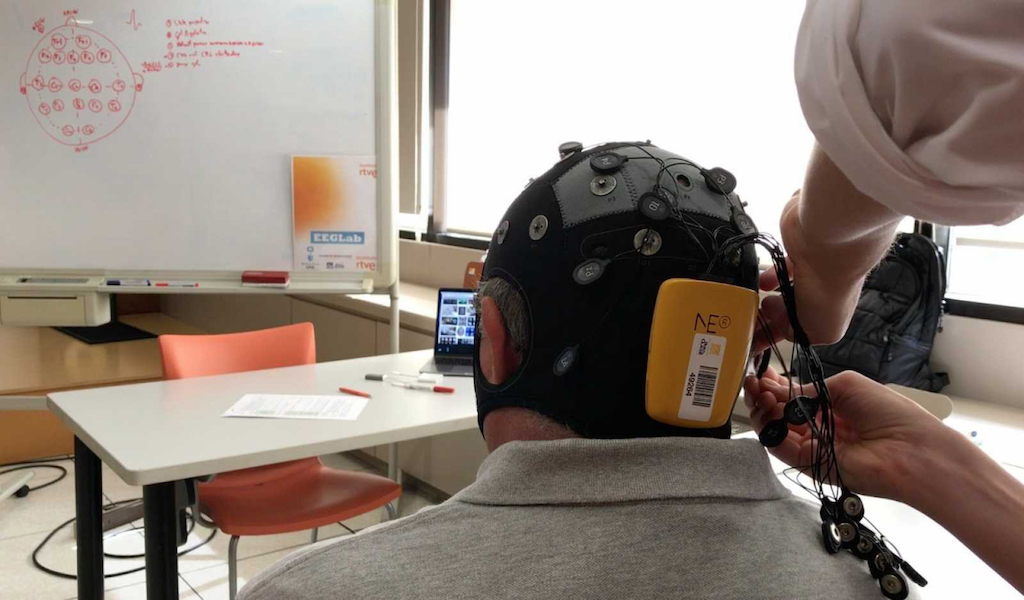
He RTVE Institute, the Autonomous University of Barcelona and the Pablo Olavide University of Seville have carried out a study in order to detect the effect of audiovisual narrative versus the mounting style in the viewers' blink rate. The research, published in Brain Sciences, presents a group of subjects with audiovisual content with a different editing style, but identical narrative to study their blinking frequency.
Previous studies had already concluded that the style of audiovisual editing affects the blinking frequency of viewers. Now, the synchronization of flicker rate increases and decreases has been shown to occur at specific moments in the narrative, regardless of the editing style in which they occur. Therefore, it can be stated that the narrative content has a more relevant role than editing style for attention management.
These results have a direct application for creators of narrative content, such as filmmakers, video editors, directors of photography, directors of actors or scriptwriters, among many others.
The doctor Miguel Ángel Martín-Pascual, from the Spanish Radio Television Institute and the Autonomous University of Barcelona, author of this research, considers that "it is very interesting to know how viewers' attention fluctuates depending on certain narrative content. Knowing how to find these patterns means significant progress in the planning, production and scripting of audiovisual content."
The doctor Celia Andreu-Sanchez, from the Neuro-Com group of the Universitat Autònoma de Barcelona, also a researcher in this study, understands that "these results are not only useful in the professional audiovisual field, but can also have a direct impact on the educational field. It is an objective tool to teach future creators of audiovisual content how to manage the attention of their viewers."
For its part, Agnès Gruart y José María Delgado-García, professors and researchers from the Neurosciences Division of the Pablo de Olavide University of Seville, agree that "this work is a step forward in the difficult task of accessing the unconscious of the human brain, since viewers are managing their own blinking frequency to adapt it to the prediction of audiovisual narrative content, in a completely unconscious way."
Did you like this article?
Subscribe to our NEWSLETTER and you won't miss anything.
Related articles
 The Master in content production engineering from RTVE Instituto and the UPM returns
 RTVE Instituto's training offer now available through RTVE Play
 RTVE Institute expands its free training with the 'Master Voices' format
 The RTVE institute promotes a 360º Master's Degree in Journalism with cutting-edge technology
 The RTVE Institute and the Fraunhofer Institute organize a conference on new generation audio in Madrid
 The RTVE Institute and AES focus on women in the audio sector
 The RTVE Institute organizes a workshop at the Almagro Festival to test audiovisual technologies
 The RTVE Institute opens the doors of 'Versus', a new space for debate that will bring together professionals from the sector
 The RTVE Institute organizes the IV Audiovisual Campus at its headquarters in Madrid and Barcelona
 The RTVE Institute delivers its annual awards, which recognize the best practical work of its students
 The RTVE Institute delivers its annual awards
 Multichannel audio seminar on television at the RTVE Institute
 The RTVE Institute in Classroom 2012
 The RTVE Institute in AULA 2010