





Carlos Rigo: breaking the perfection of the video in the photography of 'Cardo'
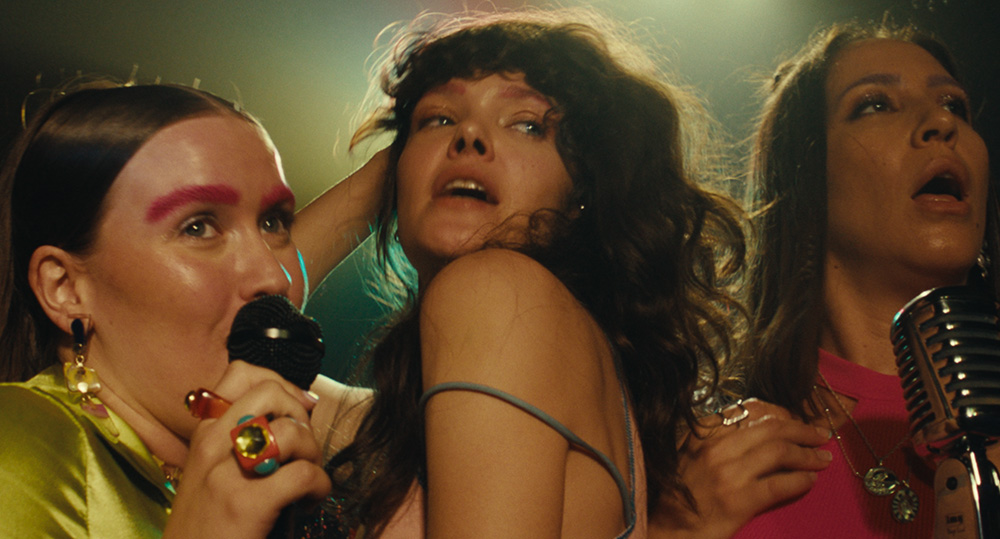

Carlos Rigo Bellver, director of photography, reveals all the keys to filming Cardo, production of Atresmedia TV, Buendía Studios y Summa Latina (Suma Content) to Atresplayer Premium.
At the beginning of 2021, Atresmedia TV y Buendía Studios announced the creation of Cardo, a fiction co-created between what would be one of its directors, Claudia Costafreda, and its leading actress, Ana Rujas. The project, which would have the creative talent of The Javis by participating in the six-chapter fiction through his production company Take Content Its objective was to create a portrait of the generation born between the mid-80s and early 90s. A year later, Cardo It has earned the praise of a large part of critics in Spain and has obtained international recognition, such as its top 3 on the magazine's list. Variety of the best international series of the year, only surpassed by the British one Time (BBC Studios) and by The Squid Game (Netflix).
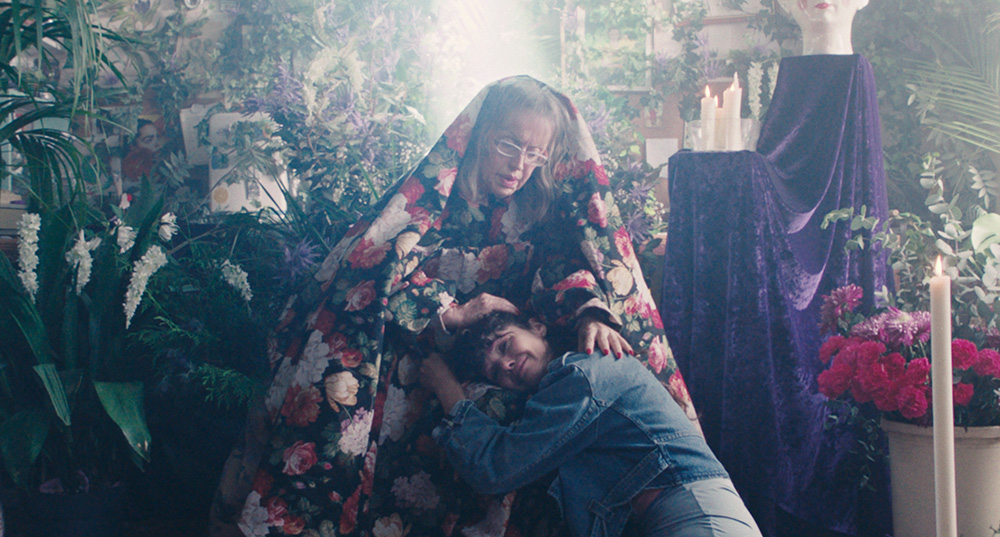
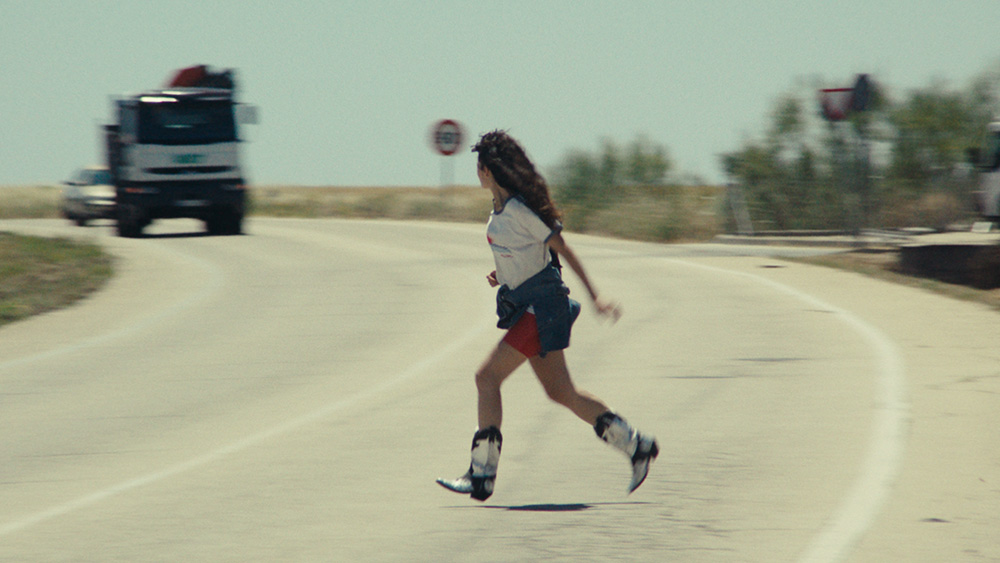
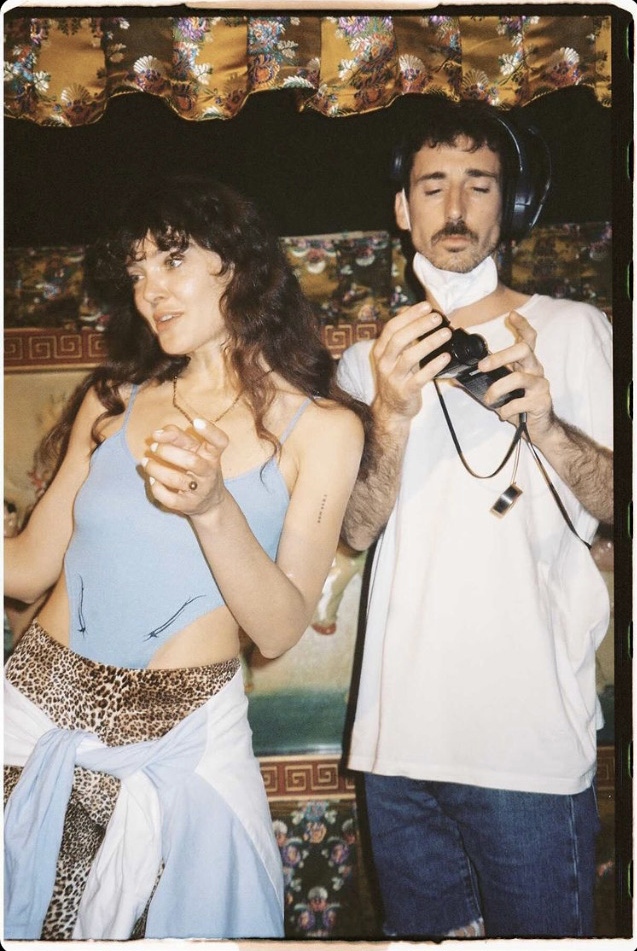 Cardo It is a raw production, which reflects without filters the experiences of the character of María, which walks a tightrope marked by its own disappointments, past experiences, anxiety, drugs and the expectations of a suffocating society. Everything is reflected under the lens of its directors and the versatile and ductile photography of Carlos Rigo Bellver, which alternates eminently naturalistic moments with a stylized and effective approach.
In this interview, Rigo Bellver addresses his professional career, his way of understanding photography and analyzes in detail all the keys to Cardo: from his commitment to filming in Super 16 Mode, to the artistic references that give shape to a fiction that has already confirmed its second season.
The value of creativity
At what point did you begin to opt for photography direction as a path for the future?
Since I was a child, I have always taken still photos. I don't remember recording beyond phones, but I do remember always carrying cameras with me: both SLRs and simpler compact cameras. Basically, I entertained myself by recording my daily life. My friends and I were skateboarding, and I was the one who took the photos. And, in the end, if a video had to be recorded, I recorded it. I think my interest in images and moving images comes from there, perhaps a little bit, intuitively.
Then, once I discovered that in Barcelona there was a school where you could study cinema (something that I had not considered before as a career or as a way to make a living), that was when I decided on it and went to Barcelona to study at the CHESS. I was lucky that a good friend of the family studied at the CECC (Centre d’Estudis Cinematogràfics de Catalunya), which now no longer exists. In this way, when I was considering studying this as a profession, he was already working on it, making his first steps as an electrician or gaffer, and charging for it. That helped me, above all, to convince my mother (laughs). He helped us a lot to understand that it really is a profession; It is a trade that can be learned and then make a living from it. And this has been demonstrated over the years. Although it is true that it is a bet. We enroll 100 students each year, although only 30 or 40% of us end up dedicating ourselves to it, so it is complicated. 
During your professional career, you have made television, films, advertisements, music videos... What is the field in which you feel most comfortable working? In which have you felt greater creative freedom?
Creative freedom is very relative, because it depends a lot on the project. In fields such as music videos or fiction there is more creative freedom than in others, although you can also find it in advertising. You can find the juice in all projects. I got into this with the goal of making films. But, obviously, until you get to making movies, there are a thousand other branches that you have to go through, and they all have their positive and negative parts. In reality, you learn from everything. I think the big difference is that fiction projects, whether they are series or movies, require a longer creative process over time. By requiring more planning and closer collaboration with the director, you can delve into more concepts than in a video clip or an advertisement, which are more “here I catch you, here I kill you.”
Can you say that the long format is your final objective?
Yes, definitely. Or, at least, today. I have the feeling that the series thing is something that has happened since I started studying until today, when I dedicate myself to it. The series were not on the table, at least in Spain. They were not an option. Now, obviously, it is not something I am disgusted with, far from it. However, they are different processes and I think that, depending on the projects, they can be exhausting. In the end, you end up stuck with 13 or 14 week shooting plans that can be very tiring. In short, the series are different. They are not better or worse. But if you ask me what I prefer to do, I choose movies. My first film as a cinematographer was I look for her, in 2018. Then at the end of 2019, I made The Planet, which ended its festival tour in November of last year. And then it came Cardo, my first series project as a director of photography.
Photographing television series
Recently, he has been a camera operator in series such as Paradise y Sky Red. Additionally, he has directed the photography of Cardo. What does this field offer that is different from other areas of audiovisual? What positive or negative elements do you identify?
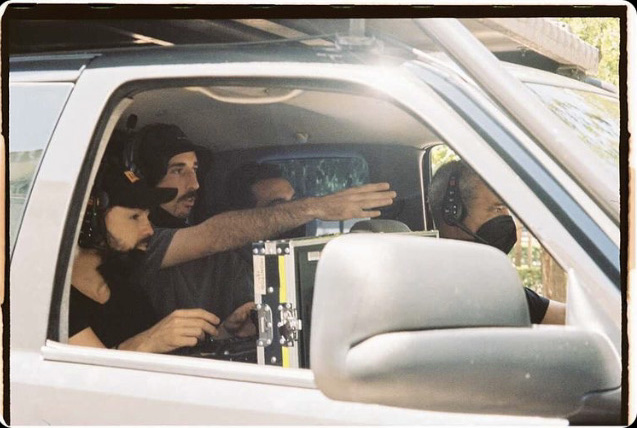
Something that I have really enjoyed about the series is that they give you the possibility of working with different directors on the same project, something that doesn't happen as much in movies. When you go to series of 50 minutes per episode and 8 episodes per season, we are talking about a practically unbearable amount of footage for a single director or photographer (although, in my case, I have covered the six episodes of Cardo). This has allowed me to do something that I had not done before: work in parallel with several directors (Claudia Costafreda and Lluís Sellarès, people who are also part of the project), and enjoy the very different points of view of each one, having a very clear global concept. It has been very enriching. In many series, it is similar to the directors of photography, since the chapters are divided. Preparing shoots with a partner, delegating and knowing how to manage the team among several people is very interesting and in the cinema it doesn't happen as much.
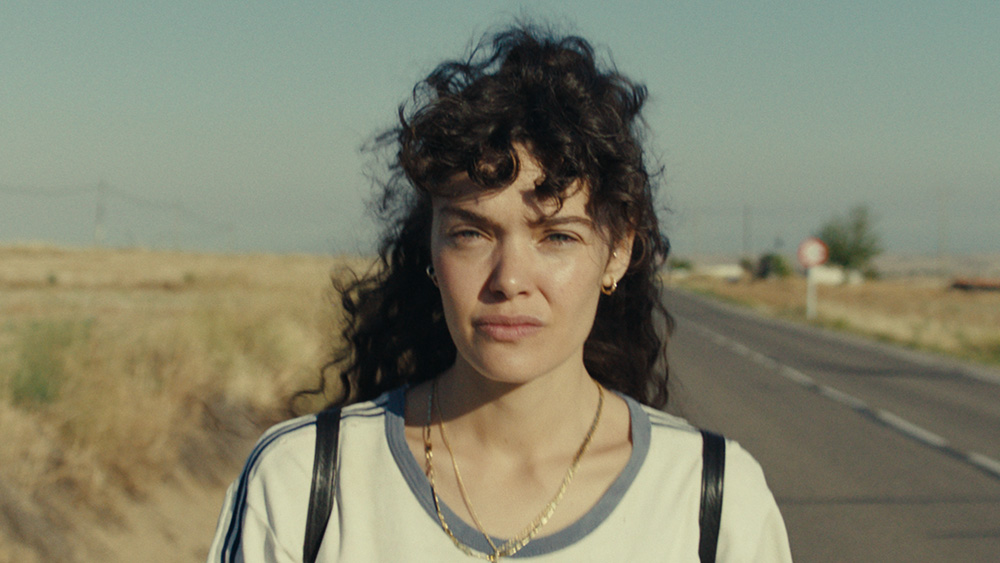 Cardo It has received recognition from critics inside and outside our borders. It is striking that it has reached these positions with a limited distribution: that corresponding to Atresplayer Premium, an emerging but not consolidated platform in Spain.
It's good that you tell me, because as I have experienced it from the inside... At the level of social networks, as you can imagine, I am connected with all the people on the team. And it has been overwhelming for me. bombing of the series promotion. But the reality is that you ask anyone else outside the field of cinema or audiovisuals, or our age range, and it has probably reached few people. The reality is that AtresPlayer Premium is a small platform that is not especially widespread among the target which I think the series is aimed at. Hopefully in the future one of the most internationally renowned platforms will buy it and it can reach more people, because in the end this is about reaching as many people as possible. Cardo It has had good recognition from critics and among people who are dedicated to audiovisuals, but I still keep running into many people who congratulate me on the series and the next thing they tell me is: “I haven't seen it yet” (laughs). In short, I have the feeling that not as many people have seen it as they should.
Do you consider photography decisive for this “success” of the format?
On a photographic level, it is difficult for me to believe that we have a determining role in whether the series is liked more or less. I believe that cinema is a group effort and it is a puzzle in which all the pieces have to fit together for it to work. And I think that, in this case, in Cardo, yes it has fit together very well, because both art, costumes, makeup, direction and photography went in a very clear, very marked direction. I think the series has its own look, which is saying a lot.
Although people don't really know what it is, quite a few people have emphasized that "it looks different" or that "it looks like cinema." "There's something about it, it doesn't look like the rest of the things you see on TV." I think we have managed to create something that looks different or, at least, with personality. It will have its successes and its mistakes, but at least it has a specific look, an identity.
The photography of Cardo
Due to the type of spaces, personnel and situations it includes Cardo, it could have been easy to fall into a look very customary or naturalistic. However, the result transcends that “closeness”, with daring approaches. How would you define photography? Cardo?
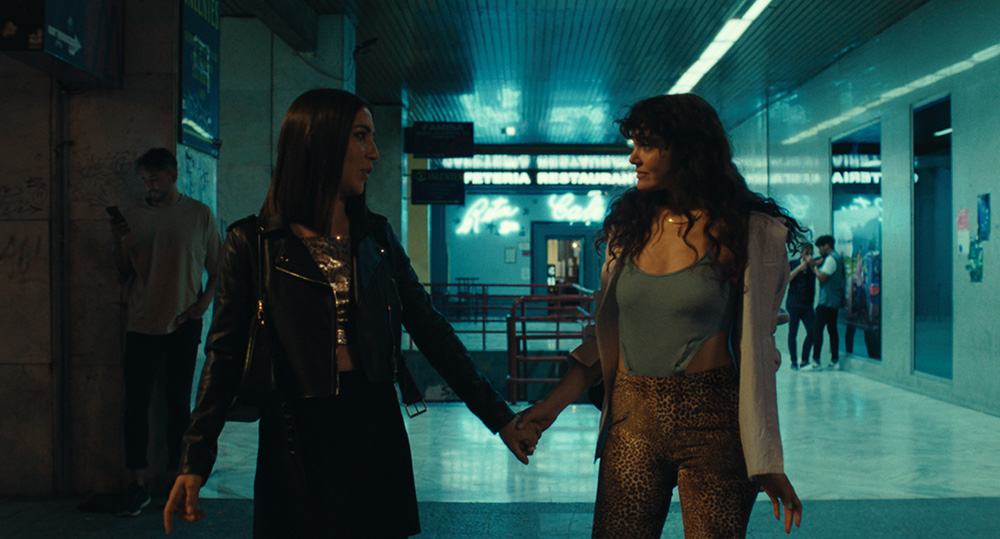
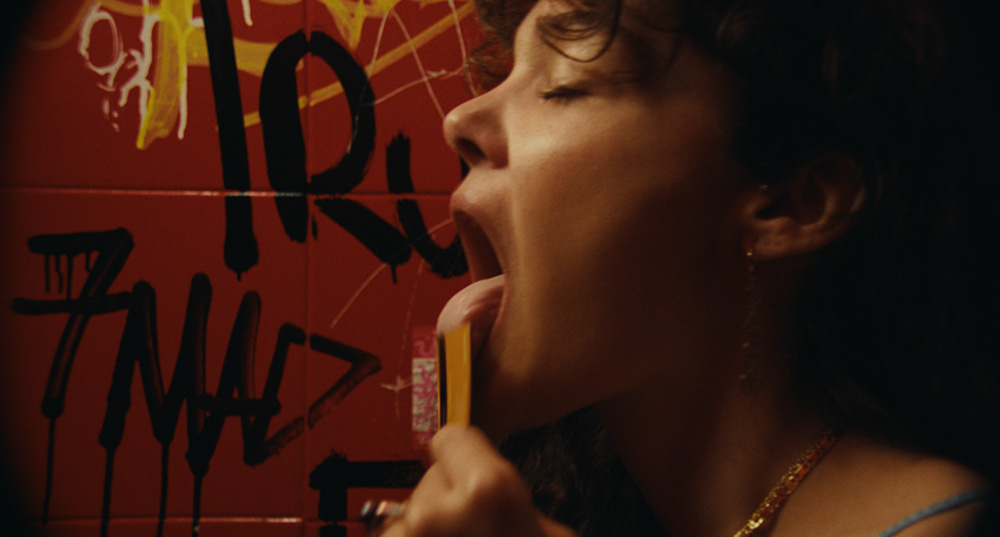
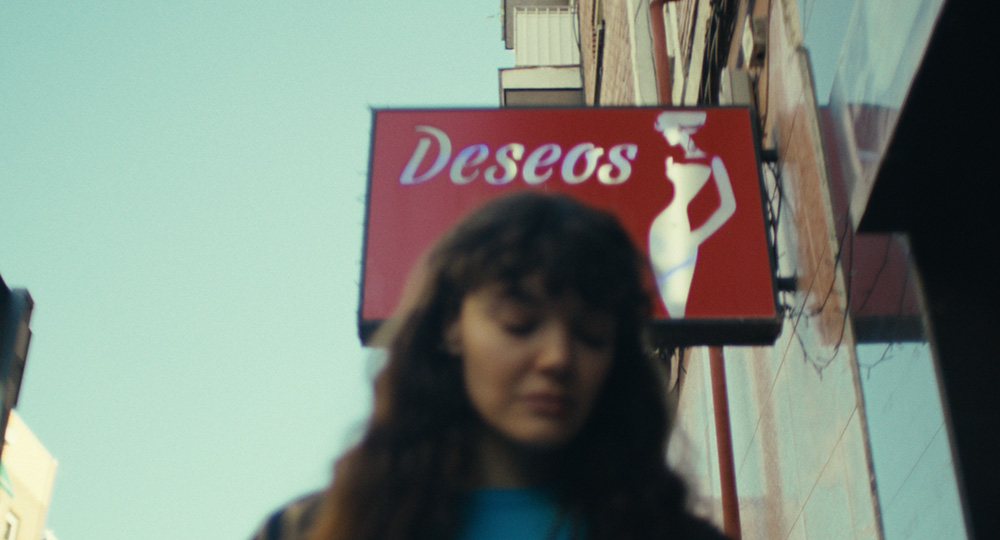
I very much agree. One of my objectives was to find a balance between that traditionalism and that naturalism, to which I tend to tend due to the type of cinema I consume; and the “fantasy” that the character of María requested and the situations in which she finds herself involved. I tried to find a balance between a natural photograph and a more effective photograph; a balance that would allow us to be free and become more dreamlike or “video clips” in certain sequences. This can be seen in sequences like the kebab scene, where you suddenly don't know where you are. In the end, I tried that: not to restrict my freedom. I think this project asked us to find moments to have fun and get out of that customs to find more magical and more cinematic moments. 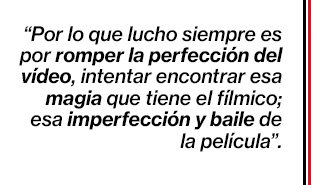
Have you taken any specific photographs as references to Cardo?
One of my clearest references, not so much in terms of form but who did help me a lot to convey my commitment to the S16 look to both direction and production, was Late for anger, in which I was a chamber meritor. See if life has turned around! The film was photographed by Arnau Valls Colomer, who was my teacher and now a friend. I also liked to think about the camera in the American series When They See Us, because I consider it hooligan, in the sense that it mixes the shoulder, the tripod and the steady in a very organic way. That's something that Claudia and I discussed a lot: we didn't want to over-conceptualize some things too much and have the series become restricted at the camera level. In the end, we developed some concepts that later become more or less visible. Depending on María's mood, the camera is more or less nervous; when we are on drugs, the camera goes steady; When we are in spaces that are beyond María's control, such as the hospital or the court, the camera becomes still and has more uncomfortable frames. Yes, there are concepts, but then, within that, the good thing about having such a conceptualized plan is that you can allow yourself to deviate from the plan depending on what the scene calls for while you shoot it. Another great reference, not only in terms of look but above all on a spiritual level, due to that mix of naturalism with more dreamlike or magical elements, is and was Happy Lazarus, photographed by French Hélène Louvart.
Previously, he has defined his work in Cardo as intuitive. David Lynch defined intuition as the “union of emotion and intellect.” Do you feel that way? How have you worked with intuition to shape the visual universe of Cardo?
Really, it's hard to explain. I understand where you're coming from and, in fact, I think Lynch's phrase is super accurate. I feel that intuition is a balance between letting all the knowledge you already have come to light and at the same time knowing how to dismantle everything: letting yourself be carried away by what a specific project requires, both in preparation and during filming. In that sense, I also have the feeling that the more I prepare and conceptualize projects, the more freedom I have later to let myself be guided by intuition and know what each moment requires. Because then all the factors that a shoot entails come into play, which is fundamentally constantly solving problems: when it starts to rain, the sun goes down, you were planning to do something during the day and it turns into night... I try to let myself go and have a very open mind, and for that it is also essential to be well supported by a team that you trust and that at the same time wants to help you move the project forward.
The question of format
What has been your camera and lens kit for filming? Cardo? In what format have you decided to record the fiction?
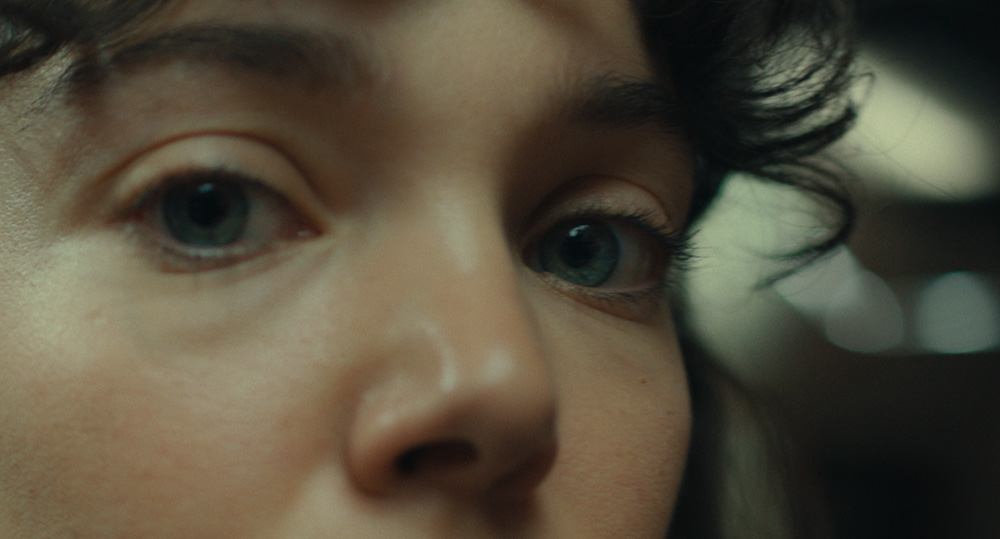
This is a great song, since it is one of the songs that broke my mind the most in preparation. My first intuition, my first approach when reading the scripts, was to get a look Super 16. I am the first to be aware that in a series like this it did not make sense to even consider it in terms of both budget and time (developing, scanning, etc.). So, I thought: What is more like it? All the ARRI, from the Mini upwards, have a mode called Super 16, which in short what it does is use a tiny part of the sensor. Less than 1920 x 1080 HD comes out, which gives you chromatic aberrations, dirt, lack of definition... In short, what I always fight for, and I don't think I'm the only one, is trying to break the perfection of the video, trying to find that magic that the film has; that imperfection and dance of the film. Obviously, you can reach that look the long way: shoot in 4K and crush the signal in postpo, but there is also the risky (and much shorter) route, which is to shoot directly in Super 16 mode, and take me to the house of postpo a sign that comes very fair.
 It's a risky bet...
That made me “horny”, in the sense that it was going to make me make decisions on the set and not leave them for postpo; illuminate the plans as I think they will be. In the end, we colored the series in a very short time, because practically what we needed was to adjust: the series came with a look very marked thanks to the previous work I did with Martí Somoza, who is the colorist of the series. I remember that he asked me for visual references and I had a hard time finding them beyond what I mentioned before, but he still understood me perfectly. We developed some LUTs that we were able to test in photogenic tests with part of the casting, and part of the costumes and some art elements. I was very stubborn to be able to obtain this evidence to be able to find the look before we start filming. Thus, we were able to develop a very clear visual concept, thanks to the work of Martí and David Maruri, a DIT technician who worked on color at SET and generated the dailies with which the series was later mounted. As I said, this made the post-production process much easier. In addition, the fact that everyone who looked at the set monitors could see how we definitely wanted the series to look helps a lot when making final adjustments. If you like it from the beginning, you like it.
How did this bet work out for the Buendía Estudios and Suma Latina team?
Unlike other production companies, Buendía Estudios, which produces the series together with Suma Latina, do not have very clear technical protocols in this regard. The moment I propose to shoot in Super 16 mode and no one says no, an alarm goes off: how easily it has slipped in! So I was the one who took it upon myself to call postpo and say: are we aware of what we are going for? Obviously, they recommended that I not do it: it is an unnecessary risk and then, if tomorrow a larger platform wants to buy the series and does not do so because the native version is in HD, it would be a problem. It also happened when I spoke with colleagues, people with much more experience, who questioned me if it was worth taking that risk. And I got it out of my head. I thought I was probably wrong and it wasn't worth it.
But that wasn't the end, was it?
That's how it is. Then, a funny thing happened two weeks into filming. Javi Calvo called me to tell me that he had heard that I wanted to shoot in Super 16 mode, but that the proposal had been rejected. Then, he came to tell me that, if I saw it clearly, that he would support me. Javi had filmed several chapters with Gris Jornada that corresponded to the past in Poison and, although not exactly why, he liked those images more. I told him that, given what it had cost me to change the material lists twice, list dizziness and a lot of stress, it was better to leave it as it was. But I went to bed and the next morning I thought: "Man, first intuitions once again; if it has to be this way, it has to be this way." I told myself that I had to take advantage of the fact that Javi is a person who obviously has a lot of weight in the opinion of the production company. The next day, we had a meeting with the executives and it was decided to go ahead with the Super 16. It was something exciting.
Lenses and lighting
What lenses did you decide to use to shape Cardo?
We have shot with the Zeiss HS 1.3, the Zeiss of Super 16 of a lifetime. We are talking about very small lenses, because Super 16 cameras have always been small cameras, so this also has a component that affects filming: the fact that the camera is smaller for the operator makes it easier to move it.
The lenses we used are very old, very imperfect and the fact that they opened at 1.3 was very tempting in this case, since it is a series that has a lot of night time and I knew that I was not going to be able to illuminate everything I wanted for a long time. Then you realize that a 1.3 does not work the same on film as it does on a video sensor; In 1.3, they basically undid the images. In the end, we ended up working between 2 and 2.8, but the entire series is made with that game. I think we had a 12, the most angular, up to 50. Then, we also used a Zeiss 11-110 zoom, a 2.2, less bright, which we used for very specific parts, such as the moment in which the poster of the series is included within a shot of the chapter. Then, on some occasions we used two cameras: I carried the second camera and we shared the lenses. 
How have you focused the lighting? Have you opted for LED solutions or a more “classic” approach?
My approach to lighting depends a lot on the project, the media, the times, the locations... It depends on many things! I, in general, do work with the ARRI M series of HMIs, like the vast majority of my colleagues. I also try to use LEDs, both for lighting performance and for autonomy and practicality. In Cardo, For example, there were a lot of “Mary walking” situations. I used to joke with that: María, Ana Rujas's character, spends her life walking from side to side. So, if you don't have the means to light streets and streets, which was our case, you have to bring devices that have batteries and that you can carry by hand. In that sense, Daniel Vázquez, the gaffer, he spent half of the series walking in favor of Ana or three-quarters of Ana, with tiny LEDs that can run on batteries and that allow you to improvise, basically.
As an aside, I am in love with the incandescence of tungsten, something that is increasingly difficult to use. Because, of course, lighting with tungsten involves carrying very large groups with brutal electricity consumption, something that is increasingly complicated. Whenever I can, at least in the interiors, I try to work a lot with wall lights and lamps from the set itself. In this sense, it was wonderful to work with Alfonso Mancha, the art director of the series, who has an exquisite approach to lamps and lighting in general.
The future after Cardo
He has already announced that he actively participated in the completion of Cardo. What was it like working in that field?
What I have learned most from Cardo It's just that, if you're lucky enough to have things clear from the beginning, you make things a lot easier. I have enjoyed the process, in which we use DaVinci Resolve. I usually find color correction tedious and this time it was not like that, since the colorist and I were on the same page and everything we proposed worked. It has been very good, in the sense that I have learned a lot and I have enjoyed it. Realize that my generation, or at least at ESCAC, learned to illuminate photochemically, on film. But, when we go out to the streets to make a living from this, we have barely shot on film; We have learned to record video while working.
Beyond his participation in the second season of Cardo, which has already been confirmed, what will be your next projects?
Apart from Cardo, the closest thing and although it is yet to be defined, is that I will go to Barcelona for a few months to work on the series that my good friend and fellow cinematographer Elías Martínez is preparing, directed by David Victori. They have a very visually ambitious project on their hands in which we constantly travel back and forth in a very short period of time. They propose that he carry one of the cameras and be in charge of photographing the second units. Then, towards the end of the year, I have to confirm a film with Amalia Ulman, who is the director with whom I filmed The Planet at the end of the 19th, who intends to shoot his second feature film in the north of Argentina.
That, possibly, is what excites me the most. Both for what I told you before making films, and for the fact of going to Argentina, since I haven't been before and I can't wait. What I am most grateful for being able to dedicate myself to this is, without a doubt, being able to film in places where I would never have thought of going on a leisure trip.
An interview by Sergio Julián Gómez
https://youtu.be/Z-S8L6M8eCE
Did you like this article?
Subscribe to our NEWSLETTER and you won't miss anything.
Related articles
 Pau Esteve Birba and the photography of 'Los Tigres': light and color, in and out of the water
 Almodóvar's film photography, recognized for the first time at the Goya through the work of Edu Grau in 'The Room Next Door'
 Juan Felipe Obreo will lead Canon's professional video and photography technology area in Iberia
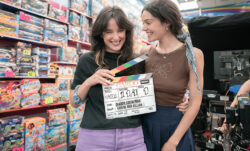 Atresmedia Televisión and Suma Content are already filming the second season of 'Cardo'
 The Carlos III University equips its facilities with a Carbonite mixer from Ross Video
 Director of photography Carlos Suárez dies
 The legendary cinematographer Vittorio Storaro travels to Madrid for a tribute to Carlos Saura
 Schneider Kreuznach: a century pursuing optical perfection
 Breaking molds in the consumption of television content
 'Kings Abbots. Breaking the molds' and 'Spanish cinema. A cultural history', Muñoz Suay Award from the Film Academy
 The director of photography of 'The Adventures of Pi', Claudio Miranda, reveals some details of the film
 Next Limit: breaking limits in fluid simulation with HP
 Dolby PRM-4200 or when a reference monitor borders on perfection
 Percon: breaking 3G-SDI boundaries