





France Télévisions experiments at Roland-Garros with new forms of distribution using 5G
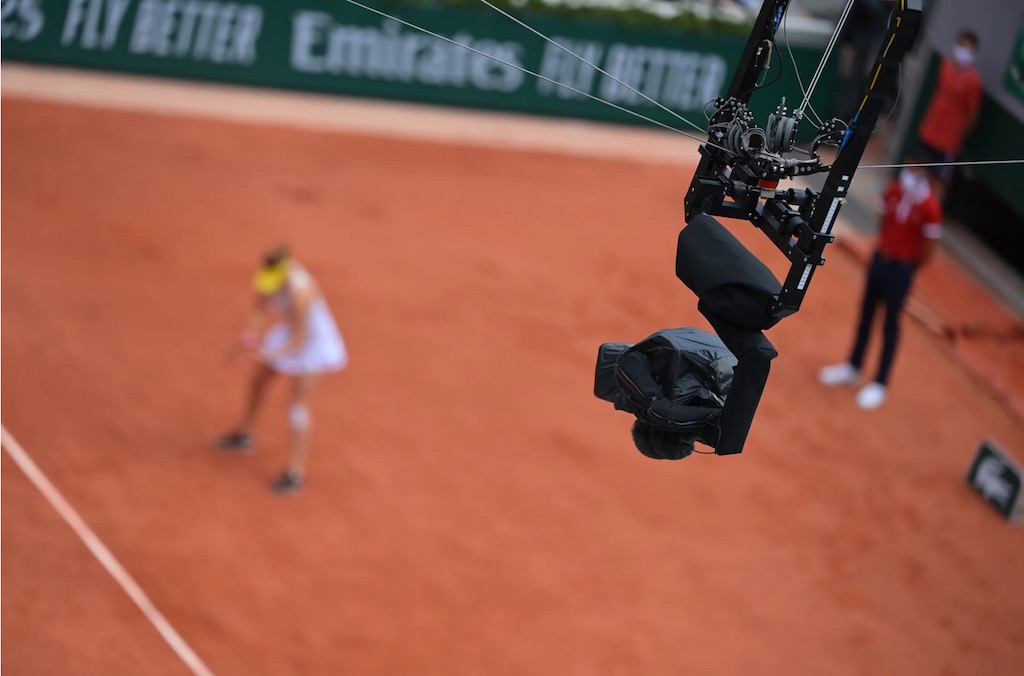
5G technology has allowed France Télévisions channels to experiment with quality-guaranteed live distribution during the Roland Garros tournament regardless of the number of users connected at the same time in the same coverage area of the broadcaster.
The principle is similar to what is done today in DTT with the broadcast of a channel on the terrestrial network only once for all customers, but with the advantage of being compatible with the different types of equipment that support 5G (and not just television) and with the possibility of enjoying it on the move.
The end-to-end 5G broadcast platform ensures wide geographic coverage. Thus, all compatible mobile phones located in the transmitter's coverage area can receive the tournament images without network saturation and with stable and guaranteed image quality.
The 5G multicast mode also allows optimized broadcasting of France Televisions' live channels. As in broadcast mode, the video stream is broadcast only once on the network to all users. This broadcast mode can be dynamically activated in the transmitters of Orange's 5G network to replace the traditional unicast mode used today, in which two mobile phones watching the same program require the broadcast of this program twice on the network.
Broadcast and multicast are complementary. Multicast transport in Orange's mobile network uses higher frequencies than broadcast, despite lower coverage, allowing content to be broadcast with higher performance.
Like 5G Broadcast, 5G multicast has the advantage for the user of having guaranteed image quality. For Orange, it allows optimizing and reducing the amount of data transmitted on the network, which reduces broadcast costs, the number of antennas necessary in dense areas and, consequently, reduces the environmental footprint related to the broadcast of audiovisual streams.
To show the interest of this technology and imagine what the broadcast of France Televisions' live channels could be in the coming years, Orange is contributing to a collaborative project called NESTED that implements new recently published standards.
The project is testing a 5G multicast that uses the VVC codec and that allows video bitrates to be reduced by four, offering the same quality compared to the codec used by DTT. In addition, Low Latency DASH (LL-DASH) mode allows working with low delay compared to live broadcast.
On the other hand, the DVB-I standard allows the viewer to receive the program on their terminal through the different broadcast modes (broadcast, multicast, unicast) in a transparent way.
Para este proyecto, France Télévisions y Orange han contado con móviles OPPO para realizar demostraciones en su stand de Roland Garros. Las empresas que participan en el proyecto con France Télévisions son Ateme, Enensys, IETR, Orange, Qualcomm Technologies, Rohde & Schwarz, TowerCast y Viaccess-Orca.
Did you like this article?
Subscribe to our NEWSLETTER and you won't miss anything.
Related articles
 France Télévisions breaks the records of its Roland-Garros 24×7 channel with a digital strategy designed by Wildmoka
 France Télévisions optimizes its operational efficiency with a Prismon master control from Pixel Power
 France Télévisions wins the EBU Technology and Innovation Award
 France Télévisions reduces its production costs by 65% with TVU cloud technology
 France Télévisions begins UHD broadcasts on two of its channels
 France Télévisions modernizes its newsroom with the OpenMedia CGI solution
 Playz experiments new forms of audiovisual storytelling with the multiplatform event #ElGranSecuestro
 TF1, M6 and France Télévisions launch Salto, their own OTT platform
 France Télévisions implements a Nimbra network in its overseas broadcasts
 Interxion responds to new forms of digital content distribution
 Beyond broadcast: new forms of television distribution in an IPTV framework
 Wohler provides monitoring solutions to France Télévisions
 France Télévisions advances with Pablo Rio
 TV France and Alfacam will broadcast the Roland Garrós with Grass Valley and Kronomav