





Oportunidades y retos de la IA conversacional para recomendación de contenidos en las plataformas


En esta tribuna, Carlos Muñoz-Romero y Nieves Ábalos Serrano, cofundadores y CEO y CPO de Monoceros Labs, respectivamente, arrojan luz sobre la llegada de la IA conversacional a las plataformas de vídeo bajo demanda, abriendo puertas al descubrimiento del contenido y a la mejora de experiencia de los usuarios.
The inteligencia artificial (IA) conversacional está transformando la manera en que las plataformas y empresas interactúan con sus usuarios. Abre puertas a ofrecer nuevas experiencias, más personalizadas e intuitivas, y que ayuden a sacar el máximo partido de los servicios o contenidos que las empresas y plataformas, como las de vídeo bajo demanda (VOD), ofrecen.
Este área de la IA Conversacional es un paraguas que engloba diferentes tecnologías basadas en algoritmos de procesamiento del lenguaje natural (NLP), aprendizaje automático (ML) y deep learning (DL). También incluyen los grandes modelos del lenguaje (LLM), bien conocidos por ChatGPT de OpenAI, Gemini de Google y el open-source Llama de Meta.
El objetivo de este área es mantener una conversación con el usuario, realizando en cada turno de la misma los siguientes pasos: reconocer la voz del usuario y/o entender lo que dice en lenguaje natural, decidir qué acción realizar en base a la información disponible para satisfacer la petición del usuario, y generar una respuesta en texto y voz por medio de una voz digital o sintética.
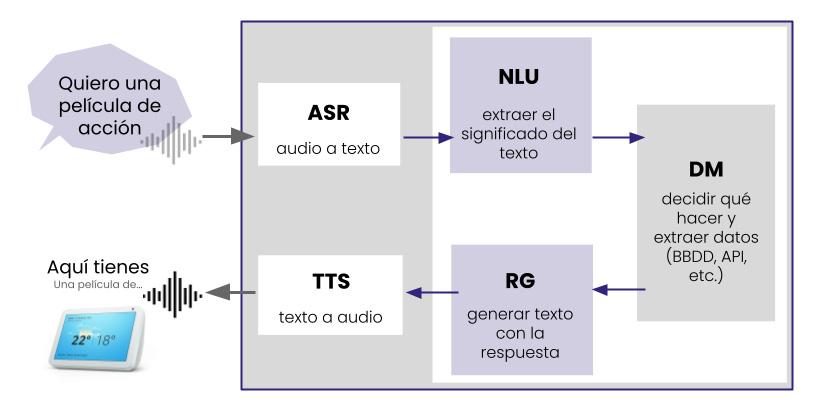
De esta manera, estas tecnologías permiten a las plataformas interactuar con sus usuarios y conversar en lenguaje natural a través de la voz o el texto, para así ofrecer recomendaciones personalizadas, ofrecer servicios de atención al cliente, y proporcionar información sobre el contenido, de forma más natural, intuitiva y atractiva. Si nos centramos en la recomendación de contenidos personalizada, sin embargo, aunque las oportunidades son enormes, también existen desafíos significativos que deben abordarse para maximizar su potencial. A continuación, exploraremos algunas de las oportunidades y retos que presenta la IA conversacional en la recomendación de contenidos.

Oportunidades
1. Personalización avanzada
Una de las principales ventajas de la IA conversacional es su capacidad para ofrecer recomendaciones altamente personalizadas. A través del análisis de las interacciones entre el usuario y la plataforma, y de las preferencias del usuario, los sistemas de recomendación pueden ajustar sus sugerencias en tiempo real. Por ejemplo, un chatbot puede entender las preferencias de un usuario en base a sus respuestas y comportamientos pasados, ofreciendo recomendaciones de contenido que se alineen con sus intereses específicos en base al contexto, que incluye el momento del día o el tipo de contenido consumido en los últimos días. Esta capacidad de adaptación dinámica mejora significativamente la satisfacción del usuario, mejorando la experiencia de uso y por lo tanto la recurrencia en la plataforma.
2. Interacción natural y eficiente
Las interfaces conversacionales permiten una interacción más natural, ya sea escribiendo o hablando, y en muchas situaciones y contextos, más eficiente con los usuarios. En lugar de navegar por menús y listas, los usuarios pueden simplemente expresar sus necesidades o intereses en lenguaje natural. Esta experiencia conversacional, si es multimodal, es decir, se acompaña de mostrar en pantalla el contenido sobre el que se está hablando, mejora aún más la experiencia que tiene el usuario en la plataforma de contenidos. Esto no solo simplifica el proceso de búsqueda y descubrimiento de contenidos, sino que también puede reducir la fricción y mejorar la accesibilidad, especialmente para aquellos menos familiarizados con la tecnología.
3. Mejora en la retención de usuarios
La personalización y la interacción natural contribuyen a una experiencia de usuario más positiva, lo que puede resultar en una mayor retención de usuarios. Los usuarios son más propensos a permanecer en una plataforma que entiende sus preferencias y proporciona recomendaciones relevantes de manera eficiente. En plataformas con mucho contenido, el tiempo que el usuario tarda en elegir el mismo se incrementa. Dedicar media hora a elegir qué ver si solo se dispone de una hora no compensa, y es uno de los problemas de plataformas de este tipo. Esto es particularmente crucial en un entorno competitivo donde la retención de usuarios es fundamental para el éxito a largo plazo de cualquier plataforma de contenidos.

Retos
1. Precisión y relevancia de las recomendaciones
Uno de los desafíos más significativos es asegurar que las recomendaciones sean precisas y relevantes. Los sistemas de IA conversacional deben ser capaces de interpretar correctamente las consultas de los usuarios y proporcionar sugerencias que realmente cumplan con sus expectativas. Esto requiere, en sistemas conversacionales tradicionales, de algoritmos de ML y NLP adaptados al idioma del usuario y a su forma de hablar, y grandes cantidades de datos de entrenamiento, lo cual puede ser complejo y costoso de desarrollar y mantener.
También, es clave entender el contenido para realizar recomendaciones más precisas. En sistemas tradicionales, es necesario que el contenido de la plataforma esté bien gestionado y etiquetado de manera manual o automática, o bien, que se utilice el mejor tipo de sistema de recomendación según los datos disponibles y la experiencia de uso que se quiera ofrecer. En sistemas más avanzados, podrían aprovecharse las capacidades de los recientes modelos de lenguaje multimodales (LMM) para poder entender y describir mejor el audio, vídeo y música del contenido sin necesidad de etiquetarlo, pero aún es pronto para determinar la viabilidad técnica y económica de la aplicación de estos sistemas a gran escala.
Además, si hablamos de sistemas conversacionales que utilizan modelos de lenguaje o LLMs, será necesario trabajar en que las respuestas sean veraces añadiendo otras técnicas que nos permitan dar fiabilidad a la respuesta en base al contenido de la plataforma, como con la técnica de generación aumentada por recuperación de información (RAG).
2. Gestión de expectativas del usuario
Otro desafío es gestionar las expectativas de los usuarios. Si bien las interfaces conversacionales pueden mejorar la experiencia del usuario, también pueden generar frustración si no cumplen con las expectativas. Las tecnologías disponibles tienen limitaciones en situaciones de ruido, idiomas no entendidos, acentos, y eficiencia en la comprensión de la intención e información que proporciona el usuario durante la conversación. Muchas de estas limitaciones se resuelven con un buen diseño conversacional, y con un mantenimiento tras el lanzamiento, pero aún así es crucial que las plataformas establezcan expectativas realistas y aseguren que sus sistemas de IA conversacional sean capaces de manejar una amplia variedad de consultas y situaciones.
3. Sesgo en los datos y equidad en las recomendaciones
Los algoritmos de IA pueden perpetuar sesgos existentes en los datos de entrenamiento, lo que puede llevar a respuestas y recomendaciones injustas o discriminatorias. Es esencial que los desarrolladores de IA implementen mecanismos para detectar y mitigar estos sesgos, garantizando que las respuestas y recomendaciones sean justas y equitativas para todos los usuarios. Por ejemplo, los algoritmos que se utilizan para reconocer las peticiones de los usuarios, pueden haber sido entrenados con poca diversidad de habla, acentos y dialectos, y pueden no entender bien a muchos grupos de usuarios.
La conversación será la clave del éxito
The IA conversacional ofrece nuevas experiencias de uso en un entorno en el que el contenido es clave. A través de la conversación, podemos mejorar la experiencia de uso de la recomendación de contenidos en las plataformas, a través de la personalización y la interacción en lenguaje natural. Una mejor experiencia del consumo del contenido en la plataforma llevará a mejorar la retención de usuarios.
Sin embargo, también presenta retos, unos más complejos que otros, asociados a las limitaciones tecnológicas y a las expectativas del usuario que deben ser tenidos en cuenta para garantizar su éxito. Retos que, aunque son complejos de afrontar, según avanza la tecnología irán transformándose en oportunidades.
Y es que en los próximos años, gracias a la rápida evolución de estos sistemas de IA conversacional, la forma que tendremos los usuarios de interactuar con los contenidos será más natural y personalizada, y esto será clave para el éxito de las plataformas de contenido.
Carlos Muñoz-Romero y Nieves Ábalos Serrano
Cofundador y CEO y cofundadora y CPO de Monoceros Labs

Did you like this article?
Subscribe to our NEWSLETTER and you won't miss anything.
Related articles
 El legado de Spideo se integra en el portfolio de Mediagenix para brindar mejoras de personalización y recomendación en IBC 2025
 La monetización del universo OTT en 2025: oportunidades y retos
 Los retos y oportunidades de la IA, en el 25º aniversario del MAC
 COITT/AEGITT marca retos para 2024: nuevas oportunidades, fomentar las vocaciones…
 Konodrac mejora la recomendación de contenidos en OTT y televisión conectada gracias a la IA
 COITT dará a conocer los retos y oportunidades de la nueva Ley General de Telecomunicaciones en un nuevo evento
 PATE identifica las nuevos oportunidades de los contenidos audiovisuales en su último informe
 El sector de media and entertainment vislumbra los retos y oportunidades de la pandemia
 1 de cada 3 hogares conectados a Internet usan plataformas de pago para ver contenidos audiovisuales online
 Gamelab analizará los retos y oportunidades de la expansión del videojuego como medio
 Comunicaciones 5G: retos y oportunidades en sectores claves
 España frente a MEDIA: retos y oportunidades
 Public commitment to R&D&i 2013-2020: challenges and opportunities of the ICT sector
 New opportunities and new businesses for the audiovisual content sector