





Qwilt exceeds 2,000 edge nodes on six continents
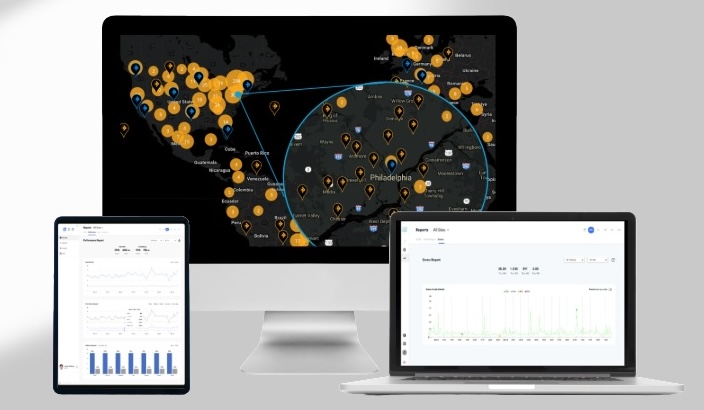
Qwilt surpasses the milestone of deploying 2,196 peripheral nodes in 38 countries on six continents. This expansion solidifies its position in the Edge Cloud, offering equal proximity, speed, and scale for edge computing and delivery.
Today, Qwilt collaborates with leading service, content and application providers around the world, including Airtel, BT, Comcast, Telefónica, Verizon and Vodafone, demonstrating its strategic alignment with the future of the service provider edge. Its highly distributed architecture forms an Edge Cloud integrated directly into the access networks of service providers.
“Through our Open Edge framework, we have unlocked access to the last mile of the network, driving a global edge ecosystem capable of ultra-low latency computing and application delivery,” he stated. Alon Maor, CEO of Qwilt.
"Surpassing 2,000 nodes at the edge demonstrates both the growing demand for hyperlocal computing at the edge and our platform's ability to scale globally. Most importantly, this massive global infrastructure can now be accessed through a single programmatic API, making it easier than ever to build and deliver next-generation applications at the true edge," adds Maor.
While traditional platforms often stop at metropolitan data centers or IXPs, Qwilt goes much further, integrating computing and caching directly into last mile networks. This offers service providers and content publishers a radically more efficient, scalable and effective alternative to legacy delivery models and centralized cloud models.
Qwilt's Open Edge architecture offers a hyperlocal distribution, at the neighborhood level, allowing us to be 10 times closer to end users than traditional CDNs or cloud platforms. Furthermore, the greater proximity allows for lower performance than a 5ms latency for real-time services and applications. On the other hand, moving content and computing to the edge reduces backhaul costs and traffic.
“There are two key reasons why our Open Edge Cloud is growing eight times faster than traditional platforms,” adds Maor. "First, our deep partnership model places edge nodes and origin servers directly into service providers' access networks, already enabling more than 150 Tbps of last-mile capacity. Second, we have made this huge global edge accessible through a single standards-based API. This is a game-changer for service providers and developers building the next generation of real-time applications."
Did you like this article?
Subscribe to our NEWSLETTER and you won't miss anything.
Related articles
 Comcast leverages Qwilt's Edge Compute technology to improve streaming
 EditShare: new hardware nodes and software improvements, at IBC 2024
 Vodafone, Qwilt and Cisco deploy Open Caching to improve streaming in Europe and Africa
 Telefónica and Qwilt develop a new content distribution system for third parties
 200 Riedel MediorNet nodes support the latest Sky Sport set
 K 2000 concludes filming of the miniseries 'Alardea'
 'The Boat' is already sailing through numerous countries on the five continents
 Matrox KVM Avio F120: peripherals at 2,000 meters over a single fiber cable
 RTVE on the five continents
 DaVinci Resolve Lite 8.1: now with unlimited color correction nodes
 Q-Ball robotic cameras triumph on four continents
 Silverspace releases 'Daisy Cutter' simultaneously on three continents
 Datavideo HS-2000, HD production anywhere
 Doremi's DCP-2000 reach 7,800 installations