





BeeLab turns an ice rink into a television studio with Blackmagic
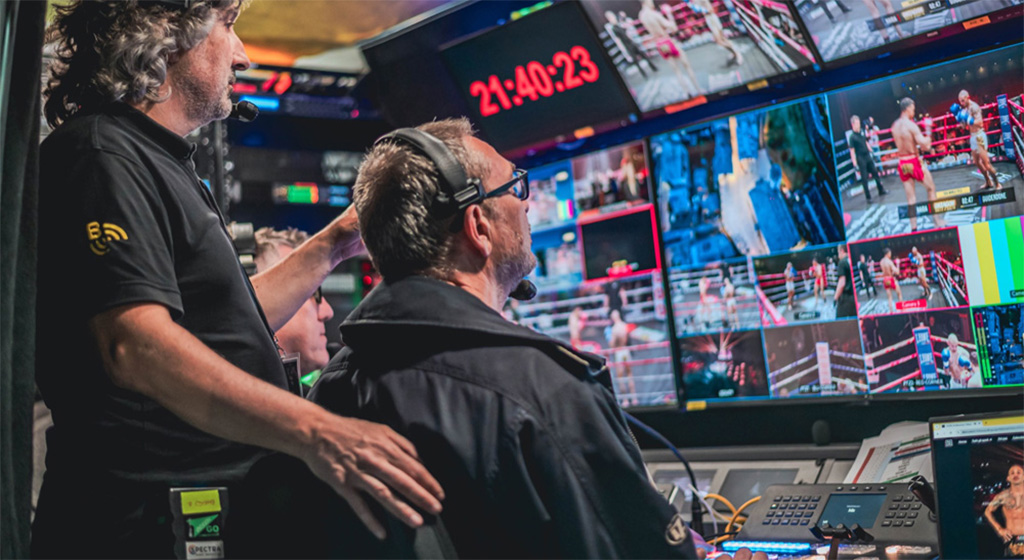
A wide selection of solutions Blackmagic allows the producer BeeLab transform the Courmayeur Sport Center ice rink into a television studio to broadcast live the 28th edition of Octagon, prestigious martial arts event.
The client's instructions were ambitious: transform the ice rink so that they could carry out a reliable coverage and with backup systems, avoiding, at the same time, affecting its daily use. The producer BeeLab, with the support of the distributor Missing, accepted the challenge from Octagon and addressed it with a solution that included two mobile units equipped with Blackmagic Design.
The first step was to assemble the equipment on a thin insulation mat above the ice rink, following a redesign of the cable distribution. It was not a simple task, since as explained Enrico Beltamo, technical director of the production company, "condensation" had to be taken into account: "We had to suspend or seal the cables, as well as separate the signal lines from the power lines to prevent short circuits. The slippery surface and the lack of upper supports also had an impact when installing the cameras and placing the accessories, as well as on movement."
Once deployed this infrastructure wiring, all that remained was to interconnect it with the two mobile units located in the vicinity of the event. Although each one had its own responsibilities, were completely synchronized: the main unit managed image acquisition, shot changes, signal distribution and audio, while the second van was in charge of graphics, replays, reproduction and transmission of the segments that were not broadcast by DAZN, the station responsible for bringing this event made up of fifteen fights to the world.
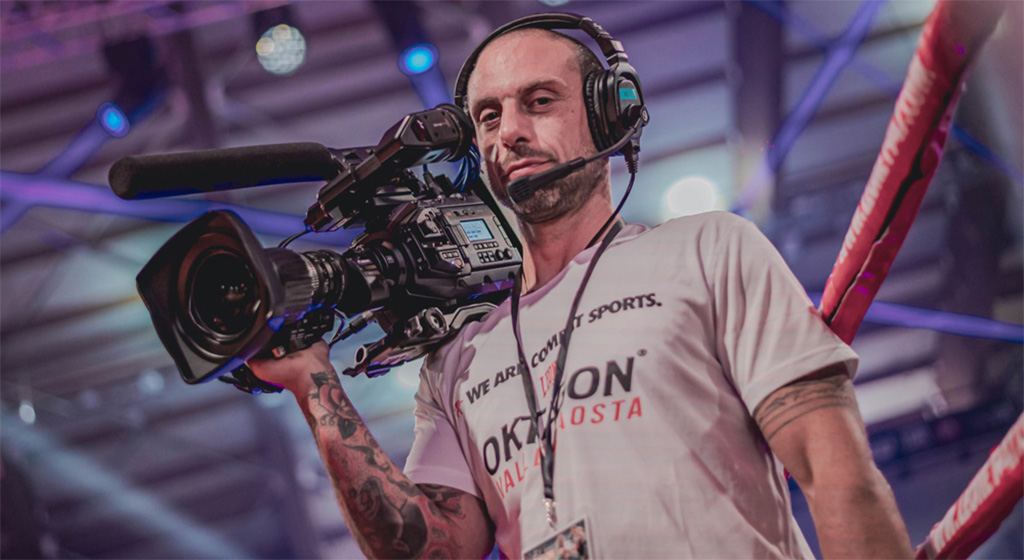
URSA Broadcast cameras and ATEM mixer, in Oktagon
The foundation of Oktagon's event coverage was built around a ATEM 4 M/E Constellation 4K mixer together with a device ATEM 1 M/E Advanced Panel 10. Specifically, they distributed four signs still simultaneous display monitor for the director, visual engineer, replay guy, and lighting technician: “The switcher allowed us to manage complex, animated transitions, as well as multi-layered multimedia elements without overloading the external graphics and replay systems,” says Beltramo.
Coverage of the main fight was done using three cameras Blackmagic URSA Broadcast G2 with fiber optic cables that comply with standards SMPTE. The additional fixed angles were captured with a mix of devices consisting of the models Blackmagic Micro Studio Camera 4K Pro y Blackmagic Micro Studio Camera 4KG2, some motorized heads and a drone.
All signals were distributed to mobile units for monitoring, recording of isolated signals and simultaneous display. To manage the signals, the team used a switching matrix Blackmagic Videohub 40×40 12G, as well as an additional unit Blackmagic Videohub 20×20 12G as a backup that would also manage return signals. In the case of the incoming and outgoing signals of the URSA Broadcast G2 cameras, the models were used. Blackmagic Camera Fiber Converter y Blackmagic Camera Studio Fiber Converter, which allowed transmitting bidirectional 12G SDI signals, activating the pilot lights, providing power and establishing communication.
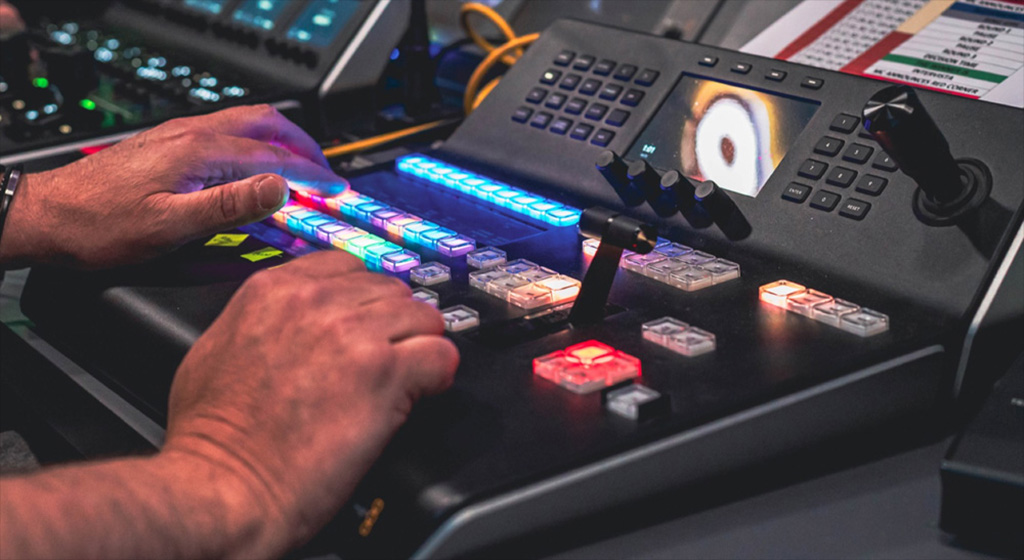
A 2110 environment deployed by BeeLab
BeeLab resorted to using duplex fiber cables already 2110 IP converters to provide hybrid support of SDI/IP signals on all important connections. Furthermore, in the transmission, BeeLab used a system LiveU together with one LU600 as backup, whose signals were directed to DAZN through the El Towers servers.
Replays were managed through the internal system of BeeLab, which captured four SDI signals through a capture and playback card DeckLink Quad 2 for instant playback. The images that were transmitted to the LED screens were sent to the Resolume Arena program using a mixer ATEM Mini Extreme ISO, while still images were processed by a recorder HyperDeck Shuttle HD. On the other hand, the preliminary fights were broadcast via a separate vMix system.
The main and clean signals were recorded to SSD drives in ProRes422 format using recorders HyperDeck Studio 4K Pro. Simultaneously, an ATEM SDI Extreme ISO recorder was used to save the backup copies in H.264, while generating a project in DaVinci Resolve, where all the angles were joined together in a multi-camera timeline synchronized in advance: "As soon as the event was over, we opened the project in Resolve and had all the camera angles, direct cuts, time codes and audio intact. This allowed us to extract the most important moments of the event and create content for social networks at high speed," concludes the technical director
Did you like this article?
Subscribe to our NEWSLETTER and you won't miss anything.
Related articles
 Tulpa resolves budget constraints for new studio with Blackmagic
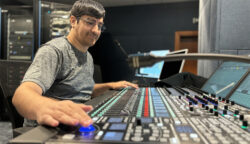 Oman TV converts an auditorium into a broadcast studio with AoIP technology from Lawo
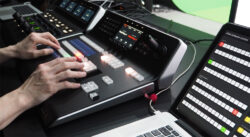 Rockets inaugurates virtual studio with Blackmagic Design solutions
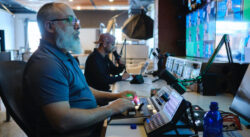 SociallyU installs a virtual studio powered by Blackmagic's Ultimatte 12 4K
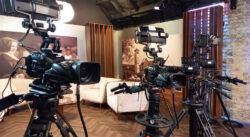 EWTN Hungary renews its studio with solutions from Blackmagic Design
 Dash Media launches a television studio with Blackmagic Design solutions
 Turn your house into a television studio with Moncada
 Arkaos' new 4K multimedia servers “dance on ice” on television in Germany
 Pay television becomes the service least valued by Spanish households
 Blackmagic democratizes access to advanced studio production solutions
 Blackmagic shows its proposals for production and studio at BIT Experience
 Roland Garros, the latest in technology on the court
 Kantipur TV becomes the first television in Nepal with a 100% tapeless system thanks to VSN
 ProHD Compact Studio: JVC turns the popular GY-HM150 into a studio camera