





Canal Extremadura: when maintaining a mobile unit does not make sense on television
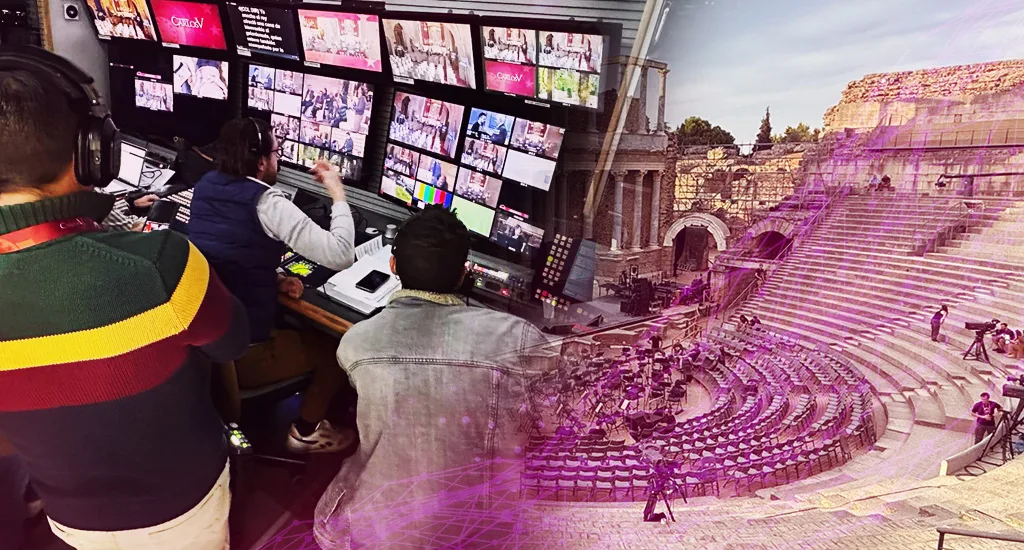

Francisco Reyes Torremocha, head of engineering and exploitation of Extremadura Channel, explains the strategy of regional television in the field of outdoor coverage, an approach in which the UU. MM are outsourced. and broadcast backpacks occupy a central role.
A few hours away from what will be one of the most important coverages of the year for Extremadura Channel, Reyes connects his webcam to reveal a small corner of the television production center in Mérida. He is finalizing the details of what will be the broadcast of the Regional Elections Extremadura, a deployment that, as he acknowledges with relief, will be calmer than on other occasions as it will not occur accompanied by local elections.
The broadcast featured most of the schedule on December 21. Deploying a total of 15 backpacks, television covered the headquarters of the four main political parties, electoral colleges, data centers and the Government Delegation. In addition, as a reserve, three units were waiting for relevant news during the long day, which began before the polling stations opened and lasted well into the night with their recount.
Election coverage did not rely on mobile units or DSNG. In fact, for years, no This type of vehicle is available in the house, opting for an exploitation model that is based on production service providers. “At a scale level, we have never considered a mobile unit,” Reyes acknowledges.
Everything indicates that, during 2026, the year in which the 20th anniversary of the origin of its regular broadcasts will be celebrated, Canal Extremadura will maintain this philosophy. A strategy that, when listening to Reyes' reflections, may make all the sense in the world.
Between current events and unique events
Following the trend that accompanies the recent success of regional television, Extremadura Channel has relied on value of closeness and the regional particularity. With the content of general television focused on global entertainment and information marked by the national agenda, showing what is close and personal, with the rediscovery that this entails, represents a whole incentive to get closer to the small screen.
“At a scale level, we have never considered having a mobile unit.”
Con 250 workers and a budget, Reyes acknowledges, “very fair,” the intelligent resource management It represents an entire axis in the strategic approach of the engineering division. The network's assets have to be prepared to shed light on regional news every day, but they must also be available for the big events that dot its calendar: Carnivals, Easter, speeches by the Presidency, bullfights or soccer broadcasts: "They are relatively specific things. At a scale level, we have never considered having a mobile unit."
The issue of mobile phones in Canal Extremadura
Reyes explains that, given the scale of Canal Extremadura, having a mobile unit “it didn't make much senseAmortization is key, given the frequently extended axiom that you should “always have it on the street.” An additional issue is the different needs of your productions, which made it complex to choose specific characteristics that could be profitable and meet your requirements.
"At carnivals you have to be in Mérida one day and, the next day, in Badajoz. Doing it with a single cell phone is feasible, but it is complicated given that sometimes these celebrations end at four in the morning."
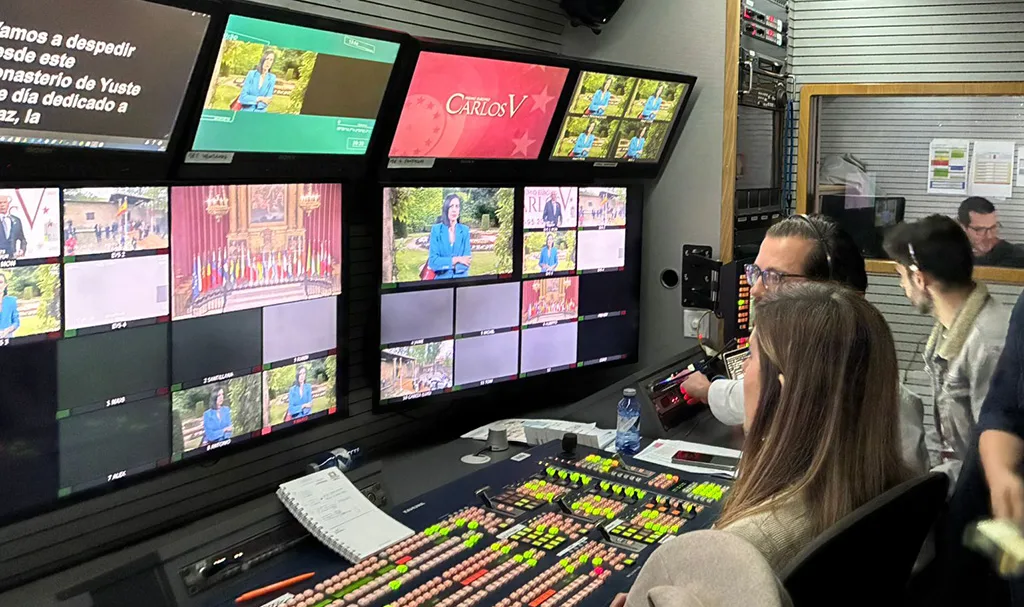
“What mobile unit are you setting up?”? Because when you do Extremadura Day you need 12 cameras, similar to when we covered Yuste, which can be even more cameras with a run of two kilometers per unit. But the reality is that most of the gigs we do tend to be between four and five cameras. How do you combine that?” explains the head of engineering, who also points out the need to have specific operating personnel.
With a total of 20 annual broadcasts that may require the deployment of a DSNG or mobile unit, Canal Extremadura resorts to publishing specifications for the hiring of these technical and human resources. Not only is it more economically profitable, but it makes it easier to key event logistics on the television calendar: "At carnivals you have to be in Mérida one day and, the next day, in Badajoz. Doing it with a single cell phone is feasible, but it is complicated given that sometimes these celebrations end at four in the morning."
The disappearance of the DSNG
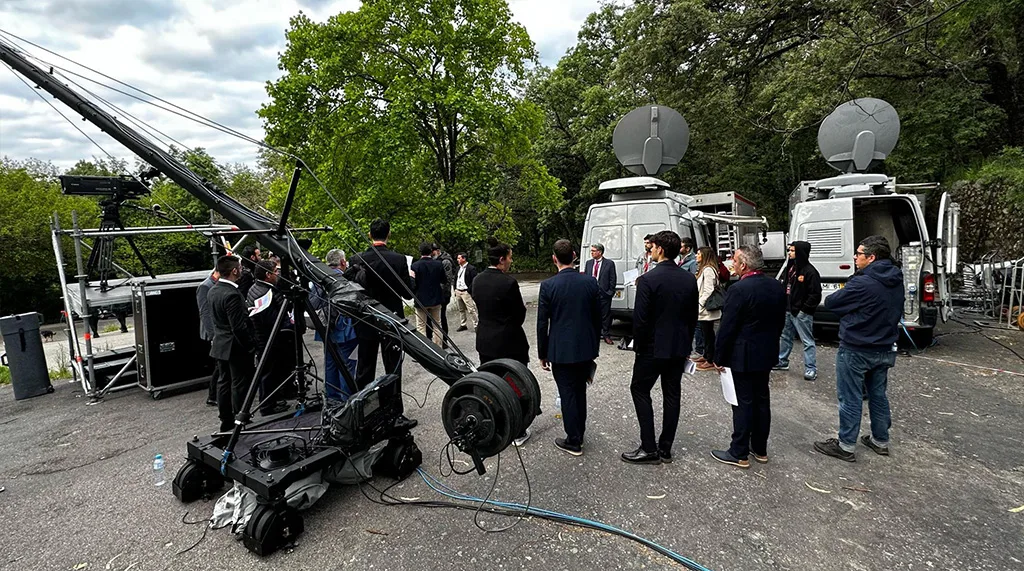
Although Canal Extremadura never had a mobile unit, it did benefit from a DSNG. Equipped with three studio cameras and support for the production, Reyes remembers that the vehicle gave them “a lot of play” and allowed them to execute, with solvency, the main television shows.
“We had to equip a new set, and it was more efficient for us to dismantle the DSNG cameras and set up a filming studio with those camera chains.”
However, faced with an urgent need, the vehicle ended up dismantled: “We had to equip a new set, and it was more efficient for us to dismantle the DSNG cameras and set up a production studio with those camera chains.” The limitation of the vehicle's three cameras was also key to the decision: "When we got to coverage we always missed one more camera. We supplemented it with ENG cameras, but they didn't give us the right result. We were left halfway."
He final blow This was borne out by the arrival of relay backpacks. And Reyes remembers that there was a time when the cameramen and editors “no longer wanted DSNG.” "It's typical. You needed permission, to cool the tubes to move it... In the end it was not operational." Today, DSNGs are subcontracted for specific productions, such as those in which television has to deliver a signal to other agents pool.
Backpacks: the present of Canal Extremadura
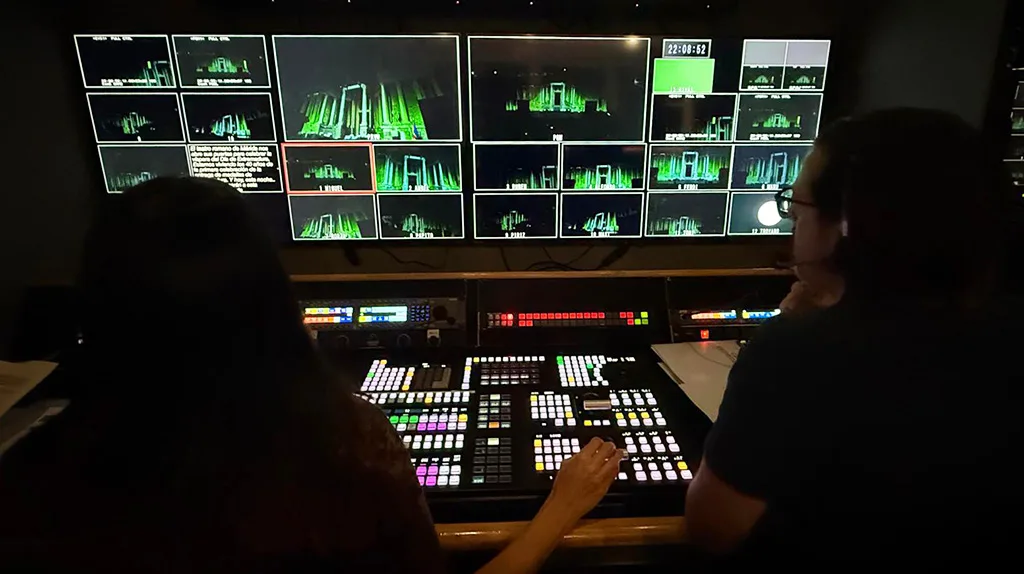
Pioneers in the deployment of retransmission backpacks, even at the time when they had to work with “seven seconds of delay”, these solutions have become the axis of Canal Extremadura's outdoor coverage. The beginnings were complex, due to a technology that still needed refinement: "The content people were used to the reliability of the DSNG. They told us: "Why doesn't this live come in?", to which we responded... "Because you've gone to the middle of the field!"
“When we do a small event, a small multi-camera production designed for a news program, we take our broadcasters, we plug them into a FTTH that we rent where we are interested and do multi-camera: remote production, basically, even returning the signal prompter of the editor".
"Despite these specific problems, they have come in very naturally. We even had a contribution network as a service with Telefónica and, seeing how well the backpacks worked, we applied the same technology in the form of stationary transmitters via fiber," explains Reyes, who also points out that they use these resources to shape small productions: "When we do a small event, a small multi-camera production designed for a news program, we take our retransmitters, we plug them into a FTTH that we rent where we are interested and do multi-camera: remote production, basically, even returning the signal prompter of the editor".
After testing with different suppliers, the tender published in 2021 for the renewal of the entire Canal Extremadura contribution network concluded with Aviwest (acquired by Haivision in 2022) as a winning brand. To facilitate signal management, television has models StreamHub, which allow through a licensing scheme to work with inputs and outputs in IP, a “little Swiss army knife” that allows the engineering team to exchange content between autonomous communities that can work with different protocols.
Mass software prevails over MOJO models
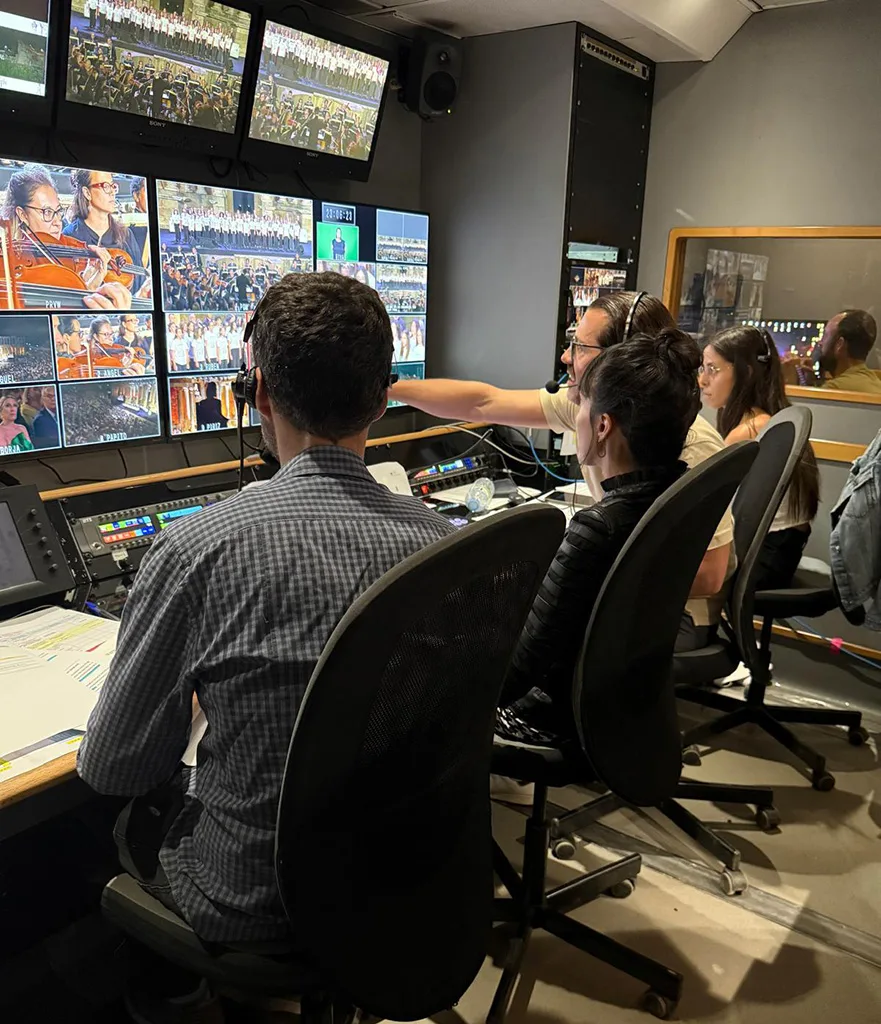
Relay unit vendors have expanded their business model to bring their IP environments to mobile devices through dedicated software. These ecosystems MOJO (mobile journalism) They have not finished penetrating the Canal Extremadura team; Even though the tool has been licensed, its use, Reyes acknowledges, has been “residual”.
"In fact, it was a surprise for us. We thought that the MOJO should have an easy entry as was the pandemic. We made a deployment, we distributed credentials to the different editors... But, in the end, its use was only limited to the El Tiempo team and little else," explains the engineering manager, lamenting that these systems "have not finished coming together" due to issues "outside the control" of the technology team or a quality that was never good enough.
Faced with these tools, Canal Extremadura has consolidated in its processes what Reyes calls “contribution with video call” through tools like Zoom: "Collaborators enter during a large part of the programs by video call. We have normalized it, with our suffering along the way, because deep down we are dealing with technologies that are not designed for this. But, in the end, the user is more accustomed to using their own WhatsApp than to install a MOJO application.”
The most complex live shows on Canal Extremadura
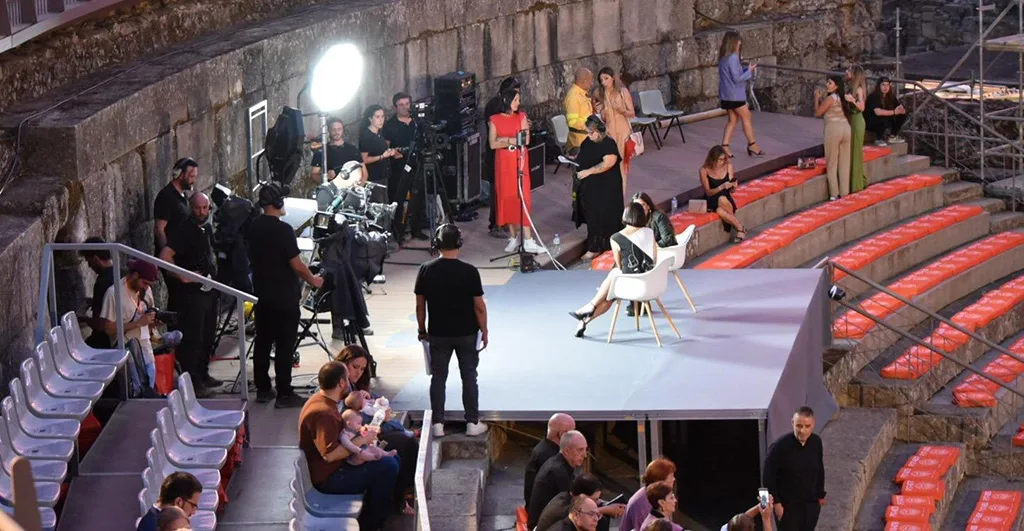
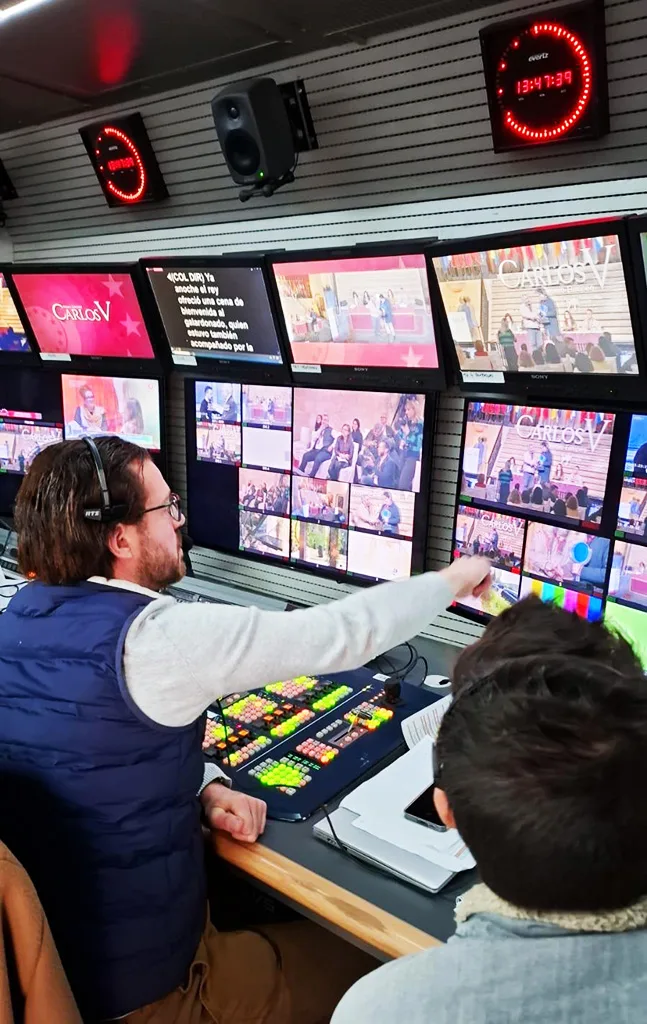
With this outdoor production scheme, combining third-party mobile units, DSNG units and backpacks (both its own and third-party), Canal Extremadura produces events of as much relevance to the autonomous community as the delivery of the Charles V European Prize from the Monastery of Yuste. For protocol reasons, the mobile unit must be parked two kilometers from the location, which implies significant operational complexity. Other key coverage is Extremadura Day, which is held within the premises of the Roman Theater of Mérida; the murgas competition and the Badajoz Carnival parade, and the Mérida chirigotas competition.
In these productions, of vital importance for television, Reyes and his team decide to use a DSNG unit rented as the main road contribution, with a series of IP encoders as back up. In his own words: “The encoder IP allows us to work with larger bandwidths and great qualities; They make it easier for us to bring us a double program signal and clean, which will later be used by the editorial staff. In short, it gives us much more flexibility, although the highest security in the communication channel is provided by the DSNG.”
Remote production: the horizon of Canal Extremadura
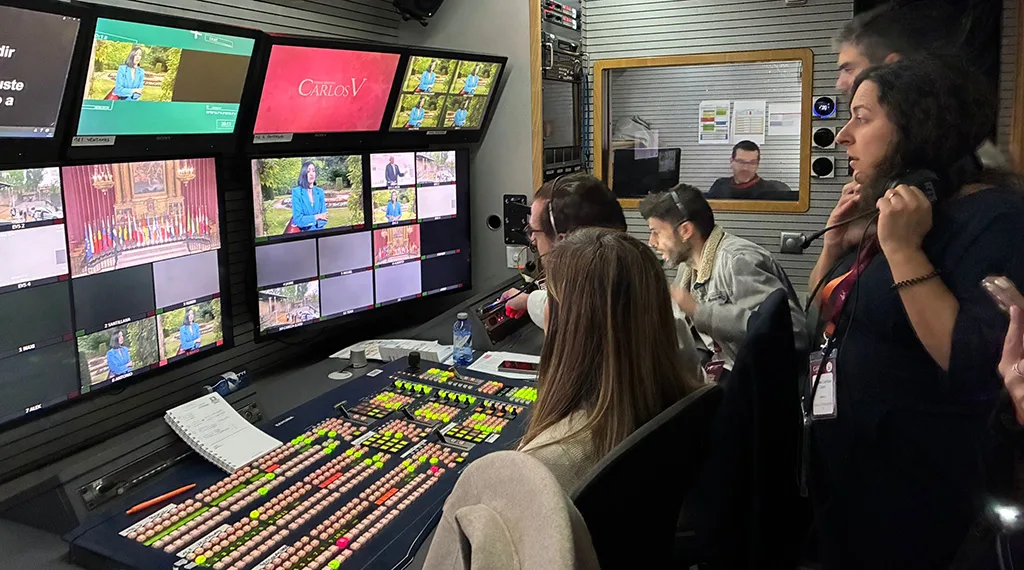
with the production edge still out of the equation, despite Canal Extremadura's growing interest in IP environments for the contribution, management and distribution of content, Reyes' team has the objective of improving its remote production processes. Specifically, in the news environment: "We would like to be able to travel with minimal equipment, connect to a fiber and make the news wherever the news is. We already do it, but we have to do it more frequently, gaining agility; make it our daily routine."
"We would like to be able to travel with minimal equipment, connect to a fiber and make the news wherever the news is. (...) We want it to become our daily life."
For these productions, Canal Extremadura hopes to continue exploring the versatility of IP encoders who have been with him for nearly five years now. There are still problems to be solved, such as hiring flexibility, but Reyes trusts that technological progress will allow them to continue rethinking those pillars that, twenty years ago, at the origins of television, seemed immovable: “Perhaps another pandemic would allow us to give a new impetus to these processes… but let's hope we don't have to live through it!”
A report by Sergio Julián Gómez
Did you like this article?
Subscribe to our NEWSLETTER and you won't miss anything.
Related articles
 AEQ transforms intercom flows in the mobile unit of Río Negro Televisión
 Canal Extremadura, for the first time in HD starting January 15
 Canal Extremadura closes the year consolidated as the fourth most watched television in the autonomous community
 Does it make sense to take MAM and playout to the cloud?
 Unitecnic custom designs the definitive mobile unit for Canal Sur
 Canal Extremadura Televisión renews its intercom with AEQ
 Nathalie Martínez, when animation has a woman's name
 Arena Television chooses Leader test and media equipment for its new HD-HDR/SDR mobile unit
 Broadcast Solutions delivers a new HD mobile unit to Belarusian television ONT
 When good streams turn bad: Maintain and sustain video quality
 Eurocom delivers an HD mobile unit to Canal 29 in El Salvador
 Grass Valley equips the new mobile unit of the South African Dimension Television
 Factoría Plural will produce more than 500 hours of television per year for Canal Extremadura
 Canal Sur integrates Neumann's KH 120 monitors into its digital mobile unit